
OpenCodeReview












English | 简体中文 | 日本語 | 한국어 | Русский
What is Open Code Review?
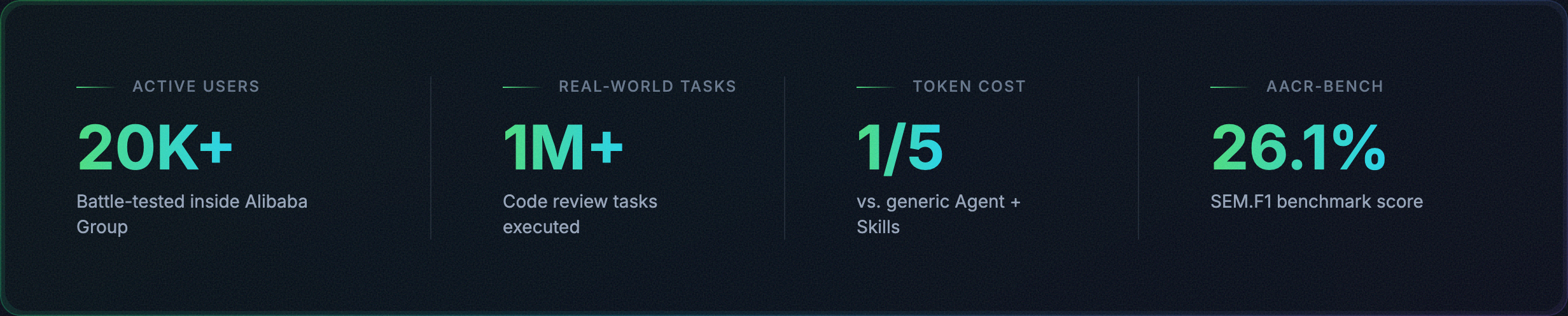
Open Code Review is an AI-powered code review CLI tool. It originated as Alibaba Group's internal official AI code review assistant — over the past two years, it has served tens of thousands of developers and identified millions of code defects. After thorough validation at massive scale, we incubated it into an open source project for the community. Simply configure a model endpoint to get started.
It reads Git diffs, sends changed files to a configurable LLM via an agent with tool-use capabilities, and generates structured review comments with line-level precision. The agent can read full file contents, search the codebase, inspect other changed files for context, and produce deep reviews — not just surface-level diff feedback. Beyond diff review, ocr scan reviews entire files for auditing unfamiliar codebases or directories that have no meaningful diff.
Visit the official website for more details.
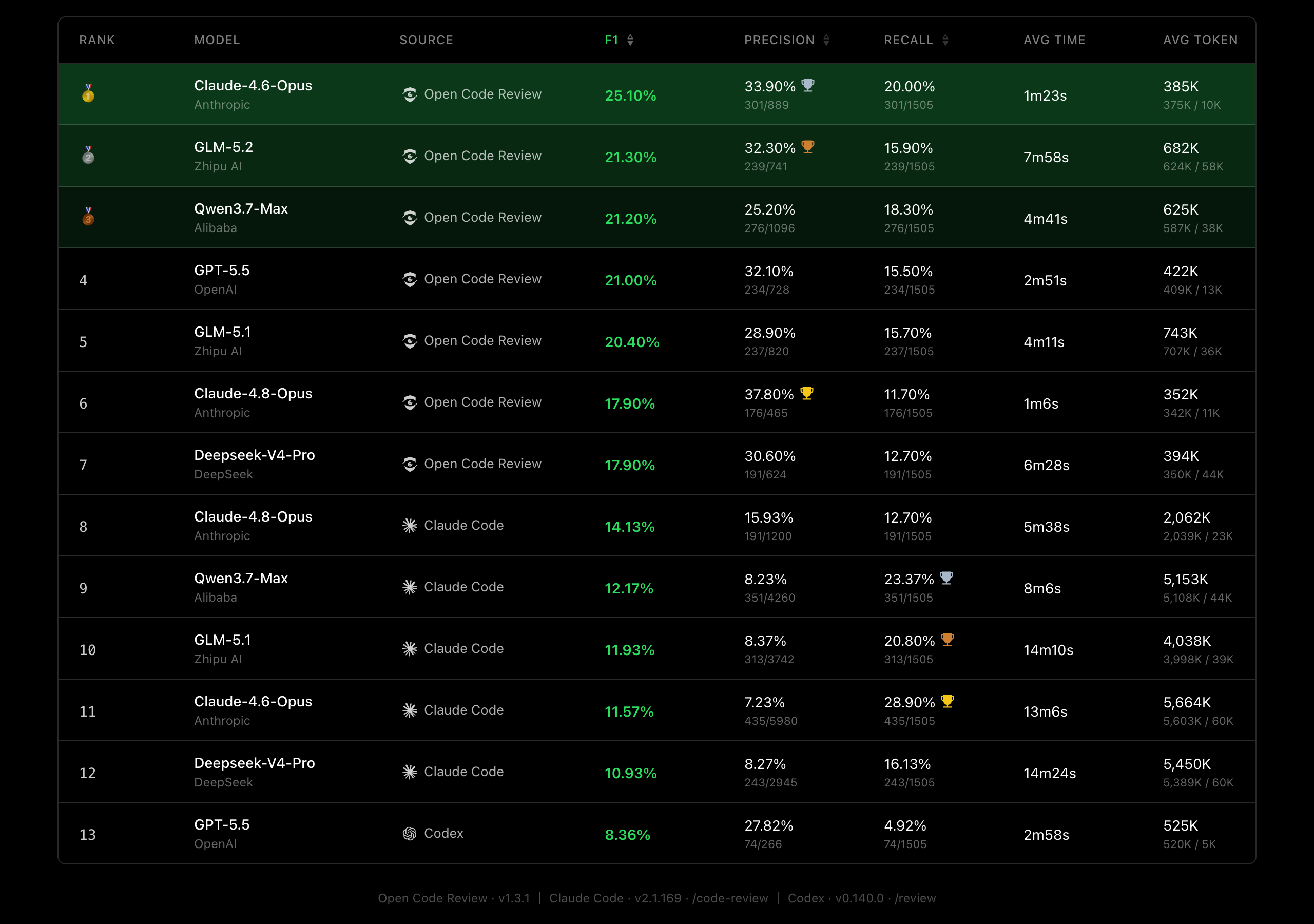
Benchmark
> Compared to general-purpose agents (Claude Code), Open Code Review achieves significantly higher Precision and F1 with the same underlying model, while consuming only ~1/9 of the tokens and completing reviews faster. Note that its Recall is lower than general-purpose agents — a deliberate trade-off favoring precision over noise.
A real-world code review benchmark built from 50 popular open-source repositories, 200 real Pull Requests, and 10 programming languages — cross-validated by 80+ senior engineers (1,505 annotated ground-truth issues).
 Explore the AACR-Bench dataset on Hugging Face.
| Metric | What it measures | Why it matters |
|---|
| F1 | Harmonic mean of precision and recall | Best single number for overall review quality |
| Precision | Proportion of reported issues that are real defects | Higher = fewer false alarms to triage |
| Recall | Proportion of real defects that are found | Higher = fewer issues slip through review |
| Avg Time | Wall-clock time per review | Matters for CI pipeline latency |
| Avg Token | Total tokens consumed per review | Directly impacts API cost |
Why Open Code Review?
The Problem with General-Purpose Agents
If you've used general-purpose agents like Claude Code with Skills for code review, you've likely encountered these pain points:
- Incomplete coverage — On larger changesets, agents tend to "cut corners," selectively reviewing only some files and missing others.
- Position drift — Reported issues frequently don't match the actual code location, with line numbers or file references drifting off target.
- Unstable quality — Natural-language-driven Skills are hard to debug, and review quality fluctuates significantly with minor prompt variations.
The root cause: a purely language-driven architecture lacks hard constraints on the review process.
Core Design: Deterministic Engineering × Agent Hybrid
Open Code Review's core philosophy is to combine deterministic engineering with an agent, each handling what it does best.
Deterministic Engineering — Hard Constraints
For review steps that must not go wrong, engineering logic — not the language model — guarantees correctness:
- Precise file selection — Determines exactly which files need review and which should be filtered, ensuring no important change is missed.
- Smart file bundling — Groups related files into a single review unit (e.g.,
message_en.properties and message_zh.properties are bundled together). Each bundle runs as a sub-agent with isolated context — a divide-and-conquer strategy that stays stable on very large changesets and naturally supports concurrent review.
- Fine-grained rule matching — Matches review rules to each file's characteristics, keeping the model's attention sharply focused and eliminating information noise at the source. Compared to purely language-driven rule guidance, template-engine-based rule matching is more stable and predictable.
- External positioning and reflection modules — Independent comment-positioning and comment-reflection modules systematically improve both the location accuracy and content accuracy of AI feedback.
Agent — Dynamic Decision-Making
The agent's strengths are concentrated where they matter most — dynamic decisions and dynamic context retrieval:
- Scenario-tuned prompts — Prompt templates deeply optimized for code review, improving effectiveness while reducing token consumption.
- Scenario-tuned toolset — Distilled from deep analysis of tool-call traces in large-scale production data — including call frequency distributions, per-tool repetition rates, and the impact of new tools on the overall call chain — resulting in a purpose-built toolset that is more stable and predictable for code review than a generic agent toolkit.
How to Use
Prerequisites
- Git >= 2.41 — Open Code Review relies on Git for diff generation, code search, and repository operations.
CLI
Install
npm install -g @alibaba-group/open-code-review
After installation, the ocr command is available globally.
For other installation methods (install script, GitHub Release binary, from source), see Installation.
Quick Start
1. Configure LLM
You must configure an LLM before reviewing code, unless you use Delegation Mode.
ocr config provider          # Select a built-in provider or add a custom one
ocr config model             # Pick a model for the active provider
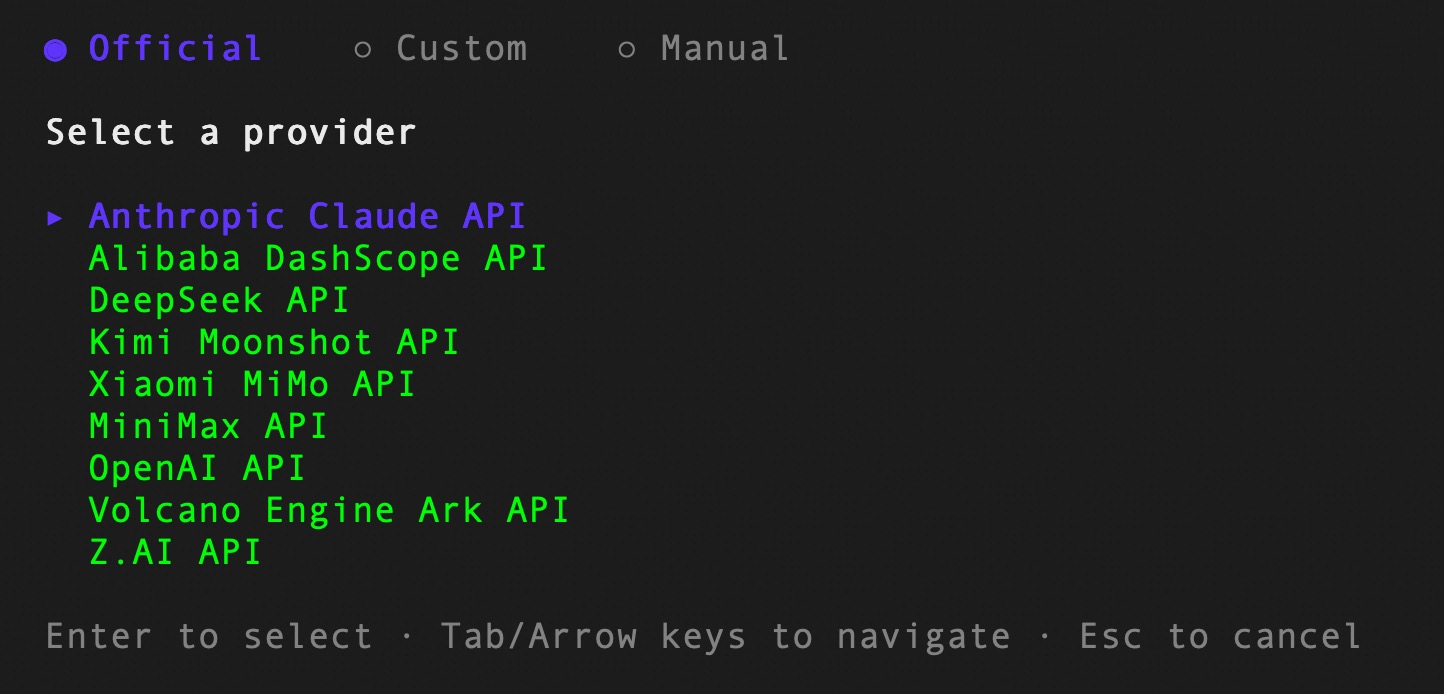
The interactive UI guides you through provider selection, API key entry, and model configuration, then automatically tests connectivity.
For CLI setup, environment variables, custom providers, and other advanced configuration, see Configuration.
2. Review
cd your-project

# Workspace mode — review all staged, unstaged, and untracked changes
ocr review

# Branch range — reviews feature-branch's changes since it diverged from main (merge-base mode)
ocr review --from main --to feature-branch

# Single commit
ocr review --commit abc123

# Resume an interrupted range or commit review
ocr session list
ocr review --from main --to feature-branch --resume

# Full-file scan — review whole files instead of a diff (no git history needed)
ocr scan                          # scan the entire repository
ocr scan --path internal/agent    # scan a directory or specific files
ocr scan --resume    # resume an interrupted full-file scan

# Save results to a file (recommended for AI host agents)
ocr review --format json --output result.json

# Delegation mode — let your AI coding agent perform the review itself
# OCR handles file selection and rule resolution; no LLM configuration needed
ocr delegate preview
ocr delegate rule src/main.go src/handler.go
Documentation
Full documentation lives at open-codereview.ai/docs:
- Quickstart — install and run your first review
- Installation — all platforms and package managers
- CLI Reference — every command and flag
- Review Rules — customize review rules with path filtering and targeting
- Configuration — config keys and environment variables
- MCP Server — extend the review agent with external tools
- Coding Agent Integrations — choose the platform you use
- Claude Code — install a plugin with review slash commands
- Codex — install a plugin with callable review skills
- Cursor — install a plugin with portable review skills
- Kimi Code — install a plugin with review slash commands and skills
- OpenCode — install native review tools and slash commands
- QCA Forward — run delegation mode with the QCA host model and a ready-to-publish template
- Skill-compatible agents — install the portable agent skill
- Review Execution Modes — after integration, choose which LLM performs the review
- CI/CD Integration — GitHub Actions, GitLab CI, GitFlic CI, and Gerrit integration
- Session Viewer — browse and replay review sessions in browser, mark comments as fixed or ignored and hide them while you work through the findings
- Telemetry — OpenTelemetry integration for observability
- FAQ — common questions and troubleshooting
Contributing
This project exists thanks to all the people who contribute. See CONTRIBUTING.md for development setup, coding guidelines, and how to submit pull requests.

License
Apache-2.0 — Copyright 2026 Alibaba