GoLogX
> A small, fast, zero-dependency toolkit on top of Go's standard log/slog.
> Pretty colored output for humans, JSON for machines, file rotation, fan-out, and a companion CLI to pretty-print JSON logs from any pipeline.




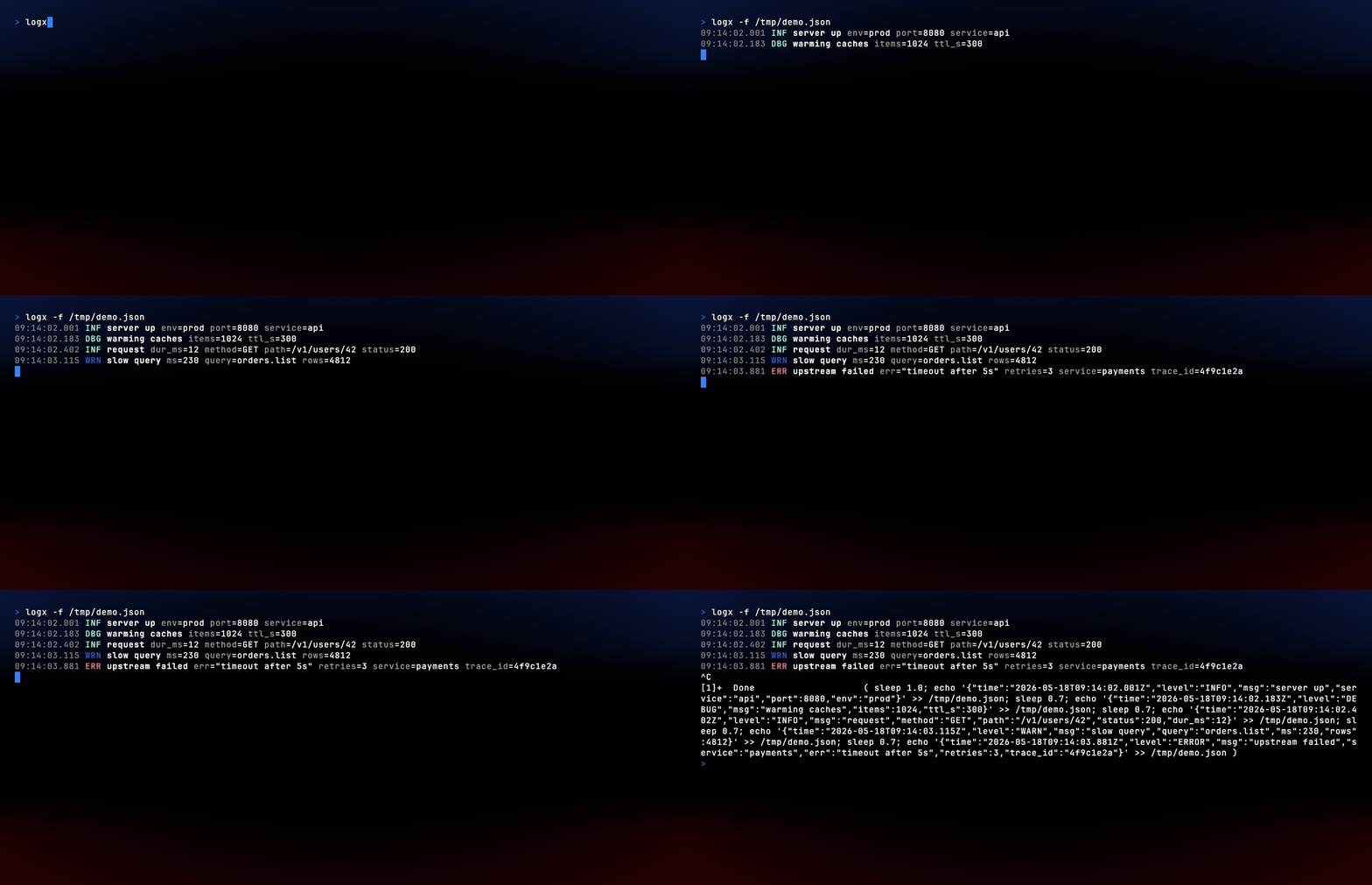
logx -f app.json tailing a live JSON stream:

Also available as GIF or MP4. Theme: atlas-ragnarok.
Why
log/slog is the right default in modern Go. But out of the box it ships only TextHandler and JSONHandler. For real use you often want:
- a colored, human-readable handler in development
- a single record fanning out to several sinks (pretty to stderr + JSON to file)
- size-based file rotation without pulling in a third-party dependency
- a CLI that pretty-prints JSON logs from any pipeline so you don't have to squint at machine output
GoLogX is those four things. Nothing more. Zero external dependencies.
Install
As a library
go get github.com/AyoubTadlaoui/GoLogX/logx@latest
As a CLI
Pick whichever fits your machine:
# Homebrew (macOS + Linux)
brew install AyoubTadlaoui/tap/logx

# Scoop (Windows)
scoop bucket add atlas https://github.com/AyoubTadlaoui/scoop-bucket
scoop install logx

# WinGet (Windows, once Microsoft accepts the submission)
winget install AyoubTadlaoui.logx

# Arch Linux (via AUR)
yay -S logx-bin     # or: paru -S logx-bin

# Nix / NixOS
nix run github:AyoubTadlaoui/GoLogX            # one-shot
nix profile install github:AyoubTadlaoui/GoLogX # persistent

# Universal install script (Linux + macOS, amd64 + arm64) — verifies SHA256
curl -fsSL https://raw.githubusercontent.com/AyoubTadlaoui/GoLogX/main/install.sh | sh

# Debian / Ubuntu — pick the .deb from the releases page
sudo dpkg -i logx_0.1.6_linux_amd64.deb

# RHEL / Fedora / SUSE — pick the .rpm from the releases page
sudo rpm -i logx-0.1.6-1.x86_64.rpm

# Docker (linux/amd64, linux/arm64)
docker run --rm -i ghcr.io/ayoubtadlaoui/logx:latest < app.json

# Go install (any OS with Go ≥ 1.22)
go install github.com/AyoubTadlaoui/GoLogX/cmd/logx@latest

# Prebuilt binary
# https://github.com/AyoubTadlaoui/GoLogX/releases
Library use requires Go ≥ 1.22. See DISTRIBUTION.md for the full channel matrix and maintainer notes.
Quickstart — library
package main

import (
    "log/slog"
    "os"

    "github.com/AyoubTadlaoui/GoLogX/logx"
)

func main() {
    log := logx.New(logx.Options{
        Level:  logx.EnvLevel(slog.LevelInfo), // honors $LOG_LEVEL
        Format: logx.FormatPretty,
        Output: os.Stderr,
    })

    log.Info("server up", "port", 8080, "env", "prod")
    log.Warn("slow query", "ms", 230, "table", "users")
    log.Error("upstream", "err", "timeout", "retries", 3)
}
21:10:27.036 INF server up port=8080 env=prod
21:10:27.120 WRN slow query ms=230 table=users
21:10:27.120 ERR upstream err=timeout retries=3
Pretty to stderr + JSON to a rotating file
rotator := &logx.RotatingWriter{
    Path:       "app.log",
    MaxSize:    1 << 20, // 1 MiB
    MaxBackups: 3,
}
defer rotator.Close()

multi := logx.NewMultiHandler(
    logx.NewPrettyHandler(os.Stderr, nil),
    slog.NewJSONHandler(rotator, &slog.HandlerOptions{
        Level:     slog.LevelInfo,
        AddSource: true,
    }),
)

log := slog.New(multi).With("service", "api")
log.Info("hit", "path", "/healthz")
Both sinks see the same record. A complete runnable version lives in examples/basic.
Quickstart — CLI
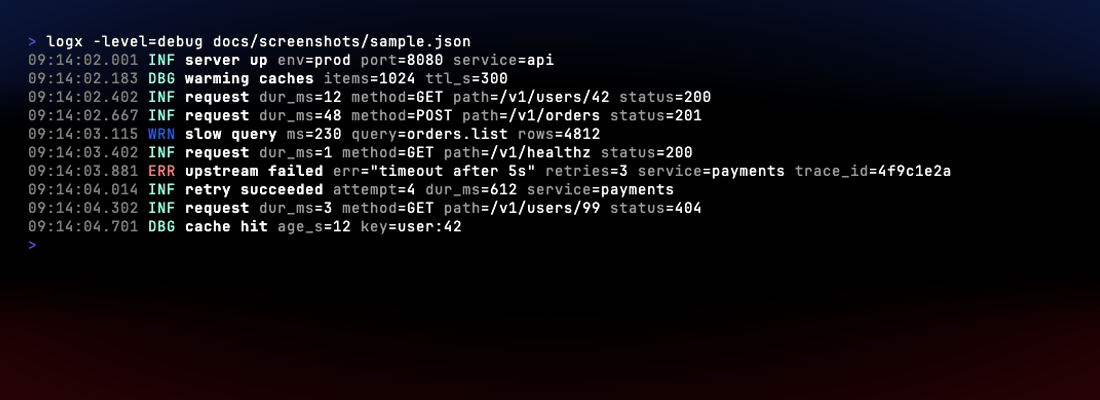
The logx binary reads JSON slog lines (from stdin or a file) and pretty-prints them.
# pipe a Go service's stderr
myapp 2>&1 | logx

# read from a file
logx app.log

# tail follow
logx -f /var/log/app.json

# filter
logx -level=warn -grep=timeout app.log

# no colors (for piping into a pager)
logx -no-color app.log | less
Lines that don't parse as JSON are passed through unchanged, so panic stacktraces and plain-text logs don't get swallowed.
All flags:
| Flag | Default | Meaning |
|---|
-level | debug | Minimum level to show (debug/info/warn/error) |
-grep | empty | Only show lines containing this substring (applied to the raw input line, so it matches JSON-encoded fields and pass-through text alike) |
-f | false | Follow the file like tail -f (single file only) |
-no-color | false | Disable ANSI color escapes |
-source | false | Show file:line if source is present in the record |
-time | 15:04:05.000 | Go time format for the timestamp column |
-version | — | Print version and exit |
API surface
Full docs and examples: pkg.go.dev/github.com/AyoubTadlaoui/GoLogX/logx.
Performance
Microbenchmarks on darwin/arm64, single record with three attributes, output discarded:
BenchmarkPretty-8        597.8 ns/op    16 B/op    1 allocs/op
BenchmarkPrettyColor-8   467.0 ns/op    16 B/op    1 allocs/op
BenchmarkStdlibText-8    592.2 ns/op     0 B/op    0 allocs/op
BenchmarkStdlibJSON-8    579.1 ns/op     0 B/op    0 allocs/op
BenchmarkMulti-8         829.7 ns/op    16 B/op    1 allocs/op
PrettyHandler is on par with stdlib TextHandler / JSONHandler in throughput, paying one small allocation per record for buffer pooling. Reproduce:
make bench
Common tasks
make help        # list everything
make build       # build the cmd/logx binary into ./bin/logx
make test        # go test ./...
make test-race   # go test -race ./...
make bench       # microbenchmarks vs stdlib slog
make cover       # coverage profile + HTML
make lint        # golangci-lint run ./...
make snapshot    # build local snapshot archives with goreleaser (needs goreleaser)
Versioning & releases
GoLogX follows Semantic Versioning. While the project is 0.x:
- The CLI is treated as stable for end users — flag names and exit codes won't change without a major bump.
- The library API may make minor changes between
0.x releases. Anything breaking is called out in CHANGELOG.md.
Tagged releases publish prebuilt CLI binaries to the Releases page (linux/macOS/windows × amd64/arm64) via goreleaser.
Contributing
PRs and issues welcome. The full bar is in CONTRIBUTING.md. The short version:
make check # gofmt + vet + race tests
Open the PR once that's clean.
License
MIT — see LICENSE.
About the author
Ayoub Tadlaoui — Atlas Kaisar — a problem-solver from Morocco, building software since 2016.
> "High performance knows no part-time commitment."