BirdNET Live - Professional bioacoustics in your pocket





Built for field researchers, conservationists, and birders, BirdNET Live identifies bird species in real time using on-device BirdNET+ inference — no internet required. Built with Flutter for Android, iOS, and Windows.
Google Play
·
App Store
·
Download APK
·
Documentation
·
All Releases
NOTE: BirdNET Live is under active development. Some rough edges and limitations remain — please report issues you run into and contribute if you can!
Table of Contents
Features
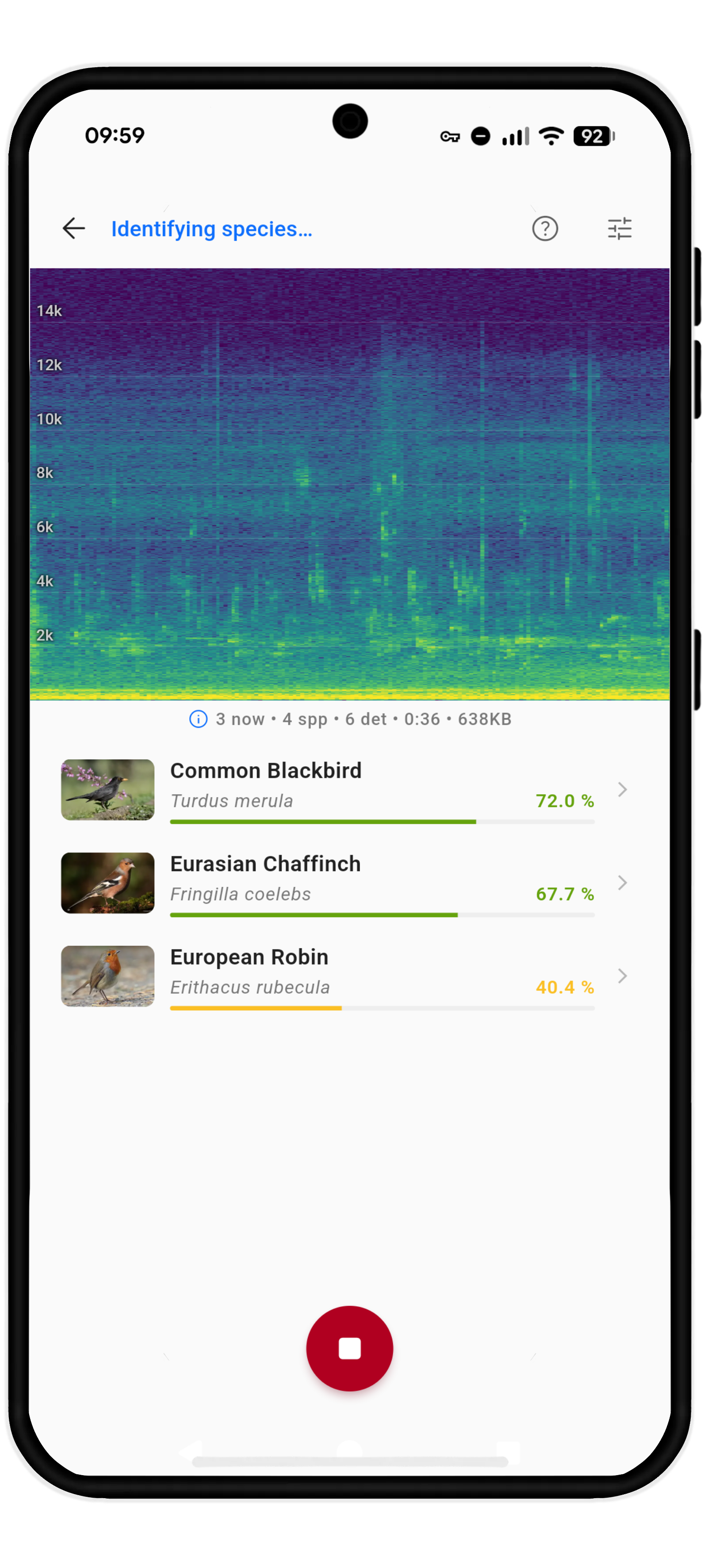
- Live Mode — Real-time scrolling spectrogram with species identification
- Point Count Mode — Timed survey sessions with countdown timer and station metadata
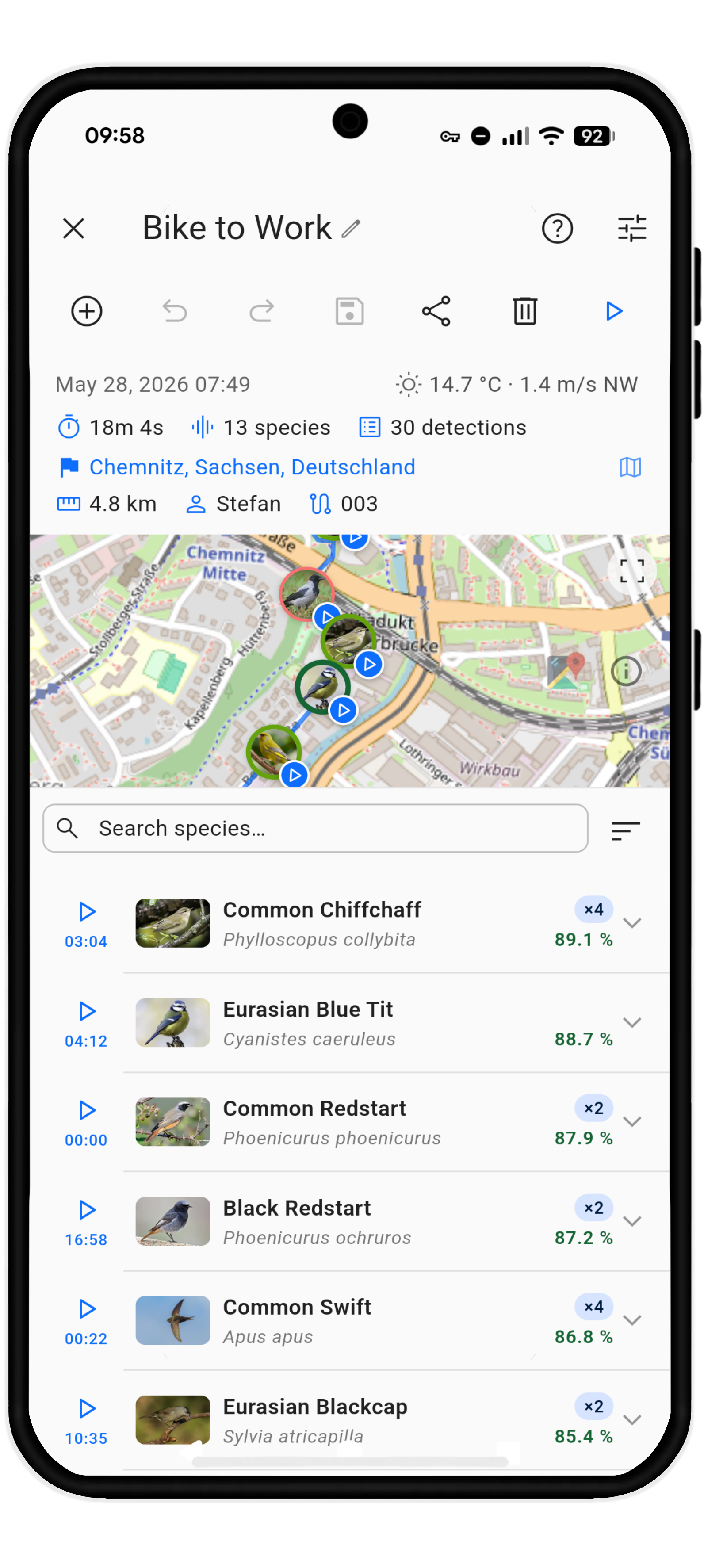
- Survey Mode — Long-running transect surveys with GPS tracking, background monitoring, and detection sampling
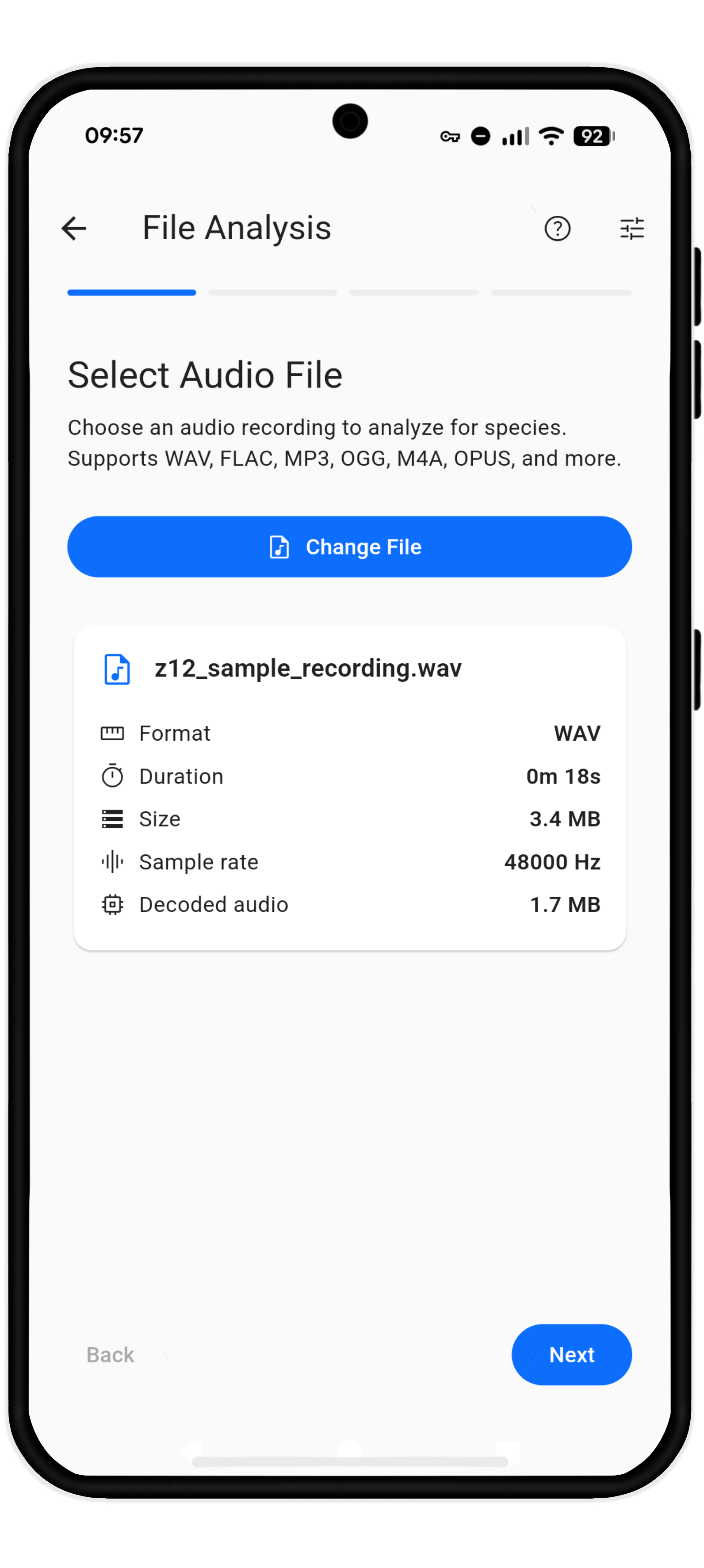
- File Analysis Mode — Analyze existing audio files (WAV, FLAC, MP3, OGG, and more)
- ARU Mode — Turn your device into an acoustic recording unit for multi-day deployments
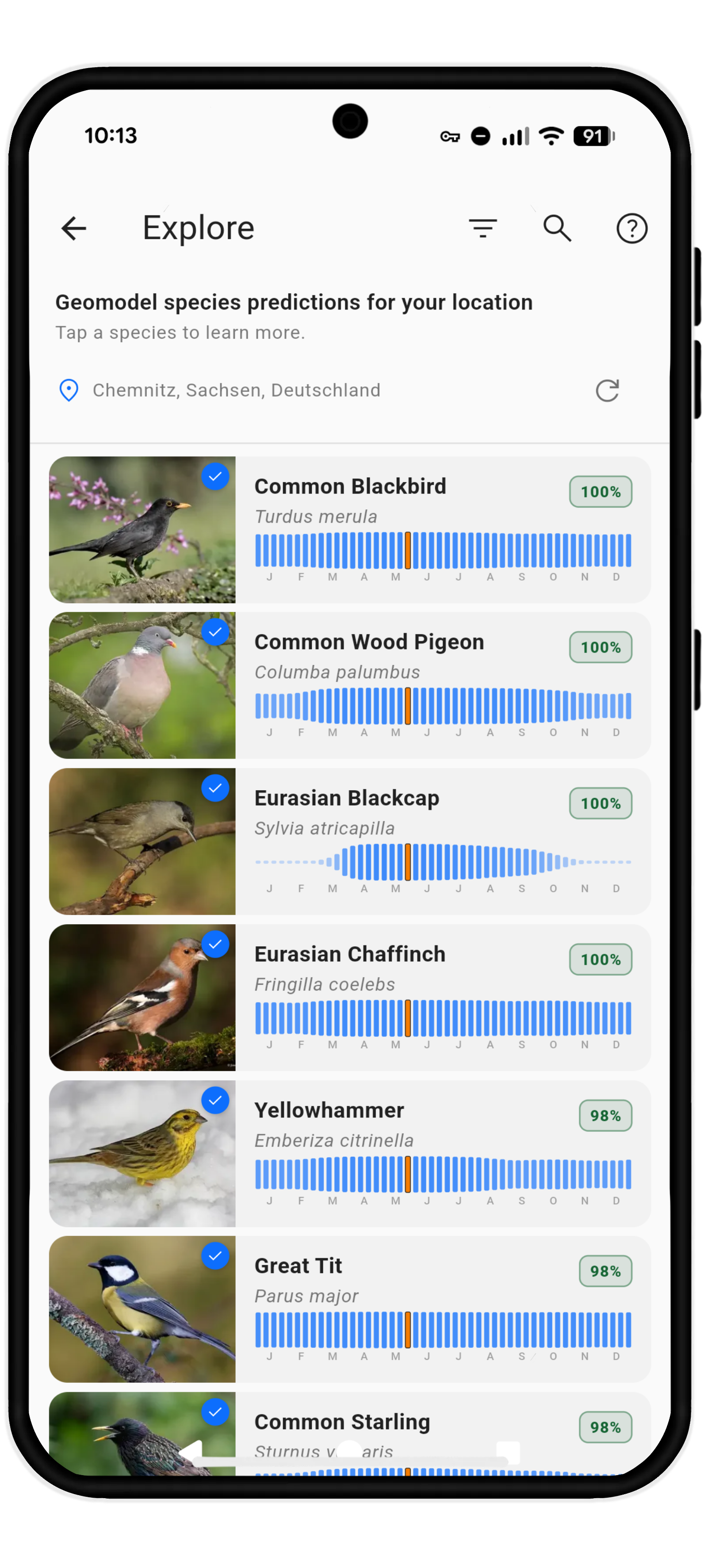
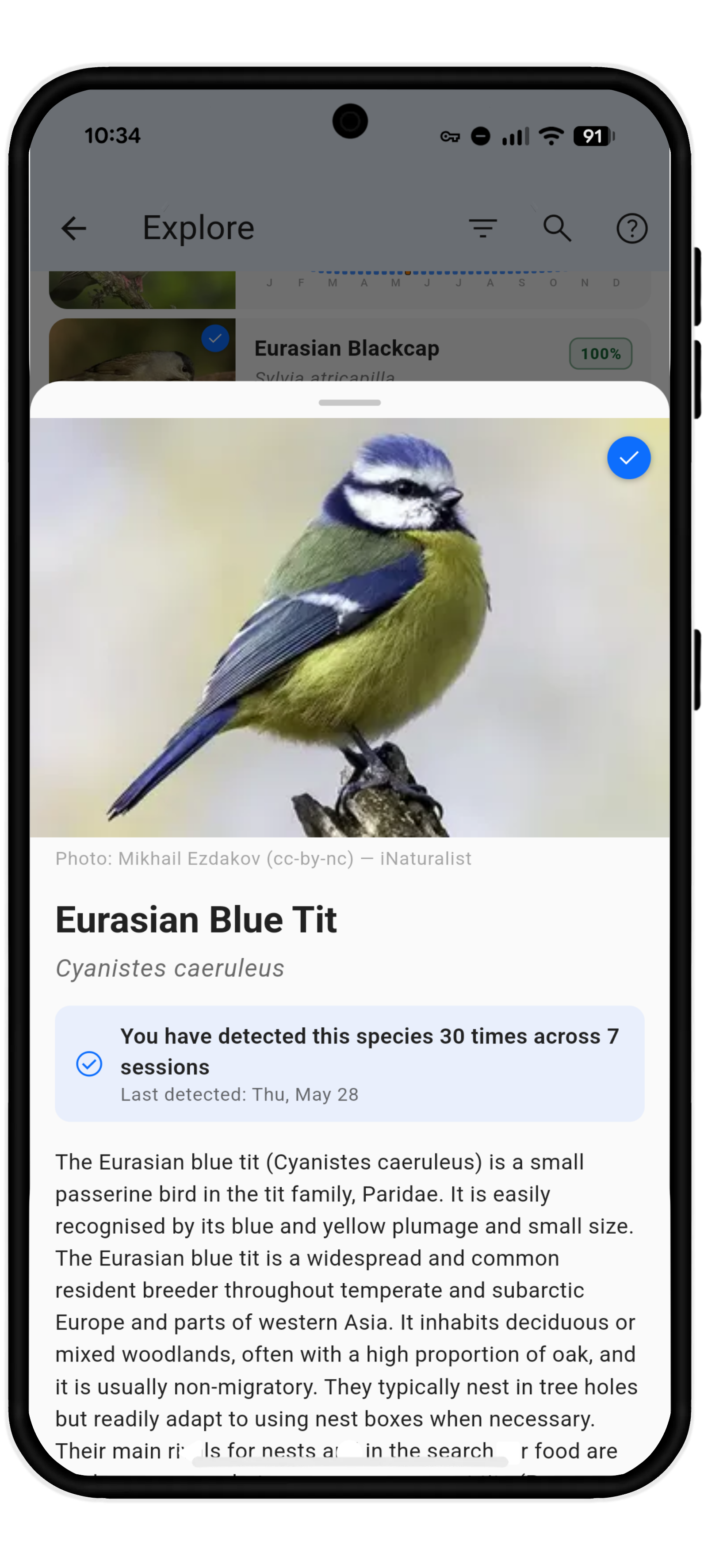
- Explore — Browse species expected at your location using the BirdNET geo-model
- Session Library — Review, edit, and export past sessions with audio playback
- Export — Raven Pro, CSV, JSON, GPX, and ZIP bundle formats
- On-device inference — BirdNET+ model (9,789 species), no internet required
- FLAC recording — Pure Dart encoder for compressed audio (50–60% reduction)
- Landscape & tablet layouts — Adaptive UI for phones and tablets in both orientations
- Localization — UI translations and spoken announcement phrasing for English, German, Czech, Spanish, French, Italian, Portuguese, Dutch, Norwegian Bokmål, Polish, Russian, and Simplified Chinese
Install on Android
BirdNET Live is available on the Google Play Store and is available as a signed APK for sideloading. Download the latest release from the Releases page, transfer the .apk file to your phone, and open it to install. You may need to allow installation from unknown sources in your device settings.
> Note: The APK is ~260 MB because it includes the full BirdNET+ audio model and all species images for full offline use.
Quick Start
Prerequisites
Setup
git clone https://github.com/birdnet-team/birdnet-live-app.git
cd birdnet-live-app
git lfs install
git lfs pull
flutter pub get
flutter gen-l10n
Do not skip the LFS step on a fresh clone. The two .onnx model files under assets/models/ are stored with Git LFS; without the real files the app may build from pointer files but model loading will fail at runtime. You only need to run the Python model build pipeline in dev/ when updating or rebuilding the models themselves.
Verify
flutter doctor    # Check Flutter setup
flutter test      # Run tests
flutter analyze   # Check for issues
Deploy to Phone
Android (USB — Windows / macOS / Linux)
-
Enable Developer Options on your phone: Settings → About phone → tap "Build number" 7 times.
-
Enable USB debugging: Settings → Developer options → USB debugging → On.
-
Connect phone via USB and accept the debugging prompt.
-
Check Flutter sees the device:
flutter devices
-
Run (debug mode with hot reload):
flutter run
Or press F5 in VS Code with the Flutter extension installed.
-
Build release APK (optional):
flutter build apk --release
The APK will be at build/app/outputs/flutter-apk/app-release.apk. It is self-contained for sideloading and includes the ONNX models. Transfer it to your phone and install.
Android (Wireless — Windows)
- Complete steps 1–3 above (USB debugging on, phone connected via USB).
- Pair over Wi-Fi (Android 11+):
# On the phone: Developer options → Wireless debugging → Pair device with pairing code
# Note the IP:port and pairing code shown
adb pair :
# Enter the pairing code when prompted
- Connect wirelessly:
adb connect :
# Use the port shown under "Wireless debugging" (not the pairing port)
- Unplug the USB cable. Run as usual:
flutter run
iOS (macOS only)
- Connect iPhone via USB.
- Trust the computer on the phone when prompted.
- Open
ios/Runner.xcworkspace in Xcode and set your signing team under Signing & Capabilities.
- Run:
flutter run
Or press F5 in VS Code.
VS Code Tips
- Install the Flutter and Dart extensions.
- Select your target device in the status bar (bottom-right).
F5 to launch with debugger attached.Ctrl+F5 to launch without debugger (faster startup).- Use the hot reload button (⚡) or
r in the terminal for quick iterations.
R in the terminal for hot restart (resets state).
Documentation
To preview the documentation locally:
pip install mkdocs mkdocs-material mkdocs-static-i18n pymdown-extensions
mkdocs serve
Then open http://127.0.0.1:8000 in your browser.
Project Structure
lib/
  core/           # Constants, theme, utilities, extensions
  features/       # Feature modules (live, point_count, survey, file_analysis,
                  #   aru, audio, recording, spectrogram, inference, explore,
                  #   announcements, history, settings, home, onboarding, about)
  l10n/          # Localization ARB files (en, de, cs, es, fr, it, pt, nl, nb, pl, ru, zh)
  shared/         # Shared models, providers, services, widgets
                  #   (e.g. ContentWidthConstraint for tablet max-width)

docs/             # MkDocs source for GitHub Pages documentation
assets/           # App assets (LFS ONNX models, species data, images, fonts)
  announcements/  # Spoken announcement phrasing per locale (second translation
                  #   surface — see assets/announcements/README.md)
test/             # Tests mirroring lib/ structure
Model Assets
BirdNET Live runs fully on-device, so the model assets are part of the checkout/build rather than downloaded by the app at runtime. The large .onnx files in assets/models/ are tracked with Git LFS:
BirdNET+_V3.0-preview3.1_Global_10K-pruned_FP16.onnx — audio classifier (~65 MB)BirdNET+_Geomodel_V3.0.4_Global_10K-pruned_FP16.onnx — location-based species model (~13 MB)
Release APKs for sideloading keep those models inside flutter_assets. Play Store App Bundles move the .onnx files into the install-time models_pack asset pack so the base module stays below Play's size limit while still working offline after installation.
Development
flutter run          # Run with hot reload
flutter test         # Run tests
flutter analyze      # Static analysis
dart format .        # Format code
See CONTRIBUTING.md for guidelines.
Contributing Translations
Translations are very welcome contributions, and they cover two surfaces — both need updating for a language to be complete:
The announcement templates are not in ARB because each entry is a list of interchangeable variants rather than a single string. A missing or incomplete template file falls back to English silently, so it is easy to ship a "complete" translation that still speaks English.
License
- Source Code: The source code for this project is licensed under the MIT License.
- Models: The bundled BirdNET model weights are licensed under the Apache License 2.0.
Please ensure you review and adhere to the specific license terms provided with each model.
Acceptable Use
Please refer to the Acceptable Use Policy for responsible-use guidance for BirdNET and BirdNET Live.
Citation
If you use this app in your scientific work, please cite it using the following BibTeX entry:
@software{BirdNET_Live_2026,
  author = {Kahl, Stefan and Börner, Andy and Mauermann, Max and Seifert, Raja Charlotte and Lasseck, Mario and Wilhelm-Stein, Thomas and Wood, Connor M. and Eibl, Maximilian and Klinck, Holger},
  title = {{BirdNET Live app - Professional bioacoustics in your pocket}},
  url = {https://github.com/birdnet-team/birdnet-live-app},
  year = {2026}
}
Funding
Our work in the Cornell K. Lisa Yang Center for Conservation Bioacoustics is made possible by the generosity of K. Lisa Yang to advance innovative conservation technologies to inspire and inform the conservation of wildlife and habitats.
The development of BirdNET is supported by the German Federal Ministry of Research, Technology and Space (FKZ 01|S22072), the German Federal Ministry for the Environment, Climate Action, Nature Conservation and Nuclear Safety (FKZ 67KI31040E), the German Federal Ministry of Economic Affairs and Energy (FKZ 16KN095550), the Deutsche Bundesstiftung Umwelt (project 39263/01) and the European Social Fund.
Partners
BirdNET is a joint effort of partners from academia and industry.
Without these partnerships, this project would not have been possible.
Thank you!
