mcp-assert: Ensuring Robust MCP Server Compatibility
Primary Purpose:
mcp-assert is a tool designed to test Model Context Protocol (MCP) servers against real-world protocols. It ensures compatibility with various clients like Claude or Cursor, providing reliable testing without mocks.
Key Features:
Cross-Language Support: Works seamlessly with servers written in Go, TypeScript, Python, Rust, Java, and more.
YAML-Based Assertions: Define tests easily in YAML and integrate them into Continuous Integration (CI) pipelines for consistent results.
Real Transport Testing: Mimics actual client connections using stdio, SSE, or HTTP to ensure accurate testing environments.
CI Tool Integration: Compatible with popular CI tools like GitHub Actions, pytest, Jest, and more, enabling seamless setup without additional toolchains.
Audience & Benefits:
Tailored for developers and teams building MCP servers, mcp-assert ensures robustness and compatibility across all MCP clients. By testing against real protocols, it helps identify issues that mocks might miss, leading to fewer errors and improved reliability. This tool is essential for ensuring your MCP server functions correctly and consistently across different platforms.
Installation:
mcp-assert can be installed via winget on Windows, making setup straightforward and efficient.
Test your MCP server against the real protocol. No mocks. No imports. No language lock-in.
mcp-assert connects to your server exactly like Claude, Cursor, or any MCP client would: real stdio/SSE/HTTP transport, full initialize handshake, actual tool calls. It checks responses against expectations you define in YAML. If it passes mcp-assert, it works with every MCP client.
> [!WARNING]
> We scanned 102 MCP servers and found 4,794 schema issues (2,239 errors) across 55 servers including AWS, Serena, and Grafana. The most common failure: parameters missing type definitions cause agents to send wrong value types. See the scorecard.
Your YAML        ──→  mcp-assert  ──→  MCP Server
(inputs + assertions)    (client)        (any language)
                            │
                        Pass / Fail
Your server can't tell the difference
mcp-assert speaks the full MCP protocol: initialize handshake, tools/list discovery, tools/call with real arguments. It finds bugs that unit tests miss because it tests over the wire, not in-process.
Adopted in production
Wyre Technology: 25 MCP servers tested via shared baseline workflow using mcp-assert-action
Structured error codes classify issues instantly. See Error Reference for all 24 codes.
> [!TIP]
> The audit connects, discovers every tool via tools/list, calls each one with schema-generated inputs, and reports which tools crash vs. handle errors properly. No YAML needed. To go deeper, generate assertion files and customize them:
# Audit + generate starter YAML for CI
mcp-assert audit --server "npx my-mcp-server" --output evals/

# Edit the generated YAMLs: add expected content, setup steps, multi-step flows

# Run in CI with regression detection
mcp-assert ci --suite evals/ --threshold 95
Write assertions from scratch
# Scaffold your first assertion
mcp-assert init evals                   # Or: init evals --server "my-server" for auto-generation

# Run it
mcp-assert run --suite evals/ --fixture evals/fixtures
Start with audit (zero setup), then fuzz (adversarial testing), then init (generates everything), then customize the YAML for your specific assertions.
Zero-Effort Coverage
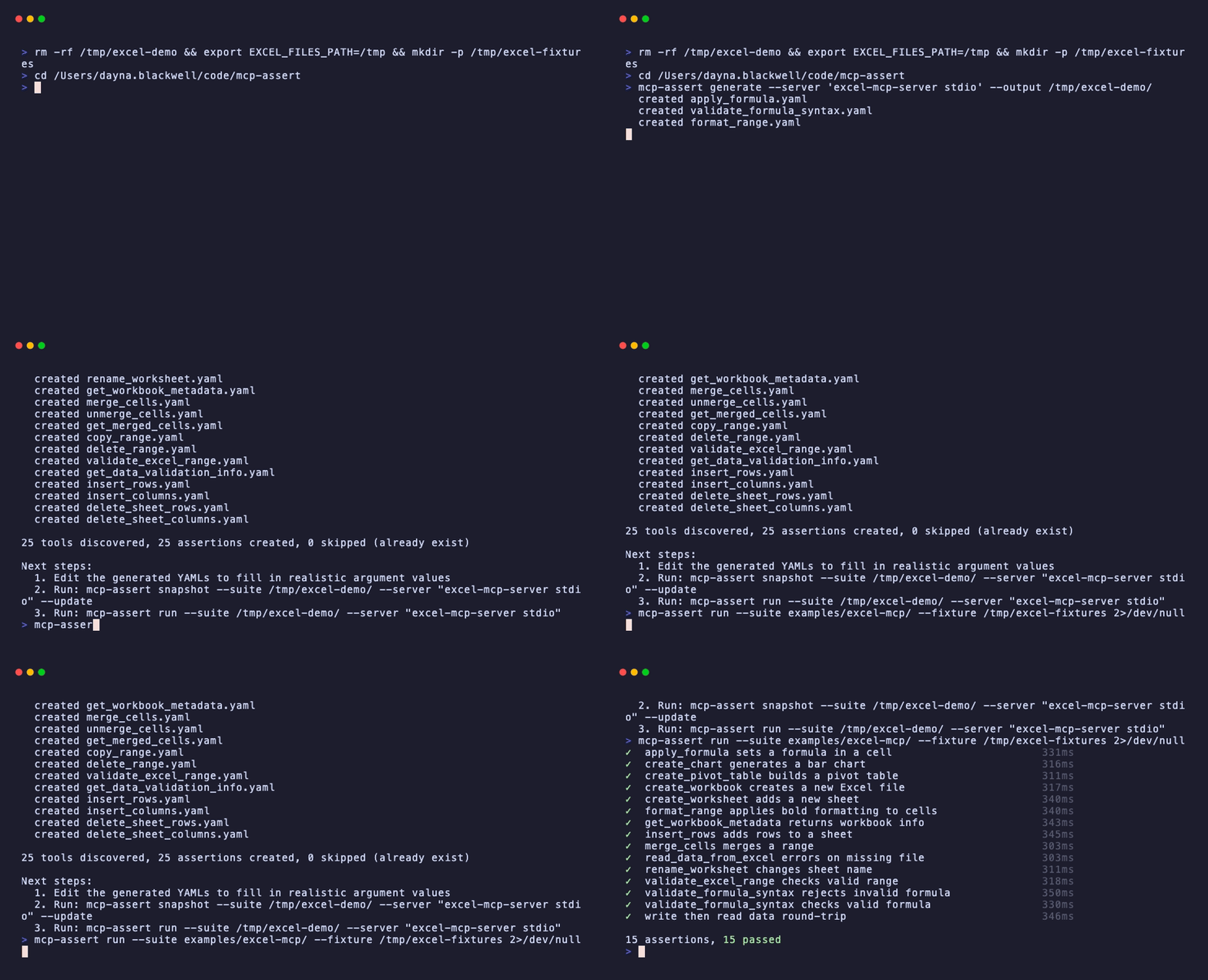
# Generate stub assertions for every tool the server exposes
mcp-assert generate --server "my-mcp-server" --output evals/ --fixture ./fixtures

# Capture actual outputs as snapshots
mcp-assert snapshot --suite evals/ --server "my-mcp-server" --update

# Assert nothing changed
mcp-assert run --suite evals/ --server "my-mcp-server"
Lint + Auto-Fix
Static analysis catches schema issues without executing tools. 24 rules detect problems that cause agents to fail:
mcp-assert lint --server "npx my-mcp-server"
  E  E103   create_entities       Required parameter "entities" has no description
  W  W114   generate_chart        Input schema is 5 levels deep. LLMs struggle with nesting
  W  W112   (server)              Server exposes 27 tools. LLM accuracy degrades beyond 20

5 error(s), 11 warning(s)
For deterministic tools, mcp-assert is the better fit. For subjective outputs, LLM-as-judge frameworks remain the right choice. Use both if your server mixes tool types.
Dimension
LLM-as-judge eval frameworks
mcp-assert
Best for
Subjective outputs (prose, creative content)
Deterministic outputs (data, state, validation)
Grading
Language model scoring (flexible, costly)
Assertion-based (exact, free)
Speed
Seconds per test (LLM round-trip)
Milliseconds per test (no LLM)
CI cost
API calls on every run
Zero external dependencies
Reliability
Not measured
pass@k / pass^k per assertion
Regression
Not supported
Baseline comparison, fail on backslide
Multi-language
Not supported
Same assertion across N language servers
Why not just write tests?
You'd need MCP protocol bootstrapping, a server-agnostic runner (your Go tests can't test your TypeScript server), and eval features (regression detection, Docker isolation, JUnit output). mcp-assert handles all of that. One YAML file, any server, any language.