OKF4net




A zero-dependency .NET (C#) implementation of the Open Knowledge Format
(OKF) v0.2 —
Google's open, human- and agent-friendly format for representing knowledge as
a directory of markdown files with YAML frontmatter.
> OKF is intentionally minimal: "if you can cat a file, you can read OKF; if
> you can git clone a repo, you can ship it." This project honors that
> spirit — it is implemented entirely on the .NET base class library, with
> no third-party dependencies (it includes its own YAML-subset parser,
> markdown link scanner, directory walker, and CLI argument parsing).
>
> OKF4net is an independent, zero-dependency .NET implementation of the Open
> Knowledge Format, built from the OKF v0.2 specification. It is backed by an
> extensive test suite, including snapshot comparisons of the CLI's output and full-projection
> tests of its machine outputs (see tests/fixtures/). Everything it builds is
> LGPL-3.0-or-later; see NOTICE.
📖 Documentation & project site → jchable.github.io/okf4net —
a guided project overview, getting-started walkthroughs, and developer docs:
getting started ·
guides ·
CLI reference ·
library reference ·
MCP ·
spec mapping.
This README is the technical reference; the site is the friendlier entry point
for newcomers.
> Want to contribute? OKF4net is a young, welcoming project with a clear
> roadmap and issues labelled
> good first issue.
> No prior OKF knowledge required — see Contributing & roadmap.
What OKF is
- A bundle is a directory tree of UTF-8 markdown files (the unit of
distribution).
- A concept is one markdown document: a YAML frontmatter block delimited
by
---, followed by a markdown body.
- A concept id is the file's path within the bundle with
.md removed
(tables/users.md → tables/users).
- Concepts cross-link via ordinary markdown links — absolute
(
/tables/users.md, bundle-relative) or relative (./other.md).
index.md files provide directory listings for progressive disclosure;
log.md files record date-grouped change history. Both are reserved
filenames.- The only hard requirement for conformance is a non-empty
type field on
every concept; consumers must otherwise be permissive (unknown types, unknown
keys, broken links, and missing optional fields are all tolerated).
See mapping to the spec below for the section-by-section
mapping, or the longer
What OKF is page on the site.
Projects & packages
OKF4net ships as several projects. The core library is the foundation; each
other project layers a specific integration on top and points back to it.
| Project | NuGet package | Responsibility | Deep dive |
|---|
OKF4net | OKF4net | Zero-dependency core library: parse, validate, index, graph OKF bundles. | Library overview |
OKF4net.Cli | OKF4net.Cli (the okf dotnet tool; also Native AOT okf binaries) | The okf command-line tool (validate/audit/verify/info/index/graph/parse/fmt). | As a CLI |
OKF4net.Render | — (Native AOT okf-render binary, no PackageId) | Standalone CLI: generates a browsable HTML site from a bundle. | As a CLI |
OKF4net.Viewer | — (ships inside the okf-render binary, not packed by release.yml) | Static HTML site generation for a bundle; backs okf-render. | As a CLI |
OKF4net.Agents | OKF4net.Agents | Microsoft Agent Framework tools + OkfContextProvider (context & memory). | Microsoft Agent Framework |
OKF4net.Catalog | OKF4net.Catalog | Local catalog of OKF bundles: catalog.json manifest + source resolver. | Local catalog · README |
OKF4net.Catalog.Hosting | OKF4net.Catalog.Hosting | IServiceCollection integration (AddKnowledge) for the catalog. | README |
OKF4net.Mcp | OKF4net.Mcp | Local MCP server exposing an OKF bundle to Claude Desktop / Claude Code. | Use OKF in Claude (MCP) · README |
OKF4net.Attestation | OKF4net.Attestation | Host-plugged §10 attested-computation orchestration (bind → execute → attest). | Attested computation · README |
OKF4net.Attestation.Containers | — (not packed by release.yml; needs a container engine on PATH) | Runs a bundle's sanctioned script/SQL and its attester in real containers (Docker/Podman/nerdctl), never reimplemented in C#. | README |
Library overview
| Type / namespace | Responsibility |
|---|
OKF4net.Yaml.YamlValue / YamlMapping | A YAML-subset value/mapping model for frontmatter |
OKF4net.Yaml.YamlValue.Parse / YamlEmitter | Parser entry point and emitter for the same YAML subset |
OKF4net.OkfDocument | Frontmatter + body; parse / serialize / validate (§4) |
OKF4net.Frontmatter | Typed accessors over an order-preserving mapping (§4.1) |
OKF4net.ConceptId | ConceptId ↔ path conversion and segment validation (§2) |
OKF4net.Actor / Trust / Provenance / Lifecycle | Provenance, trust, and lifecycle value types and parsing (§5, §7) |
OKF4net.LinkScanner | Markdown link extraction, classification, legacy citations (§6.1, §13.1) |
OKF4net.Bundle | Bundle.Load — walk a tree, build the concept graph + backlinks (§3, §6) |
OKF4net.IndexGenerator | Generate index.md directory listings (§8) |
OKF4net.ChangeLog | Parse / build log.md update histories (§9) |
OKF4net.BundleValidator | §11 conformance checking with severity-tagged diagnostics |
The split follows the OKF reference implementation's bundle/ package
(document.py, index.py, paths.py) so behaviour stays spec-compatible:
the document parser, validator, and index generator are verified by an
extensive test suite, including snapshot comparisons of the CLI's output.
Design choices
-
Frontmatter preserves everything. Rather than deserializing into a fixed
type (which would drop producer-defined keys), Frontmatter keeps the full
ordered mapping and layers typed getters (Type, Title, Tags, …) on
top. This satisfies the spec's requirement that consumers preserve unknown
keys when round-tripping.
-
Permissive loading. Bundle.Load never aborts on a bad concept file; it
collects parse failures in ParseErrors and keeps going. Broken
cross-links are retained as graph edges to non-existent concepts.
-
Two levels of validation. OkfDocument.ValidateConformance() enforces
only what §11 requires (a non-empty type). OkfDocument.Validate() is the
stricter producer-side check: type, title and description
(Frontmatter.RequiredKeys). timestamp is a legacy §13.1 field since the
v0.2 bump and is not required.
-
A documented YAML subset. Real OKF frontmatter is scalars, lists, and
shallow maps. The parser handles block/flow collections, quoted/plain
scalars, |/> block scalars, and comments. It rejects, with a
YamlParseException giving the line and naming the feature, the YAML features
that never appear in frontmatter:
- anchors (
&name), aliases (*name) and tags (!name, !!type) at the
start of an unquoted node: a block key or value, a sequence item, a node on
its own line, or a flow item or key;
- directives, meaning a line starting at column 0 with
% (%YAML 1.2);
- document markers, meaning a line starting at column 0 with
--- or ...
followed by the end of the line, a space or a tab (..., --- x, ... # end);
- an indented
--- line (spaces or tabs, then ---, then optional spaces or
tabs) anywhere except inside |/> block-scalar content, reported as a
mistyped frontmatter fence. Through OkfDocument.Parse, that message also
gives the file line;
- text after a closing quote other than a
# comment (k: "a" b).
A quoted scalar ("*a"), an indicator later in a plain scalar (a & b,
50%), a value starting with % (k: %foo), block-scalar content and a plain
scalar's continuation lines stay text. Constructs the subset does not parse
as YAML structure are read as plain strings, so an indicator inside them is not
detected: compact nested sequences (- - *a, k: - *a), flow-collection keys
([*a]: v) and ? complex keys (? *a, {? *a : b}).
The frontmatter fences themselves are --- at column 0, optionally followed
by spaces or tabs (§4). An indented --- is not a fence. On line 1 it means
the file has no frontmatter, which okf validate flags with a warning next to
the missing-type error. Inside the frontmatter it is the parse error above,
except as block-scalar content.
Usage
As a library
A concern-by-concern API walkthrough lives in the
library docs on the site;
below is the short version.
using OKF4net;

var bundle = Bundle.Load("./my_bundle");
Console.WriteLine($"{bundle.Count} concepts");

// Conformance check (§11).
var report = BundleValidator.Validate(bundle);
if (report.IsConformant)
{
    Console.WriteLine($"conformant with OKF v{OkfSpec.Version}");
}

// Traverse the cross-link graph.
var id = ConceptId.Parse("tables/orders");
foreach (var link in bundle.LinksFrom(id))
{
    Console.WriteLine($"{id} -> {link.Target} (exists: {link.Exists})");
}
foreach (var backlink in bundle.Backlinks(id))
{
    Console.WriteLine($"cited by {backlink}");
}
Parsing and round-tripping a single document:
using OKF4net;

var doc = OkfDocument.Parse("---\ntype: Metric\ntitle: DAU\n---\n\n# Body\n");
Console.WriteLine(doc.Frontmatter.Type); // "Metric"
doc.ValidateConformance(); // throws DocumentValidationException on failure

// Serialize() preserves frontmatter key order and the body.
var text = doc.Serialize();
Reading and appending to a bundle's log.md change history (§9):
using System.Globalization;
using OKF4net;

var log = ChangeLog.Parse(File.ReadAllText("./my_bundle/log.md"));
foreach (var day in log.Days) // newest first, by convention
{
    foreach (var entry in day.Entries)
    {
        Console.WriteLine($"{day.Date} {entry.Kind}: {entry.Text}"); // Kind is null without a **bold** marker
    }
}

// Days are immutable records: build the new list, then re-render.
var today = DateTime.UtcNow.ToString("yyyy-MM-dd", CultureInfo.InvariantCulture);
var added = new LogEntry("Update", "Documented the refunds table.");
var days = log.Days.ToList();
var i = days.FindIndex(d => d.Date == today);
if (i >= 0) days[i] = days[i] with { Entries = [.. days[i].Entries, added] };
else days.Insert(0, new LogDay(today, [added]));
File.WriteAllText("./my_bundle/log.md", new ChangeLog(log.Title, days).ToMarkdown());
As a CLI
On Windows, install via winget:
winget install Coderise.OKF4net
On Linux or macOS, install a release binary with the install script:
curl -sSL https://raw.githubusercontent.com/jchable/okf4net/main/packaging/install.sh | sh
It detects your OS/architecture, downloads the matching archive from the
latest GitHub Release,
verifies its SHA-256 checksum, and installs to /usr/local/bin (falling back
to ~/.local/bin when that isn't writable — it never calls sudo). Pass
--bin okf-render to install the site generator instead of okf, --version to pin a release, --dir to override the destination, or
--dry-run to see what it would do without touching disk or network beyond
resolving the version. Run it with -h for the full option list; see
packaging/install.sh for the implementation.
If the machine has the .NET SDK, okf is also a
dotnet tool, and that is the
best way to run it in CI. Pin it in the repository's tool manifest, commit
the manifest, and every clone and CI run gets the same version back:
dotnet new tool-manifest            # once per repository; creates dotnet-tools.json
dotnet tool install OKF4net.Cli     # records the version in the manifest
dotnet tool restore                 # what CI runs
dotnet okf validate ./knowledge
dotnet tool install -g OKF4net.Cli installs it globally instead, and
dnx OKF4net.Cli --yes validate ./knowledge runs it once without installing
anything. The tool is portable IL and needs the .NET 10 runtime or a later
one. It is built from the same source as the native binary and gives the same
verdicts. If both are installed, the first okf on PATH wins, while
dotnet okf always runs the manifest's version.
On any OS, you can also build from source — see
Building & testing.
okf validate     Check a bundle against OKF v0.2 conformance (§11)
okf audit        Report trust, freshness and lifecycle across the bundle
okf verify    …   Record a review of one or more concepts (--by )
okf info         Summarize a bundle (concepts, types, links, version)
okf index        (Re)generate every index.md in the bundle
okf graph        Print the cross-link graph (--dot for Graphviz DOT)
okf parse          Parse one concept document and print its structure
okf fmt            Normalize a document by parse + re-serialize (-w writes)
okf help                 Show this help (same as -h, --help)
okf version              Show version (same as -V, --version)
Every verb takes -h/--help for its own usage and option list. Arguments are
validated per verb: an option that verb does not define, or a surplus
positional, is an error rather than silently ignored — so a typo'd flag never
runs the command with different behaviour than you asked for.
okf validate exits non-zero when a bundle is not conformant, so it drops
straight into CI. No bundle of your own yet? The repository ships sample
bundles under bundles/ — ga4 validates with no
warnings, so it is a good first target:
okf validate ./bundles/ga4
okf graph ./bundles/ga4 --dot | dot -Tsvg > graph.svg
okf audit reports trust, freshness and lifecycle across a whole
bundle: counts per trust tier (§5.3) and status (§5.4), plus the worklist of
stale concepts (§5.5). Filter it to ask corpus-level questions —
# Which concepts are past stale_after and were never verified by a human?
okf audit bundles/acme_retail --stale --trust unverified,machine-confirmed
Without filter flags it selects exactly what --stale selects and prints the
summary form; with any filter flag it prints one line per matching concept, so
the output pipes. --json always emits the full document.
--as-of pins the date staleness is evaluated against, on both
okf audit and okf validate; it pins to midnight UTC on that date, since §5
makes stale_after an instant. Without it, anything touching stale_after
(§5.5) depends on the day it runs — including okf validate's
concept is stale warning, which is why a CI job that wants a reproducible
report should pin the date rather than let the calendar move under it. The
exit code never depends on it: staleness is a warning, not a conformance
error. Note the counts
always cover the whole bundle while findings covers the selection: audit is
a worklist, not an inventory (use okf info --json for that).
Both commands' --json document carries asOf (the evaluation date) and
evaluatedAt (the exact instant, yyyy-MM-ddTHH:mm:ssZ) right beside it —
asOf is evaluatedAt's date only, both coming from a single clock read per run, so
an archived report can be told apart from an unpinned run down to the second,
not just the day.
okf verify … --by records a review (§5.2): it adds — or,
for a repeat review from the same actor, replaces — a { by, at } entry in
each named concept's verified list. It is the verb that answers what
okf audit asks about trust: audit finds concepts a human has never reviewed
(--trust unverified / unverified,machine-confirmed), verify records that
the review happened, and — for a human: actor — the reviewed concept
clears that trust-filtered selection. A process: or / actor is accepted
symmetrically (§7), but only moves the concept from unverified to
machine-confirmed (§5.3), which --trust unverified,machine-confirmed
still selects. Verification only moves the trust dimension (§5.3) — it never
touches stale_after, so a concept just reviewed can still show up in
okf audit's default worklist, which selects on staleness alone (see
above). … also accepts a single -, reading one concept id per line
from standard input, so the two verbs compose into one line:
okf audit bundles/acme_retail --trust unverified | cut -d' ' -f1 | okf verify bundles/acme_retail --by human:ada -
An empty stream there is "nothing to do", not an error: okf audit exits 0
printing nothing when the worklist is empty, and okf verify - on that
stream writes nothing and exits 0 too, so the loop is idempotent and safe
under set -e on a healthy bundle. Naming no concept at all
(okf verify ) is still an error — that is the mistyped-validate
case, and it stays loud.
Every named concept is checked for existence and §11 conformance before
anything is written, so a batch is rejected as a whole at that stage; a
mid-batch I/O failure can still leave the concepts already written stamped
(okf verify lists the concepts it wrote before it stopped). --dry-run prints what
would be recorded without writing anything; --at
overrides the default of "now" for reproducible scripting — a bare date, a
numeric offset, or fractional seconds are all rejected, not silently rounded.
> What a verified stamp does and doesn't prove. It guarantees the
> stamp is well-formed, dated, and attached to the concepts named — nothing
> more. It does not guarantee the signer's identity, nor that anyone
> actually read the concept: no zero-dependency tool can authenticate --by,
> and okf_write_concept can write the exact same field with no ceremony at
> all — deliberately unguarded, since a full frontmatter rewrite (importing a
> bundle, correcting a concept) has to be able to touch verified too.
> Credibility comes from where the stamp lands: in a diff a human reviewed,
> under branch protection, where the reviewer sees the assertion and can
> reject it. That argument only works if the diff is legible, which is why
> verify is deliberately not like every other write path in this
> library: instead of re-serializing the whole document, it edits the
> verified: block in place in the raw text (FrontmatterBlockEdit) and
> leaves every other byte untouched — CRLF line endings, YAML comments, and
> flow-style/folded scalar spellings elsewhere (tags: [a, b], generated: { > by: …, at: … }, description: >) survive exactly as the bundle had them.
> The one exception is a column-0 comment sitting inside the verified:
> block itself (between the verified: line and the next top-level key): it
> is replaced along with the block it comments on, since there is no way to
> know which of the stamp's lines it was meant to annotate. A reviewer's diff
> for a verify run is therefore just the changed verified: lines, with no
> okf fmt -w step needed first to keep the reformat from swallowing it.
> Never infer
> a stamp from a PR approval — that turns "a human
> approved this diff" into "a human vouches for this knowledge," which are
> different every time a PR touches a file for a reason other than reviewing
> it (which is most of the time). Doing so would mass-promote every concept
> the diff happens to touch and silently empty the very worklist this feature
> exists to populate.
okf is OKF4net.Cli, published two ways from the same project: a
self-contained, Native AOT single-file binary for winget and the install
script, which needs no .NET runtime on the target machine, and the portable
OKF4net.Cli dotnet tool described above. Full command reference with real output samples:
CLI docs on the site.
okf-render — generate a static HTML site
Static HTML site generation lives in a separate binary, okf-render
(OKF4net.Render), not in okf itself — okf is meant to be the small,
dependency-free CI validator that winget and nuget.org distribute, and the site generator pulls
in a vendored copy of marked (MIT) and
three embedded fonts (SIL OFL 1.1) that a CI job running okf validate never
needs. OKF4net.Mcp already
established the pattern this follows: a leaf executable owns the dependencies
its one job needs, instead of pushing them into the shared core.
dotnet publish src/OKF4net.Render -c Release   # Native AOT, self-contained okf-render binary
okf-render bundles/ga4 --out /tmp/ga4-site
# then open /tmp/ga4-site/index.html
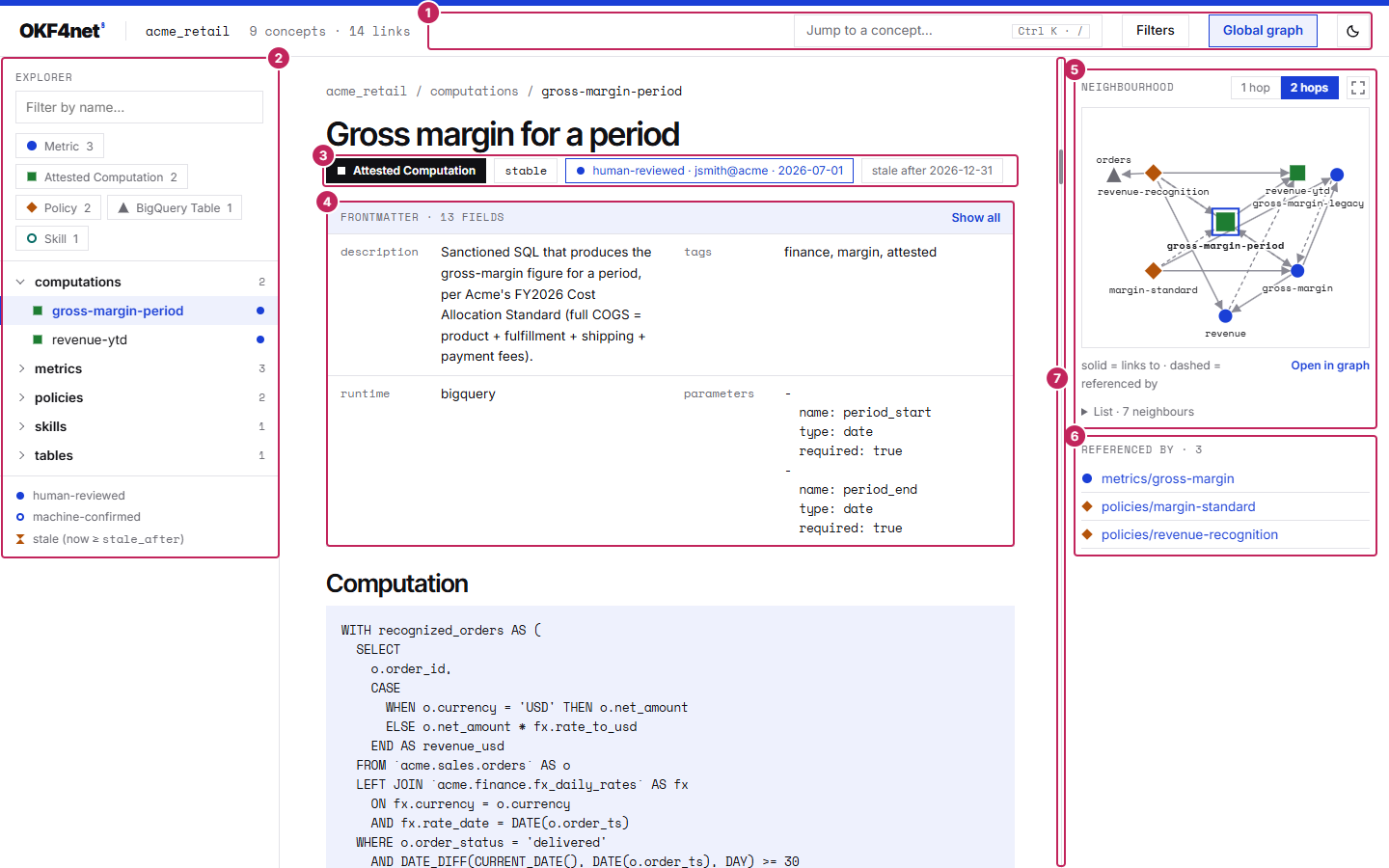
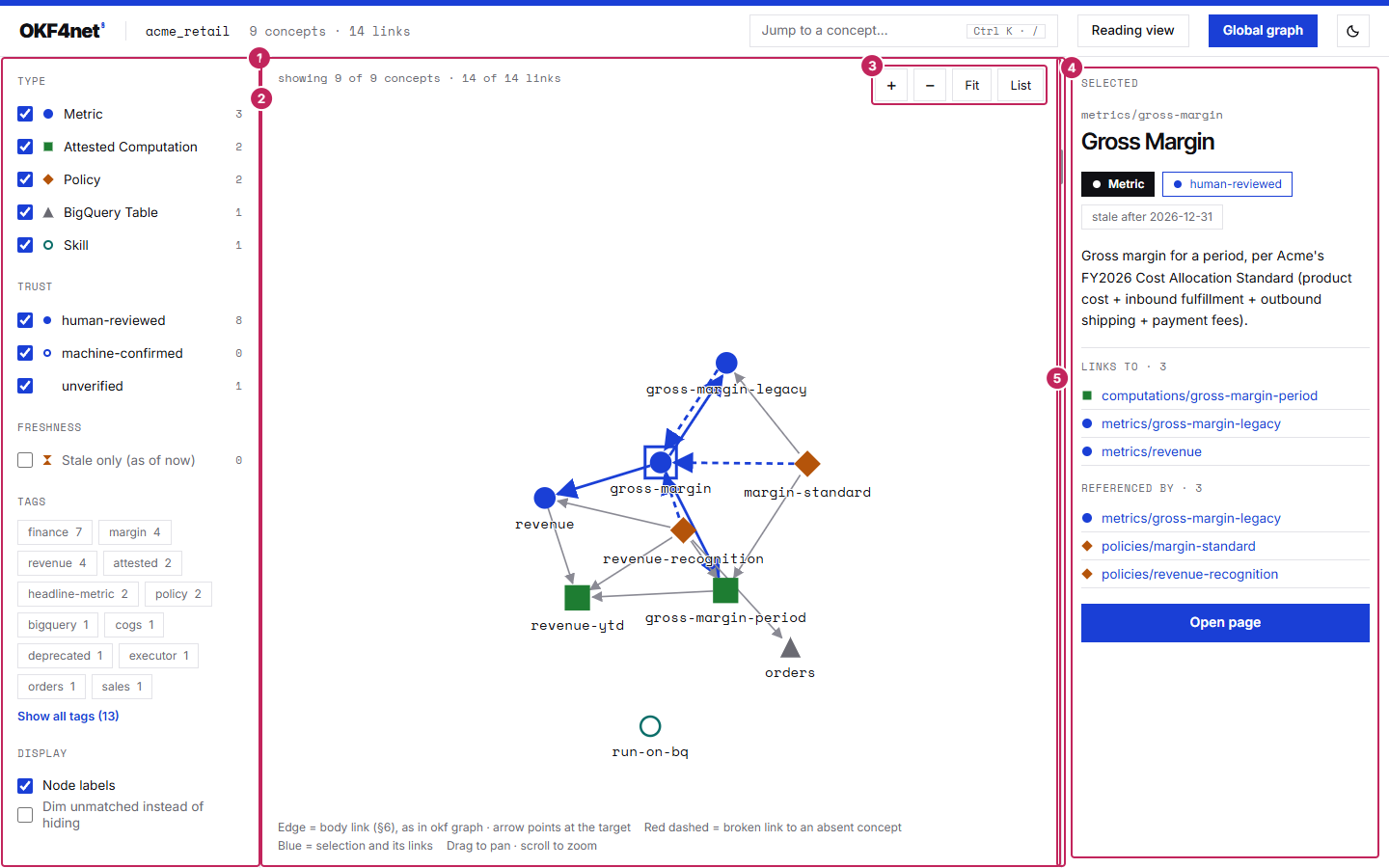
The acme_retail sample bundle rendered by okf-render: a concept page (top) and the global graph (bottom). Screenshots are regenerated by tools/viewer-security-check/recette/docs-shots.js.
The generated site is self-contained and opens straight off the filesystem —
no server needed. Every page carries one header (the bundle's name, its
concept and link counts, a "Jump to" palette — Ctrl+K or /, matching
titles, ids and tags —, a "Global graph" link and a light/dark toggle) and a
tree explorer of the bundle with type shapes, type filters and trust and
staleness flags. A concept page shows a breadcrumb, its title, chips for
type, status, trust and staleness, and a folding frontmatter box; its side
panel holds the page's contents, the pages that reference it and, when the
concept has neighbours, a "Neighbourhood" local graph (its neighbours at one
or two hops, at most 40 drawn, with an equivalent list of all of them and an
"Open in graph" link; it can be enlarged into a dialog). "Global graph" opens graph.html, a page that draws
the whole bundle's links with a layout computed in the browser, narrowed by
facets (type, trust, freshness, tags), with a list equivalent and keyboard
navigation; both are described in
src/OKF4net.Viewer/README.md and, with screenshots, in the
viewer docs. The right-hand
column can be resized with a splitter (drag it, or use the arrow keys). The Inter,
Inter Tight and Space Mono fonts are embedded.
It is read-only, and has no full-text search: a static site has no server
to run the shared ConceptSearch scorer, and mirroring its weights in
JavaScript would fork it. Interactive browsing with search is planned as a
VS Code extension instead (see
#163), not as a local
server. okf-render has its own winget package,
Coderise.OKF4net.Render, built and attached to each Release the same way
as okf's — but its first submission to winget-pkgs is a manual, one-time
step (see packaging/winget/README.md) that has
not happened yet, so winget install Coderise.OKF4net.Render will not resolve
until it does. Until then, on Linux or macOS install it with the same script
as okf above (--bin okf-render), or on any OS grab a prebuilt archive from
a GitHub Release or build it
from source as shown above.
Using OKF4net with Microsoft Agent Framework
src/OKF4net.Agents/ exposes bundle operations as function tools for the
Microsoft Agent Framework:
OkfBundleTools wraps one bundle root and its GetTools() method returns
twelve ready-to-use AITools unconditionally, which AsAIAgent turns into an
agent's tool list, plus a thirteenth — okf_run_computation — only when the
tool set is constructed with an OKF4net.Attestation orchestrator wired in
(see Attested computation).
using Microsoft.Agents.AI;
using Microsoft.Extensions.AI;
using OKF4net.Agents;

IChatClient chatClient = /* your IChatClient, e.g. from an OpenAI/Azure client */;
var tools = new OkfBundleTools("./my_bundle");

// The write tools need the host's approval before they run. `GetTools()` with
// no argument returns them ungated — see the security note below.
AIAgent agent = chatClient.AsAIAgent(tools: tools.GetTools(OkfToolMode.RequireApprovalForWrites));
var response = await agent.RunAsync("Search the bundle for concepts about refunds.");
Console.WriteLine(response.Text);
To see this run before choosing a model,
samples/agents-quickstart/ does it with
no LLM endpoint, API key or network access: it lists the tools, calls two of
them directly, then drives the same AsAIAgent wiring — with the read-only
tool list — through a scripted IChatClient against bundles/ga4
(dotnet run --project samples/agents-quickstart/src/AgentsQuickstart).
samples/acme-retail-agent/ is the
same kind of agent over a real OpenAI-compatible endpoint.
The twelve unconditional tools, plus the thirteenth conditional on an attestation
orchestrator being wired (read → browse → graph → search → audit → write →
verify → append → regenerate → validate → changes-since → get-computation → run-computation):
| Tool | Description |
|---|
okf_read_concept | Read one concept from the OKF bundle: its frontmatter, body, outgoing links and backlinks. |
okf_browse | Browse the bundle via its index files (progressive disclosure). Without a path, lists the bundle root. |
okf_graph | Inspect the cross-link graph. With a concept id: its outgoing links, backlinks and broken links. Without: bundle-wide stats. |
okf_search | Full-text search across concept titles, descriptions, tags and bodies. Returns the best-matching concept id first, then spreads the remaining results across top-level id families, so the list is not in descending score order. |
okf_audit | Audit the bundle's trust, freshness and lifecycle signals (§5.3–§5.5): counts by trust tier and status, plus the concepts needing attention. Read-only. |
okf_write_concept | Create or update a concept document. The frontmatter must contain non-empty type, title and description (producer-grade validation is enforced before writing). |
okf_verify | Record a review (§5.2): adds or replaces the caller's {by, at} entry in each concept's verified list — a dated declaration, not a proof; never infer one from a PR approval. |
okf_append_log | Append an entry to the bundle root log.md under today's date (ISO). Note: log.md is re-rendered through the strict §9 model, so non-conforming prose or comments in a hand-authored log.md are not preserved. |
okf_regenerate_indexes | Regenerate every index.md in the bundle (progressive-disclosure listings). Run after adding or changing concepts. |
okf_validate_bundle | Validate the bundle against OKF v0.2 conformance (§11). Returns the diagnostics report. |
okf_changes_since | Summarize bundle changes since a given ISO date, aggregated from every log.md in the bundle. |
okf_get_computation | Read a §10 attested-computation concept's contract and sanctioned computation source. Always available; read-only, needs no attestation runtime. |
okf_run_computation | Run a §10 attested computation end to end (bind → execute → attest → stale-gate) through a host-wired AttestationOrchestrator. Only present in GetTools() when one was passed to the constructor. |
Security note: bundle content (concept bodies, frontmatter, log entries)
is untrusted — it comes from files on disk that may have been written by
another agent or a human contributor — and is never injected into the
conversation with a system role; it only ever reaches the model as tool
output.
That matters most for the four write-capable tools (okf_write_concept,
okf_verify, okf_append_log, okf_regenerate_indexes), because an injection carried in a
concept body is only dangerous if it can reach a persistent write.
GetTools() returns them ungated, and nothing asks on your behalf: the
Agent Framework's approval mechanism is not active by default, so a plain
AIFunction is invoked directly. Choose how they are exposed:
// The model must not write at all:
var tools = okf.GetTools(OkfToolMode.ReadOnly);

// Or: every tool, but a write needs the host's approval first.
var tools = okf.GetTools(OkfToolMode.RequireApprovalForWrites);
RequireApprovalForWrites wraps exactly the write tools in
ApprovalRequiredAIFunction; read tools stay ungated, since prompting for
everything trains a user to click through and is how the one approval that
mattered gets waved past. OkfBundleTools.WriteToolNames is the single source
of truth for which tools count, so a write tool added later cannot slip past a
host's own filtering either. The parameterless GetTools() keeps its
historical ungated meaning so existing hosts are not changed under them.
The core OKF4net library stays dependency-free (BCL only); only
OKF4net.Agents references Microsoft.Agents.AI (see
Hard rules for the per-project dependency policy).
Automatic context & memory (OkfContextProvider)
OkfContextProvider is an AIContextProvider that, layered onto the same
OkfBundleTools instance as the tools above, automatically injects relevant
bundle context into each invocation and — when explicitly enabled — captures
the exchange back into the bundle as long-term memory, no extra tool calls
required from the model. Register it via ChatClientAgentOptions.AIContextProviders
(the tools + providers convenience overload doesn't exist; this is the one
API surface that wires both):
using Microsoft.Agents.AI;
using Microsoft.Extensions.AI;
using OKF4net.Agents;

var tools = new OkfBundleTools("./my_bundle");
// MemoryCapture defaults to MemoryCaptureMode.Disabled; opt in explicitly
// (see the memory trust model caveat below) to get the capture behavior
// shown here.
var provider = new OkfContextProvider(tools, new OkfContextProviderOptions { MemoryCapture = MemoryCaptureMode.Enabled });

AIAgent agent = chatClient.AsAIAgent(new ChatClientAgentOptions
{
    ChatOptions = new ChatOptions { Tools = tools.GetTools(OkfToolMode.RequireApprovalForWrites) },
    AIContextProviders = [provider],
});

var response = await agent.RunAsync("What do we know about orders?");
OkfContextProviderOptions:
| Option | Default | Meaning |
|---|
TokenBudget | 2000 | Approximate token budget (chars/4 estimate) for context injected per invocation. |
MemoryCapture | MemoryCaptureMode.Disabled | Opt-in: MemoryCaptureMode.Enabled captures exchanges as long-term memory concepts in the bundle after each invocation; Disabled writes nothing. |
MemoryDirectory | "memory" | Bundle subdirectory holding memory concepts, as a single ConceptId segment (no /). |
MaxConceptsInjected | 5 | Maximum number of scored concepts injected into a single invocation's context. |
OnInternalError | null | Host-side sink for exceptions context assembly swallows (a failed bundle load, a failed knowledge/memory read). The model only ever sees a category. |
Security note: as with the tools above, bundle content is untrusted.
ProvideAIContextAsync injects the bundle root index plus the top scored
concepts (progressive disclosure, budget-bounded) as reference data in a
message — it is never written into AIContext.Instructions, so a
prompt-injection payload smuggled into a concept body cannot reach the
instructions channel.
Information flows the other way too. When context assembly fails, the model is
told a category (bundle unavailable: I/O error), never the exception's own
message — a .NET filesystem exception carries the absolute path, and an
exception from a host-plugged runtime can carry a connection string or a query.
The same applies to okf_run_computation: the outcome rendered to the model
names the failing stage and the exception type, while the exception itself
stays on AttestationOutcome.Error for the host. Wire OnInternalError to get
the detail into your own logs.
Memory design (v1, deterministic): StoreAIContextAsync captures each
exchange with no LLM call — the last user message and the agent's final
response are appended to one memory concept per UTC day
(/), plus a matching log.md entry. Captured
text is blockquote-neutralized (each line prefixed with >) so injected markdown
structure (---, headings, a fake # Citations section) can't be mistaken
for genuine document structure. Writes go through the same
OkfBundleTools.WriteConcept/AppendLog calls — and therefore the same
producer-grade validation, write lock and reparse-point guards — any other
caller would use, and the provider never throws toward the invocation
pipeline. The write lock and the reparse-point guards have precise scopes —
see the concurrency and reparse-point caveats below before relying on either
as a stronger guarantee than documented.
A few known v1 caveats:
- Budget is approximate:
TokenBudget uses a crude chars/4 estimate, and
the per-block `` framing overhead (tags, id, joining newlines,
a trailing truncation marker) is charged against it, so the injected
message tracks the budget closely — but it's still a soft budget, not a
hard cap: the estimate itself is approximate, so the result can land a
little under or over.
- **The
fences are readability markers, not a security boundary:** the whole injected message is untrusted user-role reference data (a concept body containing a literal could visually
break out of its fence); this doesn't matter because nothing in that
message is ever treated as instructions in the first place (see the
security note above).
- Memory is bundle-global, unscoped, and opt-in: captured memory carries
no session/user/tenant key, so a scored recall in
ProvideAIContextAsync
can surface one session's captured exchange in a completely different
session sharing the same bundle. That's why MemoryCapture defaults to
MemoryCaptureMode.Disabled — set it to MemoryCaptureMode.Enabled
only for a bundle that's intended to be a shared, non-sensitive memory
across those sessions.
- Concurrent same-day capture is safe only within one process, and only up
to a residual filesystem-race caveat: same-day capture is a
read-modify-write on one concept file, done through
OkfBundleTools.AppendToConceptAtomic under a write lock that's shared —
not just by one instance — via a process-wide registry, by every
OkfBundleTools instance whose bundle root resolves, at the moment it
takes the lock, to the same directory (a junction or symlink to the bundle
shares its lock; if resolution fails, the lexical path is the key; a
topology change during an operation is not followed). Operations using an
identical namespace-normalized lexical root also remain serialized when
its resolved key changes, with one exception: a thread that already holds
a write lock never waits for that lexical gate. A nested acquisition that
finds the gate busy (which ordinary contention on that root causes, with
no topology change) takes the resolved monitor without the gate and holds
no gate for its whole operation; if the root's resolution changes while
it runs, another writer on the same lexical root can overlap it.
Releasing the gate before the monitor, and retrying it once (without
blocking) after resolving, narrow this but do not close it.
Different aliases can still diverge if the
topology changes during an active operation: no filesystem handle pins
their targets. Nested calls over different resolved bundles need a
consistent caller lock order over the registry's case-folded keys. A
link on the path retargeted during an operation, even one every alias
follows, splits the bundle in two for that purpose: aliases of it nested
in opposite order can then deadlock between their resolved monitors.
Within these limits, two (or more) truly concurrent
StoreAIContextAsync calls, even across separate OkfBundleTools/
OkfContextProvider instances sharing a session pool, never lose a
same-day section as long as they're all in the same process. This
guarantee does not extend across separate processes (e.g. two CLI
invocations, or two independently-hosted server processes sharing a
network bundle path) — nothing coordinates them, so a same-day count
divergence between log.md and the memory concept is possible there.
Separately, the reparse-point guard that write tools use to reject a
symlink/junction inside the bundle is a check-then-write: it rejects a
reparse point present when it runs (both an early check and a second,
best-effort re-check immediately before the actual write), but a
concurrent local actor able to substitute a path component with a
symlink/junction in the narrow remaining window is not something a C#
lock — in-process or not — can fully close (there's no portable
no-follow atomic write in .NET). That actor would already need write
access inside the bundle tree to plant the substitution in the first
place, so this residual gap defends the bundle's own content from causing
an accidental escape more than it defends against a hostile, already
co-resident writer.
Attested computation (OKF4net.Attestation)
src/OKF4net.Attestation/ orchestrates §10 Attested
Computations:
a concept can declare a runtime/parameters/computation/executor/attester
contract (Frontmatter.ComputationContract) and a sanctioned computation —
an inline fenced # Computation block or a computation: file resolved via
§6.2 path-safe resolution (OkfDocument.Computation()). The host plugs in
IParameterBinder, IComputationExecutor and IAttester per runtime name
through an IAttestationRuntimeRegistry; AttestationOrchestrator.RunAsync
drives one run end to end — resolve → bind → execute → receipt-shape check →
attest → gate on the verdict and stale_after — always returning an
AttestationOutcome (errors-as-data, never throwing for an expected
failure). §10.6: a verdict is never written back to the bundle — attestation
is per-run, not stored provenance.
using OKF4net;
using OKF4net.Attestation;

IAttestationRuntimeRegistry runtimes = new AttestationRuntimeRegistry(
    new Dictionary { ["bigquery"] = myBigQueryRuntime });

var orchestrator = new AttestationOrchestrator(runtimes);

AttestationOutcome outcome = await orchestrator.RunAsync(
    bundle, conceptId, new Dictionary { ["region"] = "eu" });

if (outcome.Displayable)
{
    Console.WriteLine(outcome.Receipt);
}
else
{
    Console.WriteLine(string.Join("; ", outcome.Reasons));
}
OKF4net.Agents' okf_get_computation tool (read-only, always available)
surfaces a computation's contract and source without running anything; pass
an AttestationOrchestrator to new OkfBundleTools(bundleRoot, orchestrator) to also expose okf_run_computation — see the tool
table above. OKF4net.Attestation
references only OKF4net — zero third-party runtime dependencies. See
OKF4net.Attestation's README for the
full contract/value-type reference.
Local catalog (OKF4net.Catalog)
src/OKF4net.Catalog/ and src/OKF4net.Catalog.Hosting/ add a catalog of
local OKF bundles: a hot-reloadable catalog.json manifest naming one or more
bundles as sources, and a resolver that searches every enabled source.
catalog.json is an OKF4net manifest, not an OKF concept — it configures
the catalog from the outside and is not part of the OKF spec.
using OKF4net.Catalog;
using OKF4net.Catalog.Hosting;

services.AddKnowledge(o => o.AddCatalogFile("./config/catalog.json"));

// Elsewhere, resolve and search:
IKnowledgeResolver resolver = provider.GetRequiredService();
KnowledgeContext result = await resolver.SearchAsync(new KnowledgeQuery("refund policy"));
V1 limits, stated exactly:
- Local filesystem bundles only.
- One shared catalog.
- No semantic/fuzzy deduplication across sources (two manifest entries
resolving to the same directory are collapsed only under the two merged
strategies; similar content in genuinely different bundles is not).
- No external connectors.
- No tenant-aware authorization of any kind.
Scoped memory (shipped): a read-only knowledge vs writable memory
source role split, and host-scoped, layered memory tiers (session / user /
tenant) so captured memory can be enabled on a multi-user deployment without
cross-scope leakage — see
the scoped-memory design
for the full reasoning and
OKF4net.Catalog's README
for the deployment example.
Cross-source ranking (shipped): three selectable resolver strategies —
GroupedBySource (the default, unchanged behaviour), Merged (one ranking
by descending score across every source), and PriorityWeighted (source
priority first, score within a tier) — chosen per host or per query, with
optional fairness interleaving for budget-truncated consumers. See
the resolver-strategies design
and OKF4net.Catalog's README.
Source visibility (shipped): restrict which sources a caller may see,
per host default or per query — a host-precomputed PermittedSourceIds set
(the recommended default) or a SourceVisibilityPolicy function evaluated
per source, either overridable per query. See
the source-visibility design
and OKF4net.Catalog's README.
See OKF4net.Catalog and
OKF4net.Catalog.Hosting for full
package documentation.
Use OKF in Claude (MCP)
OKF4net.Mcp is a local MCP server that plugs an OKF bundle straight into
Claude Desktop / Claude Code, so you can read, search, and persist knowledge in
your bundle from a chat — the way an Obsidian MCP server exposes a vault.
dotnet tool install -g OKF4net.Mcp
Then point Claude Desktop at a bundle in claude_desktop_config.json:
{ "mcpServers": { "okf": { "command": "okf-mcp", "args": ["/path/to/bundle"] } } }
okf-mcp serves the bundle read-only by default; set OKF_MCP_WRITABLE=1
to register the four write tools as well. See
src/OKF4net.Mcp/README.md for the full tool list, or the
MCP setup guide on the site.
Mapping to the spec
This table is also published as the
spec-mapping page on the site.
| Spec section | Implemented by |
|---|
| §2 Terminology / concept id | OKF4net.ConceptId |
| §3 Bundle structure | OKF4net.Bundle, Bundle.ReservedFilenames |
| §4 Concept documents | OKF4net.OkfDocument, OKF4net.Frontmatter |
| §4.2 Body headings | OkfDocument.Computation() (fenced # Computation heading) |
| §5 Provenance, trust, and lifecycle | Frontmatter.Sources/Generated/Verified/TrustTier/Status/StaleAfter, Actor/Trust/Provenance/Lifecycle |
| §5.2 Generation and verification stamps | Frontmatter.Generated/Verified, BundleConceptWriter.RecordVerifications — the governed writer behind okf verify and okf_verify |
| §5.3–§5.5 trust, lifecycle, staleness | ConceptAudit, AuditQuery, AuditReport — the corpus-level query behind okf audit and okf_audit |
| §6 Cross-linking and paths | OKF4net.LinkScanner, Bundle.LinksFrom / Bundle.Backlinks |
| §6.2 Path-valued fields | OkfDocument.FrontmatterResources(), Bundle.TryResolveResource / Bundle.ReadResourceText |
| §7 Actor convention | OKF4net.Actor.Parse — human:/process:// |
| §8 Index files | OKF4net.IndexGenerator |
| §9 Log files | OKF4net.ChangeLog |
| §10 Attested Computation | Frontmatter.ComputationContract, OkfDocument.Computation(), OKF4net.Attestation (AttestationOrchestrator) |
| §11 Conformance | OKF4net.BundleValidator |
| §12 Versioning | Bundle.OkfVersion, OKF4net.OkfSpec.Version |
| §13 Changes from v0.1 (legacy fallbacks) | Frontmatter.LastChangedAt (falls back to legacy timestamp), OkfDocument.Sources() (falls back to a legacy # Citations list) |
OKF4net version ↔ OKF spec version
| OKF4net | OKF spec | Highlights |
|---|
| 0.1.0 | v0.1 | Core library + okf CLI (validate/info/index/graph/parse/fmt), Native AOT |
| 0.1.1 | v0.1 | winget distribution; project website and developer docs |
| 0.2.0 | v0.1 | OKF4net.Agents (Agent Framework tools + context provider), OKF4net.Catalog(.Hosting), OKF4net.Mcp server, scoped long-term memory (V2) |
| 0.3.0 | v0.2 | Provenance/trust/lifecycle frontmatter model, v0.1 legacy-field fallbacks, v0.2 validator diagnostics |
| 0.3.1-preview.1 | v0.2 | Per-caller source visibility, §10 Attested Computation (new OKF4net.Attestation package, okf_get_computation/okf_run_computation), §6.2 path-valued frontmatter resolution |
| 0.4.0 | v0.2 | okf-mcp bundle auto-discovery, OkfBundleTools.WriteToolNames, ComputationExtractor fence-safety fix, path-containment comparison hardening |
| 0.5.0 | v0.2 | --json diagnostics on validate/info, §11 conformance now enforced for malformed reserved files, YAML multi-line scalar support, producer-facing in-memory concept API |
| 0.6.0 | v0.2 | okf audit / okf verify (§5.2–§5.5), okf-render split out of okf, okf-mcp read-only by default, §6.2 paths resolved from the bundle root, container-based §10 host (unpublished), hardened model-facing output and link guards |
| 0.7.0 | v0.2 | Interactive okf-render sites (explorer, palette, local and global link graphs), okf as the OKF4net.Cli dotnet tool, one YAML nesting rule, okf verify output hardened against forged lines, bounded YamlValue equality and emitter |
Contributing & roadmap
Contributions are welcome and the barrier to entry is deliberately low — the
library is pure BCL C# with no third-party runtime dependencies, so there is
no framework to learn before you can help.
Building & testing
dotnet build OKF4net.sln           # core library + okf CLI + okf-render + test project
dotnet test OKF4net.sln            # unit + integration tests (incl. golden CLI comparisons)
dotnet publish src/OKF4net.Cli -c Release     # Native AOT, self-contained okf binary
dotnet pack src/OKF4net.Cli -c Release        # the portable okf dotnet tool (OKF4net.Cli)
dotnet publish src/OKF4net.Render -c Release  # Native AOT, self-contained okf-render binary
Just want the okf binary on Windows, not a source build? winget install Coderise.OKF4net (see As a CLI).
License
OKF4net is licensed under the GNU Lesser General Public License v3.0 or
later (LGPL-3.0-or-later) — see LICENSE for the full LGPLv3
text and LICENSE.GPL-3.0 for the GPLv3 text it
incorporates by reference.
That applies to everything this project builds: every OKF4net library and
binary is original work, LGPL-3.0-or-later in its entirety. The okf binary
and the packages published to NuGet — OKF4net, OKF4net.Agents,
OKF4net.Catalog, OKF4net.Catalog.Hosting, OKF4net.Attestation,
OKF4net.Cli, OKF4net.Mcp — carry that one licence and include no third-party source
code.
The exceptions anywhere in the build are both in OKF4net.Viewer (not itself
published to NuGet): it vendors a copy of
marked (MIT) for client-side markdown
rendering, and the Inter, Inter Tight and Space Mono fonts (SIL Open Font
License 1.1). Their licence texts are written beside them under
assets/fonts/ (the fonts') and assets/licenses/ (marked's) and travel with
the okf-render archives; all of it is embedded in that library and shipped
inside the okf-render binary it backs; okf itself never references them. See NOTICE
for the full accounting, including those vendored copies and the two kinds of
Apache-2.0 material also in this repository — the vendored
OKF specification and the upstream sample bundles
under bundles/, both Copyright Google LLC and
documentation/sample data rather than code, covered by
LICENSE.Apache-2.0 and not packaged for
distribution.
This is an independent implementation and is not affiliated with or endorsed by
Google.