NeoStego does two things:
- Data hiding — conceal any file inside an image or audio file, optionally encrypted.
- Watermarking — embed an invisible, password-keyed signature to detect unauthorized copying.
It's a modernized fork of OpenStego by Samir Vaidya, adding strong
authenticated encryption, detection-resistant algorithms, runtime-bundled native installers, and a
new Android app — while staying format-compatible with OpenStego.
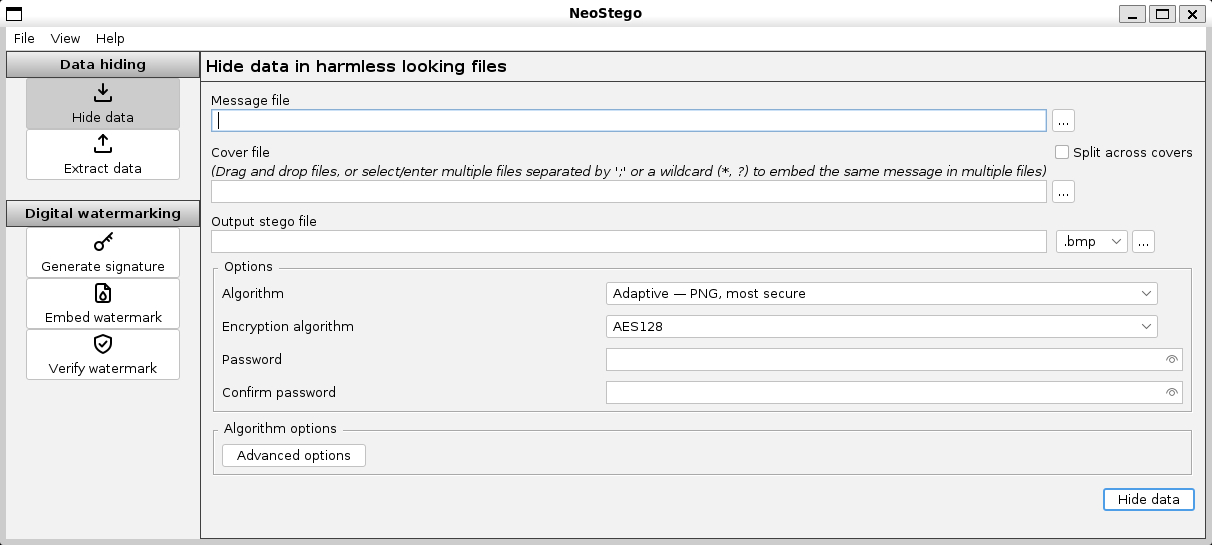
The desktop app (light theme; a dark theme is also included).
Download
Installers bundle their own Java runtime — there's nothing else to install.
¹ Installers are currently unsigned: on macOS right-click → Open the first time; on Windows choose More info → Run anyway if SmartScreen prompts.
Features
- 🔒 Modern encryption — PBKDF2-HMAC-SHA256 (random salt, high iteration count) + AES-GCM authenticated encryption. Older OpenStego data still decrypts automatically.
- 🖼️ Detection-resistant hiding —
RandomLSBMatch (±1 LSB matching) defeats classic statistical steganalysis; Adaptive (HILL + Syndrome-Trellis Codes) concentrates changes in textured regions to resist modern, including CNN-based, detectors.
- 💧 Robust watermarking —
DWTSVD embeds a real multi-bit payload, recovered blindly, that survives JPEG recompression, noise, blur, resampling, brightness changes, and small crops.
- 🎵 Audio support — hide data in uncompressed WAV (PCM) files.
- 🎨 More formats — read PNG/BMP/WebP covers, preserve embedded ICC color profiles, choose JPEG quality for watermarking.
- 🧵 Split across covers — spread one payload across multiple cover images when a single one isn't big enough, reassembled automatically on reveal.
- 🖥️ Native desktop UX — FlatLaf light/dark themes, native OS file dialogs, drag-and-drop, password reveal.
- 📱 Android app — a Kotlin / Jetpack Compose client sharing the same core engine.
- 🧩 Full CLI — scriptable
embed / extract / watermarking commands.
- 🌐 Multilingual — English, Simplified Chinese, and Japanese UI, with an in-app language switcher.
> [!NOTE]
> Steganography hides data; it isn't magic invisibility. NeoStego raises the bar against detection
> but does not make embedding undetectable. See How it works for the honest details.
How it works
Each algorithm, the steganalysis benchmarks (BOSSbase / StegExpose / SRM / CNN), the watermark
robustness results, and the full academic citations are documented in
docs/ALGORITHMS.md.
Compatibility with OpenStego
The on-disk steganography format is unchanged, so files created by older OpenStego versions remain
readable, and unencrypted NeoStego output round-trips with upstream OpenStego (regression tests
enforce this). The one exception: newly encrypted output uses AES-GCM and is not readable by
stock OpenStego — pass --legacyencrypt (CLI) to write the original format when you need interop.
Usage
GUI — launch from the installed app's menu shortcut, or run the bundled neostego launcher from
the portable zip.
CLI — every function is scriptable:
neostego --help                  # list commands and options
neostego algorithms              # list available steganography algorithms
neostego embed   -mf secret.txt -cf cover.png -sf out.png -p
neostego extract -sf out.png -xd ./out -p
Commands: embed, extract, gensig, embedmark, checkmark, algorithms, readformats, writeformats.
Building from source
Requires JDK 21. Common tasks:
./gradlew :desktop:jpackage      # native installer for the current OS (bundles a runtime)
./gradlew :desktop:distBin       # portable zip (needs a system Java to run)
./gradlew :android:assembleRelease   # Android APK (needs the Android SDK)
./gradlew test                   # run the test suite
The desktop installer task uses the OS it runs on (an MSI via WiX on Windows, dmg on macOS, deb/rpm
on Linux); CI builds all of them on a tag. The Android release build signs the APK when an
android/keystore.properties is present, and builds unsigned otherwise.
Limitations
- Save and share losslessly. Hidden data lives in least-significant bits, so stego output must
stay lossless (PNG for images, uncompressed WAV for audio). Re-encoding as JPEG/MP3 — including the
recompression chat apps apply to "photos" — destroys the payload. Share as a file, not a photo.
- Capacity scales with the cover. Roughly one payload byte per ~3 image pixels (or ~8 audio
samples); oversized payloads fail fast with a clear message. The content-adaptive algorithm trades
capacity for security and holds less than plain LSB. The app shows usable capacity once a cover is selected.
- Transparency is preserved, not used. Alpha channels survive the round-trip; data is hidden only
in RGB channels.
Contributing
Issues and pull requests are welcome. The project is split into core (platform-independent
algorithms, crypto, plugin SPI), desktop (Swing GUI + CLI), and android (Compose app). Run
./gradlew test before submitting.
Optionally enable the local pre-push hook so a formatting slip can't reach CI:
git config core.hooksPath .githooks
It runs spotlessCheck on push (./gradlew spotlessApply fixes any findings).
License
NeoStego is a modified version of OpenStego, distributed under the GNU General Public License,
version 2 (see LICENSE). Original copyright notices are retained, files changed in this
fork carry modification notices, and the complete corresponding source is this repository.
Acknowledgements
- OpenStego by Samir Vaidya — the project NeoStego is forked from.
- The legacy spread-spectrum DWT watermarking plugins are based on code from Peter Meerwald's
thesis on wavelet-domain watermarking (University of Salzburg, 2001).
- The modern data-hiding and steganalysis algorithms implement methods published by Jessica
Fridrich's DDE Lab at Binghamton University and collaborators.
NeoStego's implementations are independent, clean-room implementations written from the published
papers — no DDE Lab source code is used or derived. Full citations are in
docs/ALGORITHMS.md.
- The F5 plugin's algorithm core and Blake2b PRNG are lifted, near-verbatim, from
Secret Space Encryptor (SSE) by Paranoia Works under the MIT
License (the Blake2b digest is CC0 public domain); the F5 algorithm itself is due to Andreas
Westfeld (2001). Unlike the DDE Lab plugins above, this is licensed reuse rather than clean-room —
see NOTICE for the full attribution and license text.