Fedora Media Writer is a tool that helps users write Fedora images onto USB flash drives. It can automatically download the required image and write it in a dd-like fashion using direct device access. Because this overwrites the drive's partition layout, it also provides a Restore feature to reformat the drive back to a standard single-partition layout when you are done.
Fedora Media Writer runs on Linux, Windows, and macOS.
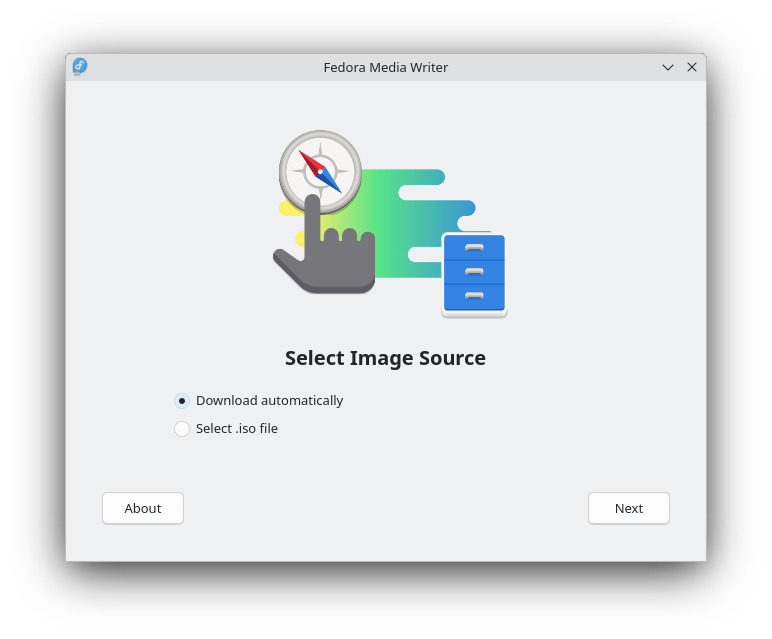
Table of Contents
Building
You can build Fedora Media Writer using the standard Qt cmake build system. For a detailed look at how releases are composed, see the GitHub Actions configuration.
Requirements
| Platform | Dependencies |
|---|
| All | Qt (>=6.10.2) |
| Linux | udisks2 or storaged, xz-libs |
| Windows | xz-libs |
| macOS | xz-libs |
Linux
Specify the install prefix using the -DCMAKE_INSTALL_PREFIX cmake option (default is /usr/local):
cmake [OPTIONS] .
The main binary mediawriter will be installed to $PREFIX/bin and the helper binary to $PREFIX/libexec/mediawriter/helper.
Windows
Building on Windows is a matter of running cmake and make, as long as all dependencies are in your include path.
To create a standalone package, use the windeployqt tool included with your Qt installation. You will likely need to bundle some additional DLLs manually.
It is also possible to cross-compile using the MinGW compiler suite on Fedora and some other distributions.
macOS
Run cmake and make as usual. To create a standalone package, use the macdeployqt tool included with your Qt installation.
Translation
If you want to help translate Fedora Media Writer, please visit our Weblate project page.
Information about the individual Fedora flavors is retrieved from the Fedora websites and translated as a separate project.
Troubleshooting
If you experience any problem with the application, such as crashes or errors when writing to your drive, please open an issue here on GitHub.
Please attach the FedoraMediaWriter.log file from your Documents folder ($HOME/Documents on Linux and macOS, %USERPROFILE%\Documents on Windows). It contains some non-sensitive information about your system and a log of all events during the session.
My flash drive stopped working after writing
We understand how frustrating this can be, especially if it was a drive you relied on. We'd like to help explain what may have happened.
Fedora Media Writer writes the Fedora image sequentially to your drive and then reads it back in full to verify the result — much like a large file copy, just at the raw device level. From the hardware's perspective, there is nothing unusual about this. There are no special commands involved that could instruct a drive to misbehave, and the application has no ability to damage the physical flash memory.
Flash drives do have a limited number of write cycles before the memory naturally wears out, but that limit is typically in the tens of thousands for standard hardware. A single write-and-verify pass uses a tiny fraction of that budget, so ordinary use of Fedora Media Writer will not meaningfully shorten the life of a healthy drive.
If your drive is no longer recognized, here are the most likely explanations:
- The drive is in an inconsistent state. If the write process was interrupted, the drive's partition layout may be left in a state the operating system cannot recognize. This is recoverable — try using Fedora Media Writer's own Restore feature, or use Disk Management on Windows /
fdisk or gparted on Linux to reformat it manually.
- The drive uses low-quality components. Very cheap USB drives are often built with flash memory and controllers that cannot sustain the heat generated by continuous high-speed writing. Fedora Media Writer writes at full speed and then immediately reads the entire drive back to verify — this sustained workload can push such drives beyond what they were designed to handle.
- The drive was already near end of life. Flash memory can fail suddenly once it reaches its limit. If the failure coincided with writing a Fedora image, it is very likely the drive would have failed just the same had you been copying any other large file at the time.
If the drive shows up as read-only or containing no media, the flash memory controller has most likely detected an internal failure. This is a sign that the drive has reached the end of its life and will need to be replaced.
For a more in-depth explanation of how flash drives fail and how to detect a faulty drive, the Rufus FAQ covers this topic in great detail.
Security & Privacy
For details about cryptography, see CRYPTOGRAPHY.md.
For brief privacy information regarding User-Agent strings, see PRIVACY.md.