Bitbucket Command Line Interface
bb is the missing command line interface for Bitbucket. It brings the power of the Bitbucket platform to your command line. Creating and merging Pull Requests, cloning repositories, and more are now just a few keystrokes away.
Installation
Linux
You can grab the latest binary package on the Downloads pages.
On Debian/Ubuntu distributions, you can use my package repository. First download the signing key:
curl -fsSL https://gildas.github.io/apt/gildas-archive-keyring.gpg | \
  sudo tee /usr/share/keyrings/gildas-archive-keyring.gpg >/dev/null
Add this source:
echo "deb [arch=amd64,arm64 signed-by=/usr/share/keyrings/gildas-archive-keyring.gpg] https://gildas.github.io/apt stable main" | sudo tee /etc/apt/sources.list.d/gildas.list
sudo apt update
Then install bb with:
sudo apt install bitbucket-cli
If you use Homebrew, you can install bb with:
brew install gildas/tap/bitbucket-cli
You can also install bb with snap:
sudo snap install bitbucket-cli
sudo snap alias bitbucket-cli bb

After it is installed, you need to connect bb to the Password Manager Service (Secret Service) to store your credentials:
sudo snap connect bitbucket-cli:password-manager-service
macOS
You can get bb from Homebrew with:
brew install gildas/tap/bitbucket-cli
Windows
You can get bb from Chocolatey with:
choco install bitbucket-cli
You can also install bb with scoop:
scoop bucket add gildas https://github.com/gildas/scoop-bucket
scoop install bitbucket-cli
Go
If you have Go installed, you can install bb with:
go install github.com/gildas/bitbucket-cli@latest
mv $GOPATH/bin/bitbucket-cli $GOPATH/bin/bb
This method also allows you to install bb from the development (dev) branch with:
go install github.com/gildas/bitbucket-cli@dev
mv $GOPATH/bin/bitbucket-cli $GOPATH/bin/bb
Binaries
You can download the latest version of bb from the downloads page.
Once you get the bb executable, you can install/copy it anywhere in your $PATH.
Usage
bb is a modern command line interface. It uses subcommands to perform actions. You can get help on any subcommand by running bb --help.
General help is also available by running bb --help or bb help.
By default bb works in the current git repository. You can specify a Bitbucket repository with the --repository flag.
bb recognizes git remotes pointing to bitbucket.org as well as to ssh.bitbucket.org, the new hostname Bitbucket Cloud uses for git over SSH starting November 12, 2026 (for example, git@ssh.bitbucket.org:myworkspace/myrepository.git or ssh://git@ssh.bitbucket.org/myworkspace/myrepository.git).
Many commands and flags are dynamically auto-completed. See the Completion section for more information about completion.
Most delete, upload, and download commands support multiple arguments. You can pass a list of arguments or a file with one argument per line:
bb repo delete myrepository1 myrepository2 myrepository3
You can tell bb to stop on the first error, warn on errors, or ignore errors when processing multiple arguments with the --stop-on-error, --warn-on-error, or --ignore-errors flags.
All commands that would modify something on Bitbucket now allow you to preview the changes before applying them. You can use the --dry-run flag (also known as --noop or --whatif) to see what would happen.
bb repo delete myrepository3 --dry-run
Most commands will support the --workspace and --repository flags to specify the workspace and repository to use. If not provided, the workspace and repository will be determined from the git configuration or the profile configuration (in that order). The workspace and repository can be combined in the --repository flag in the form workspace/repository. For example:
bb repo list --workspace myworkspace
bb pullrequest list --repository myrepository
bb pullrequest list --workspace myworkspace --repository myrepository
bb pullrequest list --repository myworkspace/myrepository
The --workspace flag is also dynamically auto-completed with the workspaces you have access to.
get and list commands support the --columns flag to specify which columns to display in the output. You can pass a comma-separated list of columns, repeat the flag, or use all to display all columns. If you do not provide this flag, the default columns are displayed.
bb repo list --columns all
bb repo list --columns name,slug,project
bb repo list --columns name --columns slug
list commands also support the --sort flag to sort the output by a specific column. You can pass a comma-separated list of columns, repeat the flag, or use all to sort by all columns. If you do not provide this flag, the default sorting is used.
bb repo list --sort name
list commands also support the --query flag to filter the output by a specific query. The query syntax is similar to the one used in the Bitbucket web interface. For example, to filter Pull Requests updated after a specific date:
bb pullrequest list --query 'updated_on > 2025-12-31'
Please refer to the Bitbucket API documentation for more information about the supported query syntax and fields.
list commands also support the --page-length flag to set the number of items to retrieve per request to Bitbucket API at a time. By default, the page length is set on the profile (with --default-page-length) and the default is 50. You can set it to a value between 1 and 100.
bb repo list --page-length 25
You can get more information about what bb is doing with the --verbose flag, and you can display the version of bb with the --version flag.
Output
bb outputs a table by default. You can change the output format with the --output flag, by setting the BB_OUTPUT_FORMAT environment variable, or by modifying the profile configuration (See Profiles).
The following formats are supported:
csv: CSVjson: JSONyaml: YAMLtsv: TSVtable: Table
For example:
bb --output json workspace list
Or
bb workspace list --output json
Changing the format with the environment variable BB_OUTPUT_FORMAT can be done like this:
export BB_OUTPUT_FORMAT=json
bb workspace list
The Table output format displays the data in a human-readable format. Here is an example of the output for the bb pullrequest list command:
$ bb pr list --state all
+----+---------------------------+--------------------------------+---------------------+-------------+----------+
| ID |           TITLE           |          DESCRIPTION           |       SOURCE        | DESTINATION |  STATE   |
+----+---------------------------+--------------------------------+---------------------+-------------+----------+
|  1 | Merge feature/links       | Feature links. Do not delete   | feature/links       | dev         | DECLINED |
|    |                           | the feature branch after the   |                     |             |          |
|    |                           | merge.                         |                     |             |          |
|  2 | Merge feature/links       | Feature links. Do not delete   | feature/links       | dev         | MERGED   |
|    |                           | the feature branch after the   |                     |             |          |
|    |                           | merge.                         |                     |             |          |
|  3 | Merge release/1.0.0       | Feature 1.0.0. Do not delete   | release/1.0.0       | master      | MERGED   |
|    |                           | the feature branch after the   |                     |             |          |
|    |                           | merge.                         |                     |             |          |
|  4 | Merge feature/bb          | Feature bb. Do not delete the  | feature/bb          | dev         | DECLINED |
|    |                           | feature branch after the merge |                     |             |          |
|  5 | Merge feature/bb          | Feature bb. Do not delete the  | feature/bb          | dev         | MERGED   |
|    |                           | feature branch after the merge |                     |             |          |
|  6 | Merge feature/bb-doc      | Feature bb-doc. Do not delete  | feature/bb-doc      | dev         | MERGED   |
|    |                           | the feature branch after the   |                     |             |          |
|    |                           | merge.                         |                     |             |          |
+----+---------------------------+--------------------------------+---------------------+-------------+----------+
Profiles
Setting up OAUTH 2.0
To add an OAuth 2.0 profile, you need to create an OAuth consumer on Bitbucket. First, go to the settings page of the Bitbucket workspace you want a consumer for (where xxxx is the workspace name/ID). On that page, click on the OAuth clients link in the Apps and features section. Then click on the Create OAuth client button. Fill in the form.
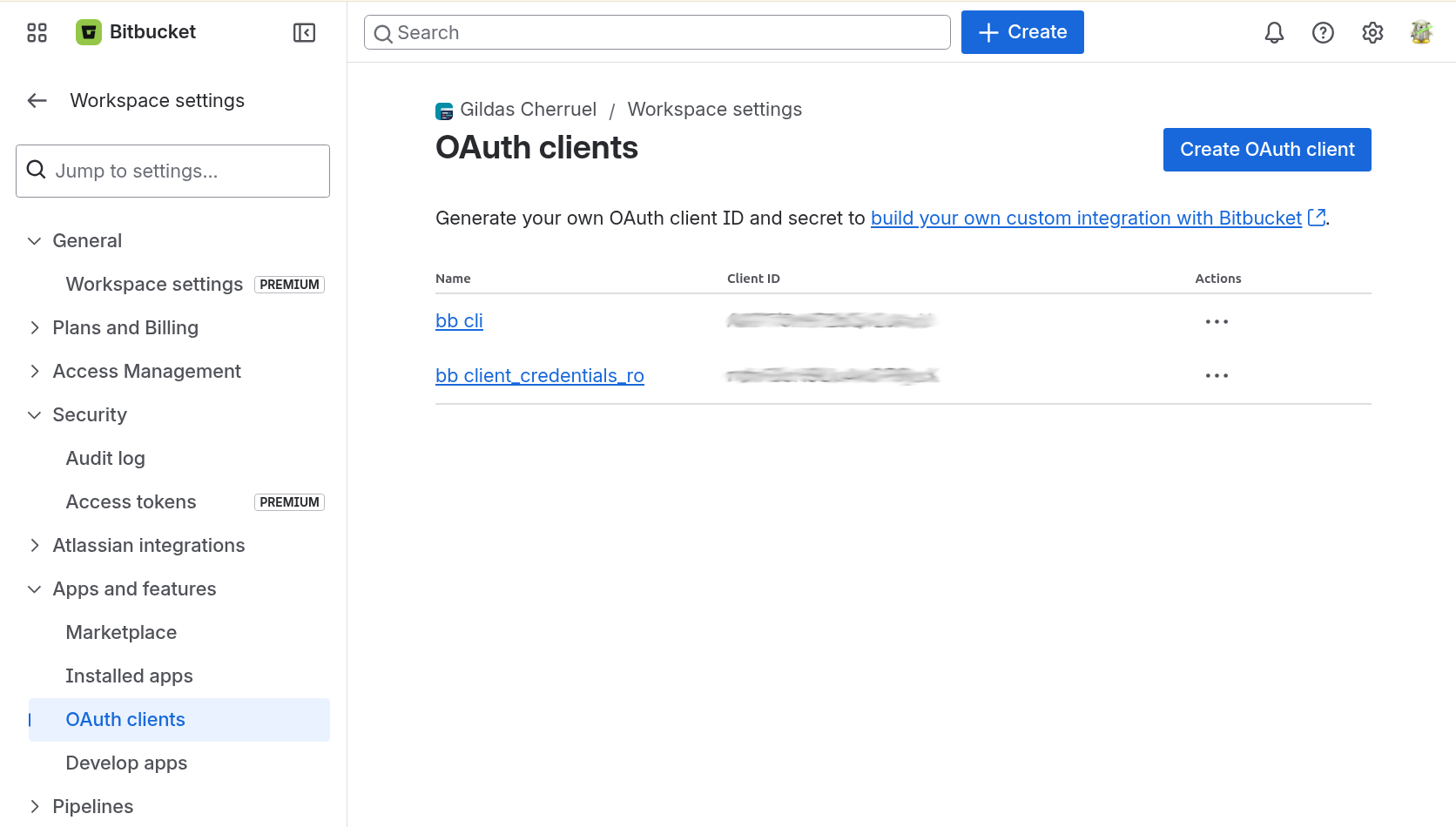
To use an OAuth 2.0 with Authorization Code Grant, you will need to fill in the Callback URL with a link like (where yyyy is the port you want to use and provide to the --callback-port flag of bb profile create) and do not enable the check box for This is a private consumer.
To use an OAuth 2.0 with Client Credentials, you will need to enable the check box for This is a private consumer and add a dummy Callback URL.
In both cases, you will need to fill in the permissions you want to grant to the consumer.
Once you hit the Save button, your OAuth consumer will be created and you can use the credentials (client identifier and secret) provided to configure your profile with bb.
Managing Profiles
bb uses profiles to store your Bitbucket credentials. You can create a profile with the bb profile create command:
bb profile create \
  --name              myprofile \
  --default-workspace myworkspace \
  --client-id          \
  --client-secret      \
  --callback-port     8080
You should define the default workspace for the profile with the --default-workspace flag. This will allow you to use bb without specifying the workspace every time.
You can also pass the --default flag to make this profile the default one, or pass a --output flag to change the profile output format. If you use only one profile, it will be used as the default profile.
You can also pass the --default-project flag to set the default project for this profile.
You can also pass the --default-ssh-key-file flag to set the default SSH key file to use when cloning repositories with the ssh protocol.
You can also pass the --progress flag to display a progress bar when upload/downloading artifacts and attachments.
You can also pass the --default-page-length flag to set the number of items retrieved per request by list commands (between 1 and 100, default is 50).
You can also pass the --error-processing flag to set how errors are handled when processing multiple arguments. The supported values are StopOnError (default), WarnOnError, and IgnoreErrors. This can be overridden with the --stop-on-error, --warn-on-error, or --ignore-errors flags.
You can also pass the --description flag to add a description to the profile.
By default, the password or client secret is stored in the vault of the operating system (Windows Credential Manager, macOS Keychain, or Linux Secret Service). You can pass the --no-vault flag to disable this feature and store the password or client secret in plain text in the configuration file. This is not recommended, but can be useful for testing purposes.
Once the profile is created in bb, for an OAuth 2.0 with Authorization Code Grant, you will need to authorize the profile with the following command:
bb profile authorize myprofile
You can also use the --verbose to get some information about the authorization process.
Profiles support the following authentications:
Permission Scopes:
When you use a user/password, the password is stored in the vault of the operating system (Windows Credential Manager, macOS Keychain, or Linux Secret Service). You can pass the --no-vault flag to disable this feature and store the password in plain text in the configuration file. This is not recommended, but can be useful for testing purposes. On Linux and macOS, you can also pass the --vault-key flag to set the key to use in the system keychain. By default, the key is bitbucket-cli. On Windows, this option is not available.
You can also pass the --clone-protocol flag to set the default protocol to use when cloning repositories. The supported protocols are https, git, and ssh. This option can be overridden with the --protocol flag when using repo clone.
In case you are not using a user/password, you can also pass a --clone-user flag to set the username to use when cloning repositories with the https protocol. If you use a user/password, you don't need to set this flag, usually, as the username will be used for cloning repositories. This option can be overridden with the --user flag when using repo clone.
You can get the list of your profiles with the bb profile list command:
bb profile list
You can get the details of a profile with the bb profile get or bb profile show command:
bb profile get myprofile
By default, the profile details will not show the password client secret, or access token. You can use the --show-secrets flag to display them:
bb profile get myprofile --show-secrets
bb profile list --show-secrets
You can get the details of the current profile:
bb profile get --current
Or:
bb profile which
You can update a profile with the bb profile update command:
bb profile update myprofile \
  --client-id  \
  --client-secret
If the profile was not using the vault to store the credentials and you update it with new credentials, the updated profile will keep using plain text to store the credentials. If the profile was using the vault and you update it with new credentials, the updated profile will keep using the vault to store the credentials.
You can move the profile credentials to the vault with the bb profile update:
bb profile update myprofile --to-vault
During that process, you cannot change the credentials. But you can specify the vault key for non Windows OS with the --vault-key flag:
bb profile update myprofile --to-vault --vault-key my-vault-key
The default vault key is bitbucket-cli.
You can delete a profile with the bb profile delete command:
bb profile delete myprofile
You can delete all profiles with the --all flag:
bb profile delete --all
You can set the default profile with the bb profile use command:
bb profile use myprofile
You can also set the profile with the environment variable BB_PROFILE:
export BB_PROFILE=myprofile
The profile can also come from your current .git/config file. You can set the bb.profile variable in the [bitbucket "cli"] section of your .git/config file:
[bitbucket "cli"]
  profile = myprofile
git config --local bitbucket.cli.profile myprofile
The current profile comes in order from:
- the
--profile flag
- the
BB_PROFILE environment variable
- the
profile variable in the [bitbucket "cli"] section of your .git/config file,
if the profile does not exist, the command will print a warning and use the default profile
- the profile marked
default in the configuration file
- the first profile in the configuration file
Profiles are stored in the configuration file (YAML format). By default, the configuration file is located:
- on Linux:
$XDG_CONFIG_HOME/bitbucket/config-cli.yml, or ~/.config/bitbucket/config-cli.yml
- on macOS:
$HOME/Library/Application Support/bitbucket/config-cli.yml
- on Windows:
%AppData%\bitbucket\config-cli.yml
- on Plan 9:
$home/lib/bitbucket/config-cli.yml
If the user configuration folder cannot be determined, ~/.bitbucket-cli is used instead.
You can also override the location of the configuration file with the environment variable BB_CONFIG or the --config flag:
export BB_CONFIG=~/.bb/config.json
bb --config ~/.bb/config.json workspace list
Users
You can get the details of your user with the bb user me command:
bb user me
You can get the email addresses of your user with the --emails flag:
bb user me --emails
You can get the details of a user with the bb user get or bb user show command:
bb user get {UUID}
Or,
bb user get UUID
Workspaces
You can list workspaces with the bb workspace list command:
bb workspace list
You can also get the details of a workspace with the bb workspace get or bb workspace show command:
bb workspace get myworkspace
Additionally, you can get the members of a workspace with the flag --members:
bb workspace get myworkspace --members
Or, even, a specific member with the flag --member:
bb workspace get myworkspace --member mymember
You can get your permission in a workspace with the bb workspace permission get command:
bb workspace permission get myworkspace
You can list all user permissions in a workspace with the bb workspace permission list command:
bb workspace permission list myworkspace
Projects
You can list projects with the bb project list command:
bb project list
You can also get the details of a project with the bb project get or bb project show command:
bb project get myproject
You can create a project with the bb project create command:
bb project create \
  --name myproject \
  --key MYPROJECT
You can also set the project's description, visibility, and avatar with the --description, --is-private, and --avatar-file (or --avatar-url) flags.
You can update a project with the bb project update command:
bb project update myproject \
  --name myproject
You can delete a project with the bb project delete command:
bb project delete myproject
Project Default Reviewers
You can list the default reviewers of a project with the bb project reviewer list command. Similarly to the --workspace, if the --project flag is not provided, the default project of the workspace is used (if the workspace does not have a default project, the command will fail):
bb project reviewer list --workspace myworkspace --project myproject
bb project reviewer list --project myproject
bb project reviewer list
You can add a default reviewer to a project with the bb project reviewer add command:
bb project reviewer add userUUID
The {} around the userUUID are optional.
You can remove a default reviewer from a project with the bb project reviewer delete or bb project reviewer remove command:
bb project reviewer remove userUUID
You can get the details of a default reviewer with the bb project reviewer get or bb project reviewer show command:
bb project reviewer get --project myproject userUUID
Repositories
You can list repositories with the bb repo list command:
bb repo list --workspace myworkspace
If you do not provide a workspace, the command will attempt to list all repositories you have access to, which can take a very long time.
You can narrow down the list of repositories with the --role, --project, --project-key, --has-issues, --has-wiki, --is-private, --language, and --main-branch flags:
bb repo list \
  --workspace myworkspace \
  --role        owner \
  --project     myproject \
  --has-issues  true \
  --has-wiki    true \
  --is-private  false \
  --language    go \
  --main-branch master
All filterers are optional and combined with an AND operator.
You can also get the details of a repository with the bb repo get or bb repo show command:
bb repo get myrepository
You can clone a repository with the bb repo clone command:
bb repo clone myworkspace/myrepository
Or, with the --workspace flag:
bb repo clone --workspace myworkspace myrepository
Or, using the profile's default workspace:
bb repo clone myrepository
By default, the repository is cloned in a folder with the same name as the repository. You can specify a different folder with the --destination flag:
bb repo clone --workspace myworkspace --destination myfolder myrepository
You can clone a bare repository with the --bare flag.
The repository uses the active profile's clone protocol when one is configured and otherwise falls back to git. You can override it for this clone with the --protocol flag. The supported protocols are https, git, and ssh. The profile default can be set with the --clone-protocol flag when creating or updating a profile.
The git and ssh protocols clone from ssh.bitbucket.org (git@ssh.bitbucket.org:myworkspace/myrepository.git and ssh://git@ssh.bitbucket.org/myworkspace/myrepository.git), while the https protocol clones from https://bitbucket.org/myworkspace/myrepository.git. With the git protocol, authentication is done by your SSH agent.
Note: With the git and ssh protocols, the host key of ssh.bitbucket.org is verified against your ~/.ssh/known_hosts file. If that file only knows about bitbucket.org, the clone may fail with a host key error. Connect once to the new hostname with ssh to add it, after checking the fingerprint against the ones published in the Bitbucket Cloud documentation:
ssh -T git@ssh.bitbucket.org
bb repo clone --protocol https myrepository
When using the ssh protocol, you can also specify the SSH key to use with the --ssh-key-file flag. If not provided, the key set in the profile (--default-ssh-key-file) is used, and if nothing is configured: ~/.ssh/id_rsa:
bb repo clone --protocol ssh --ssh-key-file /path/to/ssh/key myrepository
When using the https protocol while cloning a private repository, you can specify the username to use for authentication with the --user flag. If the username is not provided, the cloneUser from the profile is used. If the profile does not have a cloneUser, you cannot clone a private repository with the https protocol.
bb repo clone --protocol https --user myusername myrepository
For authenticated HTTPS clones, bb invokes your system git with the username from --user, the profile's cloneUser, or the profile's user, in that order. Configure Git's credential helper to supply the password or token. The profile's --vault-key controls storage of API credentials, not credentials used by git clone. If not set, the default value is bitbucket-cli.
On Linux and macOS, the system keychain will be used to retrieve the credentials. On Windows, the Windows Credential Manager will be used to retrieve the credentials. And the username should be : or :.
You can create a repository with the bb repo create command:
bb repo create myrepository_slug \
  --name      myrepository \
  --project   myproject \
  --workspace myworkspace
If the --project flag is not provided, the repository will be created in the default project of the profile.
You can also set the repository's visibility (--private or --public), --description, --language, --main-branch, and --fork-policy (default is no_public_forks). These flags are also available with bb repo update and bb repo fork.
You can update a repository with the bb repo update command:
bb repo update myrepository \
  --private \
  --fork-policy no_public_forks
You can delete a repository with the bb repo delete command:
bb repo delete myrepository
You can fork a repository with the bb repo fork command:
bb repo fork myrepository \
  --workspace myworkspace \
  --project   myproject \
  --name      myfork
You can list the forks of a repository with the bb repo get --forks command:
bb repo get myrepository --forks
Branches
You can list branches with the bb branch list command:
bb branch list
Commits
You can list commits with the bb commit list command:
bb commit list
You can restrict the list to commits reachable from some branches or commits, and not reachable from others, with the --include and --exclude flags (they can be repeated or comma-separated):
bb commit list --include mybranch --exclude master
You can get the details of a commit with the bb commit get or bb commit show command:
bb commit get 123456
While the completion for commit hashes works, it can be a bit slow if there are a lot of commits in the repository. If you know the first few characters of the commit hash, it will be much faster to complete. You also do not need to enter the full commit hash, the first 7 characters are usually enough to identify a commit. But less can be enough if there are not many commits in the repository.
You can get the difference between two commits with the bb commit diff command:
bb commit diff 123456 654321
If you provide only one commit, the difference will be between that commit and its parent:
bb commit diff 123456
If you want to get the diffstat of a commit, you can use the --stat flag:
bb commit diff --stat 123456
You can get the common ancestor of two commits with the bb commit ancestor command:
bb commit ancestor 123456 654321
You can also get the patch between two commits with the bb commit patch command:
bb commit patch 123456 654321
You can list tags with the bb tag list command:
bb tag list
You can get the details of a tag with the bb tag get or bb tag show command:
bb tag get v1.0.0
You can create a tag with the bb tag create command:
bb tag create \
  --name    v1.0.0 \
  --message "My tag message" \
  --commit  123456
By default, the target of the tag is the latest commit on the default branch.
You can delete tags with the bb tag delete command:
bb tag delete v1.0.0
Pull Requests
You can list pull requests with the bb pullrequest list command:
bb pullrequest list
You can get the list of pull requests for a given commit hash (it must be the full hash) with the --commit flag:
bb pullrequest list --commit ae86d5323477989fab3bf3879cd1234543565753
You can create a pull request with the bb pullrequest create command:
bb pullrequest create \
  --title "My pull request" \
  --source "my-branch" \
  --destination "master"
You can add reviewers to the pull request with the --reviewer flag:
bb pullrequest create \
  --title "My pull request" \
  --source "my-branch" \
  --destination "master" \
  --reviewer    username1 --reviewer {userUUID2}
If the first reviewer is default, the command will try to get the default reviewers from the repository or project settings.
You can also set the description of the pull request with the --description flag, create it as a draft with the --draft flag, and close the source branch after the merge with the --close-source-branch flag.
You can get the details of a pull request with the bb pullrequest get or bb pullrequest show command:
bb pullrequest get 1
You can also modify a pull request with the bb pullrequest update command:
bb pullrequest update 1 \
  --title "My pull request" \
  --description "My pull request description"
To add or remove reviewers from a pull request, you can use the --add-reviewer and --remove-reviewer flags:
bb pullrequest update 1 \
  --add-reviewer    username1 --add-reviewer {userUUID2} \
  --remove-reviewer username3 --remove-reviewer {userUUID4}
You can approveor unapprove a pull request with the bb pullrequest approve or bb pullrequest unapprove command:
bb pullrequest approve 1
If no pull request is provided, the command will try to approve the opened pull request with the current branch.
You can decline a pull request with the bb pullrequest decline command:
bb pullrequest decline 1
If no pull request is provided, the command will try to decline the opened pull request with the current branch.
You can merge a pull request with the bb pullrequest merge command:
bb pullrequest merge 1
If no pull request is provided, the command will try to merge the opened pull request with the current branch.
You can choose the merge strategy with the --merge-strategy flag (merge_commit (default), squash, or fast_forward), set the merge commit message with the --message flag, and close the source branch with the --close-source-branch flag:
bb pullrequest merge 1 --merge-strategy squash --message "My merge" --close-source-branch
You can also merge the pull request asynchronously with the --async flag:
bb pullrequest merge 1 --async
In that case, you will receive a merge task ID in return, and you can check the status of the merge task with the bb pullrequest merge-status command:
bb pullrequest merge-status 1 --task-id 6a0ddb61-40cf-4224-b9e8-bbb5852c66ba
If no pull request is provided, the command will try to request the merge status of the opened pull request with the current branch.
You can request changes on a pull request with the bb pullrequest request-changes command:
bb pullrequest request-changes 1
If no pull request is provided, the command will try to request changes on the opened pull request with the current branch.
To remove the request for changes, you can use the bb pullrequest remove-request-changes command:
bb pullrequest remove-request-changes 1
If no pull request is provided, the command will try to remove the request for changes on the opened pull request with the current branch.
You can see the activities of a pull request with the bb pullrequest activities command:
bb pullrequest activities 1
If no pull request is provided, the command will try to list the activities of the opened pull request with the current branch.
You can list the commits of a pull request with the bb pullrequest commits command:
bb pullrequest commits 1
If no pull request is provided, the command will try to list the commits of the opened pull request with the current branch.
You can see the diff of a pull request with the bb pullrequest diff command:
bb pullrequest diff 1
If no pull request is provided, the command will try to show the diff of the opened pull request with the current branch.
You can get the diffstat of a pull request with the bb pullrequest diff --stat command:
bb pullrequest diff --stat 1
If no pull request is provided, the command will try to show the diffstat of the opened pull request with the current branch.
You can also get the patch of a pull request with the bb pullrequest patch command:
bb pullrequest patch 1
If no pull request is provided, the command will try to show the patch of the opened pull request with the current branch.
You can list the comments of a pull request with the bb pullrequest comment list command:
bb pullrequest comment list --pullrequest 1
You can add a comment to a pull request with the bb pullrequest comment create or bb pullrequest comment add command:
bb pullrequest comment add --pullrequest 1 \
  --comment "My comment" \
  --file    README.md \
  --line    404
You can comment on a range of lines with the --from and --to flags (instead of --line), reply to an existing comment with the --parent flag, and mark the comment as pending (i.e. part of a review not yet published) with the --pending flag:
bb pullrequest comment add --pullrequest 1 \
  --comment "My reply" \
  --parent  452466
You can resolve a comment with the bb pullrequest comment resolve command:
bb pullrequest comment resolve --pullrequest 1 452466
You can re-open a comment with the bb pullrequest comment reopen command:
bb pullrequest comment reopen --pullrequest 1 452466
You can get the details of a comment with the bb pullrequest comment get or bb pullrequest comment show command:
bb pullrequest comment get --pullrequest 1 452466
You can update a comment with the bb pullrequest comment update command:
bb pullrequest comment update --pullrequest 1 452466 \
  --comment "My comment"
You can delete a comment with the bb pullrequest comment delete command:
bb pullrequest comment delete --pullrequest 1 452466
Pull Request Tasks
You can list the tasks of a pull request with the bb pullrequest task list command:
bb pullrequest task list --pullrequest 1
You can add a task to a pull request with the bb pullrequest task create or bb pullrequest task add command:
bb pullrequest task create --pullrequest 1 \
  --content "My task"
You can reference a comment in a task with the --comment flag:
bb pullrequest task create --pullrequest 1 \
  --content "My task" \
  --comment 452466
You can also mark the task as pending with the --pending flag.
You can get the details of a task with the bb pullrequest task get or bb pullrequest task show command:
bb pullrequest task get --pullrequest 1 7643545
You can complete a task with the bb pullrequest task update command:
bb pullrequest task update --pullrequest 1 7643545 \
  --state RESOLVED
You can also re-open a task with the same command:
bb pullrequest task update --pullrequest 1 7643545 \
  --state UNRESOLVED
The same command can change the content of the task with the --content flag.
You can delete a task with the bb pullrequest task delete command:
bb pullrequest task delete --pullrequest 1 7643545
Issues
You can list issues with the bb issue list command:
bb issue list
By default, all open and new issues are listed. You can use the --state flag to filter the issues by state:
bb issue list --state open
The flag --state can be used multiple times to filter by multiple states:
bb issue list --state open --state new --state resolved,wontfix
You can create an issue with the bb issue create command:
bb issue create \
  --title       "My issue" \
  --description "My issue description" \
  --kind        bug  \
  --priority    major
You must also set the kind of the issue with the --kind flag (bug (default), enhancement, proposal, or task), its priority with the --priority flag (trivial, minor, major (default), critical, or blocker), and, optionally, its assignee with the --assignee flag (myself or a user ID).
You can get the details of an issue with the bb issue get or bb issue show command:
bb issue get 1
You can see the history of changes of an issue with the --changes flag:
bb issue get 1 --changes
You can update an issue with the bb issue update command:
bb issue update 1 \
  --title       "My issue" \
  --description "My issue description"
The --kind, --priority, and --assignee flags are also available, as well as the --version flag to set the version (by name) the issue belongs to.
You can delete an issue with the bb issue delete command:
bb issue delete 1
You can vote for an issue with the bb issue vote command:
bb issue vote 1
You can unvote for an issue with the bb issue unvote command:
bb issue unvote 1
You can watch an issue with the bb issue watch command:
bb issue watch 1
You can check if you are watching an issue with the --check flag:
bb issue watch 1 --check
You can unwatch an issue with the bb issue unwatch command:
bb issue unwatch 1
You can list the comments of an issue with the bb issue comment list command:
bb issue comment list --issue 1
You can add a comment to an issue with the bb issue comment create or bb issue comment add command:
bb issue comment add --issue 1 \
  --comment "My comment"
You can get the details of a comment with the bb issue comment get or bb issue comment show command:
bb issue comment get --issue 1 7643545
You can update a comment with the bb issue comment update command:
bb issue comment update --issue 1 7643545 \
  --comment "My comment"
You can delete a comment with the bb issue comment delete command:
bb issue comment delete --issue 1 7643545
You can list the attachments of an issue with the bb issue attachment list command:
bb issue attachment list --issue 1
You can upload an attachment to an issue with the bb issue attachment upload command:
bb issue attachment upload --issue 1 myattachment.zip
You can download an attachment with the bb issue attachment download command:
bb issue attachment download --issue 1 myattachment.zip
You can delete an attachment with the bb issue attachment delete command:
bb issue attachment delete --issue 1 myattachment.zip
Components
You can list the issue tracker components of a repository with the bb component list command:
bb component list
You can get the details of a component with the bb component get or bb component show command:
bb component get 123456
Artifacts (Downloads)
You can list artifacts with the bb artifact list command:
bb artifact list
By default the current repository is used, you can specify a repository with the --repository flag.
You can also upload an artifact with the bb artifact upload command:
bb artifact upload myartifact.zip
At the moment, only one file at a time is supported (no folders or stdin). The artifact name is the file name.
You can download an artifact with the bb artifact download command:
bb artifact download myartifact.zip
You can provide a --destination flag to specify the destination folder. If the folder does not exist, it will be created.
You can also pass the --progress flag to display a progress bar when upload/downloading artifacts. This override the default value set at the Profile level.
Finally, you can delete an artifact with the bb artifact delete command:
bb artifact delete myartifact.zip
Pipelines
You can list pipelines with the bb pipeline list command:
bb pipeline list
By default the current repository is used, you can specify a repository with the --repository flag.
If there are too many pipelines and bb pipeline list seems to hang, you can use the --limit flag to set the maximum number of pipelines to retrieve. By default, the limit is set to 0, which means no limit.
You can get the details of a pipeline with the bb pipeline get or bb pipeline show command:
bb pipeline get 123456
You can start a pipeline with the bb pipeline trigger command:
bb pipeline trigger --branch master --variable KEY1=VALUE1 --variable KEY2=VALUE2
By default, the pipeline is started on the current branch. You can also specify a tag or a commit with the --tag or --commit flags instead of a branch.
You can also use the --pattern flag to specify the pipeline definition to use when triggering the pipeline.
You can stop a running pipeline with the bb pipeline stop command:
bb pipeline stop 123456
You can get the list of the steps of a pipeline with the bb pipeline step list command:
bb pipeline step list --pipeline 123456
With the --show-logs-command flag, the command to get the logs of each step is also displayed (this flag is also available with bb pipeline step get).
You can get the details of a step with the bb pipeline step get or bb pipeline step show command:
bb pipeline step get --pipeline 123456 {stepUUID}
You can get the logs of a step with the bb pipeline step logs command:
bb pipeline step logs --pipeline 123456 {stepUUID}
You can display the report of a step with the bb pipeline step report command:
bb pipeline step report --pipeline 123456 {stepUUID}
You can list the test cases of a step with the bb pipeline step cases command:
bb pipeline step cases --pipeline 123456 {stepUUID}
Steps must be given by their UUID, which you can find with bb pipeline step list --pipeline .
GPG Keys
You can list GPG keys with the bb gpg-key list (or bb key list) command:
bb gpg-key list
By default, the keys are listed for the current user. You can specify a user with the --user flag.
You can also get the details of a GPG key with the bb gpg-key get or bb gpg-key show command:
bb gpg-key get
By default, the key is retrieved for the current user. You can specify a user with the --user flag.
You can create a GPG key with the bb gpg-key create command:
bb gpg-key create \
  --user  \
  --name  \
  --key
The key name is optional. You can also provide the key in a file with the --key-file flag. If the filename is -, the key is read from stdin.
If the --user flag is not provided, the key is created for the user associated with the current profile. If it is provided, it must be the UUID of the user, not the username.
You can delete one or more GPG keys with the bb gpg-key delete command:
bb gpg-key delete
SSH Keys
You can list SSH keys with the bb ssh-key list command:
bb ssh-key list
By default, the keys are listed for the current user. You can specify a user with the --user flag.
You can also get the details of an SSH key with the bb ssh-key get or bb ssh-key show command:
bb ssh-key get
By default, the key is retrieved for the current user. You can specify a user with the --user flag.
You can create an SSH key with the bb ssh-key create command:
bb ssh-key create \
  --user  \
  --name  \
  --key
The key name is optional. You can also provide the key in a file with the --key-file flag. If the filename is -, the key is read from stdin. You can set an expiration date for the key with the --expires-on flag (RFC3339 format, e.g. 2027-01-01T00:00:00Z).
If the --user flag is not provided, the key is created for the user associated with the current profile. If it is provided, it must be the UUID of the user, not the username.
You can delete one or more SSH keys with the bb ssh-key delete command:
bb ssh-key delete
Cache
The bitbucket-cli caches some data to speed up the commands. The following items are cached:
- workspaces
- repositories
- users
The cache is stored in the os.UserCacheDir directory, under bitbucket. The values are stored for a duration of 5 minutes, you can override this value with the environment variable BITBUCKET_CLI_CACHE_DURATION (for the format please follow core.ParseDuration). By default, the items are stored as JSON files unencrypted. To encrypt these files, you can set the environment variable BITBUCKET_CLI_CACHE_ENCRYPTIONKEY with an AES-256 key. The key must follow the crypto/aes requirements.
You can clear the cache with the bb cache clear command:
bb cache clear
Completion
bb supports completion for Bash, fish, Powershell, and zsh.
Bash
To enable completion, run the following command:
source <(bb completion bash)
You can also add this line to your ~/.bashrc file to enable completion for every new shell, or save the completion script in your bash-completion folder:
bb completion bash > ~/.local/share/bash-completion/completions/bb
fish
To enable completion, run the following command:
bb completion fish | source
You can also add this line to your ~/.config/fish/config.fish file to enable completion for every new shell, or save the completion script in your fish completions folder:
bb completion fish > ~/.config/fish/completions/bb.fish
Powershell
To enable completion, run the following command:
bb completion powershell | Out-String | Invoke-Expression
You can also add the output of the above command to your $PROFILE file to enable completion for every new shell.
zsh
To enable completion, run the following command:
source <(bb completion zsh)
You can also save the completion script in your functions folder to enable completion for every new shell.
bb completion zsh > "${fpath[1]}/_bb"
On macOS, you can add the completion to the brew functions:
bb completion zsh > "$(brew --prefix)/share/zsh/site-functions/_bb"
Obtaining logs for debugging
If you encounter an issue with bb, you can obtain logs to help with debugging.
You can instruct bb to log its activity by using the --log flag:
bb --log tmp/bb.log workspace list
or with the environment variable LOG_DESTINATION:
LOG_DESTINATION=tmp/bb.log bb workspace list
bb will create the log file as needed (but it will not create the parent directories). By default, the log level is set to info, but you can set it to debug to get more detailed logs:
LOG_LEVEL=DEBUG bb --log tmp/bb.log workspace list
Or, with the --debug flag:
bb --log tmp/bb.log --debug workspace list
You can also set these environment variables in a .env file in the current directory, and bb will automatically load them:
LOG_DESTINATION=tmp/bb.log
LOG_LEVEL=DEBUG
If you set the log level to DEBUG or more, bb will also log the source of the log message (file and line number, function name).
bb will write log messages following the format in gildas/go-logger. You can find some extra information about the log configuration in the documentation of that package. You can use gildas/lv or The Bunyan log viewer to view the logs in a human readable format.
Notes:
bb tries hard to not log sensitive information, but be careful when sharing the logs, and make sure to remove any sensitive information before sharing them. You can open an issue if you feel like bb is logging sensitive information it should not. (We will do our best to fix it as soon as possible)- If you set the log level to
TRACE, the logs will contain the full HTTP requests and responses, including headers and body. This can be useful for debugging, but it can also contain sensitive information, so be careful when sharing these logs.
- When sending the logs to our team, please send the JSON version, not the pretty printed version, as it will be easier to analyze.
TODO
We will add more commands in the future. If you have any suggestions, please open an issue.
We are in the process of adding support for Bitbucket Server/Data Center. (Issue #65, Branch feature/Issue-#65-Datacenter)
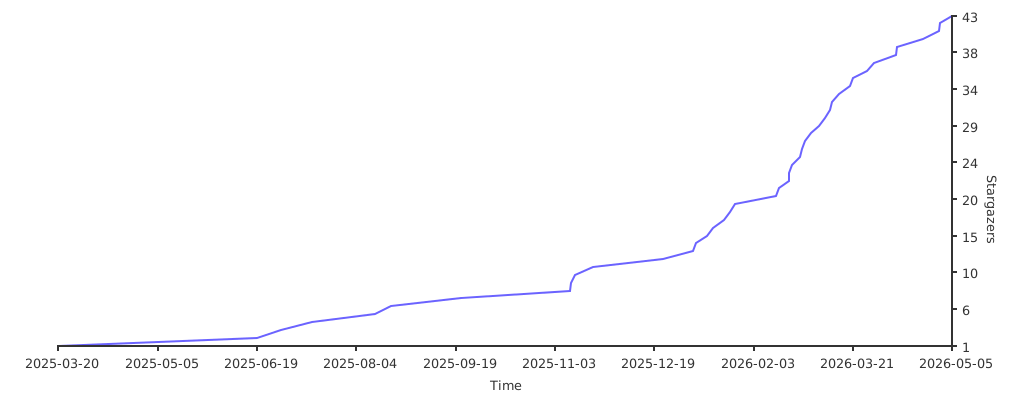
Stargazers over time