LoopTroop
> A smart local engine that automates big coding tasks from start to finish.
> LLM councils plan it. Ralph loops perfect it. OpenCode worktrees ship it.
LoopTroop helps you turn a coding ticket into a planned, reviewable, agent-executed pull request.
Instead of trusting a single, endless AI chat session, where the conversation history gets bloated, the AI gets confused, and code quality falls off a cliff, LoopTroop breaks the job into clean, separate stages. Planning turns an interview into a PRD, which is then split into the smallest manageable milestones, called "beads." Execution runs each bead through multiple targeted auto-fix loops. A final review ties it all together.
| Architectural Layer | Core | Technical Lifecycle |
|---|
| 1. Planning | LLM Councils Plan It | Human Input ➔ AI Interview ➔ PRD ➔ Atomic Beads |
| 2. Execution | Ralph Loops Perfect It | Isolated Bead Work ➔ Multi-Loop Automated Testing & Fixing |
| 3. Shipping | OpenCode Worktrees Ship It | Code Isolation ➔ Final Verification Pass ➔ Main Branch Handoff |
Start here: Docs | Getting Started | Ticket Lifecycle Screenshots | LLM Council | Context Engineering | Execution
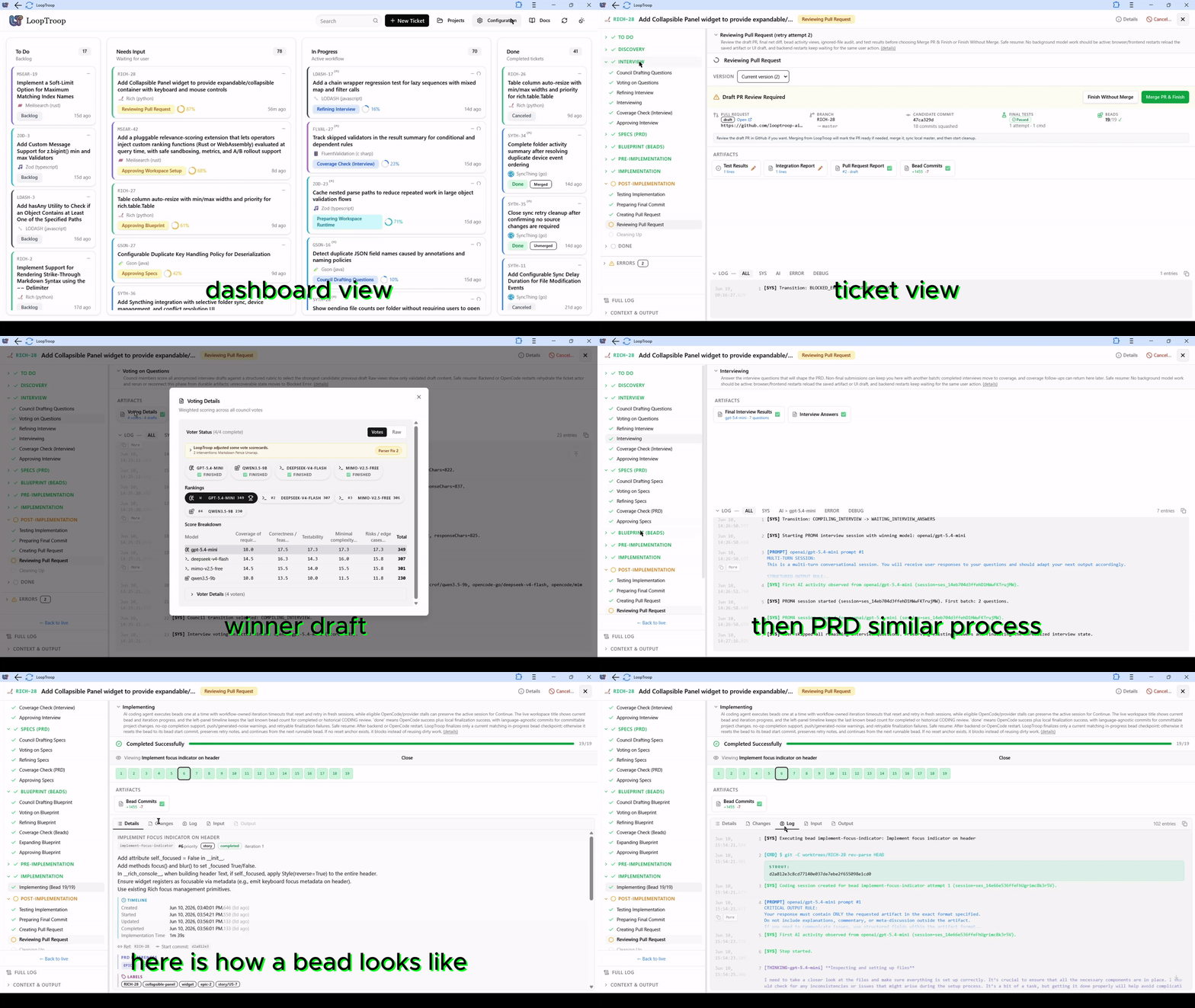 An animated walkthrough of a ticket lifecycle and the configuration menu.
📸 Screenshots
Click to expand the screenshot gallery
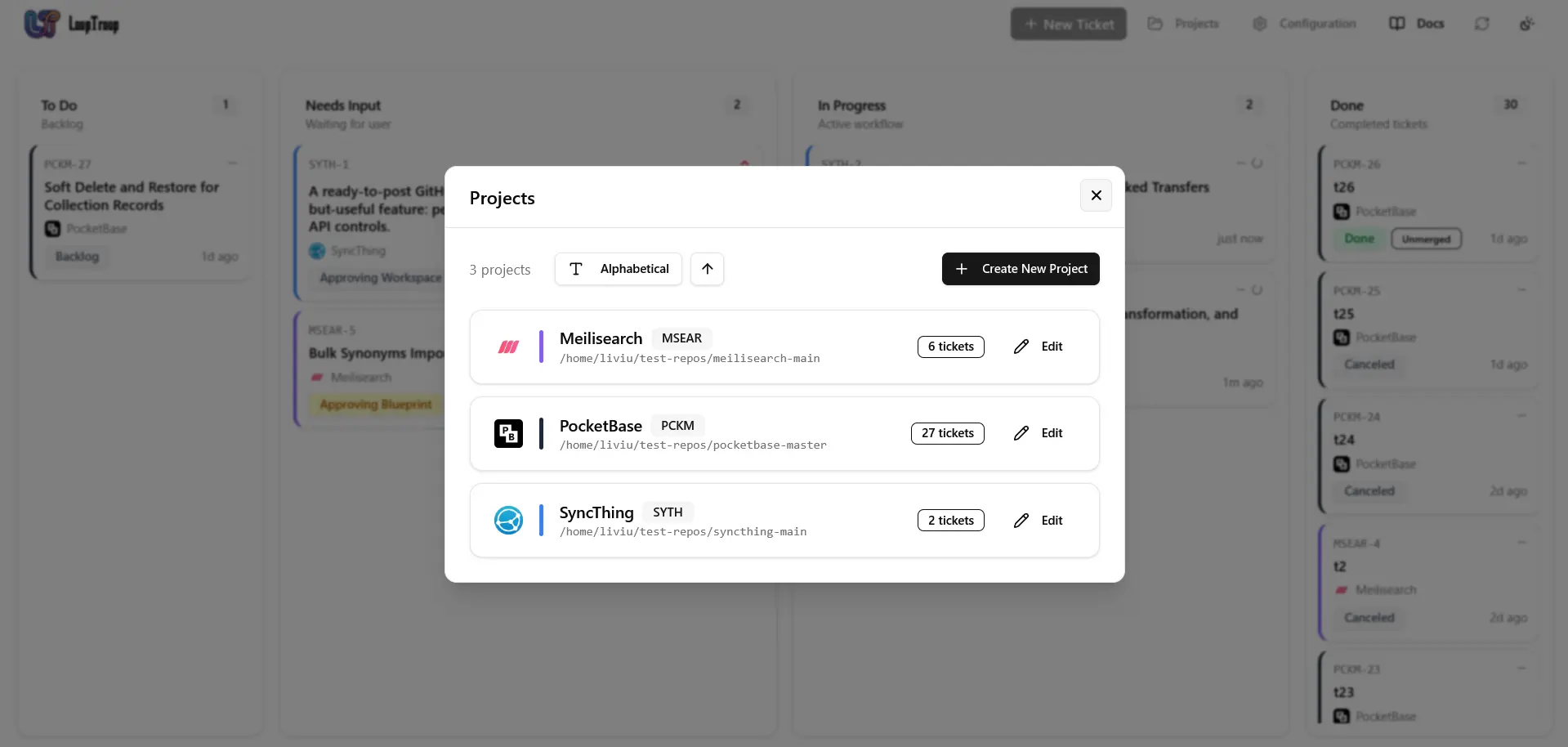 Manage attached repositories, review ticket counts, and add new projects from the dashboard.
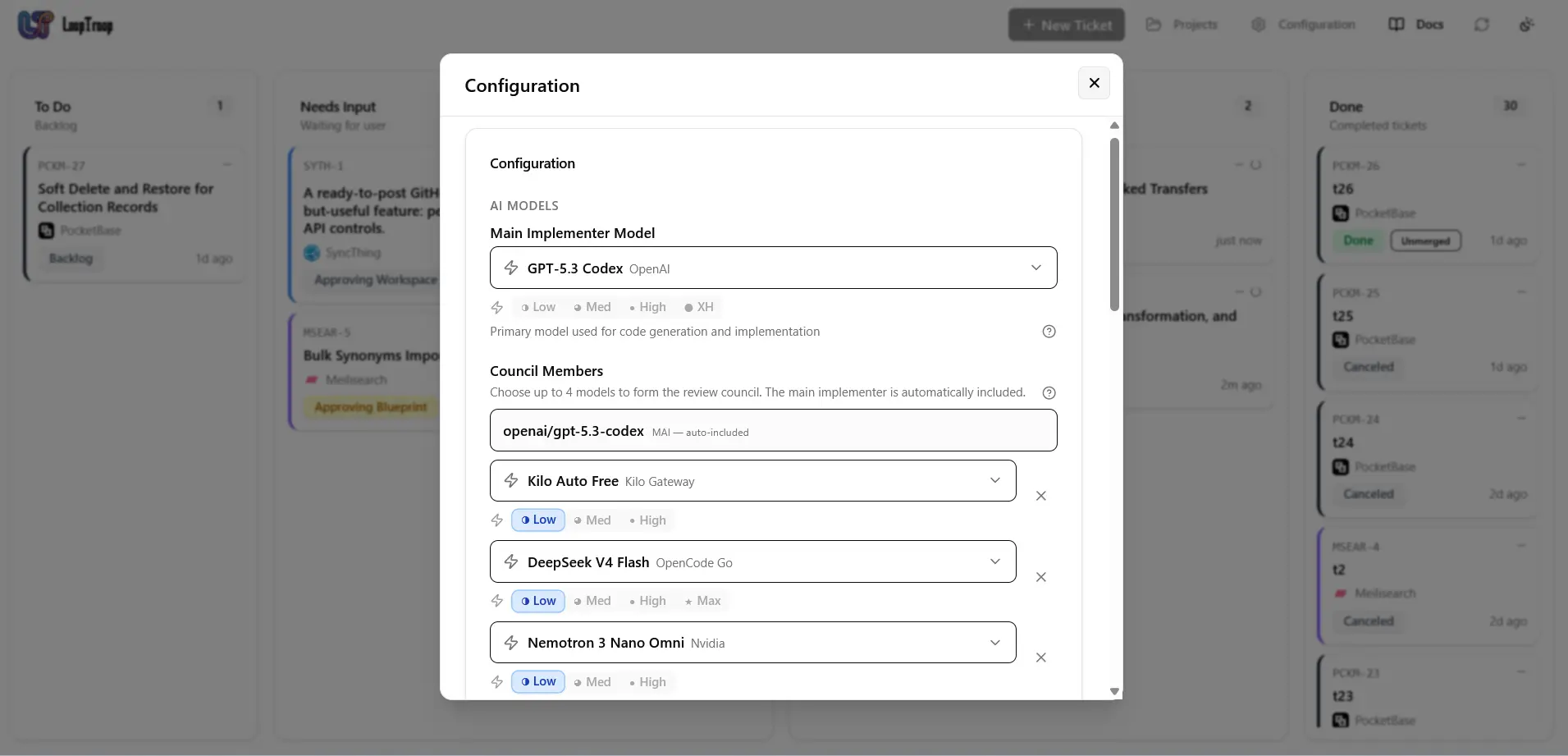 Choose the main implementer model, council members, and effort levels for local orchestration.
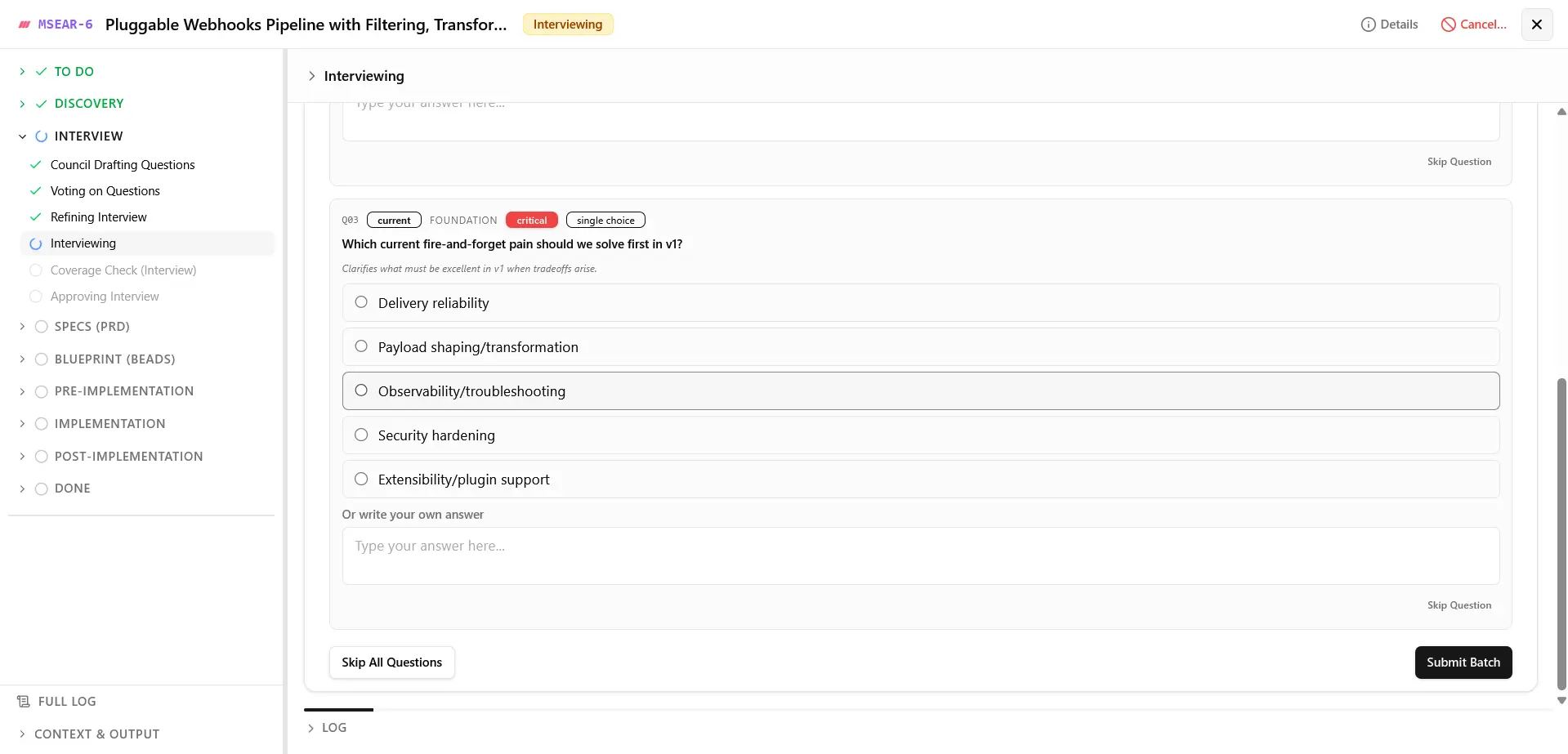 Answer focused planning questions before specs and implementation plans are approved.
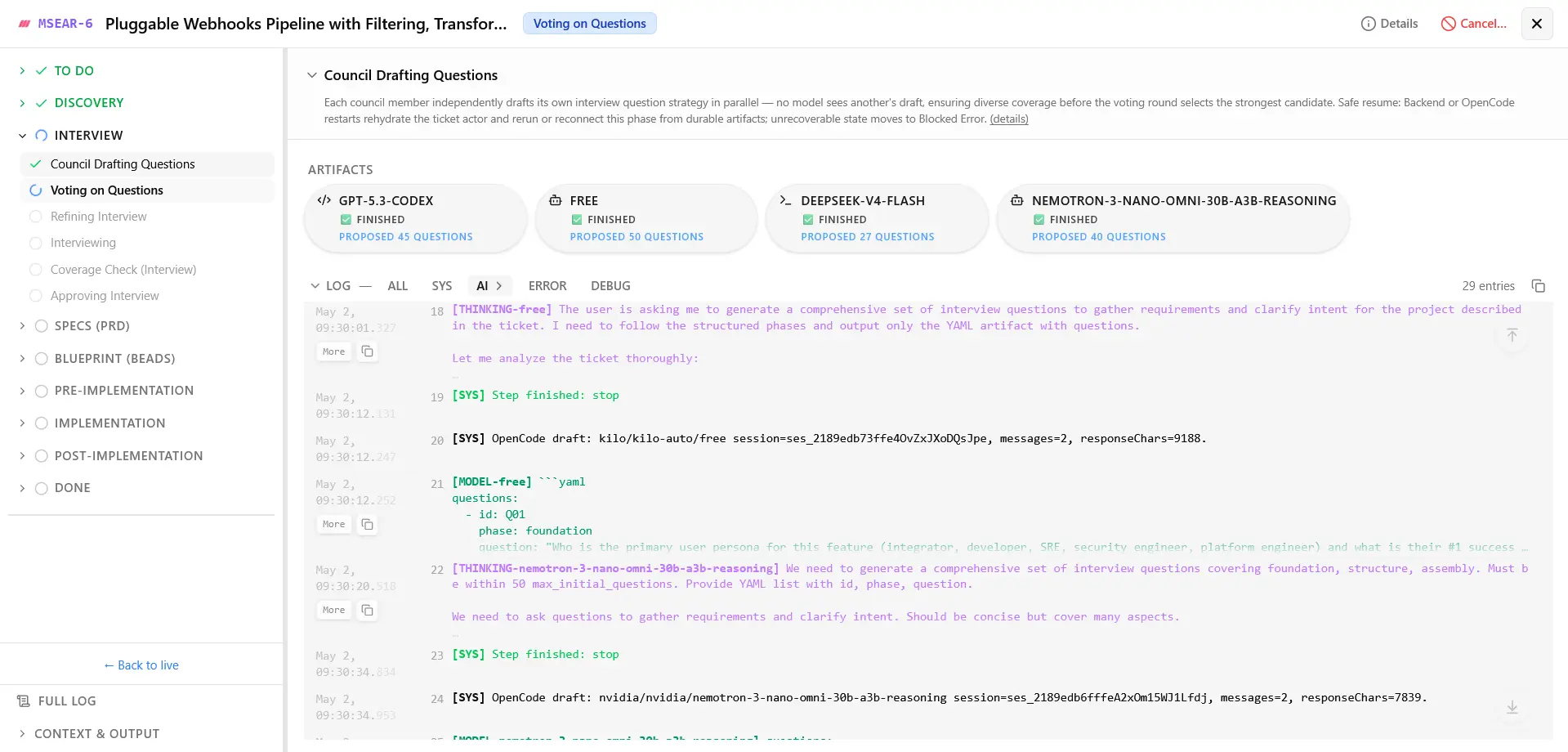 Track council progress, generated artifacts, and live execution logs inside a ticket.
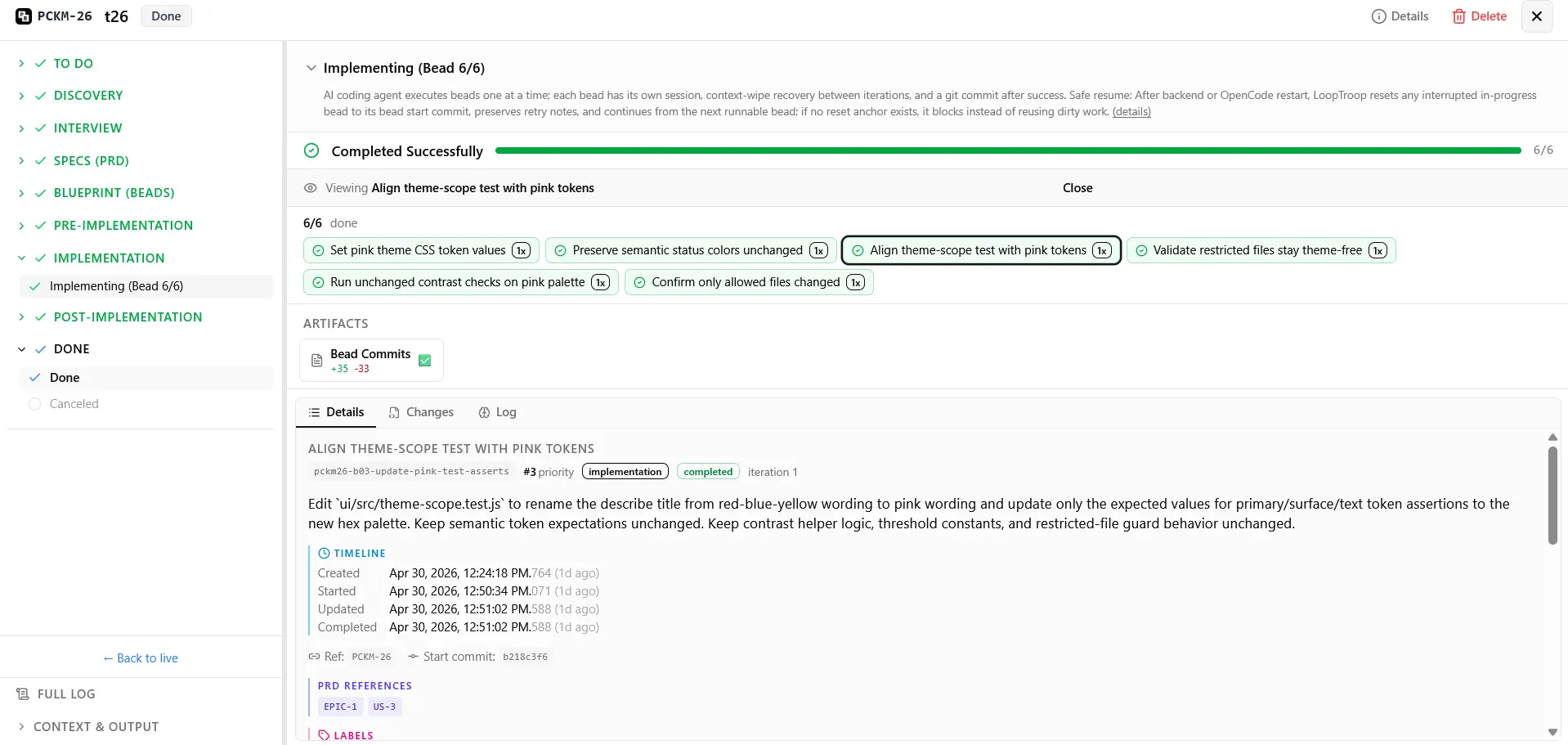 Review bead completion, commits, changes, and final implementation details before closing the workflow.
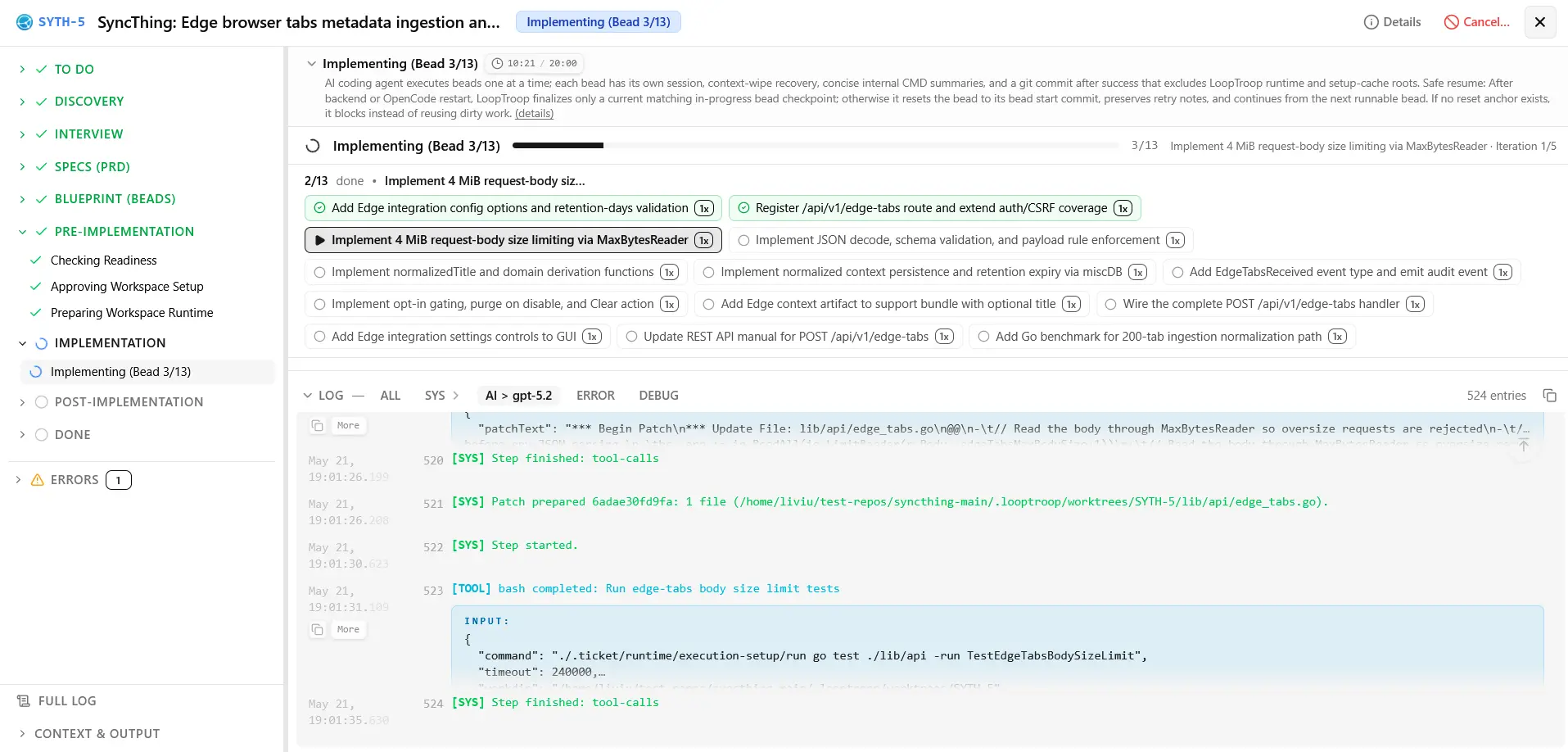 Inspect bead-level progress, task status, and live execution logs while an implementation bead runs.
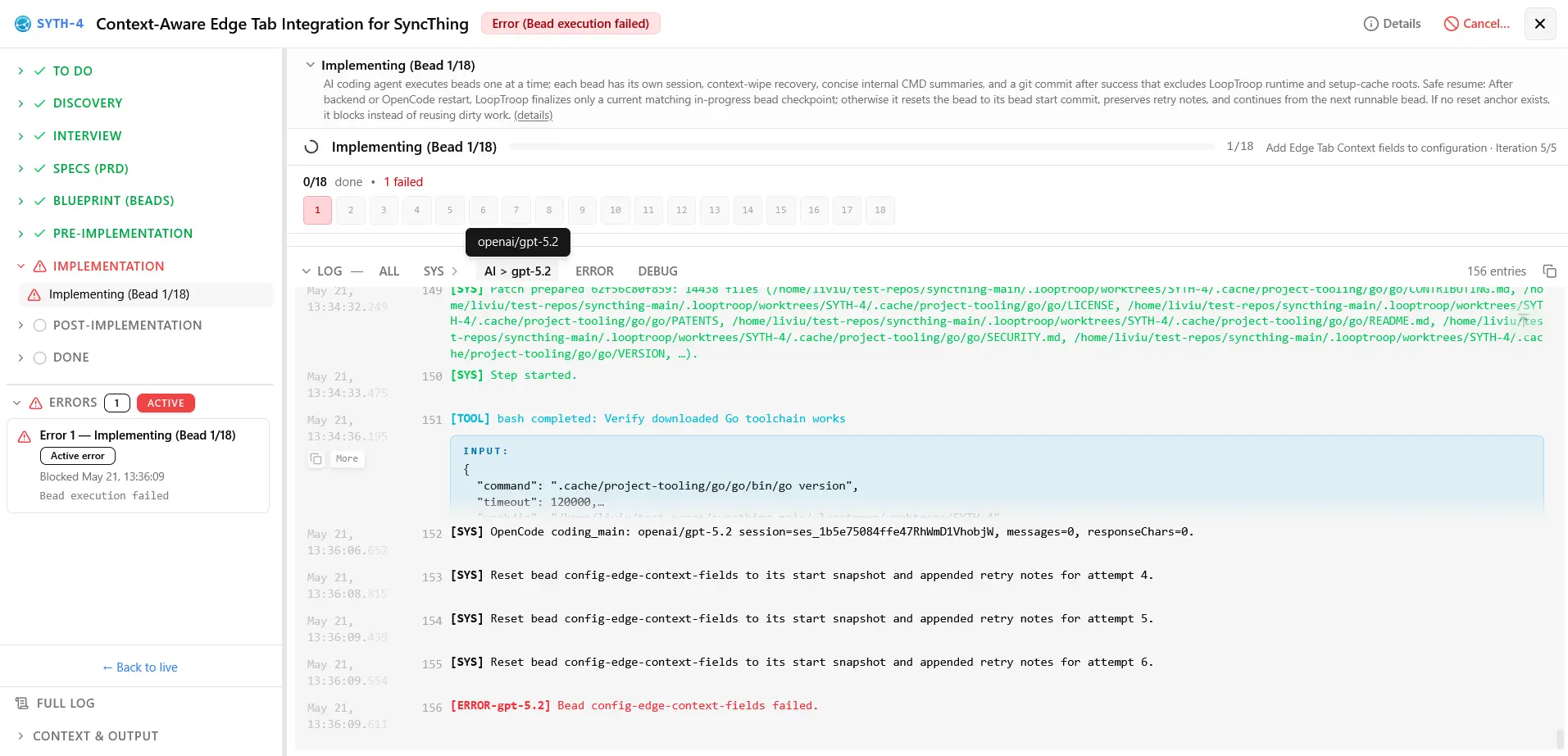 Review the focused workspace view shown when an implementation bead is blocked by an error.
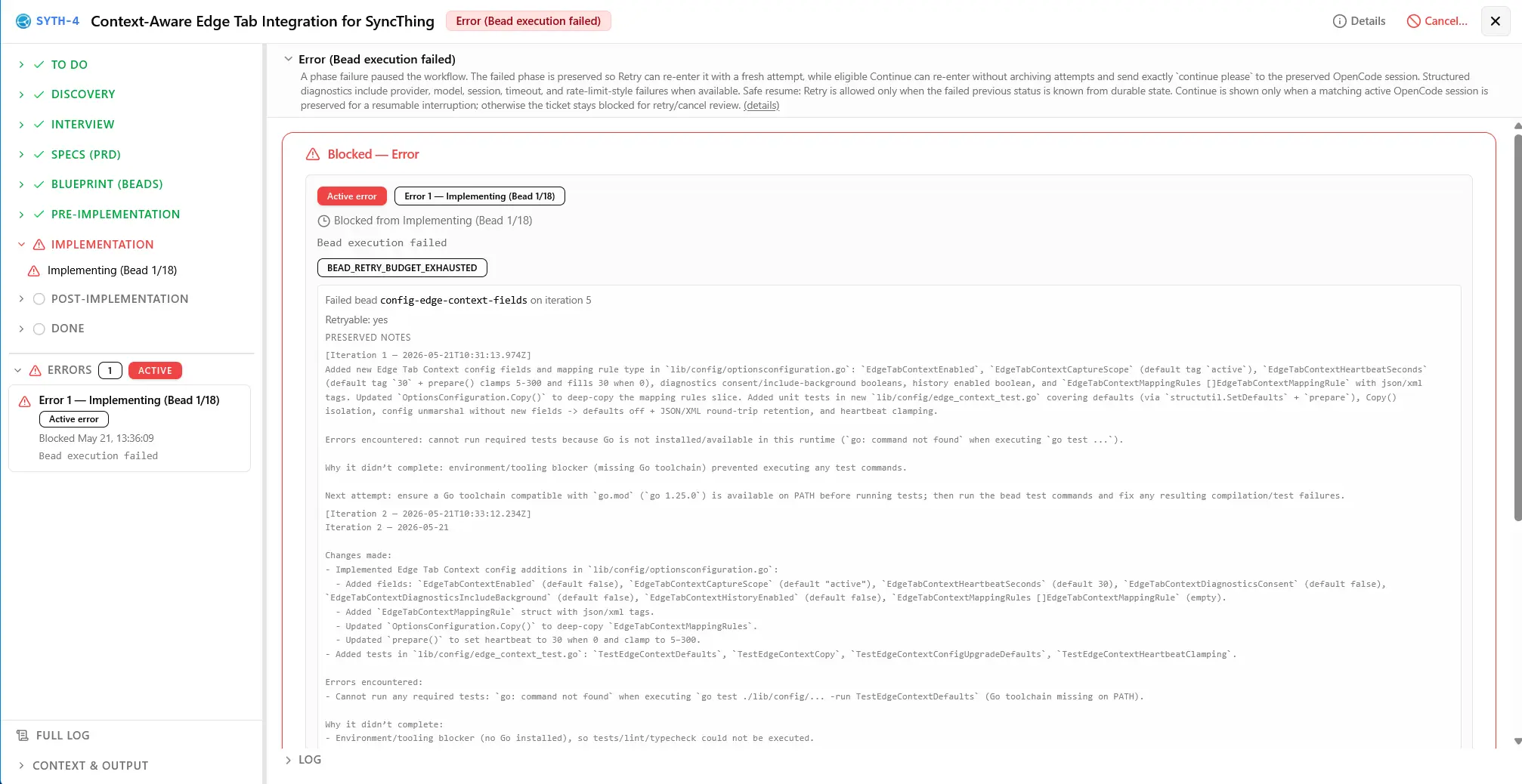 Compare a different bead's error state, diagnostics, and recovery context before deciding whether to continue or retry.
🎬 16 Min Deep Dive - Presentation & Full Ticket Demo
Click to expand the presentation and demo
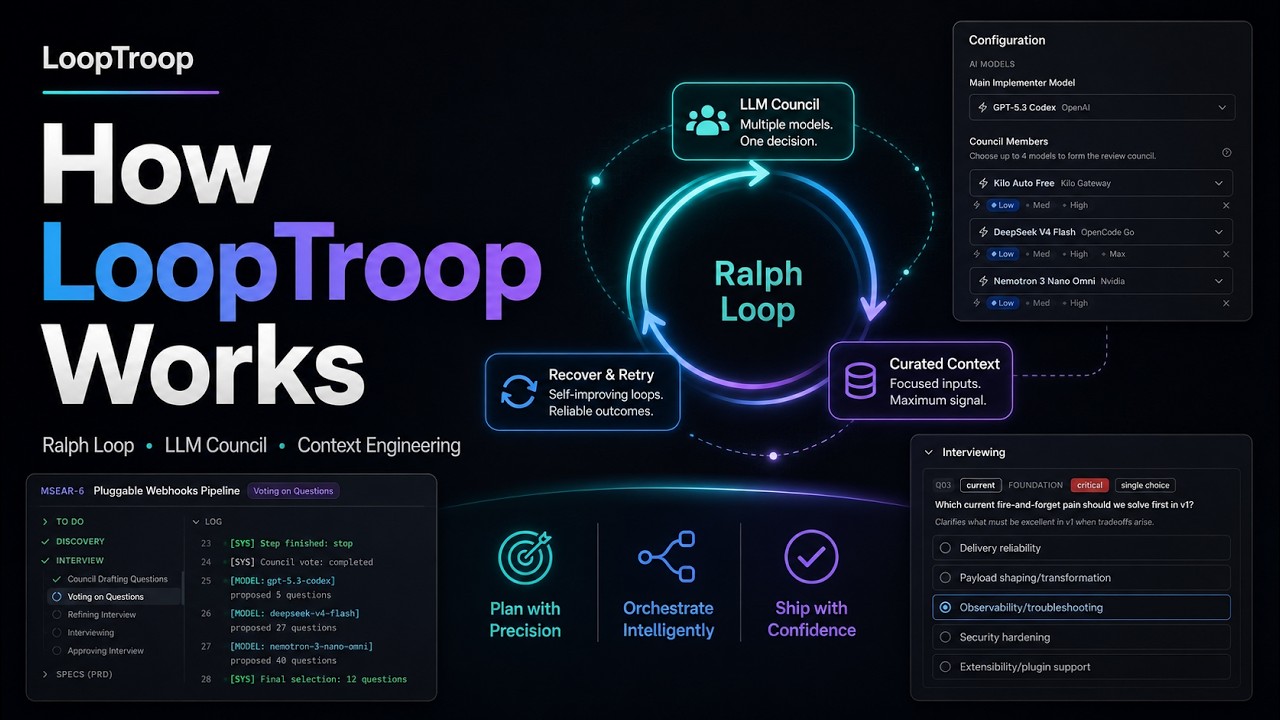 Watch the full 16-minute presentation and ticket demo.
Quick start
curl -fsSL https://www.looptroop.ovh/install | sh
looptroop open
open starts LoopTroop in the background and opens the browser.
Configure a provider in OpenCode, choose a model in LoopTroop's Configuration
screen, attach a local repository with a GitHub origin, and create a ticket.
Every way to install it
curl / PowerShell
curl -fsSL https://www.looptroop.ovh/install | sh
irm https://www.looptroop.ovh/install.ps1 | iex
Requires Node 24.18.0 or newer. Installs the latest release through npm.
npm
npm install -g looptroop
npm install -g looptroop@latest # upgrade
Requires Node 24.18.0 or newer.
Homebrew (macOS and Linux)
brew install looptroop-ai/tap/looptroop
brew upgrade looptroop # upgrade
Installs Node and gh; uses the OS's Git.
Scoop (Windows)
scoop bucket add looptroop https://github.com/looptroop-ai/scoop-bucket
scoop install looptroop
scoop update looptroop # upgrade
Installs Node, Git and gh.
Chocolatey (Windows)
choco install looptroop
choco upgrade looptroop # upgrade
Installs Node, Git and gh. New releases can take a few days to reach the feed.
WinGet (Windows)
winget install LoopTroopAI.LoopTroop

# Stop before upgrading so Windows can replace the executable.
looptroop stop
winget upgrade LoopTroopAI.LoopTroop
Includes Node; installs Git and gh. New releases can take a few days to reach
the feed.
bun
bun add -g looptroop
bun add -g looptroop@latest # upgrade
Requires bun and Node 24.18.0 or newer.
pnpm
pnpm add -g looptroop
pnpm add -g looptroop@latest # upgrade
Requires pnpm and Node 24.18.0 or newer. New releases may be delayed by pnpm's
24-hour publication-age check.
Yarn Classic (Bash/zsh)
yarn global add looptroop
export PATH="$(yarn global bin):$PATH"
yarn global upgrade looptroop@latest # upgrade
Requires Yarn 1.x and Node 24.18.0 or newer. Add the PATH line to your shell
profile. For modern Yarn or PowerShell, use another install method.
Docker (linux/amd64 and linux/arm64)
docker pull looptroopai/looptroop:latest
Includes Node, Git and gh. Connect an OpenCode server and mount your project
as described in Installation.
Standalone executable (macOS, Linux and Windows)
Download an archive from GitHub Releases
and extract it. Includes Node; requires Git and gh.
See Installation for upgrades,
uninstalling, download verification, and channel availability.
What you need besides LoopTroop
- git, and
gh authenticated: a ticket checks both before it starts
coding, because it ends in a pull request. Installed for you via Homebrew, Scoop, Chocolatey, WinGet and the AUR;
not installed if you used npm, bun, pnpm, Yarn or the standalone
executable, which have no way to declare a dependency.
- OpenCode, with a configured provider and available model. LoopTroop starts
the installed CLI when no server is already reachable, and detects v1 or v2
automatically. It does not install OpenCode for you.
What is LoopTroop?
LoopTroop is a local GUI orchestrator for long-running, high-correctness AI software delivery, taking you from a raw idea to merged code. It is free and fully open-source.
Unlike high-speed coding tools that optimize for immediate chat responses, LoopTroop is built for complex, multi-file feature work where alignment and correctness are paramount. It optimizes for a "slow and perfect" paradigm, intentionally sacrificing raw speed to deliver a final result that matches exactly how you envisioned it.
Great Context Engineering = Zero AI Slop: LoopTroop employs precise context curation at every stage, feeding the agent only the absolute minimum context it needs. See Context Engineering below for details.
How it works
flowchart LR
    A["🎫 Ticket Input"] --> B["🔍 Codebase Discovery"]
    B --> C["🏛️ LLM Council Planning(Interview, PRD & Beads)"]
    C --> D["🛑 Human Approval Gate"]
    D --> E["🧪 Isolated OpenCode Bead Execution(Git Worktree)"]
    E --> F["✅ Final Tests"]
    F --> H["🧭 Optional Manual QA(user runs the app)"]
    H --> I["📦 Integration & PR Review"]
    H -.->|"Failures become QA fix beads"| E
    E -.->|"On Failure"| G["🔄 Ralph-Style Recovery Loop"]
    G -.->|"Retry"| E
LoopTroop keeps workflow state outside the model, stores durable artifacts, and asks for approval at important boundaries. Optional Manual QA runs after final tests: you complete the checklist while manually controlling the app, then the ticket continues to integration. Failed checks create QA-fix beads, while improvements create new tickets.
Core ideas
Context Engineering
Context rot is the enemy of autonomous agents. Traditional agent loops suffer from it: excessive conversational history and irrelevant files overwhelm the model, causing code quality to degrade. Performance can drop severely when reaching just 40% of the maximum context window, resulting in missing files, broken imports, and "AI slop." [note]
LoopTroop solves this through precise context curation. Instead of sending full conversational transcripts, the engine isolates payloads to the active status. During execution, the agent only sees the specific active bead, its immediate file target, and the test file. During planning phases, it receives only the minimum context relevant to the current step.
This eliminates conversation pollution from previous execution attempts, prevents LLM drift and performance degradation, and keeps model focus high. Keeping the working context fresh is what makes multi-hour, multi-step engineering cycles actually work.
Read more: Context Engineering
LLM Council
The LLM Council is LoopTroop's planning system. Instead of relying on a single model run, LoopTroop orchestrates multiple independent model instances that draft plans, score each other using a weighted rubric, and vote on proposals. The winner then refines its draft by synthesizing the strongest ideas from the losing drafts and verifies coverage before any execution begins.
This multi-role process (draft → vote → refine → verify) is used for:
- Interview questions
- PRD/Specs generation
- Bead/blueprint generation
Read more: LLM Council
Interview
Before writing a spec, the LLM Council compiles a list of targeted questions to resolve any ambiguities. This interactive session gathers requirements and clarifies intent. Because matching your vision is the goal, this phase can take over an hour by design.
You answer these questions directly in the Interview workspace to clarify edge cases, design decisions, and requirements, ensuring the model never operates on false assumptions. Although a final interview is created after the council's draft-vote-refine cycle is complete, the user still receives questions in batches that can adapt based on previous answers.
Read more: Interview
PRD (Product Requirements Document)
Once the interview phase is complete, the LLM Council translates your initial ticket and your interview answers into a structured Product Requirements Document consisting of Epics and User Stories, complete with highly decomposed implementation steps. This spec serves as the single source of truth for the implementation, detailing the technical approach, edge cases, scope, and expected validation steps before any coding starts. The PRD is stored as a durable artifact for later reference during bead execution.
Read more: PRD
Beads
LoopTroop implements only the Beads methodology, not the full external Beads Project. It extracts just the lightweight planning structure needed to bring immediate value to your repository.
Using Steve Yegge's Beads Project methodology, epics are split into "beads", the smallest, independently implementable units of work. Each bead contains:
- Clear purpose and objective
- Measurable acceptance criteria
- Necessary dependencies and prerequisite context
- Specific target files
- Expected validation and testing steps
A bead acts as a small, isolated implementation unit, allowing the execution agent to complete concrete tasks sequentially rather than attempting a massive, single-pass code rewrite.
Read more: Beads
Execution & Ralph-style recovery
The actual implementation is carried out by an AI coding agent (OpenCode) running in an isolated workspace. If the agent struggles, continuing the same conversation can make things worse. LoopTroop's retry mechanism (the "Ralph Loop") preserves a highly compact error trace from the failure, attempts a safe worktree reset, discards the contaminated session, and begins a fresh run with clean context plus a note from previous failures.
fail ──> log failure trace ──> safe reset ──> retry fresh
This cycle repeats until all tests pass or retry limits are reached. This can take hours (sometimes 10+ hours) by design. It is built to run unattended (e.g., overnight).
Read more: Beads & Execution
Worktree isolation
LoopTroop runs execution steps inside isolated Git worktrees rather than modifying your active branch. This keeps your working copy clean and ensures reliable, inspectable diffs. Note that worktrees provide workspace isolation, not sandboxed host security.
When cleanup is run in its conservative mode, LoopTroop asks Git for ignored
untracked entries in a real worktree and preserves user files; only its own
.ticket/ and .looptroop/ roots are eligible for removal. A pre-start ticket
skeleton is checked directly instead of inheriting ignore rules from the parent
repository, and only its .ticket/ root is eligible. The Free Disk Space action
uses this mode for completed and canceled ticket worktrees: protected worktrees
are skipped and reported with the reason, while eligible worktrees are removed.
An ignored file such as a local environment file therefore remains in place
without preventing other cleanup. If
Git yields while a worktree is being removed, a replacement directory is left
alone. The daemon also waits for detached Git and GitHub children during
shutdown and closes active SSE streams before waiting for its HTTP server, so a
connected browser cannot hold graceful shutdown open indefinitely. Startup
recovery refuses to overwrite a target that has advanced since a completed
fallback copy.
Only select repositories you trust. LoopTroop preserves repository-local Git
configuration, including core.sshCommand, so custom SSH wrappers keep working.
Git may execute those wrappers with your account's permissions during remote
operations, including connection checks. Worktree isolation does not restrict
what a wrapper can do on the host.
Read more: System Architecture
Human approval gates
LoopTroop keeps you in control of critical state transitions. You actively review and sign off on planning specs, execution blueprints, and final pull request deliverables. (Note: Human approval gates will become optional in future releases).
For tickets with Manual QA enabled, LoopTroop prepares a checklist while you manually control the app and accept/reject/skip/create new tickets from the items.
Read more: Ticket Flow
Run it in a VM
The channel-specific install instructions appear above. Beyond the install
itself, LoopTroop needs a local repository with a GitHub origin, and strongly
wants a VM or sandboxed development environment.
Why a VM?
LoopTroop is designed for serious agentic coding work that runs unattended. To make this possible, the orchestrator runs OpenCode in dangerously-skip-permissions (YOLO) mode, granting the agent full local execution rights without prompting for confirmation.
While this makes long-running autonomous tasks possible, it introduces real risks. AI agents are not perfect. If a generation goes wrong, the agent can execute commands that delete critical system folders, corrupt active configurations, or break your workspace. Git worktrees isolate your code changes, but they do not sandbox the command execution process itself. The agent runs with your local user privileges.
Recommended setup: run LoopTroop inside a disposable VM, cloud dev machine, or sandboxed development environment.
- Git worktrees protect your attached repository checkout
- Logs and artifacts help you inspect what happened
- A VM protects the rest of your computer
Why not just use a coding agent directly?
Direct coding-agent loops are highly useful, but they degrade rapidly when task complexity or repository scale increases.
| Core Challenge | Direct Agent Behavior | LoopTroop's Structural Fix |
|---|
| Flawed Planning | A single model attempts to draft a multi-step plan in one pass, frequently missing structural edge cases. | LLM Council Consensus: Competing models draft, vote on, and synthesize a single, rigorous implementation plan. |
| Monolithic Overload | Direct agents try to solve a complex feature in a single massive prompt, leaving incomplete files or "TODO" placeholders. | Atomic Bead Decompositions: Automatically breaks down the feature into independent, test-backed "beads" to focus on smallest changes at a time. |
| Single-Provider Bias | Relying on one model makes your pipeline highly vulnerable to that specific model's logical blind spots and systemic failures. | Cross-Model Councils: Harnesses diverse providers and architectures (e.g., Anthropic, OpenAI, NVIDIA NIM) to critique and align code drafts. |
| Context Rot | Long-running chats suffer from token bloat and context degradation, leading to broken imports or forgotten criteria. | Modern Context Engineering: The environment strictly isolates context, feeding the agent only the absolute minimum context it needs at each step. |
| Degenerate Retries | When a command fails, the agent tries to fix it within the same polluted chat session, compounding previous errors. | Ralph-Style Retries: Discards the broken chat session entirely and retries the exact bead with a fresh context window (plus notes from previous failures). |
| Risky Edits | Code modifications are made directly in your active checkout, potentially leaving your main branch in an unstable state. | Isolated Git Worktrees: Executes all changes in dedicated, isolated worktrees away from your primary working branch. |
| Opaque Execution | Internal states, planning notes, and test outputs are lost inside unstructured chat history. | Structured Durability: Maintains state locally inside SQLite, JSONL logs, and easily inspectable .ticket/** YAML artifacts. |
What LoopTroop is not
LoopTroop is not a magic autopilot. It does not remove the need to review code, inspect diffs, protect secrets, or run work in a safe environment. It is best understood as an orchestration layer around coding agents: planning, state, approvals, execution boundaries, retries, and delivery.
- Cost-Sensitive Budgets: Orchestrating multi-model councils and long retry loops uses a high volume of API tokens, though subscription plans from providers in OpenCode can help reduce costs.
- Urgent or Quick Fixes: If you need a trivial change completed in seconds, LoopTroop's overhead will feel slow.
- Simple Tasks: For quick edits or trivial apps, standard IDE chat tools or tools like Replit, Bolt, or Lovable are better fits.
Documentation
The README gives a first-glance overview. The full docs are maintained in the public LoopTroop-Website repository and published at:
https://www.looptroop.ovh/docs/
Useful pages:
| Page | What it explains |
|---|
| Installation | Every channel, what each installs, upgrading, uninstalling, and verifying a download |
| CLI Reference | Every command and option, the --json output, and what running as a service means |
| Getting Started | Setup, startup, ports, and first project attach |
| Configuration | All profile settings with defaults, ranges, and trade-offs |
| Ticket Lifecycle Screenshots | Visual walkthrough of every workflow status with screenshots and action summaries |
| LLM Council | Multi-model draft, vote, refine, and coverage planning |
| Context Engineering | Why prompts are built from minimal per-status context and what each status receives |
| Beads & Execution | Bead execution, retries, resets, and context wipe notes |
When the app is running, the same docs are also available from the dashboard.
Project status
LoopTroop is early alpha software, but it is usable for real work. The full ticket lifecycle is implemented, but some bugs are still likely. The core primitives (planning, execution, retries) are functional.
Configured limitations: In LoopTroop alpha, LLM Councils support 2 to 10 distinct models, including the main implementer. Each project may have only one active ticket in the execution band at a time; additional tickets must wait until it finishes or is canceled.
Roadmap: Roadmap
Contributing
Contributions, ideas, bug reports, and workflow feedback are welcome.
See CONTRIBUTING.md for setup, issue, pull request, documentation, and changelog guidance. Please also follow the Code of Conduct.