
I2PChat




Experimental peer‑to‑peer chat client for the I2P anonymity network.
Cross‑platform Qt 6 GUI, FTXUI TUI, and Android (Kotlin + Compose) on one shared C++20 core (libi2pchat_core).
Prebuilt releases usually ship a bundled i2pd; you can switch to a system router in the app (see manuals).
Language / Язык






📑 Table of contents
✨ Features
- End‑to‑end communication over I2P SAM (in-tree SAM client in
libi2pchat_core)
- E2E encryption — handshake, key signing and verification
- TOFU — peer key pinning on first contact
- Multi-peer profiles — switch between Saved peers freely; incoming connections are accepted only from addresses present in the contact book (empty book ⇒ no inbound whitelist matches)
- Qt 6 GUI with light and dark themes (desktop)
- File transfer and image sending (Send picture: PNG, JPEG, WebP) between peers
- Profiles (.dat) — multiple profiles, load and import; each profile’s data lives under
profiles// in the app data directory (if older flat *.dat files still sit in the data root, they are migrated on startup into that layout — see § profile paths in MANUAL_EN / MANUAL_RU)
- System notifications — tray toasts for new messages
- Sound notifications for incoming messages
- BlindBox (default-on for named profiles) — offline message delivery
- Optional encrypted chat history — per-peer local history (toggle Chat history: ON/OFF in the ⋯ menu); encrypted at rest with keys derived from your profile identity (see §4.11 in MANUAL_EN / MANUAL_RU)
- Contact book (Saved peers) — left sidebar list backed by
profiles//.contacts.json: quick switch between saved .b32.i2p peers, optional display name/note, unread hints, resize/collapse, and a context menu (edit, trust details, remove). See §3.1 in MANUAL_EN / MANUAL_RU.
- Text groups — multi-member conversations over the same vNext stream as 1:1 chat; offline delivery fans out per member via pairwise BlindBox (see the manuals for prerequisites and § on group BlindBox behavior)
- Terminal client (TUI) — FTXUI console UI; shipped as
*-tui-* release zips and i2pchat-tui packages (Homebrew, apt, AUR, winget)
- Android — Kotlin + Jetpack Compose over the same C++ core; release APK on GitHub Releases or build with
./build-android.sh (details)
- Cross‑platform build scripts (Linux, macOS, Windows, Android)
📖 Manuals
🧠 Core architecture
I2PChat is a C++20 project: shared libi2pchat_core, desktop Qt 6 GUI, FTXUI TUI, and Android (JNI + Compose). Historical Python sources may still exist for interop tests; shipping builds and CI are C++.
| Layer | Role |
|---|
cpp/apps/gui | Qt 6 desktop UI |
cpp/apps/tui | FTXUI terminal UI |
cpp/apps/cli | Headless / tooling entry |
libi2pchat_core | SAM, crypto, vNext framing, BlindBox, sessions, groups |
android/ | Kotlin UI + JNI over the same core |
flowchart TB
    subgraph UI["User interfaces"]
        qt["Qt 6 GUIcpp/apps/gui"]
        tui["FTXUI TUIcpp/apps/tui"]
        and["Android Composeandroid/"]
    end

    subgraph Core["libi2pchat_core"]
        session["Session / peer transport"]
        protocol["vNext codec + delivery"]
        crypto["X25519 / Ed25519 / SecretBox"]
        blindbox["BlindBox client"]
        sam["SAM client"]
    end

    subgraph External["External"]
        router["I2P router (i2pd / Java I2P)"]
        peers["Remote peers"]
        boxes["BlindBox replicas"]
    end

    qt --> Core
    tui --> Core
    and --> Core
    session --> protocol
    session --> crypto
    session --> blindbox
    session --> sam
    sam <--> router
    router <--> peers
    blindbox <--> boxes
Runtime in practice:
- Startup: GUI / TUI / Android create a core session, load or create the profile identity, open the long-lived SAM session, warm tunnels, and start accept / tunnel watch loops.
- Transport: per-peer state (connecting / handshaking / secure / stale / failed), outbound policy, stream registry, and reconnect live in the session layer. Parallel live traffic is keyed by peer id.
- Live chat: one I2P stream per peer after handshake and TOFU; encrypted vNext frames thereafter. Multiple peers can be connected at once.
- Text groups: group envelopes over the same vNext stream; offline text fans out per member via BlindBox.
- Offline (BlindBox): when no live secure session is available, text can be queued as padded encrypted blobs on BlindBox replicas and delivered when the peer returns.
- UI split: the core stays UI-agnostic; Qt / FTXUI / Compose render chat and status.
🔌 Protocol overview
Traffic is a byte stream over I2P SAM (one TCP session to the router). Application data is split into vNext binary frames:
┌─────────── vNext frame ────────────────────────────────────────┐
│ MAGIC (4) │ VER (1) │ TYPE (1) │ FLAGS (1) │ MSG_ID (8) │ LEN (4) │ PAYLOAD (LEN bytes) │
└──────────────────────────────────────────────────────────────────┘
- Handshake uses plain frame bodies (UTF‑8 text: identities,
INIT / replies, signatures).
- After the secure handshake, payloads are encrypted (
FLAGS marks it): each body is sequence (8 B) + ciphertext + MAC (NaCl SecretBox + HMAC over metadata).
- Message IDs and sequence numbers tie frames to ordering and replay protection; see also padding below.
For a developer-oriented specification with framing, handshake, ACK, transfer,
BlindBox, and code-map sections, see docs/PROTOCOL.md.
Runtime layout summary: docs/ARCHITECTURE.md. Release scripts, signing, checksums, NixOS, BlindBox daemon notes: docs/BUILD.md.
📬 BlindBox
BlindBox is your “send now, deliver later” mode for text messages.
Why users like it:
- You can message people even when they are temporarily offline.
- Delivery happens automatically when they come back online.
- The chat stays clean and readable: only real messages, no technical noise.
- Works naturally with normal live chat — no extra routine in daily use.
Simple flow:
- If the peer is online, the message is delivered live.
- If the peer is offline, the app keeps it in the offline queue.
- When the peer returns, the message appears automatically.
Practical notes:
- For named profiles BlindBox is enabled by default.
- For the transient profile
random_address (CLI alias default) BlindBox is off.
- Disable explicitly with
I2PCHAT_BLINDBOX_ENABLED=0.
- Deployments can set Blind Box endpoints via env (
I2PCHAT_BLINDBOX_REPLICAS, I2PCHAT_BLINDBOX_DEFAULT_REPLICAS, or I2PCHAT_BLINDBOX_DEFAULT_REPLICAS_FILE). Built-in release defaults and further options → manuals / release notes above.
📸 Screenshots
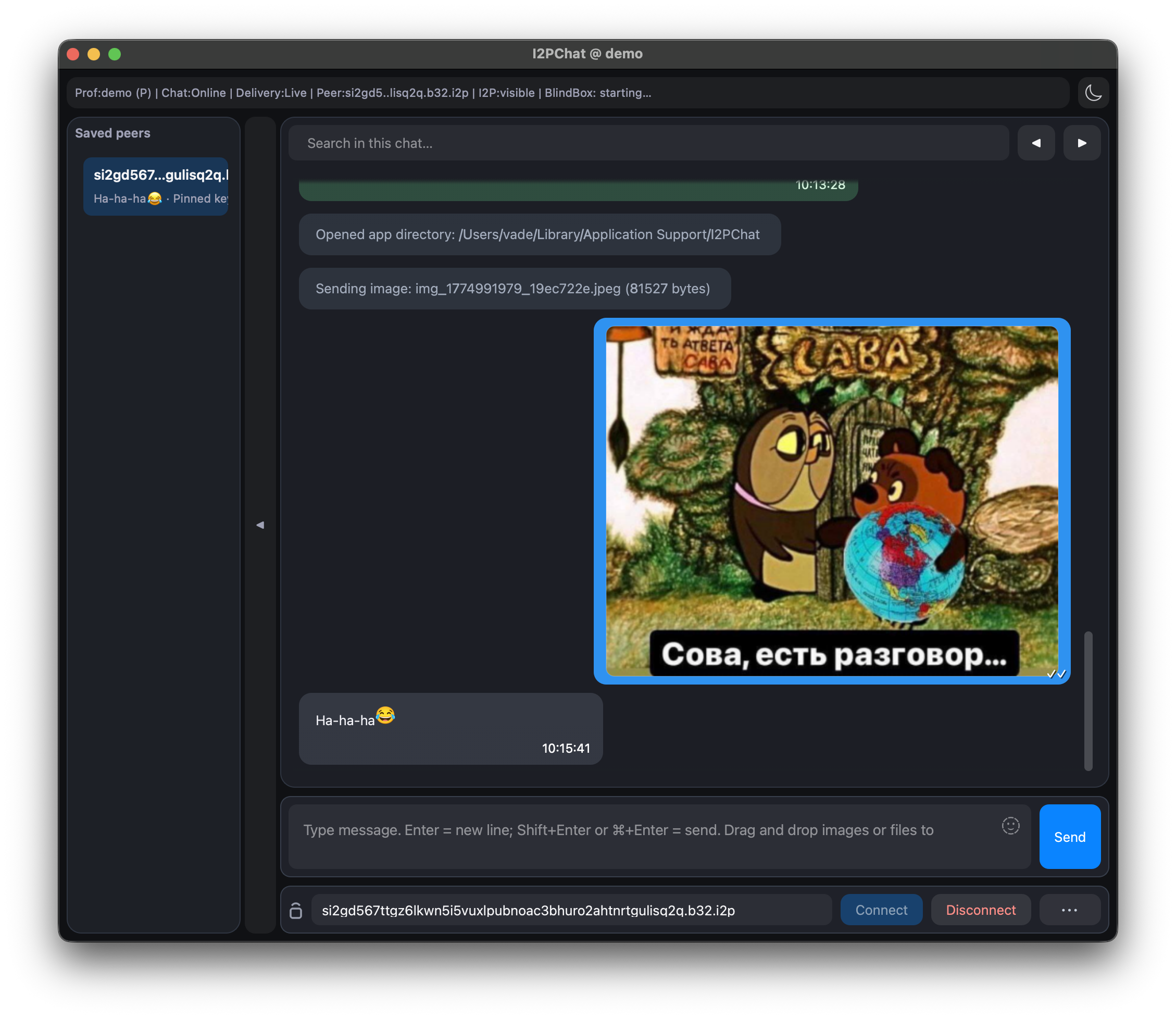
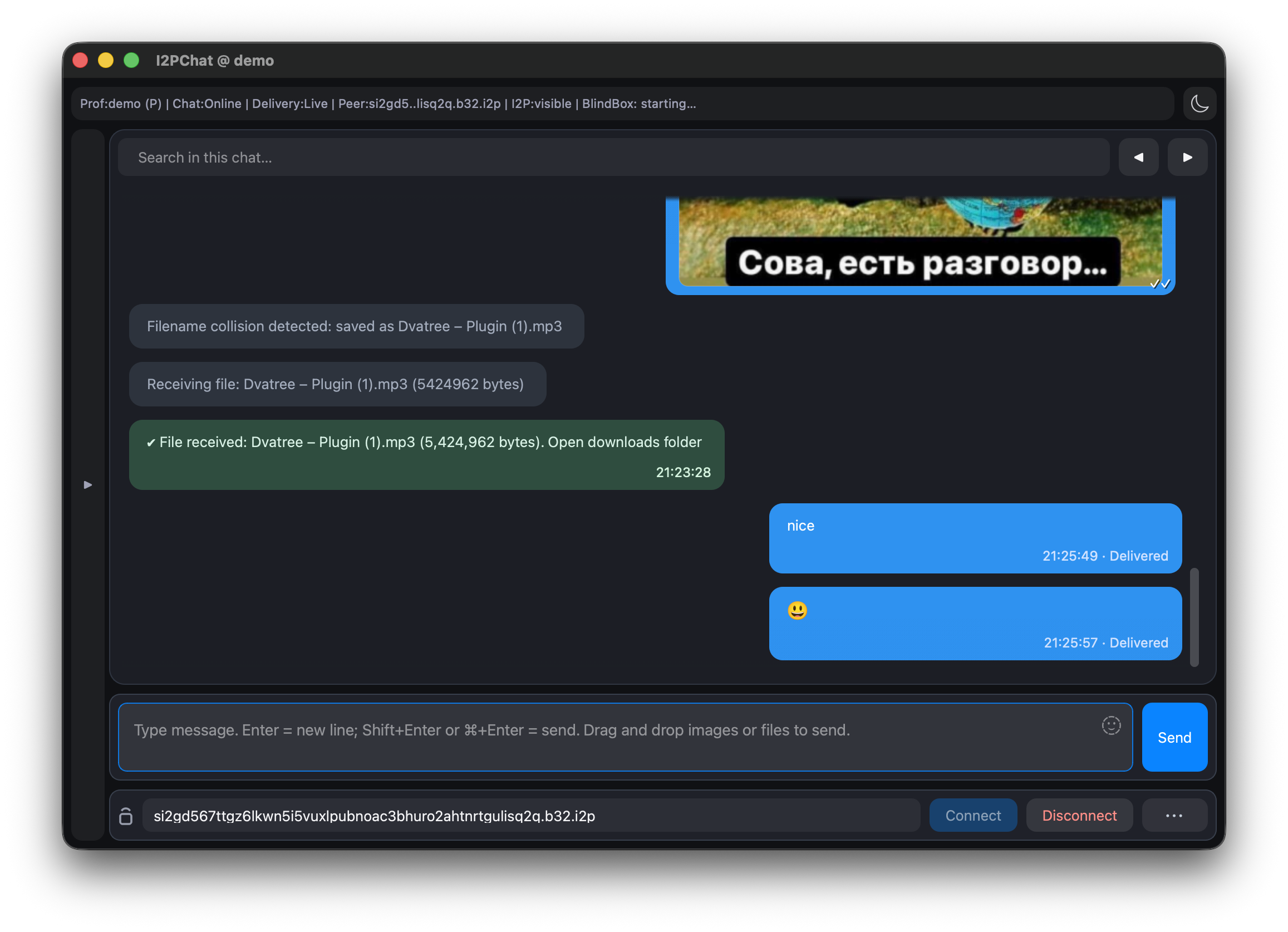
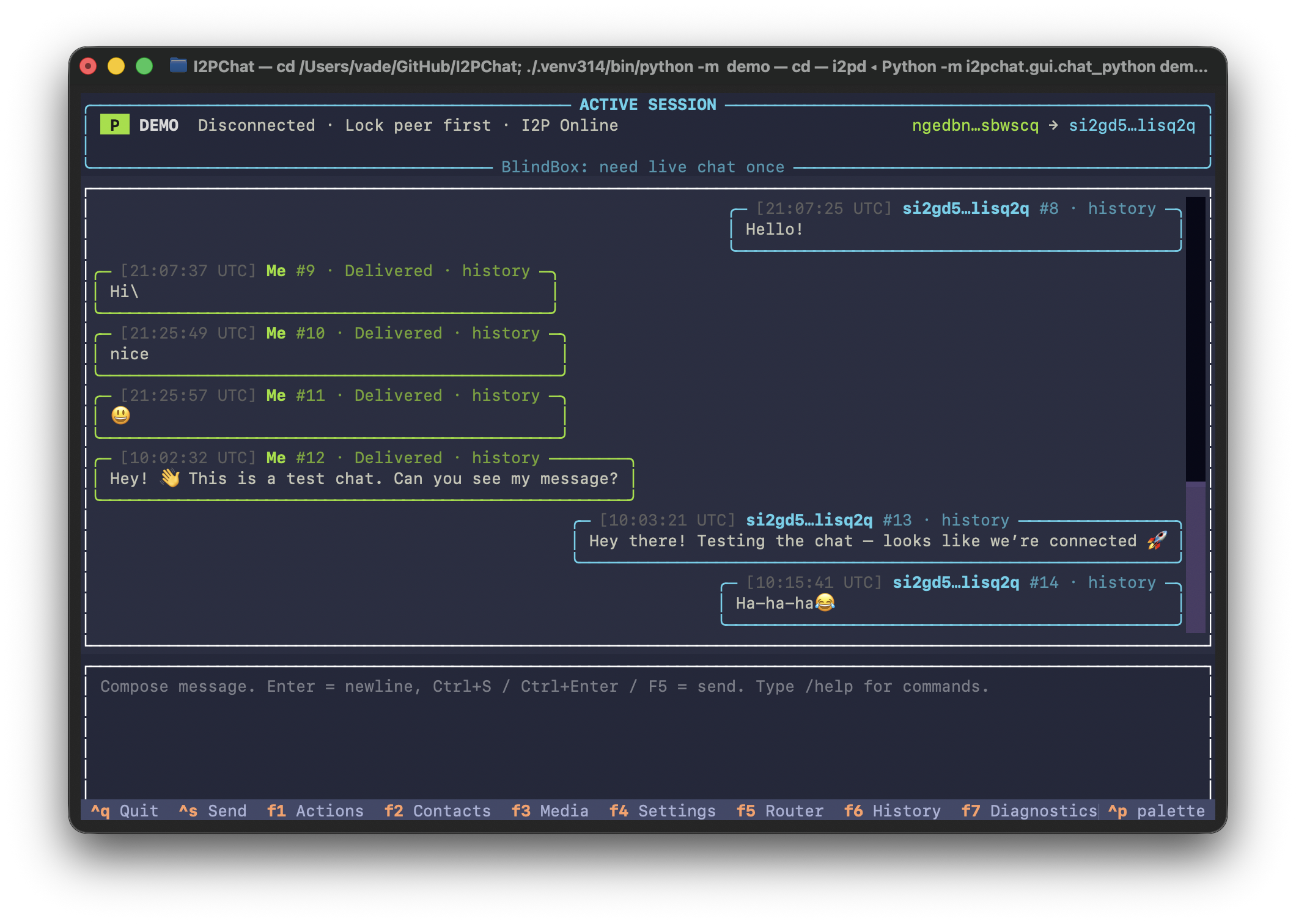
The gallery above is a short subset. screenshots/2.png (⋯ menu), 3.png (profile picker), 5.png (emoji picker), 6.png (BlindBox diagnostics), 8.png (I2P router dialog), 9.png (Blind Box setup examples — install.sh / Copy curl for a custom replica), and 10.png (TUI) are documented inline in MANUAL_EN.md / MANUAL_RU.md.
🛠 Building and running from source (C++)
The supported client is C++20 under cpp/. It is wire-compatible with Python 1.4.x peers and reads the same profile directory. CMake presets: cpp/README.md. Packaging / cutover: cpp/packaging/README.md, cpp/docs/CUTOVER.md.
Requirements (all platforms):
- CMake ≥ 3.24 and a C++20 compiler (GCC 12+, Clang 15+, Apple Clang, MSVC 2022)
- libsodium, Boost ≥ 1.86 (Asio;
asio::cancel_after), nlohmann/json
- FTXUI (TUI), Qt 6 Widgets (GUI)
- Catch2 3 only if you build tests
- a system i2pd with SAM on port
7656, or a bundled i2pd staged by the release scripts

 Linux (Debian/Ubuntu)
sudo apt install cmake ninja-build g++ pkg-config \
  libsodium-dev libboost-dev nlohmann-json3-dev \
  qt6-base-dev libxcb-cursor0
# FTXUI: distro package if present, else vcpkg feature `tui`.
# X11: libxcb-cursor0 is required for the Qt xcb platform plugin.

cmake -S cpp -B cpp/build -DCMAKE_BUILD_TYPE=RelWithDebInfo \
  -DI2PCHAT_BUILD_TUI=ON -DI2PCHAT_BUILD_GUI=ON -DI2PCHAT_BUILD_TESTS=ON
cmake --build cpp/build -j
ctest --test-dir cpp/build --output-on-failure

./cpp/build/apps/tui/i2pchat-tui --help
./cpp/build/apps/gui/i2pchat-gui --profile default
 macOS (Homebrew)
brew install cmake ninja libsodium boost nlohmann-json catch2 ftxui qt

cmake -S cpp -B cpp/build -DCMAKE_BUILD_TYPE=RelWithDebInfo \
  -DI2PCHAT_BUILD_TUI=ON -DI2PCHAT_BUILD_GUI=ON
cmake --build cpp/build -j

./cpp/build/apps/tui/i2pchat-tui -p default
./cpp/build/apps/gui/i2pchat-gui -p default
Homebrew prefixes are picked up automatically on Apple Silicon. Profiles live in ~/Library/Application Support/I2PChat/ (same as the historical Python client).
 Windows (MSVC + vcpkg)
# Visual Studio 2022 with “Desktop development with C++”, CMake, and Git.
$env:VCPKG_ROOT = "C:\src\vcpkg"   # after bootstrap-vcpkg.bat
$env:VCPKG_MANIFEST_FEATURES = "tests;tui;gui"

cmake -S cpp -B cpp/build `
  -DCMAKE_TOOLCHAIN_FILE="$env:VCPKG_ROOT\scripts\buildsystems\vcpkg.cmake" `
  -DI2PCHAT_BUILD_TUI=ON -DI2PCHAT_BUILD_GUI=ON -DI2PCHAT_BUILD_TESTS=ON
cmake --build cpp/build --config RelWithDebInfo --parallel
ctest --test-dir cpp/build -C RelWithDebInfo --output-on-failure

.\cpp\build\apps\tui\RelWithDebInfo\i2pchat-tui.exe --help
.\cpp\build\apps\gui\RelWithDebInfo\i2pchat-gui.exe --profile default
Without vcpkg, install libsodium/Boost/nlohmann-json/Qt/FTXUI yourself and pass CMAKE_PREFIX_PATH.
CLI flags (TUI and GUI share the parser): -p / --profile, --app-root, --sam-host, --sam-port, --bundled-router, --connect, --replica, --replica-direct, --poll-seconds, --help, --version.
SAM: the C++ stack talks SAM v3 itself. You do not need Python or i2plib.
BlindBox daemon: i2pchat-blindbox-daemon. systemd / fail2ban: cpp/apps/blindbox-daemon/packaging/. Public replicas behind I2P may keep replica auth empty; raw TCP should still use a token. See §4.9 in MANUAL_EN / MANUAL_RU.
Legacy Python sources (if present) are only for interop / golden-vector tests; they are not required to build or run shipping clients.
The project is cross-platform. Release scripts compile the C++ GUI (i2pchat-gui → I2PChat), TUI (i2pchat-tui → I2PChat-tui) and BlindBox daemon, then pack the same artifact names as before so apt/AUR/winget/Homebrew consumers only need new checksums.
Shared helper: scripts/build_cpp_binaries.sh (cmake + install). Optional bundled router is still staged by scripts/ensure_bundled_i2pd.sh — see docs/BUILD.md.
 Linux (GUI AppImage)
./build-linux.sh
This script:
- Requires cmake (≥ 3.24), a C++20 compiler, Qt 6, FTXUI, libsodium, Boost, nlohmann/json. Ninja is used when present.
- Builds into
cpp/build-release and installs to dist/cpp-install.
- Stages
I2PChat / I2PChat-tui plus linked libraries and Qt platform plugins, packs I2PChat.AppDir, then appimagetool (pinned SHA-256, same as before).
- Writes
dist/I2PChat-linux--v.AppImage and I2PChat-linux--v.zip (by default one AppImage inside). arch is x86_64 or aarch64. Set I2PCHAT_LINUX_GUI_ZIP_MODE=portable for a zip of the onedir (I2PChat, I2PChat-tui, lib/, vendor/).
- Also packs
I2PChat-linux--tui-v.zip (launcher i2pchat-tui + usr/bin/I2PChat-tui).
- Bundled
i2pd: scripts/ensure_bundled_i2pd.sh into vendor/i2pd/ (default clone i2pchat-bundled-i2pd). Boost SONAME staging is unchanged (stage_i2pd_linux_shlibs.sh).
Need zip on PATH for the archives. wget for appimagetool.
macOS (GUI .app bundle)
./build-macos.sh
- Homebrew cmake, qt, ftxui, libsodium, boost, nlohmann-json.
- Builds
dist/I2PChat.app (Contents/MacOS/I2PChat and I2PChat-tui).
- Runs
macdeployqt when found (brew --prefix qt).
- Always ad-hoc
codesign nested Qt libraries after macdeployqt (required on recent macOS). Optional I2PCHAT_CODESIGN_IDENTITY for Developer ID + hardened runtime.
- Zips
I2PChat-macOS--v.zip and I2PChat-macos--tui-v.zip.
Windows
powershell -ExecutionPolicy Bypass -File .\build-windows.ps1
Safer one-off:
powershell -NoProfile -Command "Set-ExecutionPolicy -Scope Process RemoteSigned; .\build-windows.ps1"
This:
- Requires cmake and a C++20 toolchain (MSVC 2022). Prefer vcpkg: set
VCPKG_ROOT (manifest features tui;gui). Otherwise set CMAKE_PREFIX_PATH / QTDIR.
- Installs into
dist\cpp-install, then copies dist\I2PChat\I2PChat.exe and I2PChat-tui.exe.
- Runs
windeployqt on the GUI when available.
- Packs
I2PChat-windows-x64-v.zip, I2PChat-windows-tui-x64-v.zip, and winget zips without embedded i2pd (*-winget-*) so Microsoft validation does not flag Riskware.I2PD.
The GUI zip is self-contained after windeployqt + vcpkg DLLs; machines do not need MSVC or Python.
 Android
Native phone client: Kotlin + Jetpack Compose over the same C++ libi2pchat_core / ChatService. Application id org.i2pchat.android, min SDK 26. Details: android/README.md.
./build-android.sh --debug            # installable debug APK (default)
./build-android.sh --release          # release APK (unsigned unless a keystore is configured)
./build-android.sh --debug --install  # adb install -r after build
- Needs JDK 17+, Android SDK, NDK r28 (
28.2.13676358), and CMake (Android Studio SDK Manager or CI sdkmanager).
- Bundled
libi2pd.so (arm64 + x86_64) lives under android/app/src/main/jniLibs/ (rebuild with ./android/scripts/build-i2pd-16k.sh if needed).
- Output:
dist/I2PChat-android-v-.apk (+ .sha256).
- Day-to-day: open
android/ in Android Studio; use an arm64 device or x86_64 emulator.
Default theme is dark. Tap the green Online! My Address notice to copy your destination to the clipboard.
Verify release artifacts
Release build scripts generate:
SHA256SUMS file for produced release archive(s) (Linux aarch64 builds may use a separate SHA256SUMS.linux-aarch64 on GitHub Releases so amd64 sums are not overwritten);- detached armored GPG signature
SHA256SUMS.asc (best-effort by default).
These files are not tracked in git (they differ per OS/build); upload them with the release assets on GitHub.
Build-time controls:
I2PCHAT_SKIP_GPG_SIGN=1 — always skip detached signature creation;I2PCHAT_REQUIRE_GPG=1 — fail build if GPG signing is unavailable or fails;I2PCHAT_GPG_KEY_ID= — select a specific key for detached signature (avoids “no default secret key” when you have several keys or no default-key in gpg.conf);I2PCHAT_GPG_BATCH=0|1 — override auto mode: by default the Linux/macOS scripts use gpg --batch only when neither stdin nor stdout is a TTY (typical CI). If either is a TTY (including build.sh | tee log), they omit --batch so pinentry can ask for your passphrase. Force batch with I2PCHAT_GPG_BATCH=1 (needs gpg-agent with a cached passphrase if the key is protected).
Official release builds should set I2PCHAT_REQUIRE_GPG=1 so unsigned archives are not produced silently; publish SHA256SUMS and SHA256SUMS.asc next to each asset.
Verification example:
gpg --verify SHA256SUMS.asc SHA256SUMS
sha256sum -c SHA256SUMS
The transport is encrypted after handshake, but some protocol metadata remains
observable on the wire:
- frame type (
TYPE);
- frame length (
LEN);
- pre-handshake peer identity preface exchange.
To reduce traffic-shape leakage, encrypted payloads use a padding profile:
- default:
balanced (pads encrypted plaintext to 128-byte buckets);
- optional:
off (disable padding).
You can override the profile with:
I2PCHAT_PADDING_PROFILE=off ./I2PChat # or I2PChat-tui / Android env
Trade-off: stronger padding reduces length correlation but increases bandwidth.
❄️ NixOS
# Run directly
nix run github:MetanoicArmor/I2PChat

# Install into your profile (adds `i2pchat`, `i2pchat-tui`, desktop entries and icon)
nix profile install github:MetanoicArmor/I2PChat

# Development shell
nix develop github:MetanoicArmor/I2PChat
The flake now wraps the app with the Qt runtime pieces that are easy to miss on NixOS sessions: Wayland/platform plugins, multimedia/image plugins, desktop metadata, and Linux notification/sound helpers (notify-send, canberra-gtk-play, paplay, aplay).
System keyring integration is optional. If no Secret Service backend is available, I2PChat falls back to file storage automatically; for native keyring support on NixOS, enable a provider such as gnome-keyring or KeepassXC Secret Service.
📄 License
I2PChat is licensed under the GNU Affero General Public License v3.0 (or any later version — see section 14 of the license). The full text is in LICENSE.
Bundled i2pd binaries, when injected for portable release builds, follow their upstream licenses. The application SAM stack is i2pchat.sam (no PyPI or vendored i2plib).
☕ Developer Support
If you like this project and it brings value, you can support its development by buying a virtual coffee:
☕ Buy developer a coffee:
₿ Bitcoin:

Минимальная сумма транзакции / Minimum transaction amount: 0.0001 BTC
📋 Bitcoin Address:
bc1qfenneg8pt7g42f94uww3l3d7gtw6rl9dd3uslg
Thank you for your support! It motivates to continue working on the project 🙏
🚀 Quick Start
📥 Prebuilt Downloads
Latest release — C++ desktop (Qt GUI + FTXUI TUI), Linux .deb/.rpm, and Android APK. Bundles match v + VERSION (v1.5.0 in the table; update filenames when you tag). No Python runtime needed.
Full zip layouts, winget, .deb, Flatpak notes → docs/INSTALL.md.
> Router backend: On a fresh install (no router_prefs.json yet), I2PChat defaults to a system i2pd SAM endpoint (typically 127.0.0.1:7656). Switch to the bundled sidecar when your build includes it via More actions → I2P router… (shortcut Cmd/Ctrl+R); the choice is persisted. The same dialog opens the router data/log paths and can restart the bundled router.
📦 Package managers
Windows (x64) — winget (community manifests in winget-pkgs; ships the *-winget-* zip without embedded i2pd. For a bundled router, use the full *-windows-x64-v*.zip from Releases.)
winget install MetanoicArmor.I2PChat       # GUI
winget install MetanoicArmor.I2PChat.TUI   # TUI only
If the catalog lags behind a fresh release merge, winget show MetanoicArmor.I2PChat lists available versions; use --version x.y.z only when you need to pin one.
macOS (arm64) — Homebrew (tap)
brew install --cask metanoicarmor/i2pchat/i2pchat       # GUI — I2PChat.app
brew install --cask metanoicarmor/i2pchat/i2pchat-tui   # TUI only
Отдельный brew tap подключать не нужно — при установке через metanoicarmor/i2pchat/... tap подтянется автоматически.
(brew tap MetanoicArmor/i2pchat then brew install --cask i2pchat тоже работает, если нужен классический путь.)
 Arch Linux — AUR (x86_64 and aarch64; example yay)
yay -S i2pchat-bin       # GUI — AppImage from release
yay -S i2pchat-tui-bin   # TUI only
> Not this repo: i2pchat-git builds vituperative/i2pchat — another I2P chat client (Qt5). For this project use i2pchat-bin / i2pchat-tui-bin, or build the C++ clients from cpp/.
Debian / Ubuntu — .deb from Releases (works without any mirror):
# after downloading e.g. i2pchat_1.5.0_amd64.deb
sudo apt install ./i2pchat_*_amd64.deb
# optional TUI-only: sudo apt install ./i2pchat-tui_*_amd64.deb
Optional apt mirror (GitHub Pages, amd64 + arm64): metanoicarmor.github.io/I2PChat-ng — see packaging/apt/README.md. (Repo rename: old …/I2PChat/ Pages path 404; use I2PChat-ng.) Or install .deb from Releases above.
sudo mkdir -p /etc/apt/keyrings
curl -fsSL "https://metanoicarmor.github.io/I2PChat-ng/KEY.gpg" | sudo gpg --dearmor -o /etc/apt/keyrings/i2pchat.gpg
sudo tee /etc/apt/sources.list.d/i2pchat.sources >/dev/null <<'EOF'
Types: deb
URIs: https://metanoicarmor.github.io/I2PChat-ng
Suites: stable
Components: main
Signed-By: /etc/apt/keyrings/i2pchat.gpg
Architectures: amd64 arm64
EOF
sudo apt update
sudo apt install i2pchat i2pchat-tui   # pick one or both
Legacy one-line:
echo 'deb [signed-by=/etc/apt/keyrings/i2pchat.gpg] https://metanoicarmor.github.io/I2PChat-ng stable main' | sudo tee /etc/apt/sources.list.d/i2pchat.list
ℹ️ About
I2PChat is a cross‑platform chat client for the I2P anonymity network over SAM — C++ Qt 6 GUI, FTXUI TUI, and Android on one shared core.
Audit / Аудит


📜 Sur le secret — Pierre Janet
> Chez l'homme naïf la croyance est liée à son expression. Avoir une croyance, c'est l'exprimer, l'affirmer; beaucoup de personnes disent: «Si je ne peux pas parler tout haut, je ne peux pas penser. Si je ne parle pas de ce en quoi je crois, je ne peux pas y croire. Et, au contraire, quand je crois quelque chose, il faut que je l'affirme; quand je pense quelque chose, il faut que je le dise.» Si l'on empêche ces personnes de parler, elles penseront à autre chose. Le secret n'est donc pas une fonction psychologique primitive, c'est un phénomène tardif. Il apparaît à l'époque de la réflexion.
>
> Il vaut mieux ne pas communiquer ses projets: en les racontant on se met immédiatement dans une position défavorable. Même si l'idée n'est pas prise, elle sera critiquée d'avance. Il ne faut pas montrer les brouillons. Que se passera-t-il si vous commencez à exprimer toutes vos rêveries, toutes ces pensées «pour vous-même» qui vous soutiennent? Les autres se moqueront de vous, diront que c'est ridicule, absurde, et détruiront vos rêves. «Peu importe», direz-vous, «puisque je sais bien moi-même que ce ne sont que des rêves». Mais en détruisant vos rêves, ils emporteront aussi votre courage et l'enthousiasme que vous y puisiez.
>
> Il vient une époque où il n'est plus toujours bon d'exprimer au dehors les phénomènes psychologiques, de les rendre publics. Dans la société, dans le groupe auquel nous appartenons, il faut savoir garder certaines choses secrètes et en dire d'autres; avoir quelque chose pour soi et quelque chose pour les autres. C'est une opération difficile qui se rapproche de l'évaluation, car pour produire une impression favorable il vaut mieux ne pas tout dire. Tout le monde devrait savoir faire cela. Mais c'est difficile et les timides y réussissent mal; aussi l'une de leurs difficultés dans la société est-elle un trouble de la fonction du secret.
>
> Il existe toute une catégorie de personnes — les primitifs, les enfants, les malades — chez qui la fonction du secret n'existe pas; ils ne savent pas ce que c'est. Le petit enfant n'a pas de secret. Le malade en état de désagrégation mentale parle tout haut et dit toutes sortes de sottises: il ne comprend absolument pas qu'il y ait des choses qu'il faut garder secrètes.
Created with ❤️ by Vade for the privacy and anonymity community
© 2026 Vade