I2PChat TUI is a terminal-based client designed for secure, anonymous communication over the I2P network. It leverages Textual to provide a user-friendly console interface, enabling users to engage in encrypted peer-to-peer conversations.
Key Features:
End-to-End Encryption: Ensures messages are securely transmitted with TOFU verification for peer trust.
Text Groups: Facilitates multi-member discussions with offline message delivery capabilities.
File Transfer: Supports sending images and files, enhancing communication flexibility.
System i2pd Integration: Utilizes an external I2P router via SAM for reliable communication channels.
Terminal Interface: Offers a responsive Textual-based console experience ideal for privacy-focused users.
Audience & Benefits:
Ideal for privacy-conscious individuals, security professionals, and activists seeking secure communication. I2PChat TUI enhances privacy by enabling decentralized peer-to-peer interactions over the I2P network, ensuring messages remain confidential and anonymous.
Install via winget to enjoy a seamless experience with enhanced security and privacy features.
README
I2PChat
Experimental peer‑to‑peer chat client for the I2P anonymity network.
Cross‑platform PyQt6 GUI and a separate terminal client (often labeled TUI — terminal user interface: the same chat in a console via Textual, no Qt windows) on one shared asynchronous core.
Prebuilt releases usually ship a bundled i2pd; you can switch to a system router in the app (see manuals).
End‑to‑end communication over I2P SAM (internal i2pchat.sam layer)
E2E encryption — handshake, key signing and verification
TOFU — peer key pinning on first contact
Multi-peer profiles — switch between Saved peers freely; incoming connections are accepted only from addresses present in the contact book (empty book ⇒ no inbound whitelist matches)
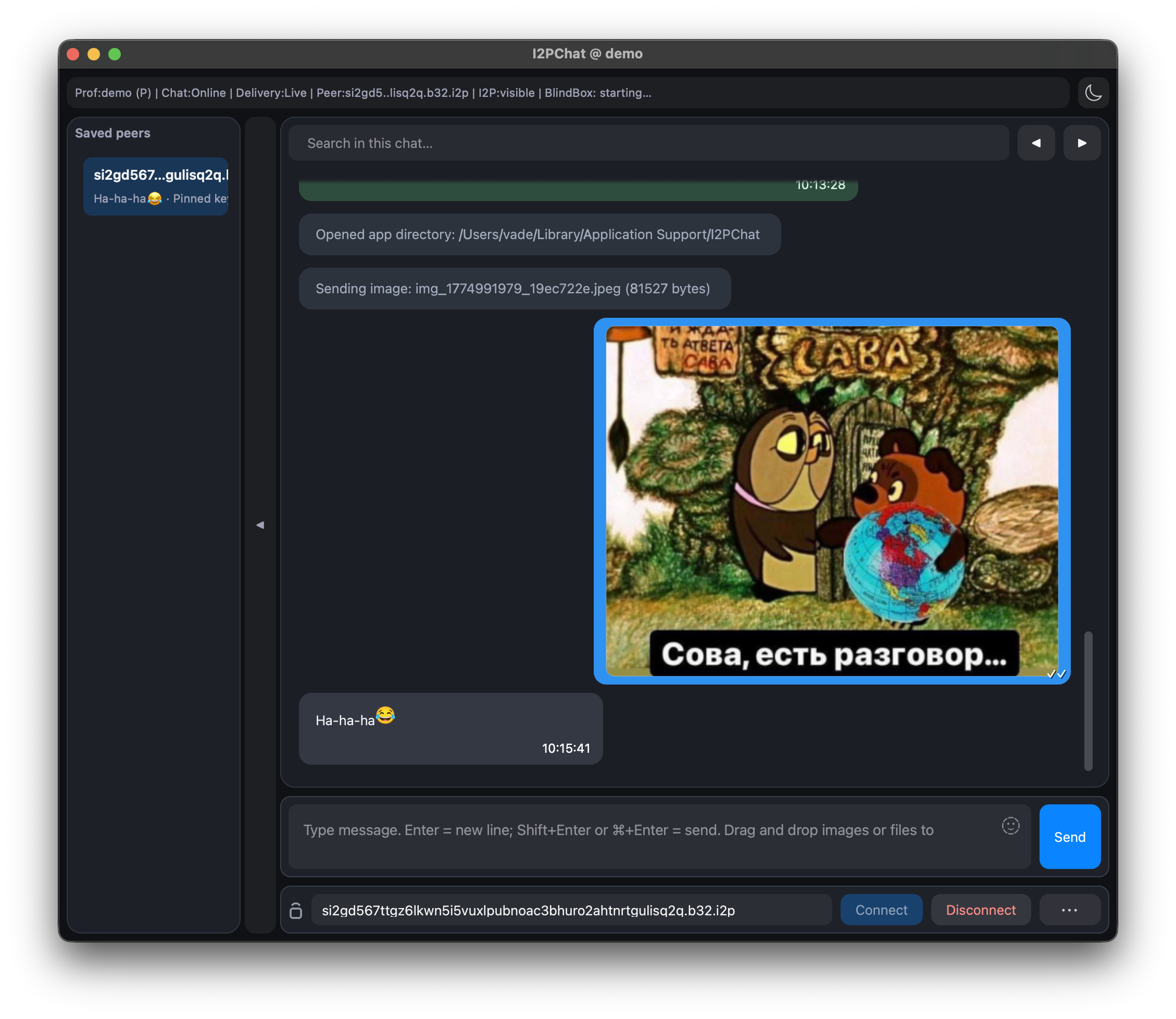
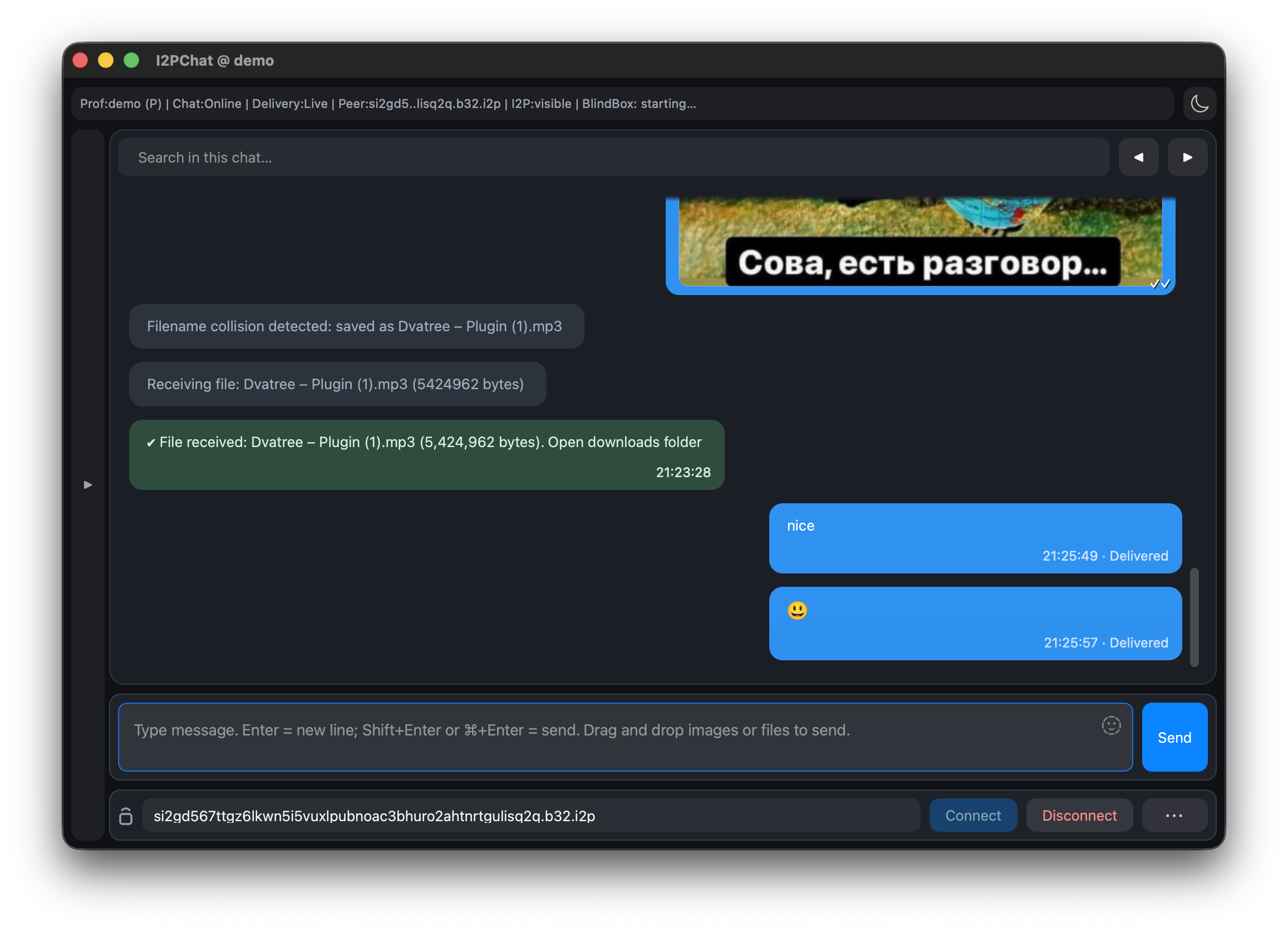
PyQt6 GUI with light and dark themes (macOS-style, consistent and predictable on all platforms)
File transfer and image sending (Send picture: PNG, JPEG, WebP) between peers
Profiles (.dat) — multiple profiles, load and import; each profile’s data lives under profiles// in the app data directory (if older flat*.dat files still sit in the data root, they are migrated on startup into that layout — see § profile paths in MANUAL_EN / MANUAL_RU)
System notifications — tray toasts for new messages
Sound notifications for incoming messages
BlindBox (default-on for named profiles) — offline message delivery
Optional encrypted chat history — per-peer local history (toggle Chat history: ON/OFF in the ⋯ menu); encrypted at rest with keys derived from your profile identity (see §4.11 in MANUAL_EN / MANUAL_RU)
Contact book (Saved peers) — left sidebar list backed by profiles//.contacts.json: quick switch between saved .b32.i2p peers, optional display name/note, unread hints, resize/collapse, and a context menu (edit, trust details, remove). See §3.1 in MANUAL_EN / MANUAL_RU.
Text groups — multi-member conversations over the same vNext stream as 1:1 chat; offline delivery fans out per member via pairwise BlindBox (see the manuals for prerequisites and § on group BlindBox behavior)
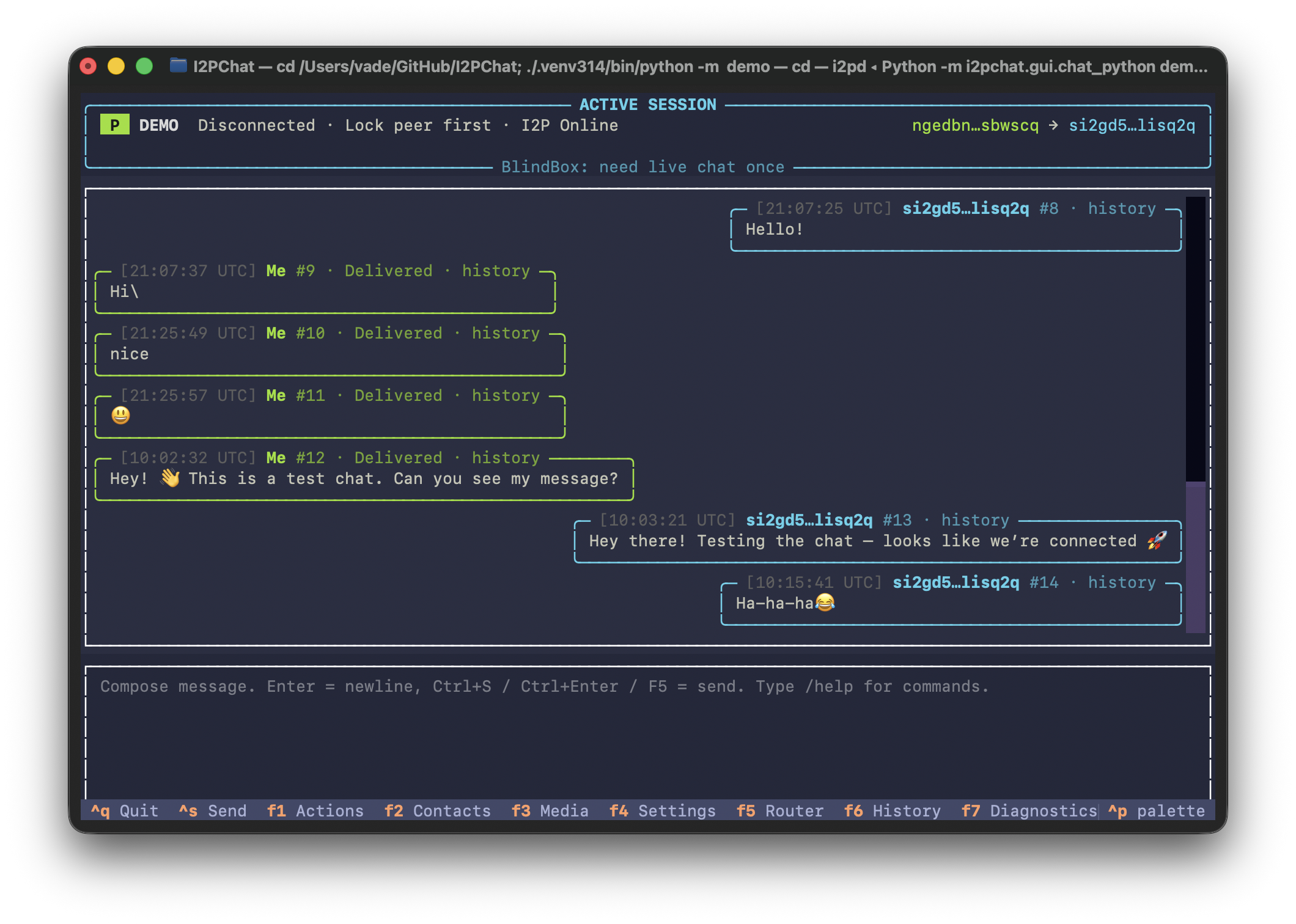
Terminal client (TUI) — terminal user interface: full chat in a text shell (Textual, i2pchat/gui/chat_python.py); shipped as *-tui-* release zips and i2pchat-tui packages (Homebrew, apt, AUR), or python -m i2pchat.tui from source
The runtime is built around one shared async engine — I2PChatCore — plus SessionManager (per-peer transport lifecycle and outbound policy since v1.2.6) and parallel live streams (LivePeerSession rows in _live_sessions[peer_id]), with GroupManager for text groups. Thin UI adapters sit on top; protocol / crypto / BlindBox below.
Toolchain: Python dependencies are managed with uv (pyproject.toml, uv.lock). I2P SAM (router control connection, sessions, streams, naming lookups) is implemented in-tree as i2pchat.sam — not the PyPI i2plib package; the old vendored i2plib tree was removed.
flowchart TB
    subgraph Entry["UI / entrypoints"]
        run["python -m i2pchat.gui
python -m i2pchat.tui
i2pchat/run_gui.py"]
        qt["PyQt6 GUI
i2pchat/gui/main_qt.py
ChatWindow + qasync event loop"]
        tui["Textual TUI
i2pchat/gui/chat_python.py"]
        present["Presentation helpers
i2pchat/presentation/*
status / drafts / replies / unread / groups / notification policy"]
        guiStore["GUI-side persistence
chat_history.py
contact_book.py
group_store.py
profile_backup.py"]
        run --> qt
        qt --> present
        qt --> guiStore
        tui -->|"commands + callbacks"| core
        qt -->|"commands + callbacks"| core
    end

    subgraph CoreRuntime["Shared async core"]
        core["i2pchat/core/i2p_chat_core.py
I2PChatCore
• profile/session bootstrap
• accept/connect orchestration
• _live_sessions[peer_id] → LivePeerSession
• secure handshake + TOFU pinning
• per-peer send/receive loops
• ACK tracking + delivery telemetry
• text / file / image + text groups
• BlindBox root exchange
• delegates transport lifecycle → SessionManager"]
        sessionMgr["i2pchat/core/session_manager.py
SessionManager
per-peer transport state
outbound policy · streams · reconnect"]
        groupMgr["i2pchat/groups/manager.py
GroupManager
live + BlindBox fan-out"]
        retry["Retry helpers
send_retry_policy.py
transfer_retry.py"]
        core --> sessionMgr
        core --> groupMgr
        core --> retry
    end

    subgraph ProtocolSecurity["Protocol + security"]
        codec["Framing codec
protocol/protocol_codec.py
vNext header / flags / msg_id / len"]
        delivery["Delivery state model
protocol/message_delivery.py
sending / queued / delivered / failed"]
        crypto["i2pchat/crypto.py
X25519 + Ed25519
HKDF
SecretBox + HMAC"]
    end

    subgraph BlindBox["Offline delivery subsystem"]
        bbclient["blindbox_client.py
quorum PUT / GET
SAM or direct TCP"]
        bbkeys["blindbox_key_schedule.py
lookup / blob / state keys"]
        bbblob["blindbox_blob.py
encrypted padded offline blob"]
        bbstate["storage/blindbox_state.py
send_index / recv window / consumed set"]
        bblocal["blindbox_local_replica.py
optional local BlindBox"]
    end

    subgraph Transport["Network / external boundary"]
        samLayer["i2pchat.sam (internal)
SESSION / STREAM / NAMING
no PyPI i2plib"]
        sam["I2P router
SAM API"]
        peer["Remote peers
N concurrent SAM streams
one secure session per peer id"]
        boxes["BlindBox replicas
I2P or loopback endpoints"]
    end

    subgraph ProfileState["Profile / local identity"]
        profile["profiles// per profile
.dat + keyring
contacts.json Saved peers
trust store
signing seed"]
    end

    profile -->|"load / save identity,
trust pins, contacts"| core
    core -->|"encode / decode frames"| codec
    core -->|"derive UI delivery semantics"| delivery
    core -->|"handshake, encryption,
MAC, replay checks"| crypto
    core -->|"queue offline text,
root rotation, polling"| bbclient
    core -->|"derive per-message keys"| bbkeys
    bbkeys --> bbblob
    core -->|"persist offline counters
and root metadata"| bbstate
    core -.->|"optional local fallback"| bblocal
    bbclient -->|"stores / fetches blobs"| bbblob
    bbclient <-->|"SAM streams or TCP"| samLayer
    samLayer <--> sam
    sam <--> peer
    bbclient <--> boxes
    core -->|"status / message / file /
delivery callbacks"| qt
Runtime in practice:
Startup: main_qt.py runs profile directory migration when needed (flat *.dat in the data root → profiles//) before the profile picker, then creates ChatWindow; start_core() calls I2PChatCore.init_session(), which loads or creates the profile identity, opens the long-lived SAM session, warms up tunnels, and starts accept_loop() / tunnel_watcher().
Transport lifecycle (SessionManager, since v1.2.6): per-peer transport state (connecting / handshaking / secure / stale / failed), outbound send policy (LIVE_ONLY, PREFER_LIVE_FALLBACK_BLINDBOX, QUEUE_THEN_RETRY_LIVE, BLINDBOX_ONLY), stream registry, reconnect metadata, and inflight ACK hooks live in SessionManager. Parallel live traffic is keyed by peer_id in _live_sessions (LivePeerSession: conn, crypto, ACK tables, receive loop). Legacy self.conn may still reflect the active UI peer; routing and ACKs are peer-scoped, not “single global connection”. Delivery telemetry and UI read this so Send vs Send offline stay correct after handshake.
Live chat path: connect_to_peer() / accept_loop() opens or updates one I2P stream per peer; I2PChatCore runs the handshake, TOFU pinning, and subkeys, then encrypted vNext frames via ProtocolCodec + crypto. Multiple peers can be connected at once (bounded by max_concurrent_live_sessions); the UI selection (current_peer_addr) does not define which peer receives a send — the target peer for that operation does.
Text groups: GroupManager sends group envelopes over the same vNext stream as 1:1 chat; offline text fans out per member via pairwise BlindBox. State: i2pchat/storage/group_store.py (see MANUAL_EN / PROTOCOL).
Delivery tracking: each outgoing text / file / image gets a MSG_ID and ACK context; message_delivery.py turns low-level outcomes into UI states (sending, queued, delivered, failed).
Offline path (BlindBox): when no live secure session is available, send_text() can route through BlindBox — derive deterministic lookup/blob keys, encrypt a padded blob, PUT it to one or more BlindBox replicas, and later poll / decrypt GET results back into the chat stream.
UI responsibility split: I2PChatCore stays UI-agnostic and emits callbacks only; the Qt layer renders chat, status and notifications, while GUI-side storage modules persist chat history, contacts, group state, drafts and backup/export data.
🔌 Protocol overview
Traffic is a byte stream over I2P SAM (one TCP session to the router). Application data is split into vNext binary frames:
┌─────────── vNext frame ────────────────────────────────────────┐
│ MAGIC (4) │ VER (1) │ TYPE (1) │ FLAGS (1) │ MSG_ID (8) │ LEN (4) │ PAYLOAD (LEN bytes) │
└──────────────────────────────────────────────────────────────────┘
After the secure handshake, payloads are encrypted (FLAGS marks it): each body is sequence (8 B) + ciphertext + MAC (NaCl SecretBox + HMAC over metadata).
Message IDs and sequence numbers tie frames to ordering and replay protection; see also padding below.
For a developer-oriented specification with framing, handshake, ACK, transfer,
BlindBox, and code-map sections, see docs/PROTOCOL.md.
BlindBox is your “send now, deliver later” mode for text messages.
Why users like it:
You can message people even when they are temporarily offline.
Delivery happens automatically when they come back online.
The chat stays clean and readable: only real messages, no technical noise.
Works naturally with normal live chat — no extra routine in daily use.
Simple flow:
If the peer is online, the message is delivered live.
If the peer is offline, the app keeps it in the offline queue.
When the peer returns, the message appears automatically.
Practical notes:
For named profiles BlindBox is enabled by default.
For the transient profile random_address (CLI alias default) BlindBox is off.
Disable explicitly with I2PCHAT_BLINDBOX_ENABLED=0.
Deployments can set Blind Box endpoints via env (I2PCHAT_BLINDBOX_REPLICAS, I2PCHAT_BLINDBOX_DEFAULT_REPLICAS, or I2PCHAT_BLINDBOX_DEFAULT_REPLICAS_FILE). Built-in release defaults and further options → manuals / release notes above.
📸 Screenshots
The gallery above is a short subset. screenshots/2.png (⋯ menu), 3.png (profile picker), 5.png (emoji picker), 6.png (BlindBox diagnostics), 8.png (I2P router dialog), 9.png (Blind Box setup examples — install.sh / Copy curl for a custom replica), and 10.png (TUI) are documented inline in MANUAL_EN.md / MANUAL_RU.md.
🛠 Running from source
Requirements:
uv — install once (e.g. brew install uv, or the curl / PowerShell one-liner from the uv docs).
Python 3.12+ (matches CI); 3.14+ is recommended for parity with release build images.
one of:
a systemi2pd router with SAM enabled (default port 7656), or
a bundledi2pd binary shipped with your build/package
Dependencies and versions are locked in uv.lock; declared in pyproject.toml. After changing dependencies, run uv lock and commit the updated lockfile.
Quick run commands (from repo root). uv keeps the project environment in .venv (default); the commands below are enough.
Linux (Debian/Ubuntu) — system packages you may need:
# Python 3.14 (if missing)
sudo apt install python3.14 python3.14-venv

# PyQt6 6.5+ on X11: without this, Qt may fail to load the "xcb" platform plugin
# (error: xcb-cursor0 / libxcb-cursor0 is needed)
sudo apt install libxcb-cursor0
macOS / Linux
uv sync --python 3.14
uv run python -m i2pchat.gui.main_qt    # GUI; optional profile name as first arg
uv run python -m i2pchat.tui            # terminal (TUI)
Windows (PowerShell)
uv sync --python 3.14
uv run python -m i2pchat.gui.main_qt
uv run python -m i2pchat.tui
If the environment is already synced, you can run only the uv run python -m … lines you need.
SAM stack: live and BlindBox I2P traffic goes through i2pchat.sam (async client + protocol builders). You do not install i2plib from PyPI for this project.
The same GUI path is available as python -m i2pchat.run_gui (matches i2pchat/run_gui.py, the PyInstaller analyzed script) or python -m i2pchat.gui. Prefer -m from the repo root; running the .py file directly can break package imports.
PyInstaller builds use i2pchat/run_gui.py as the GUI entry script (equivalent to python -m i2pchat.gui / python -m i2pchat.gui.main_qt). Release zips can also ship I2PChat-tui / i2pchat-tui from a separate slim spec. All modules live under i2pchat/.
Developer note (BlindBox):i2pchat/blindbox/blindbox_server_example.py is the hardened service implementation, while the production-oriented package entrypoint is python -m i2pchat.blindbox.daemon. The repo now also ships package-local systemd, env, install/bundle helper scripts, a one-shot install.sh, and fail2ban assets under i2pchat/blindbox/daemon/ and i2pchat/blindbox/fail2ban/. Public replicas behind an I2P tunnel may keep replica auth empty; raw TCP / loopback exposure should still keep a token. See §4.9 in MANUAL_EN / MANUAL_RU.
🔧 Cross-platform builds
The project is intentionally cross‑platform and ships with helper scripts for the main targets.
Everywhere, the recommended/runtime version is Python 3.14+. SAM transport is implemented in i2pchat.sam (PyPI i2plib is not a runtime dependency).
Linux (GUI AppImage)
./build-linux.sh
This script:
Requires uv; uses python3.14 (or python3) and uv sync into .venv (runtime + build group).
Builds a self‑contained GUI binary via PyInstaller.
Packs it into I2PChat.AppImage using appimagetool.
Creates release archive I2PChat-linux--v.zip (contains I2PChat.AppImage); arch is x86_64 or aarch64 depending on the host. CI publishes matching I2PChat-linux-aarch64-v*.zip and may attach SHA256SUMS.linux-aarch64 separately from the amd64 checksum file.
Bundled i2pd: before PyInstaller, scripts/ensure_bundled_i2pd.sh stages binaries under vendor/i2pd/. If that tree is empty, it clones by defaultgithub.com/MetanoicArmor/i2pchat-bundled-i2pd into .cache/bundled-i2pd-source/ (override with I2PCHAT_BUNDLED_I2PD_GIT_URL, disable git fetch with I2PCHAT_SKIP_BUNDLED_I2PD_GIT=1 or I2PCHAT_BUNDLED_I2PD_GIT_URL=). See docs/BUILD.md.
macOS (GUI .app bundle)
./build-macos.sh
Uses Python 3.14+ (from PATH or Homebrew).
Builds dist/I2PChat.app via PyInstaller.
Windows build (GUI)
For reproducible Windows builds there is a PowerShell script:
powershell -NoProfile -Command "Set-ExecutionPolicy -Scope Process RemoteSigned; .\build-windows.ps1"
This limits policy relaxation to the current process and does not change machine/user policy permanently.
It will:
Require uv on PATH (install from the uv docs if needed).
Run uv sync --frozen --group build --no-dev so uv.lock pins runtime + PyInstaller tooling.
Build a GUI‑only PyQt6 binary:
Output folder: dist\I2PChat\
Main executable: dist\I2PChat\I2PChat.exe
The resulting I2PChat.exe is self‑contained and can be distributed to machines without Python installed.
Verify release artifacts
Release build scripts generate:
SHA256SUMS file for produced release archive(s) (Linux aarch64 builds may use a separate SHA256SUMS.linux-aarch64 on GitHub Releases so amd64 sums are not overwritten);
detached armored GPG signature SHA256SUMS.asc (best-effort by default).
These files are not tracked in git (they differ per OS/build); upload them with the release assets on GitHub.
I2PCHAT_REQUIRE_GPG=1 — fail build if GPG signing is unavailable or fails;
I2PCHAT_GPG_KEY_ID= — select a specific key for detached signature (avoids “no default secret key” when you have several keys or no default-key in gpg.conf);
I2PCHAT_GPG_BATCH=0|1 — override auto mode: by default the Linux/macOS scripts use gpg --batch only when neither stdin nor stdout is a TTY (typical CI). If either is a TTY (including build.sh | tee log), they omit --batch so pinentry can ask for your passphrase. Force batch with I2PCHAT_GPG_BATCH=1 (needs gpg-agent with a cached passphrase if the key is protected).
Official release builds should set I2PCHAT_REQUIRE_GPG=1 so unsigned archives are not produced silently; publish SHA256SUMS and SHA256SUMS.asc next to each asset.
The transport is encrypted after handshake, but some protocol metadata remains
observable on the wire:
frame type (TYPE);
frame length (LEN);
pre-handshake peer identity preface exchange.
To reduce traffic-shape leakage, encrypted payloads use a padding profile:
default: balanced (pads encrypted plaintext to 128-byte buckets);
optional: off (disable padding).
You can override the profile with:
I2PCHAT_PADDING_PROFILE=off python -m i2pchat.gui
Trade-off: stronger padding reduces length correlation but increases bandwidth.
❄️ NixOS
# Run directly
nix run github:MetanoicArmor/I2PChat

# Install into your profile (adds `i2pchat`, `i2pchat-tui`, desktop entries and icon)
nix profile install github:MetanoicArmor/I2PChat

# Development shell
nix develop github:MetanoicArmor/I2PChat
The flake now wraps the app with the Qt runtime pieces that are easy to miss on NixOS sessions: Wayland/platform plugins, multimedia/image plugins, desktop metadata, and Linux notification/sound helpers (notify-send, canberra-gtk-play, paplay, aplay).
System keyring integration is optional. If no Secret Service backend is available, I2PChat falls back to file storage automatically; for native keyring support on NixOS, enable a provider such as gnome-keyring or KeepassXC Secret Service.
📄 License
I2PChat is licensed under the GNU Affero General Public License v3.0 (or any later version — see section 14 of the license). The full text is in LICENSE.
Bundled i2pd binaries, when injected for portable release builds, follow their upstream licenses. The application SAM stack is i2pchat.sam (no PyPI or vendored i2plib).
☕ Buy me a coffee
If you like this project and want to support development, you can send a small donation in Bitcoin:
Latest release — bundles match v + VERSION in this repo (v1.3.2 in the table below; update these rows when you tag a new release so latest/download/… filenames stay valid). No Python on the target machine for these zips.
Full zip layouts, winget, .deb, Flatpak notes → docs/INSTALL.md.
> Router backend: On a fresh install (no router_prefs.json yet), I2PChat defaults to a systemi2pdSAM endpoint (typically 127.0.0.1:7656). Switch to the bundled sidecar when your build includes it via More actions → I2P router… (shortcut Cmd/Ctrl+R); the choice is persisted. The same dialog opens the router data/log paths and can restart the bundled router.
📦 Package managers
Windows (x64) — winget (community manifests in winget-pkgs; ships the *-winget-* zip without embedded i2pd. For a bundled router, use the full *-windows-x64-v*.zip from Releases.)
If the catalog lags behind a fresh release merge, winget show MetanoicArmor.I2PChat lists available versions; use --version x.y.z only when you need to pin one.
(brew tap MetanoicArmor/i2pchat then brew install --cask i2pchat works too.)
Arch Linux — AUR (x86_64 and aarch64; example yay)
yay -S i2pchat-bin       # GUI — AppImage from release
yay -S i2pchat-tui-bin   # TUI only
> Not this repo:i2pchat-git (yay -S i2pchat-git) builds vituperative/i2pchat — another I2P chat client (Qt5). It may still install and run as that app, but it is notMetanoicArmor/I2PChat (Python / PyQt6 / Textual TUI). For this project use i2pchat-bin / i2pchat-tui-bin, or clone this repo and run python -m i2pchat.gui / python -m i2pchat.tui.
Debian / Ubuntu — .deb from Releases (works without any mirror):
# after downloading e.g. i2pchat_1.3.2_amd64.deb
sudo apt install ./i2pchat_*_amd64.deb
# optional TUI-only: sudo apt install ./i2pchat-tui_*_amd64.deb
Optional apt mirror (GitHub Pages, amd64 only): exists only after someone sets APT_REPO_GPG_PRIVATE_KEY and runs the publish workflow — see packaging/apt/README.md. Until then,curl …/KEY.gpg will 404; use the .deb commands above.
If a mirror is live, add it with deb822 (.sources):
sudo mkdir -p /etc/apt/keyrings
curl -fsSL "https://metanoicarmor.github.io/I2PChat/KEY.gpg" | sudo gpg --dearmor -o /etc/apt/keyrings/i2pchat.gpg
sudo tee /etc/apt/sources.list.d/i2pchat.sources >/dev/null <<'EOF'
Types: deb
URIs: https://metanoicarmor.github.io/I2PChat
Suites: stable
Components: main
Signed-By: /etc/apt/keyrings/i2pchat.gpg
Architectures: amd64
EOF
sudo apt update
sudo apt install i2pchat i2pchat-tui   # pick one or both
I2PChat is a cross‑platform chat client for the I2P anonymity network over SAM — PyQt6 GUI with light/dark themes and an optional terminal (TUI) build on the same core.
Audit / Аудит
📜 Sur le secret — Pierre Janet
> Chez l'homme naïf la croyance est liée à son expression. Avoir une croyance, c'est l'exprimer, l'affirmer; beaucoup de personnes disent: «Si je ne peux pas parler tout haut, je ne peux pas penser. Si je ne parle pas de ce en quoi je crois, je ne peux pas y croire. Et, au contraire, quand je crois quelque chose, il faut que je l'affirme; quand je pense quelque chose, il faut que je le dise.» Si l'on empêche ces personnes de parler, elles penseront à autre chose. Le secret n'est donc pas une fonction psychologique primitive, c'est un phénomène tardif. Il apparaît à l'époque de la réflexion.
>
> Il vaut mieux ne pas communiquer ses projets: en les racontant on se met immédiatement dans une position défavorable. Même si l'idée n'est pas prise, elle sera critiquée d'avance. Il ne faut pas montrer les brouillons. Que se passera-t-il si vous commencez à exprimer toutes vos rêveries, toutes ces pensées «pour vous-même» qui vous soutiennent? Les autres se moqueront de vous, diront que c'est ridicule, absurde, et détruiront vos rêves. «Peu importe», direz-vous, «puisque je sais bien moi-même que ce ne sont que des rêves». Mais en détruisant vos rêves, ils emporteront aussi votre courage et l'enthousiasme que vous y puisiez.
>
> Il vient une époque où il n'est plus toujours bon d'exprimer au dehors les phénomènes psychologiques, de les rendre publics. Dans la société, dans le groupe auquel nous appartenons, il faut savoir garder certaines choses secrètes et en dire d'autres; avoir quelque chose pour soi et quelque chose pour les autres. C'est une opération difficile qui se rapproche de l'évaluation, car pour produire une impression favorable il vaut mieux ne pas tout dire. Tout le monde devrait savoir faire cela. Mais c'est difficile et les timides y réussissent mal; aussi l'une de leurs difficultés dans la société est-elle un trouble de la fonction du secret.
>
> Il existe toute une catégorie de personnes — les primitifs, les enfants, les malades — chez qui la fonction du secret n'existe pas; ils ne savent pas ce que c'est. Le petit enfant n'a pas de secret. Le malade en état de désagrégation mentale parle tout haut et dit toutes sortes de sottises: il ne comprend absolument pas qu'il y ait des choses qu'il faut garder secrètes.
Created with ❤️ by Vade for the privacy and anonymity community










 Linux (Debian/Ubuntu) — system packages you may need:
 macOS / Linux
 Windows (PowerShell)
 Arch Linux —
