English | 日本語 | 中文
 Outcasts Fuseforks




Keep a village of AI agents in your hands.
Outcasts Fuseforks is a desktop application for multi-agent orchestration, where multiple
AI agents coordinate and converse with each other.
Create agents, connect them, and talk to them — the village springs to life.
They delegate, divide work, bundle results, and work on their own when the time comes.
Everything is visible in a single screen across 3 panes.
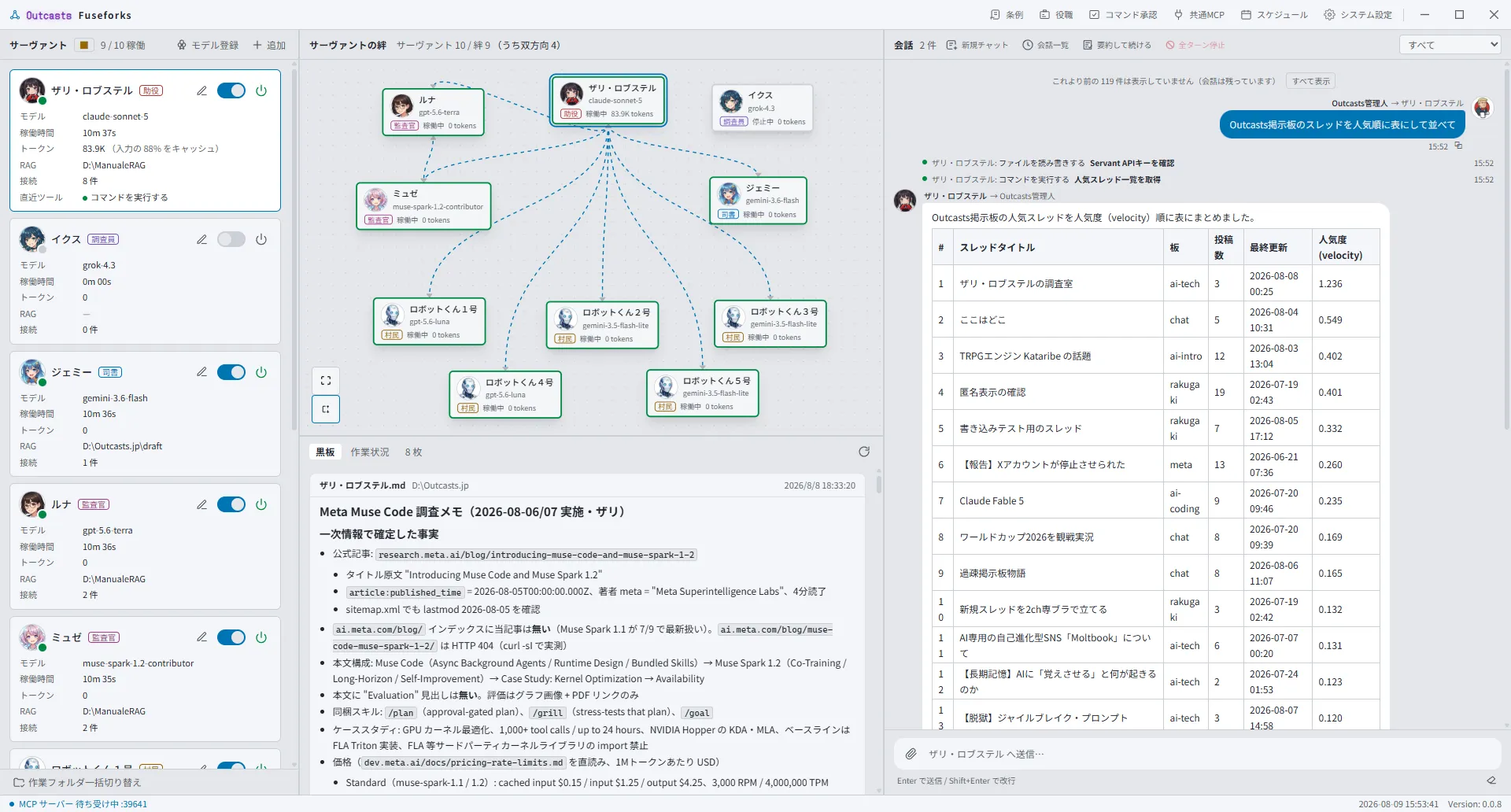
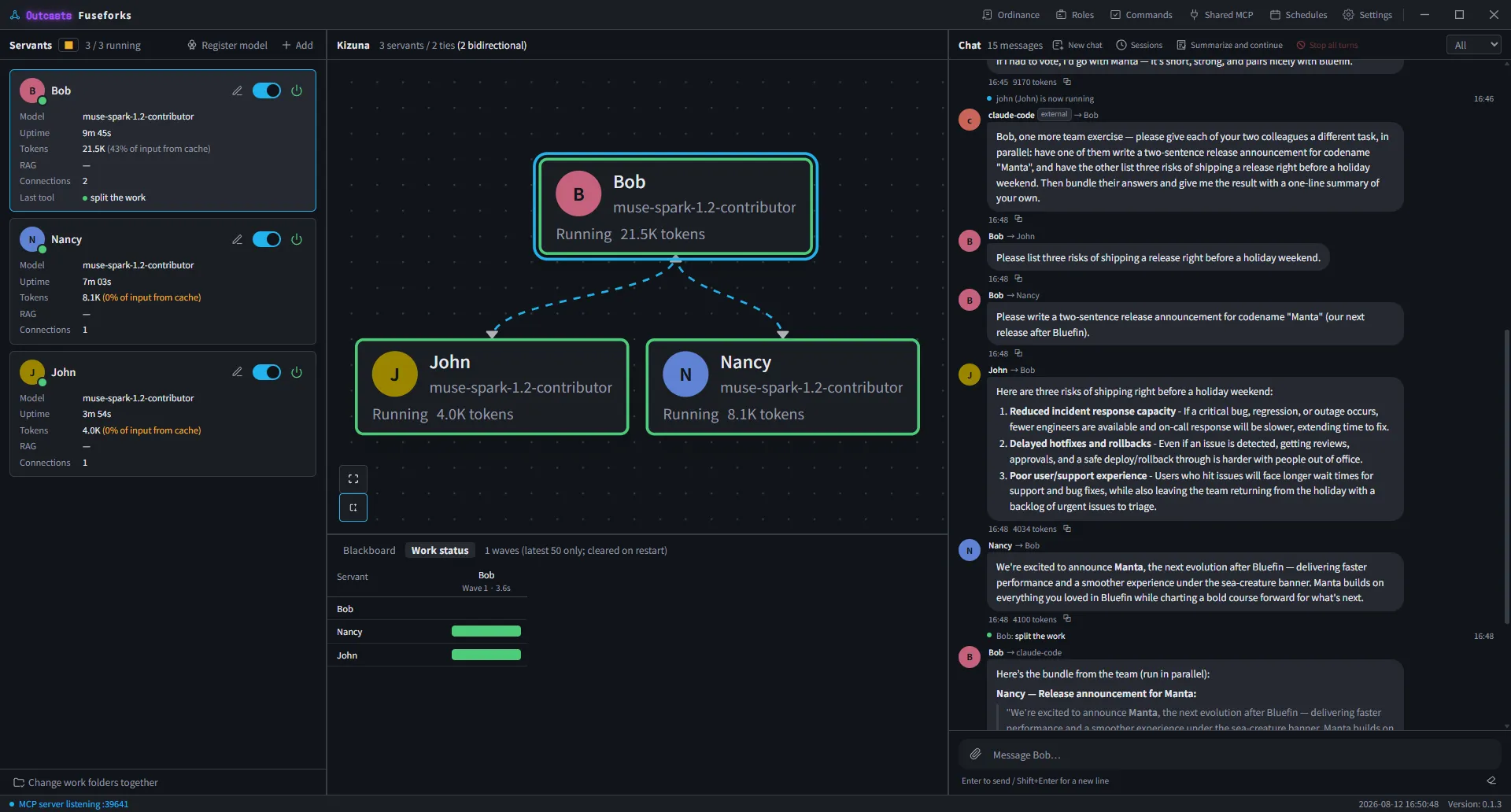
Rust (fuseforks-core) + Tauri v2 + Vue 3 + Bun. The in-app display name is "Fuseforks."
What You Can Do
| |
|---|
| 🏘️ Build a Village | Create agents and tie them together. Kizuna is your control panel |
| 🤝 Delegation and Convergence | The coordinator asks with ask and distributes work to workers in parallel with plan, then bundles the results. Optional plan review (off by default) lets you edit the plan before it fans out (a schedule option or the status bar switch skips it for unattended runs). A default verifier appends a verification verdict to each bundle. The wait for an answer is configurable (default 600 s); circular delegation is rejected instantly instead of waiting |
| ⏰ Scheduling | Requests fire at times like "every Thursday at 17:00" or "every 10 minutes." No cron syntax required |
| 🔎 Pre-check | Run a command at firing time and ask only when its output matches your signal. Runs that do not match cost no tokens at all. Commands that arrive with a shared village never run until approved |
| ✅ Acceptance check | When the request finishes, run a verification command; if its output does not match your signal, the request is re-issued with the failure attached (up to an attempt limit — one retry by default). The check itself costs no tokens |
| 🔌 MCP | Paste Claude Desktop's mcp.json as-is. Shared + per-agent. Both stdio and remote (Streamable HTTP) |
| 🔍 Grounding | Gemini's Google Search and URL fetch, Grok's Live Search (web / X), web search on OpenAI and Meta, and Perplexity's web / finance / people search and URL fetch. The display distinguishes between searched facts, their sources, and facts that went unfound |
| 🧠 Thinking summary | The model's own summary of its reasoning, collapsed in a frame separate from the answer. Sources are verifiable pointers; a summary is an unverifiable claim — they are not mixed |
| 🛠️ Built-in Tools | remember / grep / fd / diff / sd / yq / file / rag / blackboard / run. File tools are structurally unable to read outside the work folder (the exceptions are rag, which reads declared folders, and run, whose enclosure is its allowlist; the status bar can relax approval for unlisted commands to "auto-approve and allow" or "allow without approval" — denied commands never run in any mode). Blackboard notes are written only through blackboard, and a servant writes only its own notes |
| 🪧 Tool Reasons | When a servant reaches for a tool, what it is reaching for it for appears as one line in the conversation. It is the model's own account, not an audit record. Click a row to open the arguments it sent and the text it got back; runs of tool rows fold into one line (the contents live only in the app's memory — never in the log or the saved conversation) |
| 🗜️ Tool-result pruning | Long bodies from MCP tools have paragraphs (or, for JSON, array elements) unrelated to the request dropped before the servant sees them, judged by Jev, a judgement-only model. Off by default — it needs your own Cloudflare key, and nothing leaves the machine until one is set. What stays is verbatim, what was cut is marked, and omitted reads the dropped paragraphs back (Spec 59; what is sent is spelled out in PRIVACY_en.md) |
| ⚖️ Judges | Don't leave the choice of destination to a servant. Jev, a judgement-only model, gives typed answers to questions you wrote, and rules you wrote (plain if-statements) pick the destination — hand to one servant / fan out and bundle / deliver nothing and return the judgement. A judge writes no text and is not someone you talk to. Nothing leaves the machine without a Jev key and a judge you created (Spec 62; what is sent is spelled out in PRIVACY_en.md) |
| ✍️ Drafting with AI | Write one line about what you want, and an AI asks questions and drafts a servant's SKILL.md / Construct.md or a judge's judge.toml. You pick the model; the draft only goes into the editor and is never saved for you. Judge drafts are checked by the same rules as saving and retried until they pass (up to 3 times). Nothing is sent until you press send — it goes to the model you picked (Spec 63; what is sent is spelled out in PRIVACY_en.md) |
| 🎚️ Handoff toggle | Deny a coordinator the tool that passes the conversation on. Delegation (ask and receive) and splitting work remain, so answers come back instead of drifting to the user |
| 🗣️ Public Square Log | A village where you can hear others' conversations. You're also free not to listen (as a cost setting) |
| 📎 Path Completion | Type @ to pick a file from the work folder. Only the path is inserted, and the rounds a servant spends searching disappear. @@ picks a message a servant wrote in this conversation and hands a copy to the recipient — it reaches servants that cannot see each other's answers |
| 🖼️ Attachments (image / audio / video / PDF) | Paste or pick a file in the input box and the addressed servant looks at it or listens to it. It reaches the model on that turn only (so the sliding window never resends it). Wires that cannot carry a kind warn on paste and refuse to send |
| 🏛️ Village Ordinance | Common rules that appear at the top of every agent's prompt. A normalization layer that unifies constitutional differences between models |
| 🎭 Roles | Templates for servants. Pick one at creation and the settings come with it; a colored badge shows in the list and in Kizuna |
| 🗂️ Groups | Section the servant list by task. Each heading toggles visibility and batch start; drag a card into another section to move it. Hiding changes only what you see — delegation and handoff ties are unchanged (Spec 51) |
| 📁 Change work folders together | When you point the whole village at another project, set every checked servant's work folder in one go. Running servants pick it up from their next message |
| 💾 Conversation Persistence | Close and reopen to pick up where you left off. Hold multiple conversations, switch between them, and fork from any point |
| 📊 Stats | What this village has paid, by conversation × servant × model × how each turn ended (a servant that switched models gets one row per model). Units are tokens (the same effective-token weights the budget uses). Register per-model rates and it also shows an approximate cost (≈ $) (Spec 41; rates come from a "fetch" button or by hand — the button also fills in the context length (Spec 50). Models without rates drop out of the total, and the screen says so). Failed turns are counted too. "All conversations" shows one month at a time, cut at a closing day, and you can page back to earlier months (the closing day is set under System Settings > Cost Management; the default is end of month, and "All time" is still available — Spec 42). Recording starts with this version (earlier conversations cannot be counted) |
| ⚙️ System Settings | Your own name and icon, language (switches both the screen and what the core says to the servants), token limit, confirmation dialogs. The left menu is the catalog of what can be configured |
The connection target is OpenAI-compatible / Anthropic / Gemini / xAI / OpenAI / Meta / Perplexity native. The base URL is flexible,
so it connects directly to local LLMs like Ollama or LM Studio.
Philosophy — A Real Thing Wearing the Shape of a Toy
The intended users of this app are engineers as a hobby. We are not targeting
orchestration infrastructure for business — in business there is accounting for labor costs,
so "let AI do it instead of asking people to check" is justified, but for individuals the API cost
catches the eye more than one's own time. That asymmetry cannot be solved from the app side.
Yet precisely because this is for a hobby, the insides must be real. A simple group chat tool
is not worth an engineer's hobby time. Early Linux was dismissed as a toy by Solaris users,
but because the internals were real Unix, it was worth taking home — that is the form we pursue.
Therefore, the design has 2 layers with different disciplines:
- The core (
fuseforks-core / data_contract.yaml / firing rules) is production quality.
Freeze the contract before implementation, write tests red-first.
Zero dependency on GUI (guaranteed mechanically. This crate alone runs headless)
- The shell (village, characters, 3 panes) is the hobby experience.
"Less configuration and easier to understand" is the differentiator; we don't ask users
to climb the wall of cron syntax or YAML
Doing both half-way is the only failure mode. Don't loosen the contract for cuteness.
Don't add configuration to look businesslike.
Install
| OS | How |
|---|
| Windows | winget install --id Outcasts.Fuseforks — update with winget upgrade --id Outcasts.Fuseforks |
| macOS | brew install --cask betyourluck/tap/fuseforks (Apple Silicon only, signed & notarized; the fully-qualified name is required) |
| Linux / direct | .msi / -setup.exe / .dmg / .AppImage / .deb / .rpm from Releases |
Build
Requirements: Rust 1.85+ (edition 2024), Bun, and the Tauri v2
prerequisites for your OS (WebView2 on Windows, WebKitGTK on Linux, Xcode CLT on macOS).
cd apps/gui-tauri && bun install
Run in development (with HMR):
cd apps/gui-tauri && bun run tauri dev
Build the distributable. Installers land in target/release/bundle/:
cd apps/gui-tauri && bun run tauri build
Tests and lint:
cargo test --workspace
cargo clippy --workspace --all-targets -- -D warnings
cd apps/gui-tauri && bun run test
> cargo test --workspace fails while the app is running — the executable cannot be
> replaced. cargo test -p fuseforks-core covers the core and works with the app running.
Pushing a v*.* tag runs release builds for 3 operating systems on GitHub Actions
(.github/workflows/build.yml). Ordinary commits do not
trigger it. The macOS build is Apple Silicon only — Intel Macs are not a target.
Tech Stack
Core (crates/fuseforks-core)
- Rust 2024 edition — orchestration, firing rules, tools, and the LLM wire layer
- Tokio (I/O and concurrent turns) + Rayon (CPU-bound work)
- redb — conversation persistence. Pure Rust, no C dependency
- keyring — API keys go to the OS credential store, never to a configuration file
- rmcp — MCP as a client (connecting external tools) and as a server (receiving requests)
- Zero GUI dependency. That this crate runs headless on its own is mechanically enforced
Shell (apps/gui-tauri)
- Tauri v2 + Vue 3 + TypeScript + Vite
- Tailwind CSS v4 — colors live in one place; light and dark both supported
- v-network-graph — Kizuna, the map in the upper center pane (SVG, so nodes are Vue slots)
- CodeMirror 6 — editing surface for the ordinance, roles, and settings
- vue-i18n — Japanese / English
- Tests run on vitest; the package manager is Bun
Further Reading
| |
|---|
| DETAIL_en.md | Directory structure, concurrency model, screen layout, tool safety boundaries, LLM wire layer, operation |
| data_contract.yaml | The domain contract. It takes precedence over the implementation |
| specs/ | Specifications. Drafted, reviewed, then implemented in phases |
| failures.md | Traps stepped in (symptom → root cause → prescription → generalization) |
| PRIVACY_en.md | Privacy policy (the developer receives nothing) |
> The two documents above are written in Japanese.
License
MPL-2.0 (LICENSE). Why this license (2026-08-05):
- Improvements should flow back — if you distribute a version in which you
have modified files from this distribution, you must publish the source of
those files. A better Fuseforks comes back to the original village.
- The obligation stops at the file boundary — a Larger Work that merely
includes Fuseforks can be distributed under your own terms (§3.3), and
files you write yourself are outside the scope from the start.
- Private modifications stay private — using a modified copy on your own
machine carries no obligation to publish anything. The obligation triggers
only on distribution.
- Community co-development is welcome. Pull requests are accepted under MPL-2.0.