KernRift
KernRift is a bare-metal systems programming language and compiler created by Pantelis Christou.
A self-hosted systems language compiler for kernel-first development. KernRift compiles itself — no Rust, no C, no LLVM, no external toolchain. It produces native executables for x86_64 and AArch64 on Linux, Windows, macOS, and Android, with BCJ+LZ-Rift-compressed fat binaries as the default output (8 platform slices per .krbo). The kr runner executes .krbo fat binaries on any supported platform. The compiler self-hosts on all 8 targets, with the per-target caveats in What is actually proven — read that before relying on any of them. The compiler ships with an optimising IR backend — not SSA; linear three-address code over unbounded vregs, with named variables reusing one vreg across assignments — with liveness analysis, graph-coloring register allocation, an AST-level function inliner, Briggs/George copy coalescing, LICM, constant folding, DCE, and CSE — producing native machine code for all targets directly from the IR, no assembler in the loop.
Beyond the eight hosted platform targets, the same IR feeds three embedded
backends — 32-bit RISC-V (--arch=riscv32), Xtensa LX6 (--arch=xtensa),
and the ESP32 machine target (--target=esp32), which emits a direct-boot
image the mask ROM loads straight from flash. These backends are a deliberate
subset of the language, not a second full implementation: see
Embedded targets for exactly what
is and is not supported.
What is actually proven
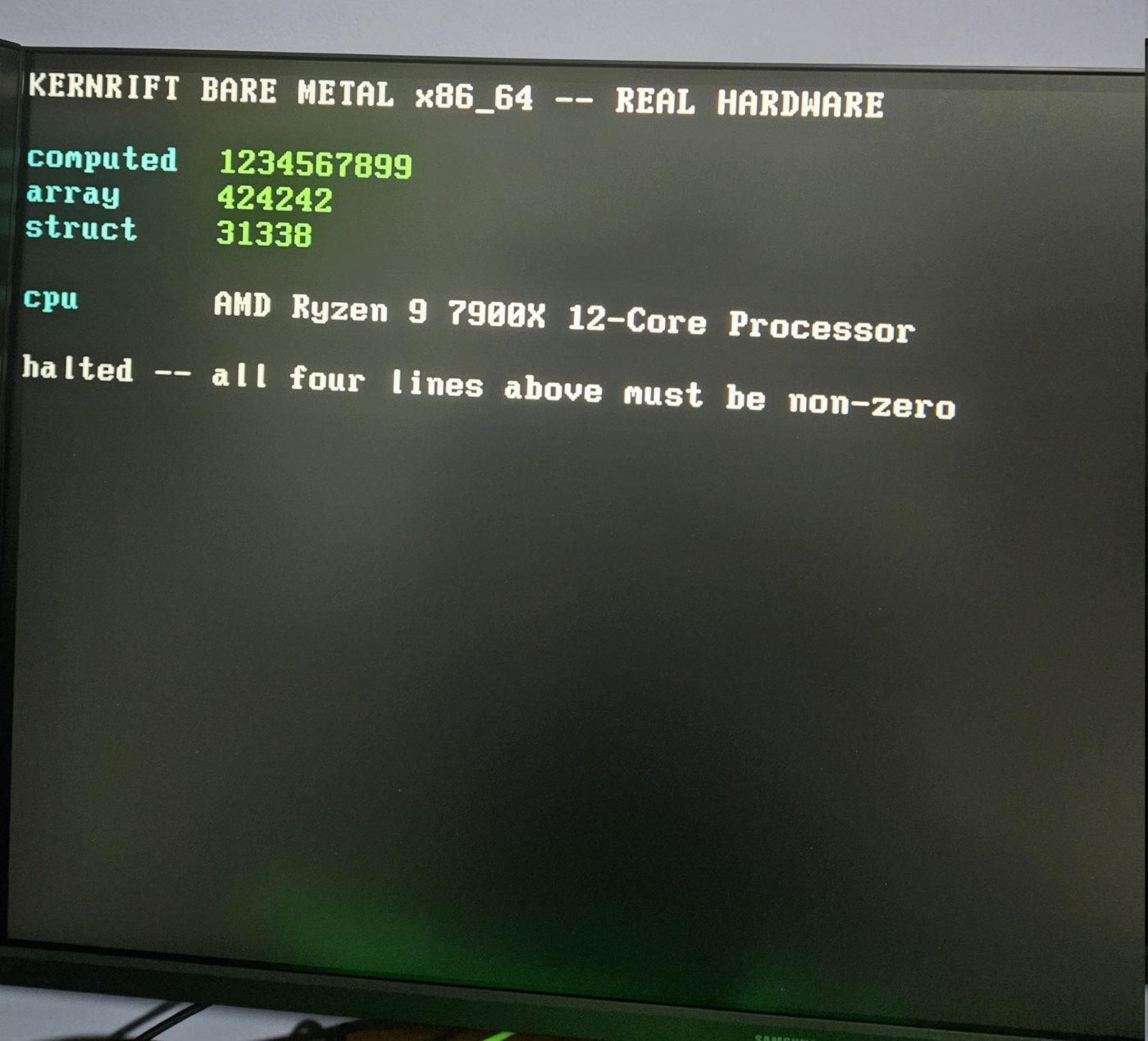
2026-08-13. A KernRift program, compiled by KernRift, booted from a USB stick
on a physical AMD Ryzen 9 7900X with no operating system underneath it. The
values are computed at runtime, not printed literals. The cpu line is read
out of CPUID leaves 0x80000002–0x80000004 by the program itself — under
emulation that line reads QEMU Virtual CPU version 2.5+, so the photograph
authenticates itself. Source:
tests/target_none/boot/hw_sentinel_x86.kr.
Read this table before anything else in this README. It is the honest version
of every capability claim below it, and where the two disagree, this table
wins.
| Status | Meaning |
|---|
| 🟢 Real hardware | Ran on physical silicon, with evidence that could not have been produced under emulation. |
| 🔵 CI-verified | Runs on every push, on a real runner of that OS/arch. |
| 🟡 Emulated, translated, or partial | Nothing outside an emulator has run it, or it runs natively but is only partly exercised. The row says which. |
| 🟠 Experimental | Usable, but a deliberate subset with limits that will stop you quickly. |
| 🔴 Not implemented | Refused at compile time. |
| ⚪ Out of scope | A deliberate boundary or an inherent property of the output — not a TODO, and not something to be fixed by trying again. |
Hosted targets — this is where the real coverage is
| Target | Status | What was actually run |
|---|
| Linux x86_64 | 🔵 CI-verified | Self-compiles to a bootstrap fixed point; the full 1620-test suite passes. This is the primary development target. |
| Linux ARM64 | 🔵 CI-verified | Self-compiles to a fixed point; suite runs on a native ARM64 runner. |
| Windows x86_64 | 🔵 CI-verified + hardware | Self-compile chain on a windows-latest runner every push. Also verified 2026-08-14 on a physical Intel Core Ultra 9 275HX / Windows 11 Pro laptop: the compiler rebuilt its own source twice on the machine and stages 1-3 are byte-identical (sha256 5b21ae16…), with the laptop-built compiler then compiling and running a program correctly. |
| Windows ARM64 | 🔵 CI-verified | Self-compile chain through a fixed point on a windows-11-arm runner. |
| macOS x86_64 | 🟡 Translated | GitHub has no x86_64 macOS runner here: the macos-14 runner is ARM64, and the x86_64 slice is executed through arch -x86_64, i.e. Rosetta translation. It runs and it self-compiles, but not on an x86_64 Mac. |
| macOS ARM64 | 🟡 Partly verified | CI runs cross-compiled test binaries on macos-14, but there is no self-compile step for macOS ARM64 in CI. Treat "self-hosts on ARM Macs" as untested by CI. |
| Android ARM64 | 🟢 Real hardware | Self-compiles to a bootstrap fixed point on a physical phone. Verified 2026-08-14 on a Redmi Note 8 Pro (Android 11, arm64-v8a): the compiler was pushed over adb, rebuilt its own 3.1 MB source on the device in 4.9 s, and the stage-2 and stage-3 binaries are byte-identical (sha256 8a39f8f6…) to each other and to the cross-compiled one. The phone-built compiler then compiled and ran a program correctly. This runs under bionic — /system/bin/linker64 is the Android runtime linker and the device has no glibc loader at all. CI cannot reproduce this: its Android jobs run PIE ELFs under the glibc loader on Linux. |
| Android x86_64 | 🟡 Emulated in CI | The Android artifact is executed by invoking /lib64/ld-linux-x86-64.so.2 directly on the x86_64 Linux CI box. No bionic, no device. |
| Capability | Status | What was actually run |
|---|
| x86_64, GRUB multiboot | 🟢 Real hardware (2026-08-13) | Booted from USB on an AMD Ryzen 9 7900X desktop and printed to VGA text memory. The artifact prints the CPU's own brand string from CPUID leaves 0x80000002–4, so the screen is self-authenticating: under emulation that line reads QEMU Virtual CPU version 2.5+, and on the desktop it read the AMD part. Source: tests/target_none/boot/hw_sentinel_x86.kr. This is the project's strongest single claim. |
arm64 bare metal (--emit=image) | 🟢 Real hardware | The boot gate's sentinel runs under qemu-system-aarch64, but the interesting result is downstream: a KernRift Phone OS boots on a Redmi Note 8 Pro (MediaTek MT6785) and drives real peripherals — MMU on with caches, the full 1080×2340 framebuffer, MT6360 PMIC over I2C5, MTK SPI5, and a Novatek NT36672A touchscreen whose ~110 KB firmware the KernRift code downloads into the chip's SRAM each boot. A zero-Rust variant emits the boot image from krc --emit=image --image-header --stack-top --load-addr alone — no rustc, no linker script — with the required gzip done by std/gzip.kr. That artifact carries a valid arm64 Image header (ARMd magic, image_size 0x5780, flags 0xa), byte-shaped exactly as krc emits today. I have booted this on my own handset; it is not reproducible from this repo alone. |
UEFI (--emit=uefi) | 🟡 QEMU only | Loads and prints under OVMF (x86_64) and AAVMF (arm64) — emulated firmware, not a vendor's. |
| UEFI + Secure Boot | ⚪ Incompatible (measured) | An MS-key OVMF refuses the identical artifact that runs with Secure Boot off. The images are unsigned, so a firmware that checks signatures rejects them — that is the system working, not a compile-time refusal or a defect. Signing would need a key, an sbsign equivalent, and a .reloc-free image the signer accepts; none of that exists here and none is planned. |
--reset-vector | 🟡 QEMU only, by design | A 64 KiB image boots from the CPU reset vector under qemu -bios, reaching real → protected → long mode. It replaces firmware, so running it on a real board means flashing a BIOS; that is deliberately out of scope. |
Linux kernel modules (--emit=lkm) | 🟢 Real hardware | examples/hello_lkm.kr loads into a running Linux kernel and executes in kernel space. Verified 2026-08-14 on 7.0.0-28-generic: insmod succeeds, lsmod shows hello_kr resident, modinfo reads the license/author/name, and the kernel log carries both the init and exit prints — Hello from KernRift at load, Bye from KernRift at rmmod, which then unloads cleanly. Requires Secure Boot off, since the module is unsigned (it taints OE). The .ko build is in CI; the load/unload cycle is not, so that part is manual. |
The bare-metal boot gate has 59 legs, all passing, and runs on every push
— but with the single exception of the multiboot row above, every leg of it is
QEMU.
Embedded targets — Xtensa/ESP32 is the real one
| Target | Status | Detail |
|---|
ESP32 (--target=esp32) | 🟢 Real hardware | examples/esp32/hello.kr boots from flash on an ESP32-D0WD-V3 and prints over UART0. |
| Xtensa LX6 | 🟢 Real hardware | The backend behind the ESP32 row. Freestanding blobs flashed to real boards have carried downstream projects — including CarRift, an ESP32 CAN interface whose KernRift firmware drives a real TI VP230 transceiver, putting actual CANH/CANL on the wire at 500 kbit/s and round-tripping frames, verified 9 resets out of 9 on an ESP32-D0WD-V3. (Bench-validated at the target vehicle's bit rate; it has not yet been attached to a live vehicle bus.) Hosted ELF emission and -c relocatables are refused (not yet implemented), and neither is on the path to an MCU: you flash a blob, you do not link objects against an OS that isn't there. |
| riscv32 (RV32IMC) | 🟠 Unfinished — scaffolding | Built as a stepping stone to the Xtensa backend, not as a target in its own right: a simpler 32-bit ISA to get the shared 32-bit code paths right before tackling Xtensa and the ESP32. It works as far as it goes — hosted ELF32 and --freestanding blobs build, .o emission works, verified under qemu-riscv32-static — but it is not finished and nobody should build on it. Its job was to make the target below possible. |
| The standard library on riscv32 / xtensa | ⚪ Out of scope by design | std/ targets 64-bit hosts: it is written in u64 throughout, and on a 4-byte-word target the compiler refuses that outright — error: 64-bit integers not supported on riscv32; use uint32. So none of the 39 modules import on these targets, and that is the type system doing its job rather than a missing port. Embedded programs are written against the builtins and fixed-size types, which is what the ESP32 example does. |
So the general-purpose, library-backed coverage of this compiler is x86_64 and
ARM64. The 32-bit backends exist for one reason: to put KernRift on an ESP32.
riscv32 was the stepping stone — a simpler ISA to get the shared 32-bit paths
right — and Xtensa/ESP32 was the goal and is the part that works, with real
firmware flashed to real boards. Their lack of std/ is by design; riscv32's
own incompleteness is not, and does not hold Xtensa back.
v2.10.0 highlights (full details in CHANGELOG.md):
The release where bare metal stopped meaning QEMU. A KernRift program, compiled by KernRift, boots from a USB stick on a physical AMD Ryzen 9 7900X with no operating system underneath it — and prints the CPU's own brand string out of CPUID, so the photograph above cannot have been produced under emulation. Three more results moved onto real devices in this release: the compiler self-compiles to a bootstrap fixed point on a physical Android handset under bionic and on a physical Windows laptop, and a KernRift-emitted kernel module loads into a running Linux kernel. Everything else bare-metal — arm64 images, UEFI under OVMF, the reset-vector path — is still QEMU, and What is actually proven says so per row. Secure Boot is incompatible by construction: the images are unsigned. The boot gate has 59 legs and runs in CI on every push, including on a native ARM64 runner.
This release also fixes a long list of silent miscompiles, the worst of which made bool b = true; b * 2 evaluate to 0 on the default backend. See the changelog.
--target=none — freestanding, no libc, no host OS. Refuses every OS-bound construct and routes print/println/f-strings/alloc through pluggable write/alloc providers instead.--emit=image — raw flat binary, no container, plus a QEMU boot gate in the test suite that requires a computed sentinel value on the wire, not just "QEMU didn't crash".- Compiler-emitted entry stubs (
--stack-top) — a --target=none binary no longer needs a hand-written loader to set up a stack before jumping into main; images are self-sufficient on both arches.
--image-header — prefixes the arm64 Linux Image header (64 bytes, magic 0x644d5241) so an arm64 build can be handed directly to a Linux boot loader.--emit=uefi — PE32+ EFI applications that load and print under QEMU's OVMF (x86_64) and AAVMF (arm64). Booting verified under emulated firmware only; unsigned, so Secure Boot refuses it.--reset-vector — a 64 KiB x86_64 image that boots straight from the CPU reset vector under qemu -bios, reaching 16-bit real → 32-bit protected → long mode and running its payload, with no GNU as, ld, objcopy, or --defsym anywhere in the build.- Defect fixes that change behaviour.
call_ptr silently dropped arguments 7+ and their side effects; now refused on both x86 backends. An unresolved extern fn produced a running binary with a wrong answer, differently per backend; now a hard error in executable emit modes. --image-header=, --reset-vector=, -c=, -h= were silently ignored — --reset-vector=1 produced a multiboot artifact, -c=1 an executable instead of a .o; now refused. --debug silently emitted no array bounds checks wherever arm64 legacy codegen was selected; now refused on every such path — and that refusal also disables the overflow/null/divide-by-zero checks that DO work there, because the checks are all-or-nothing per backend. 18 wrong write() byte lengths, 7 of which over-read past a NUL.
- Honesty correction. The IR is not, and never has been, SSA — it is linear three-address code over unbounded vregs; named variables reuse one vreg across assignments, so no phi is ever needed and none is built. 17 sites said otherwise and are now corrected.
Features
- Self-hosting — the compiler compiles itself to a fixed point. No Rust, no C, no LLVM in the build.
- Optimising IR backend — target-independent intermediate representation (not SSA — linear three-address code over unbounded vregs; named variables reuse one vreg across assignments, so no phi is needed) with liveness analysis, graph-coloring register allocation with Briggs/George copy coalescing, an AST-level function inliner, LICM, constant folding, DCE, and CSE. Emits x86_64 and AArch64 machine code directly — no assembler, no linker in the loop.
--legacy falls back to the original direct codegen.
- Cross-platform — Linux, Windows, macOS, Android on x86_64 and ARM64 from a single source tree.
- Embedded backends — 32-bit RISC-V (RV32IMC) and Xtensa LX6 from the same IR, plus an ESP32 direct-boot image writer. Reduced feature set (no floats, no 64-bit integers); see Embedded targets.
- Linux kernel modules —
--emit=lkm produces a loadable .ko relocatable object. See docs/LKM.md.
- Floating-point —
f32 and f64 types with full arithmetic, comparisons, conversions, and a math library (sin, cos, exp, log, pow, sqrt, fmt_f64). f16 for storage. Hardware sqrt, software trig/exp/log.
- Multi-return —
return (a, b) and (u64 x, u64 y) = call() for 2-tuple destructuring.
- Inline asm I/O —
asm { "rdtsc" } out(rax -> lo, rdx -> hi) with in/out/clobbers clauses.
- Fat binaries — default output is a
.krbo with 8 platform slices (BCJ+LZ-Rift compressed). The kr runner extracts and executes the right slice at startup.
- Zero dependencies at runtime — static executables, no libc, no dynamic linker.
- Kernel-first primitives —
device blocks for typed MMIO, load/store/vload/vstore builtins for clean pointer access, inline assembly with a large instruction table, signed comparisons, bitfield ops, atomic operations, --freestanding mode.
- Clean pointer syntax —
store32(addr, val) and load64(addr) instead of the verbose unsafe { *(addr as uint32) = val } form.
- Slice parameters —
fn foo([u8] data) with data.len for buffer-processing functions. It is sugar for a (ptr, len) pair, so the caller passes two arguments: foo(buf, 4).
- Fixed arrays —
u8[256] buf locally, static u8[4096] page at module level, and Point[10] pts with pts[i].field syntax for struct arrays.
- Volatile blocks and the
vload*/vstore* builtins — mfence plus a
width-correct load/store on x86_64; LDARB/H/W/X and STLRB/H/W/X on ARM64.
ARM64 gets acquire/release ordering, not a completion barrier — add an
explicit dsb() if you need the access to have completed rather than merely
to be ordered. (The --legacy ARM64 backend emits DSB SY instead.)
- ARM64 system registers — MSR/MRS access in inline asm (20+ registers including SCTLR_EL1, VBAR_EL1, MPIDR_EL1).
- Semantic analysis — argument count checking, missing return detection, undeclared identifier detection.
--emit=asm — disassembled listing with function labels.- Cross-compilation — compile for any target from any host.
Quickstart
# Install (gets krc compiler, kr runner, and stdlib)
curl -sSf https://raw.githubusercontent.com/Heniokhos-Systems/KernRift/main/install.sh | sh

# Compile to fat binary (default: 8 platform slices, BCJ+LZ-Rift-compressed)
krc hello.kr -o hello.krbo

# Run on any platform
kr hello.krbo

# Single architecture — native ELF executable
krc --arch=x86_64 hello.kr -o hello
krc --arch=arm64 hello.kr -o hello

# Embedded: 32-bit RISC-V, hosted (Linux ELF32) and freestanding (flat blob)
krc --arch=riscv32 hello.kr -o hello-rv32
krc --arch=riscv32 --freestanding kernel.kr -o kernel.bin

# Embedded: Xtensa LX6 (freestanding only) and a bootable ESP32 flash image
krc --arch=xtensa --freestanding blink.kr -o blink.bin
krc --arch=xtensa --freestanding --target=esp32 hello.kr -o hello.bin

# Linux loadable kernel module (.ko)
krc --emit=lkm driver.kr -o driver.ko

# Multi-file projects — imports resolved automatically
krc main.kr -o program    # main.kr can import "utils.kr", etc.

# Safety analysis
krc check module.kr

# Living compiler
krc lc program.kr
Self-compilation (328 104 tokens, 205 843 AST nodes, 3 106 397 bytes of source)
The compiler emits binaries for all 8 targets. CI verifies the bootstrap fixed point (krc3 == krc4) and the full suite natively on Linux x86_64 and Linux ARM64 (1620 tests, all passing on this tree). Windows and macOS are exercised on real windows-latest, windows-11-arm and macos-14 runners. The Android jobs are the weak link: they run PIE ELFs under the glibc loader on Linux, never bionic and never a device. See the per-target table for what each one actually ran. Numbers below were re-measured on an AMD Ryzen 9 7900X with the compiler built from this commit — see benchmarks/BENCHMARKS.md for the gcc / rustc comparisons — note that file is a v2.8.33 run from 2026-07-28 and has not been re-run for v2.10.0 either.
| Target | Legacy codegen | IR codegen (default) | IR vs legacy |
|---|
| linux x86_64 ELF | ~221 ms / 1.79 MB | ~450 ms / 1.12 MB | −37 % size |
| linux arm64 ELF | ~205 ms / 1.56 MB | ~488 ms / 0.93 MB | −40 % size |
| Fat binary (all 8) | — | ~3.12 s / 4.10 MB | (IR all 8 slices) |
The IR path now produces smaller binaries than legacy on both architectures. Two things landed since v2.8.8 to flip the size story: a partial used-callee-save prologue + cross-register spill-reload peephole (v2.8.21 RA work), and v2.8.24's Briggs/George copy coalescer. The function inliner (v2.8.24) also folds pure single-expression callees so DCE can drop the originals.
--legacy is now an explicit opt-out, not a fallback. --ir forces IR (the default). --no-coalesce turns off the copy coalescer.
Install
Linux / macOS / Android (Termux) — install script:
curl -sSf https://raw.githubusercontent.com/Heniokhos-Systems/KernRift/main/install.sh | sh
Debian / Ubuntu — apt (signed repository, amd64 + arm64):
curl -fsSL https://apt.kernrift.org/kernrift-archive-keyring.gpg \
  | sudo tee /usr/share/keyrings/kernrift-archive-keyring.gpg >/dev/null
echo "deb [signed-by=/usr/share/keyrings/kernrift-archive-keyring.gpg] https://apt.kernrift.org/ ./" \
  | sudo tee /etc/apt/sources.list.d/kernrift.list
sudo apt update && sudo apt install kernrift
(If you previously used the install script above, its copies in
~/.local/bin will shadow the packaged ones — apt install succeeds and
krc --version still reports the older version. Run which krc and
which kr to check: both should print /usr/bin/…. If they point at
~/.local/bin, remove ~/.local/bin/krc, ~/.local/bin/kr and
~/.local/share/kernrift/ so the package's binaries and its
/usr/share/kernrift/std are the ones in use.)
Arch Linux — AUR (amd64 + arm64):
yay -S kernrift
macOS / Linux — Homebrew:
brew install heniokhos-systems/kernrift/kernrift
Windows — winget (recommended):
winget install Pantelis23.KernRift
Windows — scoop:
scoop bucket add kernrift https://github.com/Heniokhos-Systems/KernRift
scoop install kernrift
Windows — install script (alternative):
powershell -ExecutionPolicy Bypass -File install.ps1
From source (requires bootstrap compiler):
cargo install --git https://github.com/Heniokhos-Systems/KernRift-bootstrap kernriftc
make build && make install
This installs krc and kr to ~/.local/bin/ and the standard library to ~/.local/share/kernrift/. On Windows, the installer puts krc.exe and kr.exe into %LOCALAPPDATA%\KernRift\bin\.
Language
import "std/string.kr"
import "std/io.kr"

struct Point {
    u64 x
    u64 y
}

fn Point.sum(Point self) -> u64 {
    return self.x + self.y
}

fn fib(u64 n) -> u64 {
    if n <= 1 { return n }
    return fib(n - 1) + fib(n - 2)
}

fn main() {
    Point p
    p.x = fib(10)
    p.y = 42

    // int_to_str returns a pointer — use print_str, not println
    u64 s = int_to_str(p.sum())
    print_str("sum = ")
    println_str(s)

    exit(0)
}
import "std/math_float.kr"

fn main() {
    f64 x = int_to_f64(2)
    println_str(fmt_f64(sqrt(x), 6))  // "1.414213"

    (u64 q, u64 r) = divmod(17, 5)
    println(q)  // 3
    exit(0)
}

fn divmod(u64 a, u64 b) -> u64 {
    return (a / b, a % b)
}
Types: u8/u16/u32/u64, i8/i16/i32/i64, f16/f32/f64 (long forms uint8..int64 also work), structs, enums, fixed-size arrays, device blocks. Control: if/else, while, for..in, break/continue, match, recursion. Functions with method syntax (fn Struct.method), slice parameters (fn foo([u8] data) { u64 n = data.len; ... }, called as foo(buf, n) — two arguments), imports with recursive resolution.
New to KernRift? Start with Getting Started (install → first program → running tests), then the one-page cheatsheet. Deeper references: docs/LANGUAGE.md, docs/GRAMMAR.md, the standard library, and the tutorials (B-tree, UART driver). The full documentation index is docs/README.md.
Kernel Features
KernRift is designed for kernel and driver development. The two most
important primitives:
// Typed MMIO register blocks — compile to the same volatile load/store the
// vload*/vstore* builtins emit (see the barrier table below this block)
device UART0 at 0x3F201000 {
    Data at 0x00 : u32
    Flag at 0x18 : u32
    Ctrl at 0x30 : u32
}

fn putc(u8 c) {
    while (UART0.Flag & 0x20) != 0 { }
    UART0.Data = c
}

// Clean pointer builtins (no unsafe blocks required)
// x86_64: mfence + a width-correct mov, on both backends.
// arm64 (default IR backend): LDAR / STLR — acquire/release ORDERING, no DSB.
// arm64 --legacy: a plain LDR/STR with DSB SY. See the note after this block.
u32 status = vload32(0xFEE000B0)        // volatile load
vstore32(0xFEE000B0, 0x1)                // volatile store
store8(buf + offset, byte_value)         // plain store
u64 value = load64(addr)                 // plain load

// Inline assembly — raw instructions when you need them
@naked fn isr_entry() {
    asm { "cli"; "0x48 0x89 0xE5" }
    asm("iretq")
}

// Signed comparisons (default < > <= >= are unsigned)
if signed_lt(offset, 0) { panic() }

// Bitfield manipulation for hardware registers
u64 flags = bit_range(cr0, 0, 16)
cr0 = bit_insert(cr0, 0, 16, new_flags)

// Freestanding mode — no main trampoline, no auto-exit
// krc --freestanding kernel.kr -o kernel.elf
On the vload* / vstore* barrier, precisely. Compiling the two lines
above and counting instructions in krc --emit=asm output:
| Backend | vload32 + vstore32 emit |
|---|
| x86_64, IR (default) | 2 × mfence |
x86_64, --legacy | 2 × mfence |
| arm64, IR (default — this is what ships) | 0 × DSB. LDAR W20,[X19] and STLR W21,[X19] |
arm64, --legacy | 2 × DSB SY, around a plain LDR/STR |
So on ARM64 you get acquire/release ordering, not a completion barrier —
add an explicit dsb() if you need the access to have completed rather than
merely to be ordered. (Caveat for anyone re-checking this: the --emit=asm
disassembler prints LDAR/STLR with a blank mnemonic, so grepping the
listing for stlr finds nothing. The two encodings above were decoded by hand
from the 88dffe74 / 889ffe75 words the listing does print.)
Annotations: @export, @noreturn, @naked (no prologue/epilogue), @packed (structs are already packed), @section(".text.init"). Stack frames >4KB emit a compile-time warning.
Built-in Functions
Compiler intrinsics — no imports needed.
| Category | Functions |
|---|
| Core | alloc(size), dealloc(ptr), exit(code) |
| Output | print(literal_or_int), println(literal_or_int), print_str(s), println_str(s) — use *_str for string pointers in variables |
| I/O | write(fd, buf, len), file_open(path, flags), file_read(fd, buf, len), file_write(fd, buf, len), file_close(fd), file_size(fd) |
| Memory | memcpy(dst, src, len), memset(dst, val, len), str_len(s), str_eq(a, b) |
| Pointer load | load8(addr), load16(addr), load32(addr), load64(addr) — zero-extended to u64 |
| Pointer store | store8(addr, v), store16(addr, v), store32(addr, v), store64(addr, v) |
| Volatile (MMIO) | vload8/16/32/64(addr), vstore8/16/32/64(addr, v) — x86_64: mfence. arm64: LDAR/STLR (ordering, not a completion barrier); --legacy uses DSB SY instead |
| Atomic | atomic_load(ptr), atomic_store(ptr, v), atomic_cas(ptr, exp, des), atomic_add/sub/and/or/xor(ptr, v) |
| Bitfield | bit_get(v, n), bit_set(v, n), bit_clear(v, n), bit_range(v, start, width), bit_insert(v, start, width, bits) |
| Signed cmp | signed_lt(a, b), signed_gt(a, b), signed_le(a, b), signed_ge(a, b) |
| Float | int_to_f64(v), f64_to_int(v), int_to_f32(v), f32_to_int(v), f32_to_f64(v), f64_to_f32(v), sqrt(v), fma_f64(a,b,c) |
| Syscall | syscall_raw(nr, a1, a2, a3, a4, a5, a6) |
| Platform | get_target_os(), get_arch_id(), exec_process(path), set_executable(path), get_module_path(buf, size), fmt_uint(buf, val) |
| Function ptrs | fn_addr(name), call_ptr(addr, ...) |
Standard Library
39 modules, 590 functions, ~9 100 lines in std/. The table below covers the
19 general-purpose ones; the other 16 are the bare-metal drivers added for the
boot work (vga_text, serial, uart_16550, uart_pl011, ps2, mouse,
pci, idt, x86, ramfb, fw_cfg, fw_cfg_mmio, console, cstr,
heap_bump, gzip) and are not yet written up in
docs/STDLIB.md — read the source for those.
| Module | Functions |
|---|
std/string.kr | str_cat, str_copy, str_starts, str_ends, str_find_byte, str_contains, str_sub, str_at, str_to_int, int_to_str, str_repeat, str_trim, str_index_of, str_compare, str_lower, str_upper, str_replace, str_split, str_join, str_to_float, str_from_float, str_from_bool, str_from_codepoint, utf8_decode_at, utf8_encode, utf8_lower_codepoint, utf8_upper_codepoint, utf8_is_combining, str_lower_utf8, str_upper_utf8, str_codepoint_count, str_grapheme_count, sb_new, sb_append_{str,int,hex,float,bool,byte,codepoint}, sb_finish, sb_free |
std/io.kr | read_file, write_file, append_file, read_line, print_int, print_line, print_kv, print_indent, scan_int, scan_str |
std/math.kr | min, max, abs, clamp, pow, sqrt_int, gcd, is_prime |
std/fmt.kr | fmt_dec, fmt_hex, fmt_bin, pad_left, pad_right (the two pad_* also need std/string.kr imported) |
std/mem.kr | realloc, memcmp, memzero, arena_init, arena_alloc, arena_reset |
std/alloc.kr | Bump arenas (arena_new, arena_alloc, arena_reset, arena_free) and fixed-block pools (pool_new, pool_alloc, pool_free) |
std/vec.kr | vec_new, vec_push, vec_get, vec_set, vec_pop, vec_remove, vec_contains, vec_len, vec_cap, vec_last, vec_clear, vec_free |
std/map.kr | map_new, map_set, map_get, map_has, map_len, map_keys, map_vals, map_free |
std/color.kr | Color utilities: rgb, rgba, alpha_blend |
std/fixedpoint.kr | 16.16 fixed-point math |
std/memfast.kr | Fast block memory ops |
std/fb.kr | Framebuffer primitives |
std/font.kr | 8x16 bitmap font renderer |
std/widget.kr | UI widgets: panel, label, button, progress bar, text field |
std/time.kr | time_now, time_sleep_ns, time_sleep_ms, time_elapsed |
std/log.kr | log_set_level, log_debug, log_info, log_warn, log_error, log_info_kv, log_error_int |
std/math_float.kr | sqrt, sin, cos, tan, exp, log, pow, floor, ceil, abs_f, fmt_f64, fmt_f32, f64_pi, f64_e |
std/net.kr | net_socket, net_bind, net_listen, net_accept, net_connect, net_send, net_recv, net_close, net_htons, net_htonl, net_addr_ipv4 |
std/sha256.kr | sha256_init, sha256_update, sha256_final, sha256_hash — FIPS 180-4, streaming. Host-only: every declaration is u64, so it does not compile for riscv32/xtensa. |
Import with import "std/string.kr" etc. The compiler searches ~/.local/share/kernrift/ automatically.
Editor Support
A VS Code extension (v2.10.0, versioned in step with the compiler) is available on the VS Code Marketplace:
- Syntax highlighting (TextMate grammar)
- LSP server with diagnostics (
krc check), completions, hover docs, and go-to-definition
Examples
See the examples/ directory for runnable programs covering every feature — pointers, slices, struct arrays, device blocks, recursion, stdin input, and more.
Architecture
73 870 lines of KernRift across the 25 source files the compiler is built from, plus 52 stdlib modules (9 129 lines). Self-compiles to a 1.12 MB x86_64 native binary in ~0.45 s (IR, default), a 0.93 MB ARM64 binary, or an 8-slice fat binary (BCJ + LZ-Rift compression) in ~3.12 s on an AMD Ryzen 9 7900X. 1620 tests pass on this tree. Bootstrap fixed point is verified natively on Linux x86_64, Linux ARM64, and a physical Android ARM64 handset; Windows and macOS run their own chains on real runners. Android x86_64 is the one target executed only under a glibc loader on Linux. See benchmarks/BENCHMARKS.md for micro-benchmarks vs gcc / rustc and peak-memory numbers (a v2.8.33 run, not re-measured for v2.10.0 either).
| File | Purpose |
|---|
lexer.kr | Tokenizer (95 TokenKind members) |
parser.kr | Recursive descent + Pratt precedence |
ir.kr | IR (not SSA) + x86_64 emitter (Linux / macOS / Windows / Android), liveness, graph-colour RA, Briggs/George coalescer, LICM, CF/DCE/CSE |
ir_aarch64.kr | AArch64 emitter fed from the same IR |
ir_riscv.kr / codegen_riscv.kr | RV32IMC emitter + C-compression peephole and RV32IMC disassembler |
ir_xtensa.kr / codegen_xtensa.kr | Xtensa LX6 emitter (literal pools, CALL0 frames) + ESP32 layout guards |
format_espimage.kr | ESP32 esp-image container writer (byte-identical to esptool) |
inliner.kr | AST-level pass that folds pure single-expression callees into call sites |
codegen.kr | Legacy direct x86_64 codegen (--legacy fallback) |
codegen_aarch64.kr | Legacy direct AArch64 codegen |
analysis.kr | Safety passes (incl. undeclared identifier detection) |
living.kr | Pattern detection + fitness |
formatter.kr | krc fmt source formatter |
bcj.kr | BCJ filters (x86_64 + AArch64) for compression |
format_*.kr | ELF, Mach-O, PE, AR, KRBO, KrboFat |
runner.kr | kr — fat-binary slice extractor / launcher |
std/*.kr | Standard library (39 modules, 590 functions, 9 129 lines) |
Bootstrap
released krc binary → krc (stage 1, from source)
krc → krc2 → krc3 → krc4
krc3 == krc4 ✓ (bit-identical fixed point)
A released krc binary compiles the current source into the next krc. No Rust, no C, no LLVM involved. CI verifies the fixed point on every push across all 8 platform targets.
The "How it is checked" column is the point of this table — the ✅ columns say
a thing works, that column says who watched it work.
| Platform | Compile | Run | Self-host | File I/O | How it is checked |
|---|
| Linux x86_64 | ✅ | ✅ | ✅ | ✅ | CI, native runner; bootstrap fixed point + full 1620-test suite |
| Linux ARM64 | ✅ | ✅ | ✅ | ✅ | CI, native ARM64 runner; bootstrap fixed point |
| Windows x86_64 | ✅ | ✅ | ✅ | ✅ | CI, windows-latest; self-compile chain |
| Windows ARM64 | ✅ | ✅ | ✅ | ✅ | CI, windows-11-arm; self-compile chain to fixed point |
| macOS x86_64 | ✅ | ✅ | ✅ | ✅ | CI, macos-14 under Rosetta; self-compile |
| macOS ARM64 | ✅ | ✅ | ⚠️ | ✅ | CI, macos-14: runs cross-compiled binaries, no self-compile step |
| Android ARM64 | ✅ | ✅ | ✅ | ✅ | Self-compiles to a fixed point on a physical Redmi Note 8 Pro under bionic (verified 2026-08-14). CI is weaker: it runs the artifact under qemu-aarch64-static with the glibc loader standing in for linker64 |
| Android x86_64 | ✅ | ⚠️ | ⚠️ | ✅ | CI runs the artifact via /lib64/ld-linux-x86-64.so.2 on the Linux box — no bionic, no device |
⚠️ = the capability is claimed but nothing on that actual platform has been
observed doing it. Everything Android is emulated or loader-substituted.
Embedded targets: riscv32 / xtensa / ESP32
The same IR that feeds the eight hosted platforms also drives three
embedded backends. These are a subset of the language, not a second full
implementation. The table below is the honest support matrix — every cell was
established by compiling a program that exercises the feature.
| x86_64 / arm64 | riscv32 hosted | riscv32 --freestanding | xtensa (freestanding only) |
|---|
| Arithmetic, control flow, calls | Yes | Yes | Yes | Yes |
String literals, str_len/str_eq | Yes | Yes | Yes | Yes |
Static globals, MMIO device blocks | Yes | Yes | Yes | Yes |
Structs / alloc() | Yes | Yes | No | No |
f16 / f32 / f64 | Yes | No | No | No |
64-bit integers (u64 / i64) | Yes | No | No | No |
exit(), syscalls | Yes | Yes | No | No |
Anything from std/ | Yes (39 modules) | No — std/ is u64 throughout, see the row above | No — same reason | No — same reason |
.o relocatable (-c) | Yes | Yes | Yes | No (xtensa fixup resolution not yet implemented) |
The limitations are hard compile errors, not silent miscompiles:
- No floating point.
f16/f32/f64 are rejected outright — neither
target has a hardware FPU and there is no soft-float library. The workaround
is fixed-point arithmetic you write yourself: std/fixedpoint.kr cannot
be used, because it is declared in u64 and is rejected at its first
function (std/fixedpoint.kr:5:16: error: 64-bit integers not supported on riscv32; use uint32).
- No 64-bit integers. The word size is 4 bytes;
u64/i64 are rejected at
the declaration site. Use u32. This is the limitation that bites first when
porting existing KernRift code, because u64 is the language's integer
default — and it is why none of the 35 std/ modules compile for these
targets. Every one of them declares u64 somewhere near the top. There is
no standard library on riscv32 or xtensa; you write against the builtins and
fixed-size types.
- No structs or
alloc() when freestanding. Both lower to IR_ALLOC,
which is implemented only for the hosted RISC-V path (via mmap2). Under
--freestanding the compiler stops with
error: riscv32: IR op 70 not yet implemented. Use static globals and fixed
arrays instead.
- Xtensa is freestanding-only.
--arch=xtensa without --freestanding
reports xtensa ELF image emission not yet implemented.
The freestanding programming model
Freestanding targets have no operating system underneath them, so there is no
exit() to call — it lowers to a syscall that these backends deliberately
refuse to emit. A freestanding program is instead shaped as a function that
returns its result, or one that never returns at all:
// Returns a value — the harness/debugger reads it out of the return register.
fn main() -> uint32 {
    return 42
}
// Or: never return. On real silicon there is nothing to return *to*.
fn main() {
    loop { }
}
Hosted RISC-V uses the same fn main() -> uint32 shape, but there the return
value becomes the process exit status:
krc --arch=riscv32 examples/riscv-hosted/exit_code.kr -o exit_code
qemu-riscv32-static ./exit_code ; echo $?    # 42
ESP32
--target=esp32 is a machine target, not just an architecture. It emits an
esp-image container that the ESP32 mask ROM loads directly from flash offset
0x1000 — there is no second-stage bootloader and no flash XIP. It requires
--arch=xtensa --freestanding; any other combination is a hard error.
krc --arch=xtensa --freestanding --target=esp32 examples/esp32/hello.kr -o hello.bin
esptool --port /dev/ttyUSB0 write-flash 0x1000 hello.bin
This is the M1 (RAM-only) milestone. The whole program must fit in RAM:
| Region | Window | Size | Holds |
|---|
| IRAM | 0x40080400–0x400A0000 | 127 KiB | code + literal pools |
| DRAM | 0x3FFB0000–0x3FFE0000 | 192 KiB | data, .bss, stack |
4 KiB of the DRAM window is reserved as stack headroom; the compiler fails the
build rather than emit an image whose statics leave less than that.
IRAM is 32-bit-access-only. Any byte-addressable datum — a string literal,
a u8 static — must live in DRAM, and the compiler enforces this at compile
time rather than letting the chip raise LoadStoreError at first touch:
error: xtensa/esp32: byte-addressable data (string/static) would land in IRAM,
which is 32-bit-access-only — refusing to emit an image that dies with
LoadStoreError on first byte access
Hardware-validated on an ESP32-D0WD-V3: examples/esp32/hello.kr boots from
flash and prints over UART0 at 115200. See examples/esp32/
for the annotated source, including why the UART FIFO is written through its
AHB mirror (errata CPU-3.3).
License
Apache-2.0 — see LICENSE.