mStream Music
The easiest music streaming sever
Demo & Other Links
Notable Features
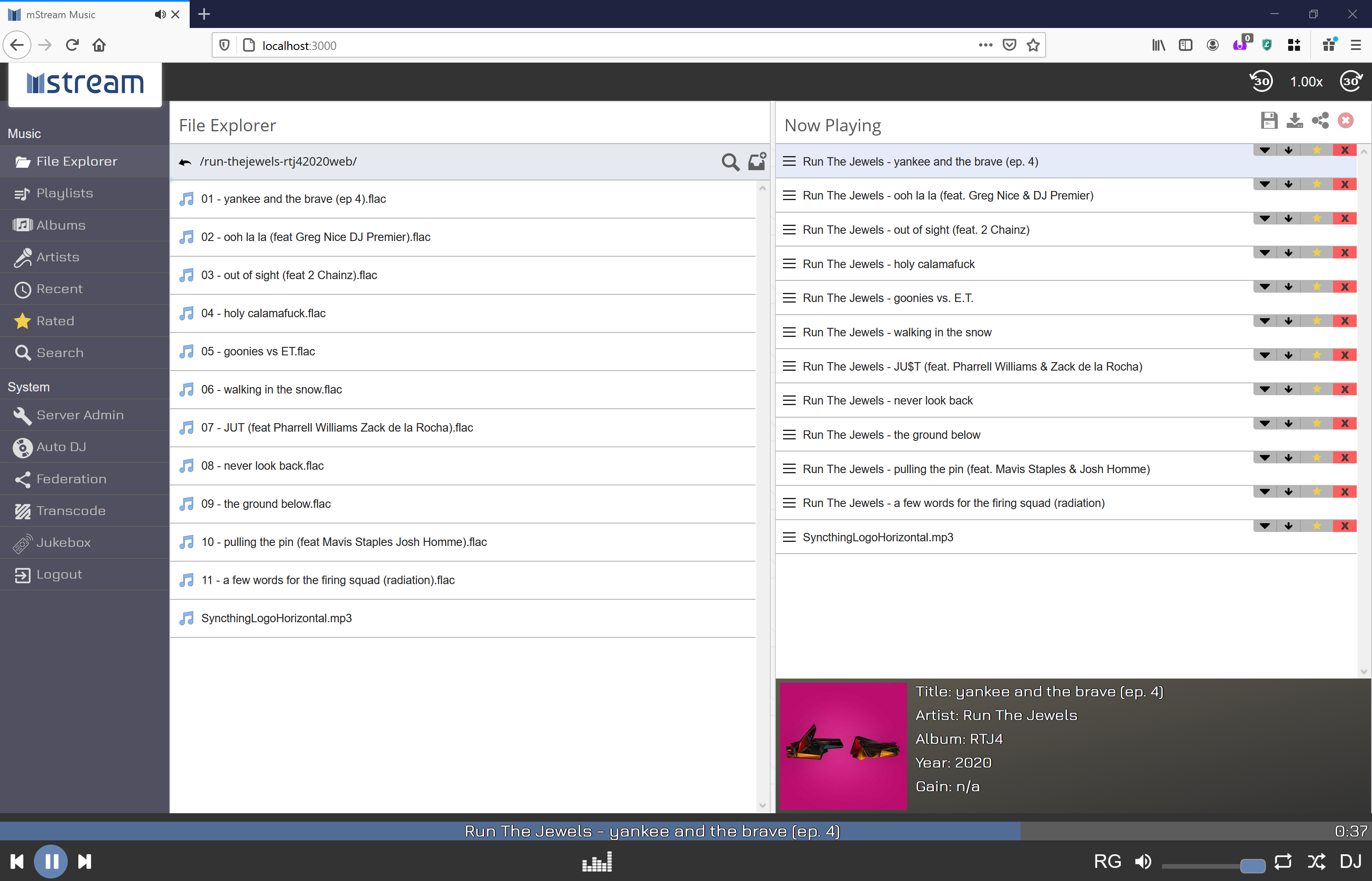
Album Art Lookup
mStream automatically retrieves album art for your collection
Quick Sync - Zero Configuration Deployments
Enable Quick Sync in the Admin Panel to access mStream without setting up port forwarding, DNS, SSL, etc. Quick Sync is a free VPN-like service powered by Iroh
NOTE: Quick Sync only works for mobile apps and the upcoming desktop app. The webapp will not work (it's the price of not having to setup DNS/SSL).
P2P Discovery
When enabled, this feature will automatically download music discovery data from other mStream servers. With this data, mStream can show your songs that are not in your collection that are similar to what your are listening to.
Please note, this is discovery only. You will have to find these songs on your own.
Federation
You can federate with other servers. Federated servers have read access to eachother's data. With this, your p2p discovery feature can now stream discovered music.
Public mode
The demo site does not require you to sign in because mStream is publicly accessible by default. This makes it easy to setup and gives you the option to keep it publicly available if you are just running it on a secured network. Once you add a user, the system becomes password protected.
Installing mStream
Binaries
NOTE: as of v6.20, releases ship one standalone bundle per platform (no Electron). Double-click the desktop face — mStream.exe on Windows, mStream.app on macOS, mstream-desktop on Linux — for the tray app with start-at-login and Quick Connect, or run the bundled mstream-server directly for a plain terminal/headless server (the only flavor in the linux-arm64 and musl bundles). Details in the install docs.
Docker
Other
Mobile Apps
Official Mobile Apps
These apps are open source! Click here to see the code


Feature List
- Torrent Client Integration - Manage your torrents through mStream
- YT-DLP integration - Download youtube videos as audio files
- DLNA Support
- Automatic Backup Feature - Backup your music to any drive connected to your server
- Transcoding
- Auto DJ - Automatically queue up songs
- Lyrics Support - includes being able to search by lyrics
- Jukebox Mode - Control your browser remotely
- Local server audio playback - Note, will not work on Docker
Credits
mStream is built on top of some great open-source libraries:
- music-metadata - The metadata parser used by the JS scanner fallback
- Lofty - Audio tag reader powering the Rust scanner
- Symphonia - Pure-Rust audio decoder used to render waveform previews during a scan
- Butterchurn - A clone of Milkdrop Visualizer written in JavaScript
- LRCLib - Optional source for synced lyrics
And thanks to the LinuxServer.io group for maintaining the Docker image!