

RDS (Rust DICOM Station) is open-source software for medical imaging and radiotherapy research, analysis, and QA, written entirely in Rust. It loads complete radiotherapy studies (CT, MR and PET series, RTSTRUCT, RTDOSE, photon and ion RTPLAN, DICOM SEG, planar images, spatial and deformable registrations, and treatment records) into an integrated environment for visualization, comparison and quantitative analysis. Beyond the classic linked MPR layout and multi-workspace comparison (up to four studies side by side), RDS provides image registration, structure propagation, DRR generation, dose-volume histograms, 4D motion analysis, interactive and AI-assisted segmentation, 3D visualization, and DICOM editing and export. The entire processing stack is native Rust: functionality normally provided through C/C++ or Python frameworks, including elastix- and plastimatch-style registration, ITK-style ray casting, TotalSegmentator, MRSegmentator, lungmask, MONAI SegResNet, CT-FM, VISTA-3D, nnInteractive, SegVol, and MedSAM2, is re-implemented directly in Rust without bindings to those frameworks.
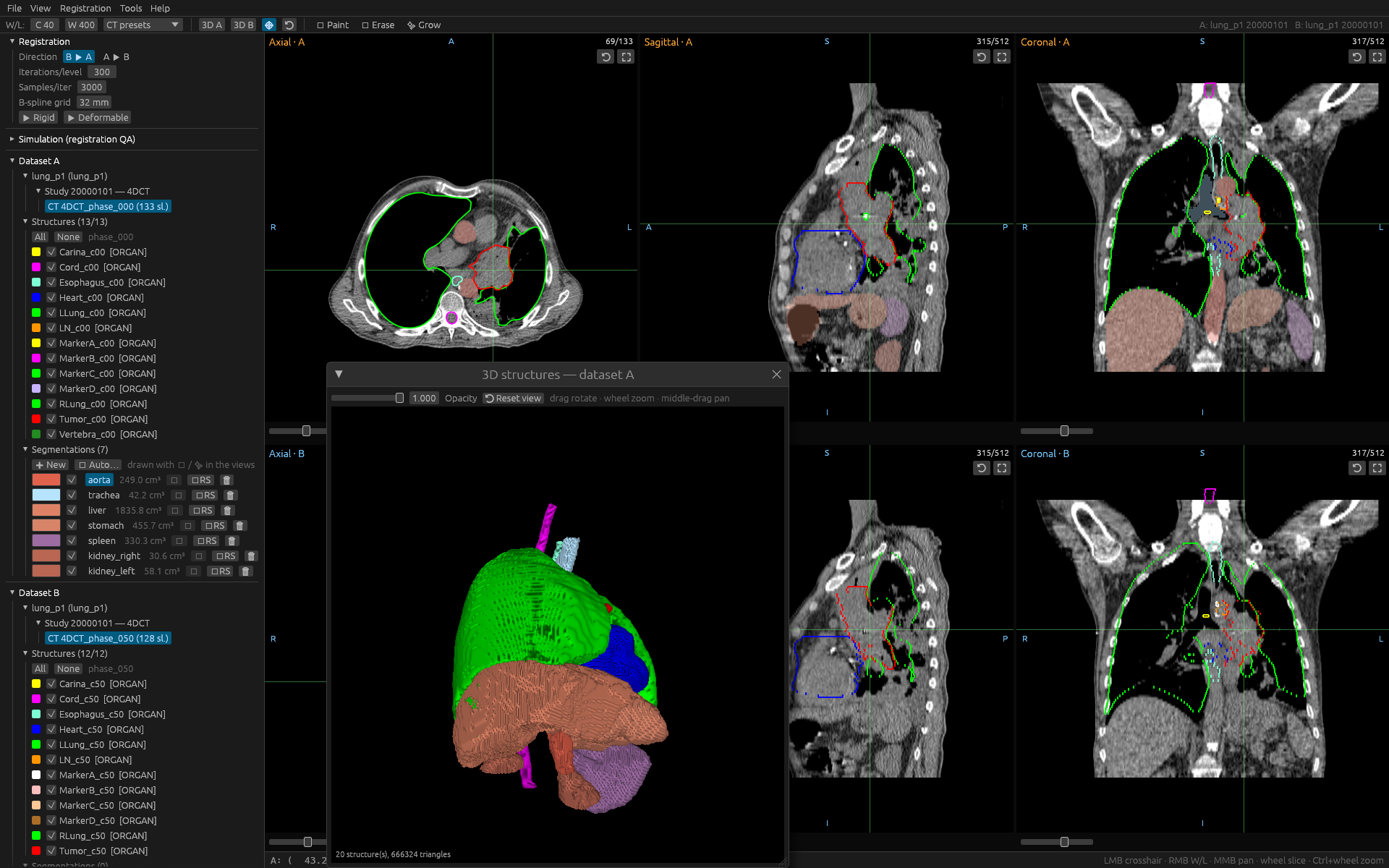
Two breathing phases of the bundled 4D-Lung patient as two rows of linked
MPR views with their RTSTRUCT contours, and the 3D window showing the RTSTRUCT
surfaces together with organs auto-segmented by the built-in TotalSegmentator
engine.
What it does
- Viewing - parallel DICOM loading (compressed syntaxes included), true
patient-space geometry, linked axial / sagittal / coronal views in rows you
lay out yourself (up to three panes each, the 3D scene among them), W/L
presets, dose colorwash and isodose lines, per-beam plan summaries, planar
images (DX / CR / RTIMAGE), dark and light themes. Folders or individual
files, and the data does not have to be a volume: a portal image, a
structure set or a plan opens on its own, in the ordinary tree, with
everything that does not need voxels still working.
- Workspaces - up to four (A - D), one row of panes each; a patient ▶
study ▶ series tree per workspace; copy / move / remove / rename at every
level with the reference chains kept intact; RT structure sets and
segmentation series as tree nodes, contours and masks converting as they
move between them; the crosshair, the slice, the zoom and the players
synced across every open workspace.
- Image information - what the displayed series actually is, read back
out of its own headers: voxel spacing, slice thickness and the gap or
overlap between slices, uneven slice positions, matrix and field of view,
gantry tilt, frame of reference, kV / mAs / CTDIvol / kernel, rescale and
units - with whatever wants a second look named and explained, and a side
by side of what two workspaces disagree about before you register them.
- Playback - ▶ on every viewport: through the slices of a view, and
through the phases of a 4D group. Playing a group carries the structure
set, the segmentation series and the dose of each phase with it and walks
the selection down the group in the tree; the phases are read into memory
once (under a budget you set) so it runs as a cine rather than a
slideshow, and the 3D window breathes with it.
- Patient archive - a local PACS on plain folders and text sidecars:
file a study, list patients without opening a DICOM file, load into either
workspace, and send the structures and segmentations you drew back as derived
objects under the original Study and Frame of Reference UIDs.
- PACS server (optional) -
rds-pacs serves one station's archive to the
others over HTTPS, on the local network or over the internet (through a
VPN, a forwarded port or a reverse proxy): stations pair with a one-time
code and the server's pinned certificate, then pull studies into a local
mirror, work on them offline and sync back, or hand the server workflows to
run on its own hardware. Every build, Android and iOS included, is a
client.
- Registration - rigid and B-spline after elastix (pyramids,
stochastic sampling, ASGD), dense B-spline after plastimatch (analytic
gradient, bending energy, L-BFGS, mean squares or Mattes mutual
information) and plastimatch's landmark warp; any of them restricted to
one structure or refined on top of a previous result. Registration by
structures aligns two images on the surfaces of structures contoured on
both (signed distance maps, a symmetric rigid fit, optionally a local
B-spline per structure), the voxel values left out. Every run reports the
Dice of the two images before and after it, per-structure Dice on request,
6 DOF, displacement statistics, Jacobian determinant and folding; the vector
field draws in the views and in 3D; fusion overlay; DICOM REG and Deformable
Spatial Registration read and written; a known-transform simulator for QA.
The 4 × 4 transform can also be typed in by hand and used in
place of a recovered one - in the registration, in propagation and in
transfer by relationship.
- Structure propagation - contours and segmentations carried through a
registration by per-voxel pull-back (no holes, any two grids), optionally
refined on an enclosing structure first.
- 4D / motion - phases recognised into 4D groups; the reference phase
registered to every other, targets propagated and their centroids tracked;
peak-to-peak, drift, correlation with a reference structure, ITV
generation, a results window with run-vs-run comparison and CSV export;
structure comparison (Dice, HD95, surface distance) and transfer by
relationship.
- Workflows - the program's own steps wired into a graph in a node
editor (Workflows in the menu bar): read a folder, find the image, the
4D group and the structures, segment (by class or by name), register,
propagate (anchored on a structure), combine and rename structures,
measure the motion and build the ITV, DVH and dose metrics with a
protocol, DRRs, export DICOM, file in the archive, write the reports.
Saved as a small file, run again on other input folders without editing
it - in the background, or step by step with every result shown in the
viewer - or as a batch over a folder of patients, with the steps a change
did not touch taken over from the last run. Undo, copy and paste between
workflows, frames around groups of steps and a map of the canvas in the
editor; a command-line runner too.
- MCP server -
rds-mcp, a second executable that lets an AI assistant
drive the station's tools (load, segment, register, propagate, 4D motion,
DVH, export, and saved workflows) headlessly over the Model Context
Protocol, with a ready-made prompt for heart target propagation;
workspaces that still name their patient are refused by default and no
tool ever returns identifiers.
- DRR - plastimatch's exact Siddon tracer and ITK's interpolating
ray-cast on one IEC cone-beam geometry, beam's-eye view from an RTPLAN
beam, side by side with their difference.
- Dose-volume histograms - cumulative and differential DVHs of any
structures against any dose, sampled on the structure's own lattice;
D95% / D2cc / V20Gy metrics, protocol constraint checking, CSV
export; verified against an analytic phantom.
- Segmentation - spacing-aware 2D / 3D brush and eraser, geodesic region
growing, undo, live 3D surfaces, mask ⇄ RTSTRUCT, DICOM SEG import and
export (binary and fractional). The Structure editor edits a segment as a
whole the way it edits a structure: keep the largest piece, fill the holes,
grow or shrink by millimetres, or trace it into contours and carry on.
- Structure algebra - union / intersection / subtraction / symmetric
difference with margins in patient directions (exact ellipsoids), crop,
ring, cleanup.
- Body contour - the EXTERNAL structure without the couch, the chair or
the mask, on CT and MR, classically or guided by TotalSegmentator's body
network.
- Auto-segmentation - 81 automatic models behind one model list, all
rebuilt natively: TotalSegmentator v2 and v3 (117 structures on CT), its
MR model, 26 task models (lung vessels and nodules, liver segments,
head and neck, vertebrae, teeth...) and its 17 licensed ones (heart
chambers, coronary arteries, tissue types... with your licence number),
the nnU-Net v1 tumour and organ models (MSD liver, lung, pancreas,
colon, KiTS, BTCV, SegTHOR), MRSegmentator, lungmask, MONAI's whole-body
SegResNet, CT-FM, VISTA-3D and NV-Segment-CTMR, plus any nnU-Net v2
model folder of your own; official weights converted without Python, a
SIMD CPU engine or a wgpu GPU path (no CUDA), TG-263 names on request;
mean Dice 0.9995 against TotalSegmentator, lungmask identical voxel for
voxel.
- Prompt segmentation - SegVol rebuilt natively: box, click or free-text
prompts ("liver", "tumor") for the structures no fixed-class model covers.
- Slice propagation - MedSAM2 (SAM 2.1 with its memory bank) and
Efficient MedSAM2 (EfficientTAM, lighter, for the CPU) rebuilt natively:
box a structure on one slice, refine with include / exclude clicks,
follow it through the stack at native resolution.
- Interactive segmentation - nnInteractive and VISTA-3D's point mode
rebuilt natively: click, box, scribble or lasso in any view, positive or
negative, and every prompt refines the same 3-D object.
- Tools - DICOM export with an editable tag table, a model manager for
every downloadable weight, a folder anonymizer with consistent UID
regeneration, a synthetic RT-study generator; every tool window can be
moved to its own monitor, and the structure tools live in the modules
panel.
Architecture
One language, one binary. All image processing runs on the CPU with rayon
and caching; the GPU (wgpu: DX12 / Vulkan / Metal) blits the UI and,
optionally, runs the networks. Long operations run on worker threads with
progress and cancellation. The module map, threading model, geometry
conventions and test suites are in
docs/architecture.md.
Quick start
Requires a Rust toolchain ().
cargo build --release
cargo run --release -- data-test/TCIA_4D-LUNG/P102/4DFBCT+RTS
cargo run --release -- data-test/TCIA_4D-LUNG/P102/4DFBCT+RTS data-test/TCIA_4D-LUNG/P102/4DCBCT
cargo test --release
To try prompt segmentation on the bundled patient: put the crosshair on the
tumor, unfold 💬 Prompt segmentation in the Structure auto tools module
(right panel), prompt Box, ▶ Segment.
The engines fetch their weights on first use into one model folder
(%LOCALAPPDATA%\RustDICOMStation\models on Windows,
~/.local/share/RustDICOMStation/models on Linux,
~/Library/Application Support/RustDICOMStation/models on macOS,
~/snap/rust-dicom-station/common/data/models in the snap,
~/.var/app/io.github.alexprotom.rust-dicom-station/data/RustDICOMStation/models
in the Flatpak), movable from any tool window; each engine also has a headless CLI in examples/.
If the program will not start at all, it is almost certainly one thing: a
Windows machine advertising a Vulkan driver that cannot create a device. It
now falls back to Direct3D 12 by itself, the installer asks which backend to
use, and View ▸ Graphics backend changes it afterwards - see
docs/viewer.md.
Windows, Linux, macOS, Android tablets, iPads and iPhones are supported; --no-default-features builds a
CPU-only viewer without the GPU inference backend. Every push to main
publishes a release: a Windows installer
(rust-dicom-station--windows-x86_64.exe - shortcuts, "Open with"
on folders, the VC++ runtime check, optional download of any model's
weights, uninstaller),
a Linux AppImage, two macOS disk images
(rust-dicom-station--macos-arm64.dmg and -macos-x86_64.dmg, both
for macOS 12 Monterey and newer, docs/macos.md) and an
Android APK (rust-dicom-station--android-arm64.apk,
the same viewer on a tablet, docs/android.md) and an
iOS package (rust-dicom-station--ios.ipa, iPad and iPhone, iOS 15 and newer,
also to TestFlight when configured, docs/ios.md), and puts the snap into the Snap Store (sudo snap install rust-dicom-station, docs/snap.md); the same program
is on Flathub as io.github.alexprotom.rust-dicom-station
(docs/flatpak.md) and, with a tap configured, in Homebrew
as the cask rust-dicom-station. A newer
installer updates an existing installation in place (no second copy,
nothing to uninstall first), Start ▸ Update Rust
DICOM Station fetches the newest release, and the package is published to
winget as RDS.RustDICOMStation (winget install / winget upgrade). The installer is its own crate in
packaging/windows/installer/. No data at hand? Tools ▶ 📐 Generate test
data writes a complete synthetic RT study, data-test/ ships a real
patient - a ten-phase 4DFBCT with an RT Structure Set per phase and the
matching ten-phase 4DCBCT (docs/example-data.md) -
and Tools ▶ 📥 Download test data fetches that folder from GitHub into an
installed copy.
Documentation
https://alexprotom.github.io/rust-dicom-station/
| |
|---|
| docs/viewer.md | Loading folders and single files, workspaces with no volume, MPR views, workspace tree, the four workspaces and comparing them, interaction reference, the graphics backend |
| docs/rt-objects.md | RTSTRUCT, RTDOSE, RTPLAN, REG, RTRECORD, reference chains |
| docs/registration.md | The four registration engines, registration by structures, local registration, analytics, vector fields, fusion, simulator, verification |
| docs/propagation.md | Carrying contours and segmentations across a registration |
| docs/volumes.md | How every volume is calculated: voxels-based, surface-based, planimetry, propagation - the exact formulas |
| docs/motion-4d.md | 4D groups, the motion / ITV workflow, results, structure comparison and transfer |
| docs/drr.md | Digitally reconstructed radiographs: the two projectors and the geometry |
| docs/dvh.md | Dose-volume histograms: curves, metrics, constraint checking, export |
| docs/segmentation.md | Brush / eraser / region growing, 3D view, mask → RTSTRUCT |
| docs/contours.md | Drawing and editing structures as contours: the draw row and the Structure editor, live wire, smart brush, interpolation, POIs, templates, locking |
| docs/generators.md | Structures without drawing: grey level (HU or SUV), shapes, isodose, field of view |
| docs/structure-algebra.md | Boolean operations, margins, cropping, cleanup |
| docs/body-contour.md | The body / EXTERNAL contour on CT and MR, verification |
| docs/auto-segmentation.md | Automatic segmentation: the 81 models and your own nnU-Net folders, their pipelines, the CPU and GPU engines, validation, TG-263 names, licensing |
| docs/segvol.md | Prompt-driven segmentation: the SegVol re-implementation |
| docs/medsam2.md | Propagating a prompt through a stack: the MedSAM2 and Efficient MedSAM2 re-implementation |
| docs/interactive-segmentation.md | Interactive segmentation: nnInteractive and VISTA-3D's point mode, validation, licensing |
| docs/pacs.md | The local patient archive: window, on-disk layout, filing, loading, sending changes back |
| docs/pacs-server.md | The PACS server: setting it up on a network and over the internet, pairing stations, mirror and sync, tasks run on the server, security |
| docs/export-and-tools.md | DICOM export, the model manager, anonymizer, test-data generator and download |
| docs/workflows.md | Workflows: the node editor, the steps, running in the background or step by step, reruns, batches, the run folder, the heart-anchored example |
| docs/mcp.md | The MCP server: tools, the heart workflow prompt, patient-identity safety, configuration |
| docs/architecture.md | Design, functional overview, module map, threading, the model folder, conventions, testing |
| docs/release-versioning.md | How versions and releases are produced |
| docs/snap.md | The Linux snap: confinement, where its files are, the MCP server in it, building and publishing |
| docs/flatpak.md | The Flatpak: the sandbox, where its files are, the MCP server in it, building and submitting to Flathub |
| docs/macos.md | The macOS package: the two disk images, the first launch, Metal, where its files are, building, signing, notarisation, Homebrew |
| docs/android.md | The Android package: installing, all files access, what differs on a tablet, where its files are, building and signing |
| docs/ios.md | The iOS package for iPad and iPhone: installing (TestFlight, ad hoc, sideloading), getting studies onto the device, what differs on a tablet and a phone, where its files are, building, signing and releasing |
| docs/example-data.md | Bundled patient data, source and citations |
| packaging/README.md | The packaging folder: one subfolder per platform, what each builds and where |
| packaging/windows/installer/README.md | The Windows installer: building it, what it installs, updating, winget, silent switches |
License and citations
The code is MIT-licensed. The MIT License
covers this project's own code; the third-party Rust libraries RDS depends on
keep their own licences, reproduced in
THIRD-PARTY-NOTICES.txt. If you publish work
produced with RDS, a citation is appreciated: see
CITATION.cff.
The bundled example data is TCIA 4D-Lung
patient P102, redistributed under CC BY 3.0 (cite it as described in
docs/example-data.md). Auto-segmentation downloads
each model's published weights at your request - TotalSegmentator's open
tasks, MRSegmentator, lungmask, MONAI and CT-FM under Apache-2.0, VISTA-3D
under the NVIDIA Open Model License - and never redistributes them (cite the
model you use as described in
docs/auto-segmentation.md). Prompt segmentation
re-implements SegVol (Du et al., NeurIPS 2024), slice propagation MedSAM2
(Ma et al., 2025) and interactive segmentation nnInteractive (Isensee et
al., 2025, weights CC BY-NC-SA 4.0); their weights are only ever downloaded
from Hugging Face to your own machine at your request and are never
redistributed; see docs/segvol.md,
docs/medsam2.md and
docs/interactive-segmentation.md.
This software is a station for research and QA convenience. Not a medical
device, neither CE-marked nor FDA-cleared, and not for clinical
decision-making. The ADDITIONAL NOTICE in LICENSE.txt states
this in full. It is a statement of fact about the software, not a condition of
the MIT License, which permits commercial use.