JYY-Code



中文文档 · English
> A runtime-first Multi-Agent coding system for long, parallel, recoverable engineering work.
>
> One goal becomes a persistent workflow: plan → parallel execution → review → reject/retry → explicit merge.
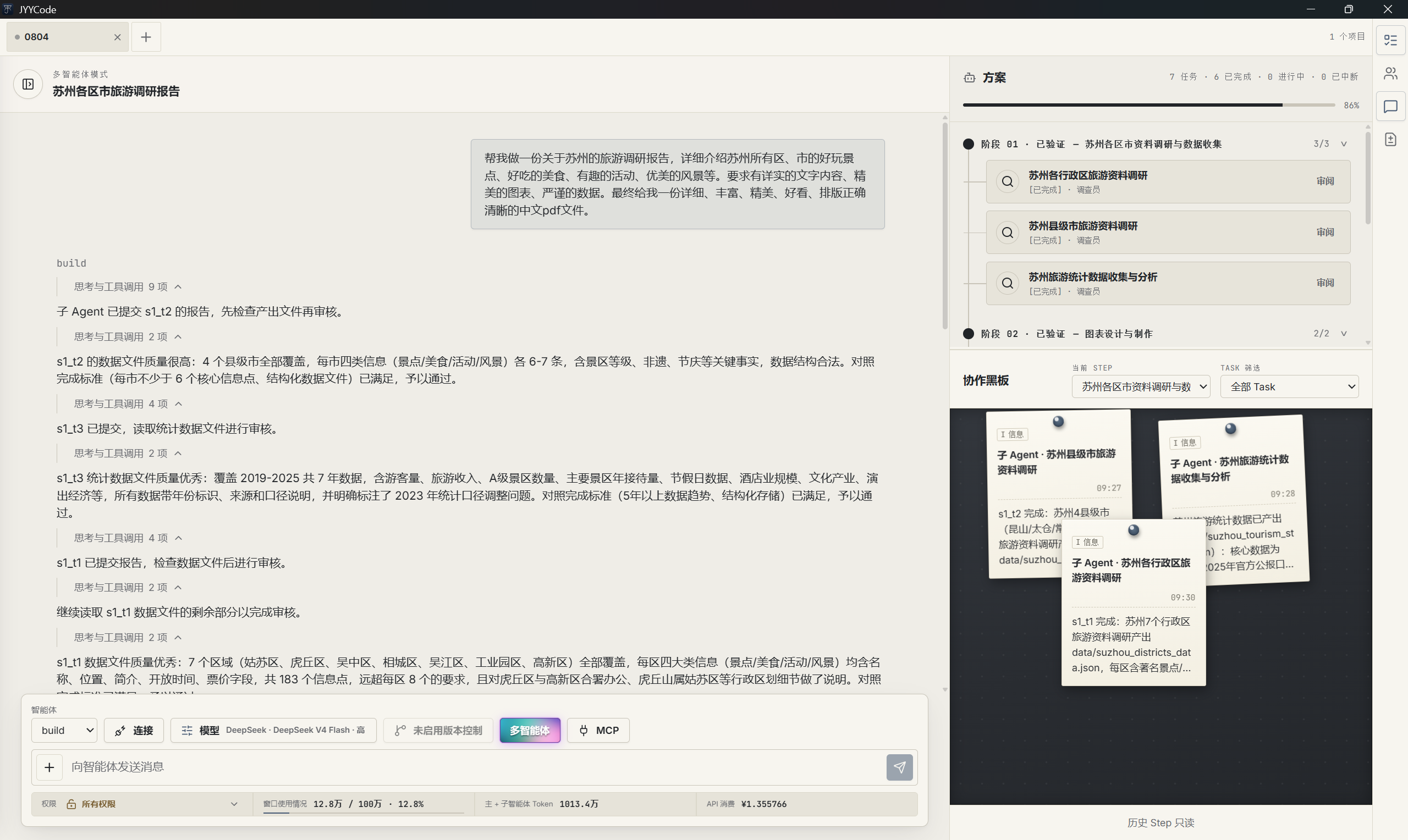
The desktop app in multi-agent mode: the root agent reviews child reports one by one while the plan panel tracks step progress and the blackboard collects findings and handoffs from every sub-agent.
Desktop install: https://github.com/Reon-Jin/JYY-Code/releases
Why JYY-Code is different
JYY-Code does not assume an LLM will reliably remember the plan, coordinate peers, enforce quality, isolate concurrent edits, or recover itself after a crash. Those responsibilities are moved into the runtime.
| Problem | JYY-Code moves it out of the prompt and into... |
|---|
| Planning | A revisioned Plan with staged Steps, explicit dependencies and judgeable done_criteria |
| Execution | A strict Task state machine and protocol-enforced dispatch |
| Parallelism | Batched waves of isolated sub-agents, up to 20 per wave |
| Quality control | Report → review → reject/redispatch as a mandatory gate |
| Integration | Worktree/snapshot isolation plus explicit Merge.apply |
| Coordination | A typed shared blackboard with read cursors and event wakeups |
| Route selection | Candidate competition with blind proposals, cross-review and final synthesis |
| Long-task continuity | Layered context, episodic digests and structured persistent memory |
| Crash recovery | Durable events, rebuildable projections, activation leases and reconciliation |
| Desktop control | Explicitly requested screen observation and mouse/keyboard control; optional Jev selection |
The result is not “one agent with more tools”. It is an engineering runtime that gives agents boundaries, shared state, recovery semantics and a reviewable execution protocol.
1. Protocol-enforced engineering loop
The core workflow is enforced by tools and state transitions, not by asking agents to cooperate in natural language.
Plan_create → Plan_update(add_task) → Dispatch_dispatch → Report → review_task(approve) → Merge.apply → merged → cleanup
     ↑                                                              ↓
     └──────────── reject + concrete feedback → redispatch ──────────┘
- Plans evolve with understanding. Work is organized into Steps. Each Step has observable
done_criteria; later Steps expand only after the current one is reviewed.
- Task state is not conversational. A Task moves through a controlled lifecycle such as
pending → dispatched → running → reported → approved / rejected / dismissed; illegal transitions are rejected by the runtime.
- Review is a gate, not a suggestion. The root agent must check the report and relevant artifacts against
done_criteria. Rejection requires a concrete gap, and that feedback is automatically injected into the next dispatch.
- Children cannot rewrite orchestration state. Standard child sessions report results; they do not mutate the parent Plan.
- Exceptions are durable work items. Failed pre-checks, cancelled children and runtime failures enter the Inbox instead of disappearing inside model text.
This turns “agent collaboration” from a prompt convention into a stateful protocol.
2. Parallelism without workspace chaos
JYY-Code is designed to parallelize real engineering work without letting concurrent agents overwrite one another.
- Protocol-level parallelization. Ready Tasks in the same wave are batch-dispatched instead of being slowly trickled out one by one. A wave can run up to 20 sub-agents in parallel.
- Forced decomposition check. For medium and large tasks, the planner must inspect independent deliverables, modules, research questions, verification surfaces and role expertise before accepting a mostly-serial plan.
- Isolated execution. Git projects use isolated Worktrees for standard Tasks; non-Git projects use writable snapshot workspaces. Shared-main-workspace execution is an explicit compatibility mode, not the default.
- Review does not imply integration. An approved child result still does not silently rewrite the parent workspace. The root agent explicitly integrates it through
Merge.apply.
- Conflicts remain decisions. Non-overlapping changes can merge automatically; real conflicts are surfaced for explicit resolution instead of applying a hidden “prefer child” policy.
- Zero polling while children run. The root suspends after dispatch and wakes on Report, Inbox or blackboard events, avoiding token-burning wait loops.
Parallel execution, isolation, review and merge are one continuous protocol rather than separate best-effort behaviors.
3. A durable runtime, not a fragile process
Long-running agent systems fail when process memory is treated as the source of truth. JYY-Code separates durable state from live process activity.
- EventV2 is the durable session source of truth. Session changes are written to a versioned event log; projections are derived, versioned views that can be rebuilt by replay.
- A child session is a durable identity. A running process is only the current activation of that child. Ownership is guarded by
owner_id + generation + lease, so a stale process cannot continue settling or mutating a child after takeover.
- Restart recovery is explicit. On cold start, the runtime distinguishes persisted rows from actually live workers, reconciles child state, resumes what is safe, and turns unrecoverable work into visible rejection/Inbox state.
- Runtime streams are not mistaken for persistence. In-memory subscriptions and notifications can disappear; durable events remain the recovery boundary.
- Recovery paths are designed for replay and audit. Projection watermarks, bounded recovery metadata and copy-first/resumable storage operations make corruption and migration failures inspectable instead of silent.
This matters most on the tasks where coding agents usually become least reliable: long sessions, many children, crashes, restarts and partial failures.
4. Shared blackboard: agents can actually coordinate
Parallel agents are not isolated chat windows. Each Step has a shared blackboard used by the user, root agent and sub-agents.
- Typed messages:
info / risk / blocker / decision / help
- @mentions, attachments, threaded replies and Task links
- Independent read cursors and live unread state for every participant
- Event-driven wakeups when another agent posts something relevant
- Protocol rules against heartbeat/progress spam: the board is for findings, dependencies, handoffs and requests for help
The root can see child-to-child discussion, intervene directly, and keep coordination outside private prompt histories.
5. Candidate mode: compete before committing
When the correct route is genuinely uncertain, JYY-Code can run a controlled competition instead of letting the root agent make an early guess.
- Blind declaration — 2–3 candidates independently state their approach, assumptions, risks and differentiator.
- Cross-review — candidates critique each other through the blackboard before execution.
- Independent proposal — each candidate develops its route in isolation.
- Synthesis and verdict — the root produces a synthesis artifact, chooses exactly one winner and records the rationale plus useful contributions from runners-up.
Candidate mode turns architectural uncertainty into an auditable search process rather than a hidden chain of guesses.
6. Context and memory built for long tasks
JYY-Code separates short-term working context from durable knowledge instead of treating the entire chat transcript as memory.
- Working context stays bounded. Full compaction, micro-compaction of completed tool output, reactive emergency compaction and media-aware context estimation prevent long tool-heavy runs from expanding without control.
- Older turns become episodic memory. Completed turns are recorded and periodically condensed into cumulative digests that can be re-injected or searched later.
- Persistent memory is structured by purpose. Task state, stable user facts and reusable experience are stored separately rather than mixed into one free-form summary.
- Memory is calibrated before and after execution. The user-input phase updates what the system currently understands; the assistant-completion phase corrects that state with what actually happened and extracts reusable lessons.
- Persistent writes are controlled. Root sessions own task/user memory writes; child agents can read relevant context and experience without racing to rewrite shared long-term memory.
- Capacity is a system property. Entries have schema, importance, keywords, deduplication and deterministic compaction instead of unbounded “remember everything” accumulation.
The objective is not maximum history retention. It is stable reasoning state across long sessions and new sessions without letting old noise dominate the prompt.
7. Capability boundaries instead of blind trust
JYY-Code deliberately limits what different actors can mutate.
- Child agents cannot rewrite the parent Plan.
- Task output paths are constrained to the intended workspace and checked against traversal/escape cases.
- Standard child work is isolated until an explicit merge.
- Sub-agent tool access is governed independently from the root agent.
- Durable session state is owned by the privileged runtime; external extensions may consume documented events but cannot append to the durable event log or directly mutate projection tables.
These boundaries reduce the blast radius of a bad sub-agent decision and make orchestration state harder to corrupt accidentally.
Desktop computer control
In the Desktop app, a single-Agent root Session can observe and operate the Windows or macOS desktop. Select a model that accepts images and explicitly request computer control in your current message, for example: “Use computer control to open Paint and save a drawing.” Ordinary requests do not enable the computer tool. It is unavailable in the TUI, Multi-Agent and child Sessions. Actions are subject to the computer permission.
- Without a Jev API key, the original control mode is used. The Agent can observe a screenshot and numbered accessibility controls. For a small target,
zoom takes the current screenshot's frameID and returns an unscaled raw-pixel crop of at most 800×600 pixels; the following click uses crop coordinates and the crop's frameID. The Agent can also move the pointer, scroll, type text, press keys, drag, wait for a window, or batch up to 12 predictable steps. Each action returns a fresh screenshot.
- With an active Jev API key, Desktop switches automatically to visual action selection. Enter the key under Settings → Advanced → Jev API computer control. The Agent can observe or request a
choose action: local accessibility and visual detection produce action-and-coordinate candidates, and Jev selects one of them. Direct actions from the original mode are disabled while Jev is active. If the target is uncertain or the screen changes, the action stops and returns a fresh screenshot; it does not fall back to the original mode. Deactivating the key restores the original mode.
- For graphical controls, configure the local OmniParser
icon_detect_v3/model.pt weight, with Python, PyTorch, torchvision, NumPy and Pillow available. The tested weight is detected in the standard Hugging Face cache; otherwise set JYYCODE_COMPUTER_VISION_MODEL to its absolute path. EasyOCR is optional. Without a working visual detector, Jev may still select uniquely named accessibility controls but may abstain on icons or other graphical targets.
With a working local detector and resolution=high, Jev's choose first runs tiled detection for small targets when the raw screenshot exceeds 1280 pixels on either axis and no unique accessibility target matches. This takes longer than the default fast detection. Jev receives structured candidate data rather than the raw screenshot. The existing 16-target pilot measured detector-box coverage only; real click hit rate remains unverified. On macOS, grant the desktop helper Accessibility and Screen Recording access. See the Desktop computer control guide for platform details, model setup and current limitations.
Quick Start
Install
End users only need Node.js 20+ and npm; Bun is required only for source development.
npm install -g jyycode-ai
cd /path/to/your/project
jyy
Inside JYY-Code, run /connect to configure a model provider.
jyy and jyycode are the same CLI. The terminal directory you launch from becomes the agent workspace.
Configuration
Global config: ~/.config/jyycode/jyycode.jsonc
{
  "$schema": "https://jyycode.ai/config.json",
  "model": "openai/gpt-5",
  "provider": {
    "openai": {
      "options": {
        "apiKey": "sk-...",
      },
    },
  },
}
Project config lives at .jyycode/jyycode.jsonc. Core extension points include provider, permission, subagents, mcp, skills and plugin.
Architecture at a glance
packages/jyycode/    Agent runtime, plans, sessions, memory, tools and TUI
packages/core/       Filesystem, providers and shared runtime utilities
packages/llm/        LLM protocol and runtime adapters
packages/plugin/     Plugin SDK and extension interfaces
packages/sdk/        HTTP/OpenAPI client SDK
packages/app/        Desktop web UI
packages/desktop/    Tauri desktop shell and sidecar packaging
packages/relay/      End-to-end-encrypted mobile relay
packages/mobile-web/ Mobile web / PWA client
.jyycode/            Project agents, skills, commands, themes and config
Foundation: Bun + TypeScript, Effect-based services, Drizzle ORM + SQLite (WAL), Turbo monorepo and oxlint.
Useful architecture references:
Develop from Source
git clone https://github.com/Reon-Jin/JYY-Code.git
cd JYY-Code
bun install
bun run dev
For source validation:
bun run check:ci && bun run verify:generated
Downloads
Windows installers, checksums and update manifests are published on the GitHub Releases page.
Privacy
JYY-Code stores application data locally and connects only to services you explicitly configure or invoke. See the privacy policy.
License
MIT © JYYCode