Weaver Scryer Media
Use this command to install Weaver:
winget install --id=ScryerMedia.Weaver -e Weaver is a Usenet binary downloader that handles downloading, decoding, PAR2 verification and repair, and archive extraction.
winget install --id=ScryerMedia.Weaver -e Weaver is a Usenet binary downloader that handles downloading, decoding, PAR2 verification and repair, and archive extraction.
A modern, all-in-one Usenet downloader built in Rust. Download, repair, and extract — in a single binary.



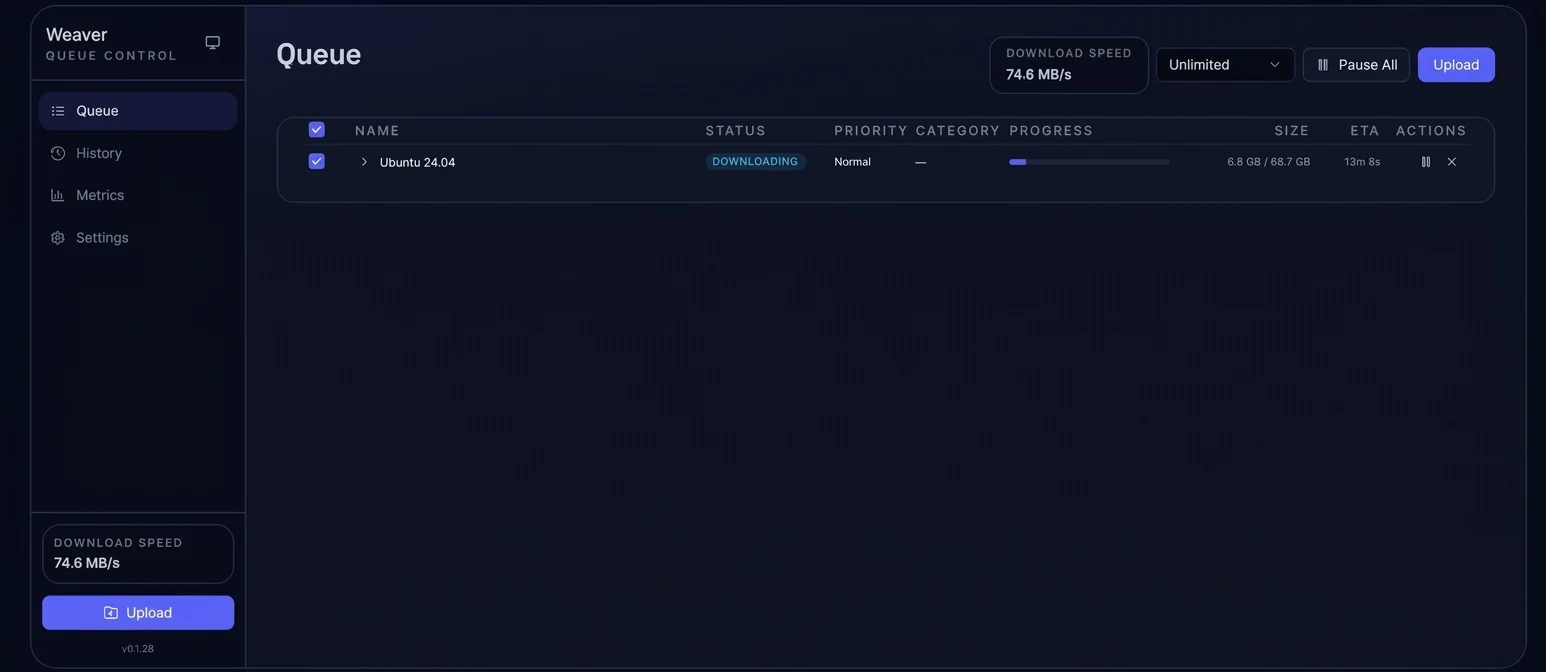
Weaver is a Usenet binary downloader that handles the entire pipeline — downloading articles, decoding, PAR2 verification and repair, and extraction (RAR, 7z, etc) — all within a single self-contained binary. No need to install unrar, par2repair, or any other external tools.
Instead of the traditional sequential approach (download everything, then repair, then extract), Weaver can run downloading and extraction concurrently*. Extraction begins as soon as the first archive volume finishes downloading, so files appear on disk while the rest of the job is still in progress.
unrar, par2, or other tools requiredInstallation instructions can be found on the Weaver docs website
Encryption-at-rest setup is automatic: Weaver creates and reuses an encryption key in macOS Keychain, Windows Credential Manager (including WinGet portable installs), or a mode-0600 key file in the Linux data directory. Existing WEAVER_ENCRYPTION_KEY overrides take precedence.
Weaver publishes a first-party container image:
ghcr.io/scryer-media/weaver:latest with both Linux binaries bundled per architecture and a CPU-aware launcher that picks the best one at startupPublished GHCR images are keyless-signed with Sigstore Cosign.
The Docker contract is intentionally small:
/configPUID / PGID when you want the container to re-own /config and then drop privilegesTZ defaults to Etc/UTCUMASK is optional and accepts standard octal values such as 022--user=1000:1000 and --read-only=true are both supportedWhen neither WEAVER_ENCRYPTION_KEY nor the Docker secret at /run/secrets/weaver_encryption_key is provided, Weaver creates /config/encryption.key with mode 0600. Preserve that file with the rest of /config; existing external keys take precedence and are not copied into the volume.
services:
  weaver:
    image: ghcr.io/scryer-media/weaver:latest
    container_name: weaver
    environment:
      - PUID=1000
      - PGID=1000
      - TZ=Etc/UTC
      - UMASK=022 # optional
    volumes:
      - /path/to/weaver/config:/config
    ports:
      - 9090:9090
    restart: unless-stopped
docker run -d \
  --name=weaver \
  -e PUID=1000 \
  -e PGID=1000 \
  -e TZ=Etc/UTC \
  -e UMASK=022 \
  -p 9090:9090 \
  -v /path/to/weaver/config:/config \
  --restart unless-stopped \
  ghcr.io/scryer-media/weaver:latest
If you run the container as root, the entrypoint will re-own /config to PUID / PGID and then drop privileges before starting weaver. If you run with --user=1000:1000, make sure the bind mount is already owned by that uid/gid because the ownership repair path is skipped in non-root mode.
For hardened deployments, weaver supports --read-only=true as long as /config remains writable.
Maintainer note: this is a first-party weaver image. Any future LSIO adoption is a separate track and should not change the current Docker contract without an explicit migration plan.
Weaver exposes a GraphQL API at /graphql with full query, mutation, and subscription support. The same API powers the web UI, so anything you can do in the interface is available programmatically.
GPL-3.0-or-later with the UnRAR source-code restriction for RAR extraction and recovery code. See LICENSE for details.