Windows acting up? Updates that fail, no internet, a slow or crashing PC:
WinMedic finds out why and repairs it, so you do not have to reinstall Windows.
It is a single program. Nothing to install, nothing else to download. It only
looks until you click Repair, and it creates a restore point first, so you
can go back. If Windows will not create one, WinMedic asks before it repairs
without it.
Download
WinMedic runs on 64-bit Windows 10 and 11.
With WinGet, which comes with Windows 10 and 11:
winget install SecretLUL.WinMedic
Or by hand: download winmedic-.exe from the
latest release and
start it. WinMedic is not code-signed yet, so Windows may warn you the first
time: click More info, then Run anyway.
How to check the download first
How to use it
- Start WinMedic and confirm the Windows prompt. WinMedic needs
administrator rights to check and repair Windows.
- Click Scan now. It takes a minute or two and changes nothing.
- Click Repair. WinMedic fixes what it can and tells you if Windows needs
a restart.
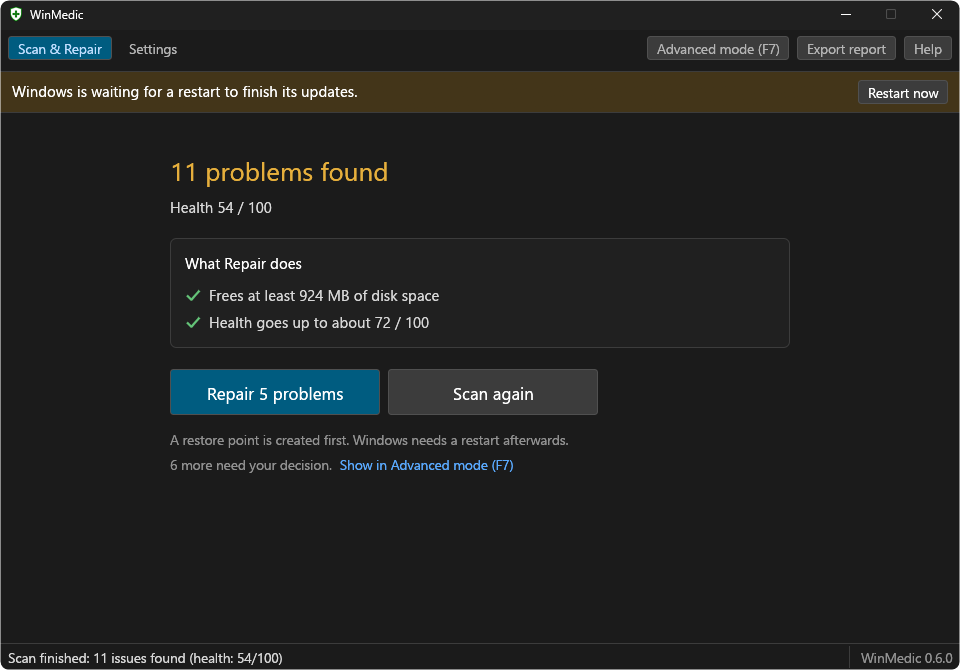
WinMedic opens in Easy mode: how your PC is doing, what Repair will do (for
example "Frees about 8.4 GB of disk space") and two big buttons. Press F7,
or click Advanced mode top right, for Advanced mode:
every detail, filters, the logs, and a simulation that shows what a repair would
do without doing it.
What it checks
| Area | What WinMedic looks for |
|---|
| System files | Damaged Windows files, the recovery environment, WMI, Start, Settings or the Store not opening, Windows features whose installation was rolled back |
| Windows Update | Stuck update services and download caches, updates that keep failing and why |
| Internet | A switched-off adapter, no IP address from the router (DHCP), name resolution (DNS), dead DNS servers, Winsock, broken proxies |
| Crashes | Blue screens, what changed in the week before they began, the last memory test, program add-ons that crash Explorer |
| Hardware | Processor, memory and PCIe errors Windows has logged |
| Disk | File system errors, drive health, disk and controller errors Windows logged, temporary files |
| Startup | Autostart entries and scheduled tasks that point at deleted programs or keep failing |
| Cleanup | Caches and leftovers that take up space |
| Memory | A switched-off or too small page file |
| Tweaks | Services, Windows system devices, policies and Defender that "tweak" and debloat tools switched off, and which device keeps a service from starting |
| Clock and restart | A wrong clock, a PC that has not been restarted for weeks |
| Devices | Devices that stopped working or have no driver, a stuck print queue |
Exactly what each check looks at and runs is in
How WinMedic works.
Is it safe?
- Scanning only reads. Nothing changes until you click Repair.
- Before a repair, WinMedic creates a Windows restore point and backs up the
registry keys it deletes from or rewrites; those can be rolled back under
Settings. Emptying the Recycle Bin or a cache cannot be undone, which is
why WinMedic asks you first.
- Repairs that delete something you may want to keep, or need a restart, are
never picked for you. You decide on those in Advanced mode.
- WinMedic is open source. Its checks are tested against output captured from
real Windows installations, and every change runs a real scan in CI.
Privacy
WinMedic collects no data and has no telemetry. It goes online only for this:
- Updates: it asks GitHub whether there is a newer version and downloads
it when you click Update now. You can turn the check off under
Settings. GitHub's
privacy statement
applies to both.
- Scan: it tests your internet connection by looking up
dns.google and
www.microsoft.com, and compares your clock with time.windows.com. It
asks the DNS servers and proxies set on your PC whether they answer, and
when names do not resolve it pings 1.1.1.1 by address, to tell a DNS
fault from no connection at all.
- Repair: DISM takes intact system files from Windows Update, and the
clock is set from
time.windows.com.
For IT admins
WinMedic also runs without its window, for scripts and remote support, from a
console started as Administrator:
winmedic --scan                        # check and print the findings
winmedic --scan --output report.html   # ... and save a report (.html, .md or .json)
winmedic --auto-fix                    # check and repair what is safe to repair
winmedic --dry-run                     # show each repair and its steps, run nothing
The exit code tells a script how it went: 0 fine, 1 warnings, 2 critical
problems, 3 a repair failed, 7 a check could not run, so the findings are
incomplete. 2 and 3 can also come with an incomplete scan; without --json
the console names each failed module ([X] Module ... failed). Every flag and
code is listed in How WinMedic works.
Uninstall
First click Settings → Remove WinMedic from Windows, or run
winmedic --uninstall. That removes the background scan, if you turned it on.
Then delete winmedic.exe, or run winget uninstall SecretLUL.WinMedic if you
installed it with WinGet.
Your settings and logs stay in %APPDATA%\WinMedic, the registry backups in
%ProgramData%\WinMedic and HKLM\SOFTWARE\WinMedic;
winmedic --uninstall --purge deletes them too.
For developers
WinMedic is written in Rust. You need Windows 10 or 11, Rust 1.95 or newer and
the MSVC build tools:
git clone https://github.com/SecretLUL/WinMedic.git
cd WinMedic
cargo build --locked --release   # creates target\release\winmedic.exe
CONTRIBUTING.md explains what CI checks and which parts need
extra care. Please report security problems privately, as described in
SECURITY.md.
License
Copyright (c) 2026 Ammar (https://github.com/SecretLUL)
GPL-3.0-only, see LICENSE. Version 0.8.0 and earlier were released
under the MIT License.