
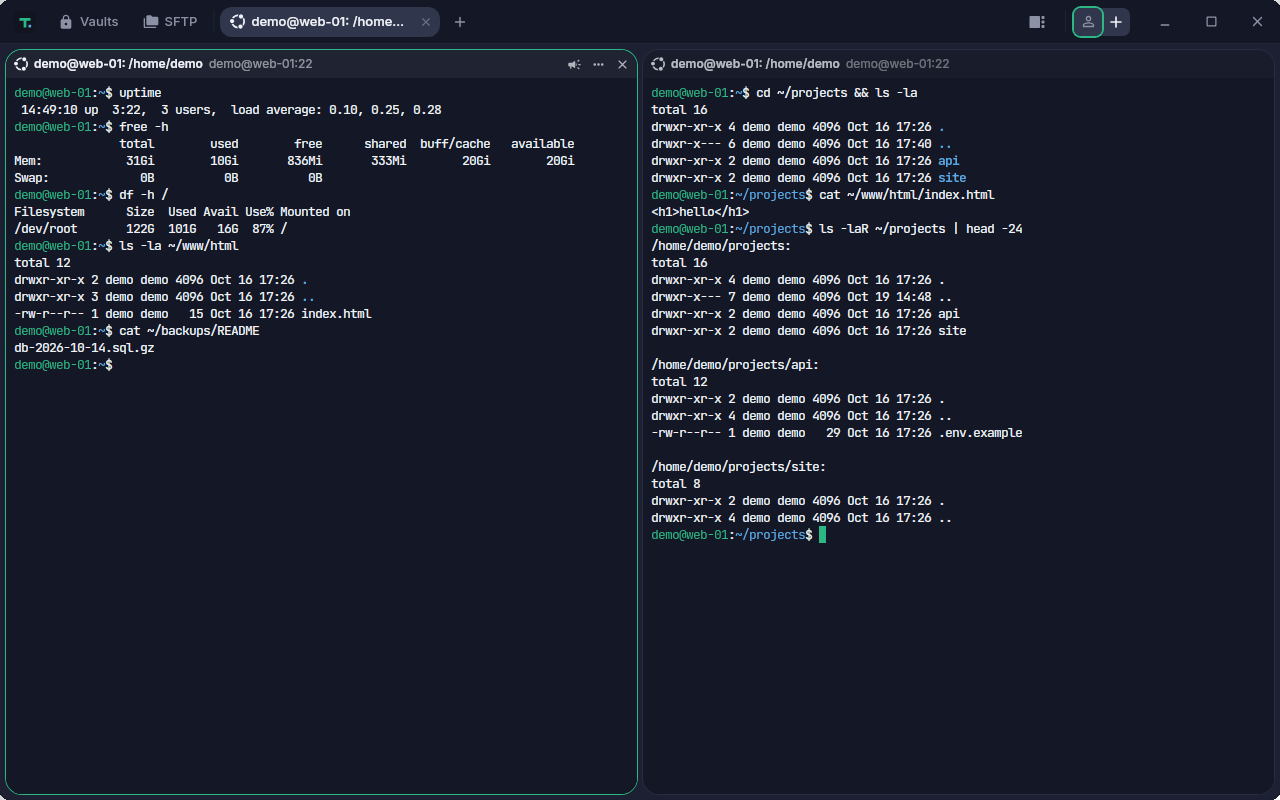
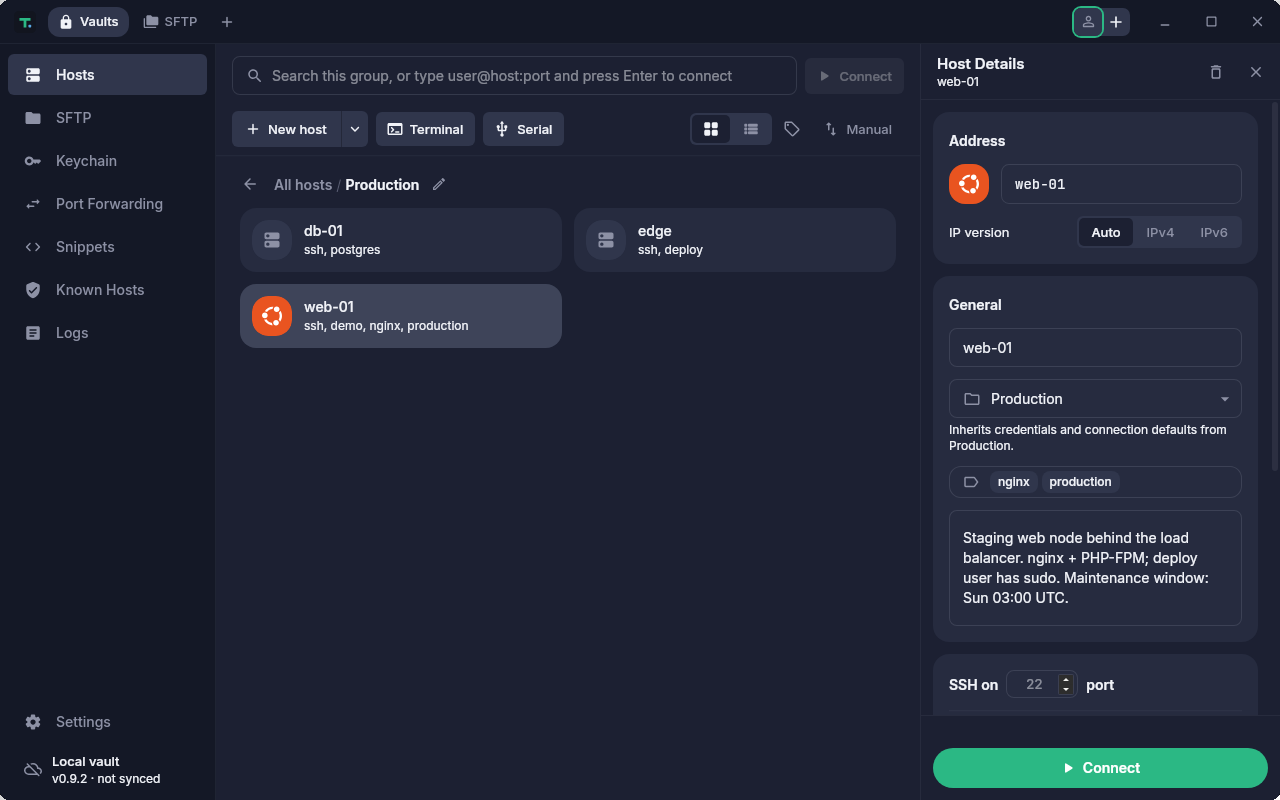
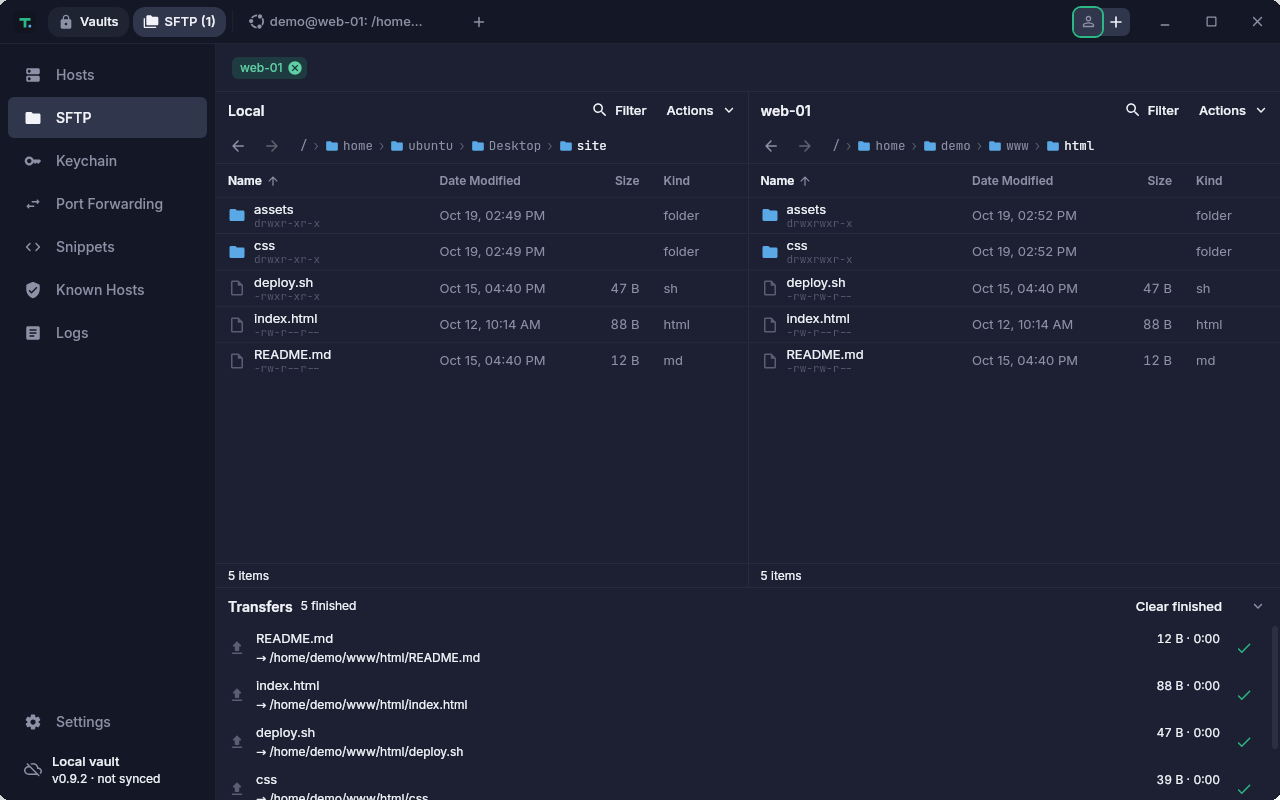
Termoso
A free, open-source, self-hostable SSH / SFTP / WebDAV / Mosh / Telnet / Serial
workstation in the spirit of Termius: one Rust core, native clients for Linux,
Windows, macOS, Android and iOS, a web cabinet for accounts and teams, and an
optional sync server you can run yourself. Every feature is available to every
user — there are no tiers, seats or paywalls.
Termoso follows one rule: software reports to you, not on you. There is no
telemetry, no analytics, no crash reporting and no "phone home". Clients talk
only to the server you point them at (or to nothing at all in offline mode);
the server's only metrics are opt-in Prometheus counters on a private listener.
- Website / hosted instance: (the same server image
everyone can self-host; hosted accounts are free)
- Downloads: GitHub Releases
(
.deb / .rpm / AppImage, NSIS / MSI, .dmg, APK, unsigned .ipa)
- License: AGPL-3.0
Contents
- What works today
- Repository layout
- Architecture in one screen
- Security model
- Self-hosting
- Configuration
- Local development
- Tests and checks
- Releases
- API overview
- Sponsoring
- Open source
- Contributing
What works today
A picture gallery of every screen below is in docs/SCREENSHOTS.md.
Version 0.9.x. Each row is shipped and covered by CI; the last column lists what
is knowingly missing.
| Component | Platforms | Shipped | Not yet |
|---|
Desktop (apps/desktop, Tauri 2) | Linux x86_64 + aarch64, Windows x86_64, macOS (Apple Silicon + Intel) | SSH (password, key, agent, keyboard-interactive, FIDO2 security keys, certificates, jump hosts, HTTP/SOCKS proxy, ML-KEM hybrid KEX), Mosh, Telnet, Serial, local shell; terminal tabs/splits/broadcast, 64 themes, bundled Nerd Fonts, shell integration (OSC 133) with autocomplete and history; SFTP and WebDAV (Basic/Digest, pinned self-signed certificates) in one two-pane Files view with queue, edit-in-place, drag-and-drop; port forwarding (L/R/D, autoreconnect); keychain (keys, identities, certificates, FIDO2, SSH ID, public-only keys signed by the system SSH agent — KeePassXC, ssh-add, Pageant); snippets with variables and bulk run; known hosts; encrypted session logs; workspaces and session restore; command palette and configurable shortcuts; import from ssh_config, PuTTY, Termius, AWS EC2 / DigitalOcean / Azure; teams, team vaults, presence, multiplayer terminals, activity log; opt-in AI command suggestions; master password + App Lock (lock on start, Lock now, inactivity timer); signed self-updater (off by default) | ARM Linux and Windows-on-ARM bundles |
Android (apps/android, Kotlin + Compose, minSdk 26) | arm64-v8a, armeabi-v7a, x86_64 | The same core over UniFFI/JNI: SSH / Mosh / Telnet and local-shell terminal with a Termius-style key panel, autocomplete, session recording, foreground service; SFTP and WebDAV with transfer queue and pause/resume, and every SSH or WebDAV host exposed to the system Files app and document pickers (Storage Access Framework); port forwarding; keychain incl. FIDO2 over USB and NFC; snippets; account sync, teams, presence, multiplayer (host and viewer), SSH ID, security-key MFA; Material You dynamic colour; app lock (biometric / device credential); Android App Links for invite/join URLs | Serial, workspaces, import from other clients |
iOS (apps/ios, SwiftUI, iOS 17+) | iPhone (sideloaded — see below) | Encrypted local vault (key in the Keychain), hosts/groups/tags and host editor, SSH terminal with extra-key panel, host-key/password/passphrase prompts, session tabs, autocomplete | Account sync, SFTP, port forwarding, keychain, snippets, biometric lock, iPad layout |
Web cabinet (web) | any browser | Sign-up/sign-in (OPAQUE in WASM, no password ever leaves the browser), MFA (TOTP, passkeys, e-mail, backup codes), device approval, recovery key, devices, security events, teams and roles, team vaults and key rotation, API bridges, admin pages, invitation and join landing pages | Vault contents are never shown in the browser by design — hosts live in the clients |
Server (crates/termoso-server, Axum) | Linux container (ghcr.io/termoso/termoso-server, amd64 + arm64) | Accounts, devices, MFA, teams, sealed vault keys, encrypted sync with conflicts and tombstones, realtime WebSocket, session-log storage (S3), presence, multiplayer relay, audit log and e-mail digests, SSO (OpenID Connect, SAML 2.0), SSH ID, AI proxy, admin API, OpenAPI 3.1 | SAML Single Logout / IdP-initiated sign-in, session logs without S3-compatible storage |
API Bridge (crates/termoso-bridge) | Linux container (ghcr.io/termoso/termoso-bridge, amd64 + arm64) | Headless client that exposes a Termius-compatible REST API for hosts/groups and pushes only ciphertext to the server — docs/API_BRIDGE.md | Snippets, keys and identities over the bridge (hosts and groups only) |
Distribution notes:
- macOS builds are ad-hoc signed unless the release is configured with a
Developer ID, so the first launch needs right-click → Open (or
xattr -cr /Applications/Termoso.app). Details in
docs/RELEASING.md.
- iOS has no App Store listing. Every release ships an unsigned
.ipa and
an AltStore/SideStore source (termoso-altstore.json); the store app signs
it with your own Apple ID and refreshes the 7-day profile —
docs/IOS_SIDELOAD.md.
- Android APKs are signed with the project key and carry no Play Services
dependency; there is no in-app updater.
Repository layout
Cargo.toml              Rust workspace (edition 2024, rust-version 1.94)
crates/
  termoso-crypto        OPAQUE, Argon2id, XChaCha20-Poly1305, X25519 sealed boxes, BIP39-style recovery key
  termoso-proto         API request/response types shared by server and clients
  termoso-server        API server: axum + PostgreSQL (sqlx) + Redis + S3-compatible storage
  termoso-core          client engine: encrypted SQLite store, SSH/SFTP/WebDAV/Mosh/Telnet/Serial/PTY,
                        port forwarding, SSH agent, FIDO2 (CTAP2 over HID/NFC), account + sync client
  termoso-client        higher-level client modules shared by desktop and mobile (keychain, snippets, …)
  termoso-mobile        UniFFI façade over termoso-core for Android (JNI) and iOS (Swift)
  termoso-bridge        API Bridge: headless client with a Termius-compatible REST API and an MCP server
  termoso-wasm          termoso-crypto compiled to WebAssembly for the web cabinet
apps/
  desktop/              Tauri 2 app: Rust owns state, storage and sessions; React + MUI renders
  android/              Gradle project; :core builds the Rust library with cargo-ndk, :app is Compose
  ios/                  xcodegen project; build-core.sh produces the xcframework + Swift bindings
web/                    web cabinet (Vite + React + MUI); all cryptography runs in the WASM module
deploy/
  Dockerfile            server image (API + built cabinet), distroless, runs as nonroot
  Dockerfile.bridge     bridge image
  docker-compose.yml    self-hosted stack (API, PostgreSQL, Redis, RustFS; optional bridge)
  docker-compose.dev.yml  backing services for development and tests (+ Mailpit)
  quadlet/              the same stack as Podman Quadlet units for systemd
  .env.example          annotated server configuration
docs/                   ARCHITECTURE, BUILDING, SELF_HOSTING, API_BRIDGE, RELEASING, IOS_SIDELOAD, SFTP_BENCHMARK
scripts/check.sh        runs the same checks as CI, per component
.github/workflows/      ci.yml (every push/PR), release.yml (tags)
Architecture in one screen
 ┌────────────── clients ──────────────┐        ┌──────────── server ────────────┐
 │ desktop (Tauri)   React/MUI webview │        │ termoso-server (axum)          │
 │   └─ termoso-core ──────────────────┼─ HTTPS ┼─► /api/v1  REST + WebSocket    │
 │ android (Compose) ─ termoso-mobile  │  + WS  │   PostgreSQL  accounts, teams, │
 │ ios (SwiftUI) ───── termoso-mobile  │        │               ciphertext, logs │
 │ bridge (headless) ─ termoso-core    │        │   Redis       sessions cache,  │
 │ web cabinet ─────── termoso-wasm    │        │               rate limits, bus │
 └─────────────────────────────────────┘        │   S3          session logs     │
        every client encrypts locally           └────────────────────────────────┘
        with per-vault keys; the server            stateless: scale by replicas
        stores ciphertext + sync metadata
- Clients are the source of truth. Hosts, keys, snippets and settings live
in an encrypted SQLite store on the device (
termoso-core::store). Sync is
optional and works offline-first: changes queue locally and reconcile by
version with tombstones.
- The server never sees plaintext vault data. It authenticates, stores
ciphertext, hands out sealed vault keys to members and fans out change
notifications over Redis pub/sub to WebSocket subscribers.
- One core, three UIs.
termoso-core is used directly by the desktop
(Tauri commands) and the bridge, and through termoso-mobile (UniFFI) by
Android and iOS. Feature parity gaps are UI work, not protocol work.
A longer walk-through of the crates, the sync protocol and the client runtime
lives in docs/ARCHITECTURE.md.
Security model
- Zero-knowledge vaults. Entities are encrypted on the client with
per-vault keys (XChaCha20-Poly1305). The server stores opaque ciphertext plus
the minimum metadata needed for sync (ids, versions, timestamps).
- OPAQUE password authentication: the server never sees the password and
cannot brute-force it offline from a stolen database.
- Each account has an X25519 key pair. Vault keys are delivered to members
as sealed boxes for their public key; the private key is wrapped by a KEK
derived from the OPAQUE export key (Argon2id) and, separately, by a
24-word recovery key. There is no third copy: if both are lost the data
is unrecoverable and the only way forward is Start over — an
e-mail-confirmed reset with a 24-hour delay (cancellable from the
notification) that wipes the old vault and issues fresh keys.
- Step-up re-authentication for anything that could lock the owner out:
changing the password, recovery key, e-mail or second factors, revoking
devices, deleting the account or SSH ID keys require re-proving the password
(and MFA) within the last 5 minutes. The owner is e-mailed about every such
change.
- Sessions are opaque bearer tokens bound to a registered device; devices can
be listed and revoked from any signed-in client, and revocation is pushed
live over the WebSocket. A device holds one live session: signing in again
on it replaces the previous token instead of leaving it valid until expiry.
- SSO (OpenID Connect, GitHub, SAML 2.0) only proves who owns the e-mail.
It replaces e-mail codes and new-device approval, never the vault password:
the vault key is derived from the password, so an identity provider cannot
read vaults. Providers are connected and disconnected per account in
Security → Connected accounts (step-up required to disconnect); an
identity already linked to another account cannot be taken over.
- MFA: TOTP, WebAuthn / passkeys / security keys, e-mail codes, backup
codes. New-device sign-in approval by e-mail.
- Server-side secrets (OPAQUE server setup, TOTP secrets) are encrypted at rest
with
TERMOSO_MASTER_KEY.
- Session logs are encrypted client-side and uploaded through pre-signed
URLs to S3-compatible storage; the server never handles the plaintext.
- Team features (shared vaults, presence, multiplayer terminals, activity
log) are opt-in per team and use the same sealed-key model; the multiplayer
relay forwards end-to-end encrypted frames it cannot read.
- API Bridge automation stays zero-knowledge: the bridge runs in your
infrastructure, holds only the vault keys you seal for it and pushes
ciphertext (docs/API_BRIDGE.md).
- AI command suggestions are absent unless the operator configures a
provider and the user opts in. The only data sent is the short request the
user typed plus the host's OS/shell label — never the terminal buffer, host
names, credentials or vault contents. The answer is one command shown for
review; nothing is executed automatically. Prompts and answers are not logged.
- Supply chain: desktop updates are minisign-verified against a public key
compiled into the app; Android APKs use the standard v2/v3 signature; Docker
images are built by CI from the tagged commit.
Found a vulnerability? Please follow SECURITY.md instead of
opening a public issue.
Self-hosting
Requirements: a Linux host with Docker Compose v2 or Podman (Quadlet),
one public hostname with TLS (plus one for the storage endpoint if you enable
session logs), and — recommended — an SMTP account. PostgreSQL 18, Redis 8
and RustFS are part of the stack.
git clone https://github.com/termoso/termoso.git && cd termoso
cp deploy/.env.example deploy/.env
$EDITOR deploy/.env                 # TERMOSO_MASTER_KEY, passwords, public URLs
docker compose -f deploy/docker-compose.yml up -d --wait
This starts the server on 127.0.0.1:8080, PostgreSQL, Redis and RustFS. The
image bundles the web cabinet: the API lives under /api/v1 and everything
else on the same origin serves the cabinet, so one hostname is enough
(the landing on / can be switched off or moved to its own domain with
TERMOSO_LANDING / TERMOSO_LANDING_URL). Put
a TLS-terminating reverse proxy in front of the server and — for pre-signed
log uploads — in front of RustFS (--profile proxy ships a ready Caddy with
automatic certificates), and set TERMOSO_PUBLIC_URL and
TERMOSO_S3__PUBLIC_ENDPOINT accordingly. Migrations run automatically on
start; the API is stateless and can be scaled by running more replicas behind
one proxy.
GET /healthz liveness, GET /readyz readiness (checks PostgreSQL and Redis);
the image ships termoso-server --healthcheck for container probes.GET /api/openapi.json (OpenAPI 3.1) and GET /docs (Swagger UI) while
TERMOSO_SWAGGER_UI=true (default; the example .env turns it off).- Optional:
--profile bridge also starts the API Bridge.
Podman users get the same stack as systemd units:
sudo install -d -m 0750 /etc/termoso
sudo install -m 0600 deploy/.env /etc/termoso/env
sudo install -m 0600 deploy/quadlet/stack.env.example /etc/termoso/stack.env   # then edit
sudo cp deploy/quadlet/*.{container,network,volume} /etc/containers/systemd/
sudo systemctl daemon-reload && sudo systemctl start termoso-api
Reverse proxies, backups and restore, upgrades, rootless Podman, horizontal
scaling and the differences between the development and production stacks
are documented in docs/SELF_HOSTING.md.
Configuration
The server reads TERMOSO_* environment variables (nested sections use __,
e.g. TERMOSO_S3__BUCKET), optionally layered over a TOML file pointed to by
TERMOSO_CONFIG. deploy/.env.example is the annotated
list; the source of truth is
crates/termoso-server/src/config.rs.
| Variable | Default | Purpose |
|---|
TERMOSO_MASTER_KEY | — | required; 32 random bytes, base64 (openssl rand -base64 32). Losing it makes server-side secrets unreadable |
TERMOSO_PUBLIC_URL | http://localhost:8080 | origin of the server (API + cabinet); used in e-mails and OAuth redirects |
TERMOSO_WEB_URL | = public URL | origin of the web cabinet, when it differs from the public URL |
TERMOSO_LANDING | true | false hides the landing page: / goes straight to /login |
TERMOSO_LANDING_URL | unset | serve the landing on its own origin (https://example.com) while cabinet + API stay on TERMOSO_PUBLIC_URL (https://app.example.com); every non-landing path on that host redirects to the cabinet |
TERMOSO_SSHID_URL | unset | dedicated origin for SSH ID handles (https://sshid.example.com/[/]); /sshid/ always works |
TERMOSO_WEB_DIR | unset (image: /app/web) | directory with the built cabinet to serve on /; unset = API only |
TERMOSO_BIND | 0.0.0.0:8080 | listen address |
TERMOSO_DATABASE_URL | postgres://termoso:termoso@localhost:5432/termoso | PostgreSQL |
TERMOSO_DATABASE_MAX_CONNECTIONS | 20 | pool size per replica |
TERMOSO_REDIS_URL / TERMOSO_REDIS_PREFIX | redis://127.0.0.1:6379 / termoso: | Redis; the prefix lets deployments share one instance |
TERMOSO_ADMIN_EMAILS | empty | comma-separated e-mails granted the admin role on sign-up / sign-in |
TERMOSO_OWNER_EMAIL | empty | the server owner — the only account that can grant or revoke admin and cannot be disabled, demoted or deleted; empty = the first registered account |
TERMOSO_TURNSTILE__SITE_KEY / TERMOSO_TURNSTILE__SECRET_KEY | empty | Cloudflare Turnstile; when both are set a captcha is required on sign-up, start over, account recovery and on login after 3 failed attempts from one IP. Unset = no captcha |
TERMOSO_SERVER_NAME | Termoso | name shown in e-mails and server info |
TERMOSO_CORS_ORIGINS | empty | extra browser origins allowed to call the API |
TERMOSO_TRUST_PROXY | false | honour X-Forwarded-For / X-Real-IP (set behind a reverse proxy) |
TERMOSO_S3__{BUCKET,ENDPOINT,PUBLIC_ENDPOINT,REGION,ACCESS_KEY,SECRET_KEY,FORCE_PATH_STYLE,PRESIGN_SECS} | unset | S3-compatible storage for session logs; unset = feature off |
TERMOSO_SMTP__{HOST,PORT,USERNAME,PASSWORD,SECURITY,FROM} | unset | outgoing e-mail (starttls / tls / none); unset = e-mail features off |
TERMOSO_WEBAUTHN__{RP_ID,ORIGINS,RP_NAME} | unset | passkeys / security keys as MFA |
TERMOSO_SSO____{NAME,KIND,ISSUER,CLIENT_ID,CLIENT_SECRET,SCOPES,ALLOWED_DOMAINS} | none | OIDC providers (google, github, microsoft presets or any discovery URL) |
TERMOSO_SSO____{SAML_METADATA,SAML_IDP_ENTITY_ID,SAML_SP_ENTITY_ID,SAML_SP_CERTIFICATE,SAML_SP_PRIVATE_KEY,SAML_SIGN_REQUESTS,SAML_ALLOW_SHA1,SAML_EMAIL_ATTRIBUTE,SAML_NAME_ATTRIBUTE,SAML_CLOCK_SKEW_SECS} | none | SAML 2.0 providers (KIND=saml): IdP metadata as URL/path/XML, optional SP certificate + key for signed requests and encrypted assertions; SP metadata at /api/v1/auth/sso//saml/metadata — see docs/SELF_HOSTING.md |
TERMOSO_AI__{API_KEY,URL,MODEL,PROVIDER,CONFIDENTIAL,DAILY_QUOTA,MAX_PROMPT_CHARS,TIMEOUT_SECS} | unset | AI command suggestions via any OpenAI-compatible endpoint; API_KEY alone enables it with the defaults |
TERMOSO_ANDROID_APP_LINKS | empty | = pairs published at /.well-known/assetlinks.json |
TERMOSO_METRICS__ENABLED / TERMOSO_METRICS__BIND | false / 127.0.0.1:9090 | opt-in Prometheus metrics on a separate listener |
TERMOSO_LOG / TERMOSO_LOG_FORMAT | info,sqlx=warn,… / text | tracing filter and text or json output |
TERMOSO_SWAGGER_UI | true | serve Swagger UI at /api/docs and the OpenAPI document at /api/openapi.json |
TERMOSO_DOCS | true | serve the documentation at /docs |
TERMOSO_DOCS_URL | – | dedicated origin for the documentation (https://docs.example.com); /docs on the other origins redirects there |
TERMOSO_BRIDGES | true | offer API bridges (cabinet page, bridge tokens); false hides the page and rejects bridge tokens. The hosted cloud at app.termoso.dev runs with it on |
TERMOSO_START_OVER_DELAY_SECS | 86400 | waiting period of the Start over account reset |
Client-side settings live in the apps. Desktop honours TERMOSO_PROFILE_DIR
(profile location) and TERMOSO_LOG (stderr filter).
Local development
This section is the dev loop (hot reload, tests). To produce the release
artifacts yourself — container images, installers for Linux/Windows/macOS,
signed APKs, the iOS .ipa — follow docs/BUILDING.md.
Prerequisites per component (all optional — work on what you touch):
| Component | Needs |
|---|
| Rust workspace | Rust 1.94+ (rustup), Docker or Podman for the backing services; Linux additionally needs the Tauri system libraries (libwebkit2gtk-4.1-dev libgtk-3-dev libayatana-appindicator3-dev librsvg2-dev libsoup-3.0-dev libjavascriptcoregtk-4.1-dev libudev-dev) because apps/desktop/src-tauri is a workspace member; mosh for the Mosh interop tests |
| Web cabinet | Node 22.12+, wasm-pack (cargo install wasm-pack) |
| Desktop | Node 22.12+, Tauri 2 prerequisites |
| Android | JDK 17, Android SDK (platform 36, build-tools 36.0.0, NDK 27.2.12479018), cargo-ndk 4.x, Rust targets aarch64-linux-android (+ x86_64-linux-android for the emulator) |
| iOS | macOS with Xcode 16, xcodegen (brew install xcodegen), Rust targets aarch64-apple-ios{,-sim} |
Server
docker compose -f deploy/docker-compose.dev.yml up -d --wait   # postgres, redis, rustfs, mailpit
export TERMOSO_MASTER_KEY=$(openssl rand -base64 32)
cargo run -p termoso-server
# → http://localhost:8080/api/docs   (Mailpit UI: http://localhost:8025)
The defaults connect to postgres://termoso:termoso@localhost:5432/termoso
and redis://127.0.0.1:6379. To also serve the cabinet, build it once (below)
and run with TERMOSO_WEB_DIR=web/dist.
Web cabinet
cd web
npm ci
npm run wasm      # builds crates/termoso-wasm → src/crypto/pkg (generated, git-ignored)
npm run dev       # http://localhost:5173, proxies /api to the server on :8080
Re-run npm run wasm after changing termoso-crypto or termoso-wasm. The
cabinet talks to /api/v1 on its own origin only — there are no third-party
scripts, fonts or analytics (the one exception is the optional Cloudflare
Turnstile captcha on sign-up, loaded only when the operator configured keys).
Desktop
cd apps/desktop
npm ci
npm run tauri dev          # Vite on :5174 + the Rust app with hot reload
npm run tauri build        # .deb / .rpm / .AppImage, NSIS / MSI, .app / .dmg
The profile (encrypted SQLite store, settings) lives in the OS data directory
(~/.local/share/termoso/default on Linux, %APPDATA%\termoso\default on
Windows, ~/Library/Application Support/termoso/default on macOS). The store
key sits in the OS keychain (Secret Service / Credential Manager / Keychain)
with an owner-only file fallback; an optional master password (Settings →
Security) wraps it instead and turns on App Lock — locked at start, Lock now,
and an inactivity timer (see docs/ARCHITECTURE.md
for what a lock closes and why a lost password cannot be reset). On macOS
shortcuts use ⌘ where Linux and Windows use Ctrl, so Ctrl+C still reaches
the shell.
Linux renders through WebKitGTK, whose DMA-BUF renderer does not get along
with the proprietary NVIDIA driver (blank or see-through window, flicker,
crash on resize — tauri-apps/tauri#9394).
When the nvidia kernel module is loaded the app therefore starts with
WEBKIT_DISABLE_DMABUF_RENDERER=1; export the variable yourself (=0 keeps
the renderer on, =1 forces it off on other GPUs) to override that. If the
window still stays blank, try __NV_DISABLE_EXPLICIT_SYNC=1 or, as a last
resort, WEBKIT_DISABLE_COMPOSITING_MODE=1.
The AppImage is built on Ubuntu 22.04 and carries its own GTK/WebKitGTK, but
deliberately not libwayland-*: a bundled copy shadows the system one and
a current Mesa (linked against a newer libwayland than 22.04 ships) then cannot load its EGL driver
(EGL_BAD_PARAMETER, WebKitWebProcess aborts, the window stays blank —
tauri-apps/tauri#15665).
Releases up to 0.6.1 did bundle it; on Arch/Fedora and other rolling distros
either upgrade or run ./Termoso.AppImage --appimage-extract && rm squashfs-root/usr/lib/libwayland-*.so* && squashfs-root/AppRun.
On Wayland the AppImage runs natively; GDK_BACKEND=x11 ./Termoso.AppImage
puts it through XWayland instead if the compositor misbehaves. The .deb/.rpm use the distribution's WebKitGTK and are
not affected.
Android
export ANDROID_HOME=~/Android/Sdk          # or wherever the SDK lives
cd apps/android
./gradlew :app:assembleDebug               # :core runs cargo-ndk and generates the Kotlin bindings
./gradlew :app:testDebugUnitTest :app:lintDebug
adb install -r app/build/outputs/apk/debug/app-debug.apk
gradle.properties → termoso.abis controls which Rust targets are built
(default arm64-v8a,x86_64; CI passes -Ptermoso.abis=arm64-v8a).
termoso.appLinkHost is the server whose https://…/invite/… and /join/…
links open in the app — change it for a self-hosted build and publish the
signing certificate through TERMOSO_ANDROID_APP_LINKS.
iOS
cd apps/ios
./build-core.sh                 # Rust → TermosoCoreFFI.xcframework + TermosoCore.swift (simulator)
xcodegen generate               # Termoso.xcodeproj
open Termoso.xcodeproj          # or: xcodebuild -scheme Termoso -destination 'platform=iOS Simulator,name=iPhone 16'
./build-core.sh --release --device produces the device slice used by the
release workflow. Generated files (Termoso.xcodeproj, the xcframework, the
Swift bindings) are git-ignored.
Tests and checks
scripts/check.sh runs exactly what CI runs, per component, and skips
components whose toolchain is not installed:
scripts/check.sh                 # rust + web + desktop (+ android when the SDK is present)
scripts/check.sh rust            # cargo fmt --check, clippy --all-targets, cargo test --workspace
scripts/check.sh web desktop     # npm ci, wasm, format:check, typecheck, lint, (vitest), build
scripts/check.sh android         # gradle assembleDebug + unit tests + lint
scripts/check.sh compose         # docker compose config for both stacks
The Rust integration suite (crates/termoso-server/tests) boots a real server
against PostgreSQL and Redis, creating a throw-away database per run. RustFS
(session logs) and Mailpit (every e-mail flow) are picked up when reachable;
SSO runs against an in-process mock OpenID Connect provider. Tests needing an
unavailable service are skipped with a notice; TERMOSO_TEST_REQUIRE_SERVICES=1
turns that into a failure (CI sets it). TERMOSO_TEST_DATABASE_URL,
TERMOSO_TEST_REDIS_URL, TERMOSO_TEST_S3_ENDPOINT, TERMOSO_TEST_SMTP_ADDR
and TERMOSO_TEST_MAILPIT_URL override the defaults.
CI (.github/workflows/ci.yml) additionally builds the macOS app and runs a
runtime smoke on a Mac runner, builds the iOS app and runs XCTest/XCUITest in
the simulator, and builds both Docker images (pushed to GHCR on main).
A load generator that exercises the real client crypto paths is available as a
Rust example: cargo run -p termoso-server --release --example loadtest -- --url http://127.0.0.1:8080 --users 20 --duration 30.
Releases
Every v* tag triggers .github/workflows/release.yml: Linux, Windows and
macOS bundles (minisign-signed, with latest.json for the built-in updater),
signed Android APKs per ABI, the unsigned iOS .ipa with its AltStore source,
SHA256SUMS.txt, and the ghcr.io/termoso/termoso-server: and
termoso-bridge: images; stable releases are then pushed to the
apt/dnf repositories (pkg.termoso.dev), the Homebrew tap
(brew install --cask termoso/termoso/termoso) and winget (Termoso.Termoso).
The version must match in the workspace
Cargo.toml, apps/desktop/package.json and apps/ios/project.yml. Process,
secrets and the updater behaviour: docs/RELEASING.md;
building the same artifacts on your own machine, with your own signing keys:
docs/BUILDING.md.
API overview
All routes live under /api/v1; authenticated routes take
Authorization: Bearer . The complete, generated reference is
GET /api/openapi.json on a server running with TERMOSO_SWAGGER_UI=true
(the development default).
| Area | Routes |
|---|
| auth | OPAQUE register/{start,finish}, login/{start,finish}, password/{start,finish}, recovery-key login, MFA step, device approval, step-up reauth/{start,finish}, start-over/*, SSO (sso/providers, sso/{provider}/start, callback), logout |
| account | profile and avatar, e-mail change/verification, devices, key material, recovery-key rotation, security events, deletion; account/mfa (TOTP, WebAuthn, backup codes); account/sshid (handle, device and FIDO2 public keys); account/ai (opt-in); account/bridges (API bridges with sealed vault keys) |
| teams | teams, members and roles, invites, settings (presence, multiplayer), owner-side member account deletion, activity log (/teams/{id}/audit), e-mail digest (/teams/{id}/digest) |
| vaults | personal and team vaults, members, sealed vault keys, key rotation, pending keys |
| sync | push / pull of encrypted entities with per-vault cursors, version conflicts and tombstones |
| history, logs | encrypted command/connection history; session-log upload via pre-signed multipart URLs, listing, deletion |
| presence, live | team presence snapshots; multiplayer sessions (create/join/stop) and the encrypted relay |
| ws | realtime notifications (vault changed, session revoked, account updated, presence) |
| ai | POST ai/command → one suggested command, never executed |
| admin | users (disable, reset MFA, revoke sessions), teams, server settings, stats, e-mail test |
| public | /healthz, /readyz, /.well-known/assetlinks.json, /sshid/[/], /bridge/me |
Termoso has no paid tier. Development is funded by the people and companies
who rely on it: one-off or monthly sponsorship, and support agreements for
organisations running their own server (deployment, SLA-backed support,
SSO / SCIM / SIEM integration work). Details and wallets are on
termoso.dev/sponsor; write to
hello@termoso.dev.
Open source
Termoso stands on other people's work. The parts a user actually touches:
| Area | Projects |
|---|
| Terminal | alacritty_terminal (grid and VT parser on Android), xterm.js with its fit / search / unicode11 / web-links / WebGL addons (desktop and cabinet), portable-pty (local shells) |
| SSH, SFTP, serial | russh and russh-sftp, ssh-key, serialport, ctap-hid-fido2 (FIDO2 keys), dav-server (WebDAV) |
| Cryptography | opaque-ke (OPAQUE sign-in), aws-lc-rs, rustls, RustCrypto (argon2, chacha20poly1305, hkdf, sha2, ed25519-dalek, p256, aes), blake3, webauthn-rs, totp-rs, bip39 |
| Server | tokio, axum, tower, sqlx, redis-rs, aws-sdk-s3, openidconnect and oauth2, lettre, utoipa, metrics, figment, tracing |
| Desktop | Tauri 2 and its plugins, React, MUI, TanStack Query, Emotion, Vite, Vitest |
| Android | Jetpack Compose and AndroidX, Kotlin coroutines, UniFFI (Rust ↔ Kotlin), JNA, CameraX; the local Linux uses proot in the Termux build with talloc and libandroid-shmem, and the official Alpine Linux mini root filesystem or Ubuntu Base |
| Web cabinet | React, MUI, TanStack Query, React Router, SimpleWebAuthn, marked, qrcode.react |
| Fonts | JetBrains Mono, Fira Code, Source Code Pro, Inter, Cascadia Code, Geist Mono, Monaspace, Intel One Mono, Commit Mono, Victor Mono, IBM Plex Mono, Red Hat Mono, Roboto Mono, Noto Sans Mono, Inconsolata, Anonymous Pro, Cousine, DejaVu Sans Mono, Fira Mono, PT Mono, Space Mono (all SIL OFL via Fontsource), Ubuntu Mono (Ubuntu Font Licence), Symbols Nerd Font Mono (MIT) |
| Infrastructure | PostgreSQL, Redis, RustFS (S3 storage in the reference deployment), Mailpit (mail in CI), Coolify (reference hosting), GitHub Actions, Sigstore and CycloneDX / SPDX for release attestations and SBOMs |
Licences of the Rust and npm dependencies are permissive (MIT, Apache-2.0, BSD, ISC, MPL-2.0, Zlib, CC0); proot is GPL-2.0 and talloc LGPL-3.0, both shipped as separate binaries and invoked as processes. The one piece that is not open source is Google ML Kit, used only to read QR codes in the Android Quick Import camera; everything else works without it. cargo deny and npm audit run in CI on every push, and every release carries a CycloneDX and SPDX SBOM. Thank you to everyone who maintains these projects.
Contributing
Issues and pull requests are welcome. CONTRIBUTING.md
covers the toolchains, scripts/check.sh, branch and commit conventions and
what reviewers look for; CODE_OF_CONDUCT.md applies to
every project space. Security reports go through SECURITY.md.
Termoso is licensed under the GNU AGPL v3: run it, change it, host
it — and keep it free for whoever you host it for.
Termius is a trademark of Termius Corporation. Termoso is an independent
project, not affiliated with or endorsed by Termius; the name is used only to
describe compatibility and comparison.