Simple HTTP Server
Simple static file server with directory listing, upload, basic auth, range requests, compression, CORS, SPA fallback, and optional PKCS#12 HTTPS support.
The current implementation is based on axum/tokio. TLS support is behind the tls feature and is disabled by default so the default binary stays smaller.
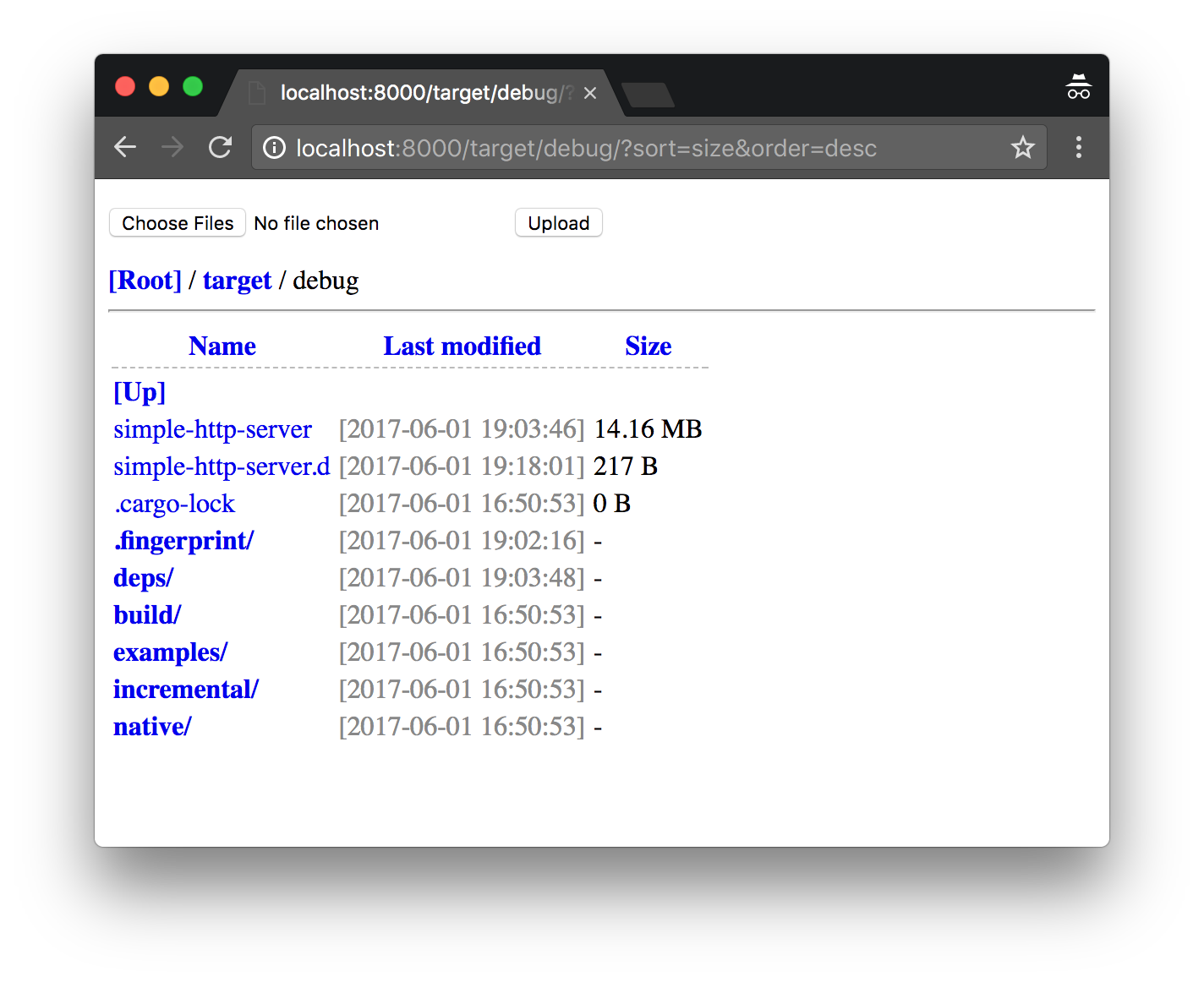
Screenshot
Installation
Default build:
cargo install simple-http-server
With PKCS#12 HTTPS support:
cargo install simple-http-server --features tls
Usage
Usage: simple-http-server [OPTIONS] [root]

Arguments:
  [root]  Root directory

Options:
  -i, --index                     Enable automatic render index page [index.html, index.htm]
  -u, --upload                    Enable upload files. (multiple select) (CSRF token required)
      --csrf               Use a custom CSRF token for upload. WARNING: this is dangerous as the token is passed via the command line and may be visible in process listings
      --redirect             takes a URL to redirect to using HTTP 301 Moved Permanently
      --nosort                    Disable directory entries sort (by: name, modified, size)
      --nocache                   Disable http cache
      --norange                   Disable header::Range support (partial request)
      --cert                TLS/SSL certificate (pkcs#12 format, requires tls feature)
      --cors                      Enable CORS via the "Access-Control-Allow-Origin" header
      --coop                      Add "Cross-Origin-Opener-Policy" HTTP header and set it to "same-origin"
      --coep                      Add "Cross-Origin-Embedder-Policy" HTTP header and set it to "require-corp"
      --certpass        TLS/SSL certificate password (requires tls feature)
  -l, --upload-size-limit   Upload file size limit [bytes, or K/M/G/T suffix interpreted with powers of 1024, such as 30K, 50M, 1G] [default: 8M]
      --ip                    IP address to bind [default: 0.0.0.0]
  -p, --port                Port number [default: 8000]
  -a, --auth           HTTP Basic Auth (username:password)
  -c, --compress ...         Enable file compression: gzip/deflate
                                  Example: -c=js,d.ts
                                  Note: disabled on partial request!
  -t, --threads              How many worker threads [default: 3]
      --try-file            Serve this file in place of missing paths. Relative paths are resolved against the server root; absolute paths are used as-is. [aliases: --try-file-404]
  -s, --silent                    Disable all outputs
  -o, --open                      Open the page in the default browser
  -b, --base-url            Base URL prefix for directory indexes and upload redirects. It is normalized to start with '/' and to end with '/' when not root. [default: /]
  -h, --help                      Print help
  -V, --version                   Print version
Examples
Serve a folder:
simple-http-server -i public
Enable upload and raise the upload limit:
simple-http-server -u -l 50M .
Serve an SPA fallback file:
simple-http-server --try-file dist/index.html dist
Run behind a reverse proxy that strips /static/ before forwarding:
simple-http-server --base-url /static/ .
HTTPS Example
--cert expects a PKCS#12 file such as .p12 or .pfx. PEM files are not accepted directly.
1. Generate a local certificate and .p12
mkdir -p /tmp/simple-http-server-tls
cd /tmp/simple-http-server-tls

openssl req \
  -x509 \
  -newkey rsa:2048 \
  -nodes \
  -sha256 \
  -keyout key.pem \
  -out cert.pem \
  -days 7 \
  -subj "/CN=localhost" \
  -addext "subjectAltName=DNS:localhost"

openssl pkcs12 \
  -export \
  -inkey key.pem \
  -in cert.pem \
  -out localhost.p12 \
  -passout pass:changeit
2. Start the server
simple-http-server \
  -i \
  --ip 127.0.0.1 \
  --port 8443 \
  --cert /tmp/simple-http-server-tls/localhost.p12 \
  --certpass changeit \
  .
3. Verify it
Strict verification:
curl --fail --silent --show-error \
  --cacert /tmp/simple-http-server-tls/cert.pem \
  https://localhost:8443/
Quick local smoke test:
curl -kI https://localhost:8443/
Features
- Directory listing with breadcrumb navigation
- Optional
index.html / index.htm rendering
- File upload with CSRF protection
- HTTP Basic Auth
- HTTP cache control with
Last-Modified and ETag
- Single-range partial content support
gzip / deflate compression- CORS plus
COOP / COEP headers
- SPA fallback via
--try-file
- Optional PKCS#12 HTTPS via the
tls feature