व Vyuha — The Trade Journal That Tells You the Truth
Every warrior had a charioteer. Yours keeps count.
Exact charges. Honest analytics. Desktop app today; a web platform is in development.








₹ Exact charges · 🧠 Honest analytics · 🖥 Desktop or web · 🇮🇳 Built for NSE/BSE/MCX
8 auto-detected brokers (Zerodha, Dhan, Groww, Angel One, Upstox, Paytm Money, Fyers, Nuvama) + any CSV via the column mapper + 4 broker-API pulls (Kite, Dhan, Angel One SmartAPI, Upstox Analytics token) — Index/Stock Options, Intraday, Delivery, Equity MTF, MCX Commodities
Why Vyuha?
Most journals tell you your P&L. Vyuha tells you why.
> Now: v4.6.0 — full history in CHANGELOG.md. Landing page: https://thejesh-k463.github.io/VYUHA-LOG/
>
> v4.6.0 — the market's real clock, two more brokers, the exchange's own
> industries, and a covered short stored as a short. Fyers and Nuvama
> join the broker list — eight brokers now auto-detect: the Fyers tradebook
> (recognised only when its filename says "fyers") and its Realised P&L as a
> reference, and Nuvama's P&L report with the charges Nuvama billed stored
> as stated; rate cards for Fyers Standard / Prime and Nuvama Lite Plus / Elite.
> Their F&O and MCX rows are verified against real exports; their equity
> rows are UNVERIFIED and import with a warning. An effective-dated market
> calendar answers every timing question — the Closing Auction Session
> from 3 August 2026, F&O to 15:40, the revised pre-open from 7 September
> 2026, holidays, Budget Sunday and Muhurat — and the day's mark waits for the
> official close (15:36 closing-auction stock, 15:31 other stock,
> 15:45 F&O). A bundled stock universe gives 5,450 of 5,482 listed
> equities the exchanges' own four-level industry, and AMFI's rank is
> the cap band (an NSE Emerge stock reads "SME — not ranked by AMFI"). The
> Market Atlas gains industry cohorts, median returns, one rotation table,
> relative strength against the market median and editable regime thresholds.
> Analytics regroup into three hubs (Edge Clinic · Capital & Expiry ·
> Costs; ten menu entries → six, every old address still opens its tab).
> Help is rewritten task-first, with a getting-started strip on the
> dashboard. A trade records which side opened it: an overnight F&O sale
> covered later in the same file is one closed short, filed in the
> financial year it was covered. /trades no longer reads the whole book
> for its KPI strip. AIS purchases split per entry fill, Harvest counts one STT
> split per ladder, and the 2018 FMV editor sets one value per scrip.
> Fixed: the ITR pack read the per-share FMV as a total and overstated a
> grandfathered long-term gain (₹20,000 for ₹5,000 in one worked case); Paytm
> Money and Groww ladders now sum to their position — a book imported
> earlier keeps its old ladders until you delete and re-import it, and Data
> Quality names them. OpenAlgo pulls need 2.0.2.6 or later. Four
> database upgrades, 0075–0078, plus the Fyers and Nuvama rate and margin rows,
> applied on first launch — take a backup first, as always. One new dependency,
> @radix-ui/react-accordion. Not in this release: no macOS build, the
> installer is still unsigned (Windows SmartScreen warns once), and no
> network host is added.
>
> v4.5.0 — the sale that closes the position, and a tax pack that knows
> whose accounts it is reading. Auto-close is ON: a sale imported for a
> holding you already hold now closes it FIFO instead of landing as a
> second, unrelated row — each import carries a "Keep sells as separate
> rows" toggle, the result card names what it closed, and an
> Un-close action on /trades puts a closed pair back as it was.
> Upstox pricing is plan-aware: Upstox sells Basic (₹20 an order) and
> Plus (₹30 an order), set per account in Settings → Accounts, and
> every Upstox delivery estimate now prices at min(₹20, 2.5%) with a
> ₹20 DP charge — a bill your broker's own file stated is kept as
> stated. Tax is per TAX PERSON: a Tax person field on the account, a
> person picker on /reports/tax when "All accounts" spans two of them,
> and the scope stated on every export. The bundled NSE ETF list — 350
> ETFs, its as-of date and sha256 shown on /instruments — drives
> STT and the capital-gains asset class, so a gold or debt ETF is no
> longer taxed as an equity share. Capital-gains heads follow the TRANSFER
> date, from one band table with each band's Act cited, and holding periods
> count in calendar months: this moves the short-/long-term line by up to
> two days for every equity trade. The ITR-2 item code for s.111A is
> A2, STT is added back in the capital-gains buckets, and MTF interest
> carries a "not deducted" line. A partly-sold staged position's fills
> are now taxed in the year they were sold, not when the ladder finally
> closes — a ladder whose fills straddle 31 March moves part of its gain to
> the earlier year. Dhan rows regroup under tickers. A broker-stated
> bill survives a re-tag, on imports made from this version on. One
> database upgrade, 0074, applied on first launch — take a backup first, as
> always. Not in this release: no macOS build, the installer is still
> unsigned (Windows SmartScreen warns once), and no network host is
> added.
>
> v4.4.0 — four more of your broker's own files, chrome that moves, and
> metrics that show their working. The importer learns the Zerodha Console
> ledger, the Groww balance statement from the Cash & Ledger screen
> (18 segment types, each row placed by its own balance because the file is not
> in posting order), and the equity contract notes of Groww and
> Upstox — a Groww note's wrapped 19-digit BSE order numbers are re-joined
> rather than dropped. F&O contract notes are still not read. An Upstox
> trade report's F&O rows are read with Upstox's own grammar, so NIFTY and
> SENSEX option trades land as option contracts and are charged as
> options. The sidebar resizes — drag its edge between 180 and 420 px, use
> the arrow keys on the focused handle, double-click to reset — and the width
> is kept on this device. Appearance moves to the end of Settings
> with a Save of its own, most pages open in a new default card order, and
> Rearrange — move-only, kept on this device — is on Settings and the
> Dashboard only. On the metrics side the per-trade risk cap becomes editable
> per segment (global, then bucket, then segment): Avg R moves on imported
> trades with no plan stop wherever a segment cap differs from ₹9,500, a limit
> never set reads "—", and a breach check for a never-set segment follows
> the global cap as you edited it. Avg R now states the split between R
> derived from your plan stop, R you typed and R sized by the default
> cap, everywhere it is printed — inside the exported share-card PNG included.
> F&O rows carry a per-lot second line, "1R = ₹X per lot", with the lot size
> and its date. Profit factor is stated after charges, with a drill-down
> that reproduces it and a free per-segment table. Ratios annualise on the
> bundled NSE calendar — 245 sessions in 2026 — so Sharpe, Sortino
> and volatility read about 1.4% lower and alpha about 2.8% lower than in
> 4.3.0 on the same trades, and the Monte Carlo horizon is 245; CAGR, Calmar,
> total return and drawdown are unchanged. The risk-free rate is one dated
> setting (7% by default) instead of three hard-coded copies, an empty figure
> reads "—" instead of 0, and every metric explainer is rewritten to
> your own arithmetic — no invented bands, and any statement about other traders
> carries a cited source. Fixes: the Outcome lens states "Share of trades";
> every trade-form number goes through one rule ("1,23,456.50" is read as
> written, "14,48" is refused); closing a stale lot refuses an unreadable stored
> date; the Signal book has its help entry. Pro Monthly is ₹999 for the
> first month, then ₹1,499/month; Annual ₹7,999 and Lifetime
> ₹29,999 are unchanged. One database upgrade, 0073, applied on first
> launch — it adds columns, moves no money and no cap. No dependency changes.
>
> v4.3.0 — option structures by name, and the signal behind the trade.
> /strategies names what your open option legs add up to, from a catalogue
> of 40 shapes, and draws each payoff at expiry from your entry premiums:
> intrinsic value only, before charges, a group that spans expiries drawn at
> its nearest one, and no Greeks. The Options Help Desk on /help
> writes up all 40, free on every copy, and each strategy card links to its
> entry. The sixteen shapes Vyuha named before 4.3 keep their names on the free
> tier; the other twenty-four names, the shelf of tiles you pick and the
> picker that edits it are Pro, and on a free copy such a group reads
> "Custom (n legs)". A new Signal book tab records, on the trade itself,
> the model, spot, zone, open-interest and volume figures and the T1 / T2 /
> SL ladder an option trade was taken on — Vyuha records the signal, it does
> not produce one — and reads it back as rule adherence against each trade's own
> levels, edge by model and direction, and ladder hit rates (those blocks are
> Pro). Data Quality joins a held lot to the sale that closed it with one
> button, lists copies already held in two accounts with a Remove the copy
> button for the plain ones, and the same broker client can no longer be
> connected into a second account. A Dhan connection that missed days
> catches up: the next pull also reads Dhan's trade history from the last
> successful pull, at most 90 days back and 50 pages; a longer gap is
> read for its last 90 days only, and the pull names the dates it did not fetch,
> in a notice that stays on the Dhan tab until you clear it. Streaks and
> drawdown now follow entry order inside a trading day. Beside them: the
> charioteer line on the splash, larger Help Desk and dialog text, a pasted
> broker token's expiry stamped in IST, an editor behind the spot? chip
> with an EOD close fallback, and one sign rule — zero unsigned, a
> percentage taking the sign of the rupee figure beside it. The desktop
> rate-card refresh had failed on every launch since v3.2.0; 4.3.0 repairs the
> F&O STT rates for dates before 1 April 2026 on first launch, adds the STT
> rates in force before 1 October 2024, dates the NSE and BSE exchange
> transaction charges and NSE's investor-protection fee by the exchanges' own
> circulars, and corrects today's NSE transaction charges and the BSE
> stock-option charge; charges already stored on trades are not rewritten. Two
> migrations, 0071 and 0072, and no dependency changes.
>
> v4.2.0 — credentials you already saved. Settings → Live feed gains a
> fourth source for the Live Desk: Upstox. It is opt-in like every other
> one — its row there stays greyed until you have saved your Upstox
> Analytics token under Import → Connect broker, and it prices nothing
> until you pick it — and it adds no
> new credential and no daily sign-in, because that token is issued
> read-only and lasts about a year. It is the same token the trade import
> uses, which is also the one way to break both at once: generating a fresh
> one at Upstox revokes the old one, and the import and the desk source stop
> together until you paste the new one back. While the desk is open Vyuha asks
> api.upstox.com for the instrument keys of the open positions of the
> selected account — at most 500, every 1 to 5 seconds at the interval
> you set — and for nothing else about them: no quantity, no entry price,
> no P&L, no account. The prices stay on this machine: never uploaded, never
> resold, and never written per tick — the one-mark-a-day rule is unchanged.
> Angel One is the fifth source, on credentials you also already saved: the
> client code, PIN and TOTP secret under Import → Connect broker. Vyuha
> signs in to apiconnect.angelone.in at most once a day while Vyuha stays
> open, again after a relaunch, after Angel One's 5 AM IST session flush, or
> when you re-save the credentials, and again when you switch the selected
> account, including to or from All accounts — the one-time code is derived
> from the secret you enrolled rather than the secret being sent, so there is
> nothing for you to click. If a sign-in is refused, Vyuha tries at most
> three times and then stops until you re-save the credentials or relaunch
> Vyuha. If Angel One
> reports an accepted session invalid, Vyuha signs in at most three times
> in a row without a priced answer in between, and then stops until you re-save
> the credentials or relaunch Vyuha.
> That host is already the one the Angel One trade pull uses,
> so no new host is added; the poll goes out in batches of 50 symbols at
> about one request a second, which makes its refresh arithmetic rather than a
> setting, counted in scrips rather than positions: 3 seconds up to 50
> scrips, 5 seconds to 200, 10 seconds to 500. The 1–5 second slider is
> hidden under this source and
> replaced by one line stating the interval and the calls each refresh takes.
> Equities this release: futures and options rows are not priced by this
> feed: each shows the position's recorded close, or a dash when no
> close is recorded, and says so on the row — under either broker source. Beside
> it, the
> automatic close-of-session mark now refuses on an exchange holiday as
> well as at the weekend, from a holiday list bundled with the release, so a
> shut Thursday no longer carries the previous session's price forward under
> that day's date. PRIVACY.md item 3 states the poll and names the host; the
> list of network requests is still exactly four kinds, because this is the
> same kind — your own broker, only when you switched it on.
>
> v4.1.0 — a bridge you already run. The Live Desk can be priced by a
> bridge you run yourself on your own machine. The feed that shipped
> switched off in v4.0.0 is switched on, and Settings → Live feed now
> offers three sources: the end-of-day bhavcopy already on this machine (still
> the default), a mark you type, or that bridge. It is opt-in and stays behind a
> disclosure every install re-accepts; while the desk is open Vyuha asks your
> bridge — 127.0.0.1 unless you enter another address — at the interval you
> set on a 1–5 second slider, and the marks on screen refresh at that interval
> for as long as the screen is in front of you. The request carries the trading
> symbols and exchanges of your open positions and nothing else about them:
> no quantity, no entry price, no P&L, no account. No new network host is
> added, and ticks are never written — one mark per position per day reaches
> the journal, written by the app itself once after 15:30 IST while the desk is
> open — it reconnects its stream at 15:31 IST to do it — or the next time the
> desk opens that day, or when you press Save today's mark, and never at the
> weekend; exchange holidays are not modelled in this version. A price you
> type yourself is that day's mark: the automatic close-of-session mark does not overwrite it,
> and typing after the close replaces the automatic one; any bhavcopy applied for that day — the Auto-MTM job if you have switched it on, a file you drop or paste yourself, or the history backfill — replaces it with the exchange close. Already-marked
> is decided per symbol per IST day, so a second account's open positions get
> their own mark the same day. Your broker's API session
> expires daily and has to be signed in again at the bridge's own screen; that
> is the broker's rule. When the bridge is unreachable or has no key, the desk
> shows a once-a-day reminder to reconnect. Beside it: the Sizing Lab's
> volatility tab shows both of its variants — Turtle unit (N) and Varsity
> (% volatility) — side by side with each panel naming the variant that produced
> its number, and the seven tabs are unchanged; the Market Atlas prints the
> sha256 of each bundled classification map's canonical JSON, as the app
> loaded it — not of the file on disk — beside its as-of date; an instrument
> can carry the date its
> company reports, shown on the desk as a free "Results in N days" chip and
> typed by you, since nothing fetches it; and the portfolio-heat tile also
> prints what your trailed stops have locked in at stop. One migration,
> 0068, and no dependency changes. Telegram stop/target alerts are not in
> it — they become their own release after v4.2 — and native Upstox and Angel
> One feeds are v4.2.
>
> v4.0.0 — the Live Desk. Open positions get a screen of their own: what
> you still hold, the mark Vyuha has for each name, the P&L that follows from
> it, and how old that price is — end of day, entered by hand, or none
> stored yet. That much is free on any copy, licence or not, because it is
> the journal reading itself back. With Pro the same rows also carry the R
> multiple, the computed loss if the stop is hit (in rupees, and as a share
> of the capital you recorded) and the desk's portfolio heat — rows with no
> stop are counted and named as excluded rather than folded into the total, and
> with no capital on file heat says it has no denominator instead of inventing
> one. Expanding a row draws your entry, stop and target on the price itself,
> beside a stop computed four ways and a trailing rail of five, each printed
> with the parameters it used. Two more Pro screens ship with it: the Sizing
> Lab, which sizes one trade by seven methods side by side — fixed rupee,
> fixed fractional, Turtle unit, % volatility, Kelly, fixed ratio, equal weight
> — with every formula and input printed beside its number and charges taken
> from your own rate card; and the Market Atlas, which computes advance /
> decline with its denominators, % above the 20/50/200-day averages, 52-week
> highs and lows, volume expansion, the same window by sector and by NSE cap
> band, and your own open names against their sector cohort — all from
> end-of-day bars already on this machine, with no account, no upload and no
> new connection. Four migrations (0064–0067) run on first launch behind the
> automatic pre-migration copy.
>
> v3.9.1 — what Vyuha says about itself, and what the import route will
> accept. The positioning is now desktop or web, the trader chooses: Vyuha
> Desktop keeps every technical guarantee it had — a licence verified on your
> own machine with no server call, a 7-day trial with no signup, one
> download-only check at launch, your journal in one SQLite file on your PC —
> but they are stated as facts about the desktop app rather than as a promise
> about the product, while a web platform is in development. The import
> route refuses a file before it reads it: an upload over 32 MB is declined
> with a 413 that says the limit, and the readability guard checks magic bytes
> first, so a file whose extension and content disagree is refused rather than
> handed to the spreadsheet reader. SheetJS is updated to 0.20.3, vendored
> in the repo — the registry copy is the abandoned line and carries
> CVE-2023-30533. A licence key bound to one computer is now refused at
> activation instead of appearing to activate and failing later. And the
> 220ms entrance transform that drew dialogs, popovers, tooltips and the
> command palette up to 190px off before snapping back is fixed.
>
> v3.7.1 — the release. v3.7.0 was cut, audited a second time, and superseded
> before anyone could install it. A second adversarial audit — run over the fixes
> the first audit had produced, which it had never seen — found that the first-run
> wizard could write NULL over a capital base you had already set, and that three
> audit-log rows on irreversible paths described changes that never happened. Both
> are fixed here, each with a test proven red against the reverted code. The v3.7.0
> tag remains for history; nothing from it was ever published.
>
> v3.7.0 — read your own trades back, and a discipline score that refuses rather
> than guesses. The new Trade Review Desk keeps a queue of the closed trades you
> have not read back yet — windowed, and always saying “showing N of M” instead of
> presenting a slice as the whole — and closes an ISO week with a Sunday ritual:
> what closed, what it netted and cost, the widest expectancy gaps by mistake tag, and
> a note. The weekly discipline score is now a transparent Process Score — five
> equal-weight components (planned · risk-cap · daily-stop · rules-followed · reviewed),
> each printed as “n of m · pct” with its own coverage. Your numbers will move.
> A week with fewer than 10 closed trades no longer scores: it shows “—”, says what
> was short, and is excluded from averages rather than counted as a zero — on a
> representative five-week fixture the honest average is 80 where v3.6 printed 32.
> And a per-trade cap or daily stop you never configured is no longer substituted with
> ₹9,500 / ₹25,000; those components refuse instead. Advance tax now measures each
> instalment against dated challans actually paid by its own due date, and names
> anything paid after 31 March as self-assessment tax — a book with no challans
> recorded sees no computed figure change. Capital resolves per account on eight
> more surfaces, which also corrects single-account books: compounding writes the
> account row, so those screens had been showing the pre-compound figure while Settings
> showed the compounded one. A fresh install now opens a four-step setup wizard
> (capital still optional), Lenses opens in about half the time (1718/1557 ms →
> 920/901 ms on a 25,000-trade book, with no figure on the page moving), and a
> failed Telegram digest is recorded durably and visible from every route.
>
> v3.2.0 — the journal stops guessing, and starts saying how sure it is. Charge rates are
> now effective-dated: a rate row had no time dimension, so every trade of every vintage was
> priced at today's rate, and a book spanning the 1 April 2026 STT revision (NSE circular
> 02/2026 — options 0.10→0.15%, exercised options 0.125→0.15%, futures 0.02→0.05%) was priced
> wholly at the newer regime. Vyuha now keeps a dated history per rate and refuses rather than
> substituting when a date has none; nothing re-prices on upgrade. Every rate on the Edge
> report now carries a Wilson confidence interval, corrected across the whole table with
> Benjamini–Yekutieli — a 68% win rate on 15 trades spans roughly 42–86%, and slices that
> are not yet distinguishable from the book's own rate are marked and still shown. New
> segment depth separates the five books inside a book — Intraday, Delivery, MTF, Options
> (Index), Options (Stock) — and four columns the journal always captured and never read now
> answer when you exit, how long you hold, how many orders a position took, and why you
> closed it, crossed with how much of the move that exit caught.
>
> v3.1.1 — an import says what it did with every row. A tradebook states executions;
> Vyuha stores positions. The screen used to announce only the second number, so 7,544
> executions imported as "804" and read as data loss. Every import surface now states the
> arithmetic — "7,544 executions → 804 positions (82 open, 72 opening sells without buy
> history)" — and the rows whose P&L is legitimately "—" say why, and how to fill them in.
> A false "conservation check FAILED" on large correct imports is fixed: it treated four
> paise of paisa-rounding residue across 804 positions as a lost lot, with quantity conserved
> exactly. And numeric scrip codes now resolve through a bundled 5,671-security snapshot
> of NSE, NSE Emerge and BSE listings, so SME-heavy books stop showing rows of numbers.
>
> v3.1.0 — an account can leave the journal cleanly, and OpenAlgo gets a manual. Every
> account in Settings now carries a Delete, with two coherent ends: delete everything the
> account owns, or merge its journal into another account, with a separate choice for its
> broker connections. A live server-computed preview shows the exact per-table counts, duplicate
> trades already in the merge target, and the warnings that apply, before a type-the-name
> confirmation arms the button. Deletions are snapshot-first and transactional — trades,
> ledger, IPOs, imports, sessions and capital history are recoverable from Deleted items, and
> restoring recreates the account; broker API credentials are never written to snapshots, and
> the dialog says so. Merges keep every trade link intact, skip and report duplicates, and carry
> the capital-compounding marker with arithmetic capped so it can neither double-count realised
> P&L nor go negative. Import Help v2 opens each broker card as a full pop-up guide with
> verified per-broker OpenAlgo setup detail (Dhan and Upstox verified against live instances),
> pointing to two new client-package files: OPENALGO_SETUP_GUIDE.html and
> OPENALGO_SETUP_GUIDE.docx — a step-by-step multi-broker OpenAlgo manual built from real
> testing.
>
> v3.0.0 — every connection knows its account, imports explain themselves, and speed is now
> measured. The public-launch release. The all-accounts Import view now lists every
> connected broker API and OpenAlgo instance with a per-account label (it used to collapse
> silently to the first account's set), saving a connection asks which account it belongs to,
> and Pull & commit always books into the connection's own account — closing a latent
> cross-account write path. A new Import Help sidebar tab carries one expandable card per
> broker: which files import, where to download them (dated "as of Aug 2026"), and each API's
> full setup path — derived from the import registry and guarded by a test. And a performance
> pass measured on a new 42-route benchmark against a seeded 25,000-trade book took Cash &
> Ledger from 27.3 s to 0.9 s (the page was serializing a 113 MB response — sums and the
> running balance moved into SQL, the table pages at 200 rows), corporate actions 1.6 s → 0.7 s,
> the dashboard 1.9 s → 1.3 s, the overall route median 1,195 ms → 987 ms, and console errors
> 3 → 0 — with npm run perf:seed + npm run perf:sweep shipping as the harness that keeps it
> honest. Six payload-bound routes remain above the internal 1.5 s budget at that abusive tier;
> they render correctly and are scheduled as v3.0.x pagination work.
>
> v2.99.104 — Upstox connects natively, and duplicate pulls explain themselves. The fourth
> broker-API pull, on the best credential of the four: Upstox's Analytics token lasts a year
> and is read-only by design — it cannot place orders, even in principle. Built and verified
> against a live account the same day (11 real fills across NSE/NFO/BFO; weekly option symbols
> canonicalised from three live contracts; MTF arriving as the stated product), then
> cross-checked against a second, independent pull of the same day — every trade matched to
> the exact hash. That test surfaced the release's other feature: a commit that would add
> nothing now opens a dialog listing each already-recorded trade instead of a one-line skip
> note; risky near-miss duplicates keep their blocking warning; ordinary re-pulls stay nag-free.
> Also fixed on the way: Vyuha forces Upstox requests onto IPv4 (the API is dual-stack, and
> Upstox's Static-IP gate rejects the IPv6 path a default fetch takes — found live, coded
> around, explained in the connection's help text).
>
> v2.99.103 — Angel One's live pull books F&O correctly, verified against its contract note.
> The first Angel One pull to return fills verified the row shape and fixed the known
> F&O-as-equity defect from the broker's stated fields — the payload's own SENSEX symbol carried
> a different date than its stated expiry, so symbol-parsing would book the wrong day. A real MTF
> trade arrived as producttype: "MARGIN", now mapped to MTF. The contract note reconciled all
> six trades to the fill time.
>
> v2.99.102 — the first live F&O pull, and everything it taught. The first broker-API pull ever
> to return real F&O fills ran on 2026-08-26 against a live Dhan account, supervised end to end and
> reconciled against the broker's signed contract note — all 9 contracts to the 4th decimal, STT
> exact to the paisa, non-brokerage levies within 0.081%. It found real defects and this release
> ships their fixes: F&O positions pulled through the Dhan API used to classify as equity (wrong
> STT, wrong segment, invisible to options analytics) — derivative names are now built from the
> facts Dhan itself states, never guessed from symbol shape; open positions arrive already
> valued with the broker's own mark; and a pull that looks like trades already in your journal
> now stops before committing and shows you exactly which rows collide — the same contract at
> two different brokers still imports as the two real trades it is. Also: Portfolio Risk shows
> rupees beside percentages, and an inline price box replaces the dead-end "enter a current price"
> link. The same classification defect is known and still open for Zerodha/Angel One API pulls
> (their file imports were always correct) — it is fixed the day a real F&O payload exists to
> verify against, because guessing is how journals lie.
>
> v2.99.101 — a closed position explains itself instead of dead-ending. Booking an exit on a
> fully closed staged position offered percentage shortcuts of nothing and a native max=0
> constraint whose "Value must be 0." blocked every quantity before the ladder's own message could
> surface. The dialog now says the position is closed and names the two real paths — add an entry
> to re-open it, or remove the wrongly-booked exit leg and book what actually happened. The button
> stays enabled throughout: the panel warns; it does not decide.
>
> v2.99.100 — imports stay proportional as a book grows; the pairing engine was quadratic. The
> FIFO walk that turns fills into positions cost three O(lots) scans per sell — a full-queue
> pass for same-day lots, .some() and .find() re-scanning inside the oldest-first loop, and a
> splice compaction — so a queue that grows (buys outnumbering sells) made the walk O(n²).
> Found by a new load case, tests/load/c8-pairing-depth.load.ts, written because an import-graph
> scan showed none of the thirteen existing load cases imported the module at all: one symbol at
> 8,000 legs → 79 ms and 32,000 → 1,249 ms, a 15.89× cost for 4× the legs. A forward-only head
> pointer plus a per-date index brings that to 3.70×, and 50,000 legs on one symbol from
> 775 ms to 63 ms — with byte-identical output, proven by 1,920 unit tests and by both
> real-broker reconciliations (Paytm's 414 executions against Paytm's own realised-P&L statement,
> and a 1,554-fill Zerodha Console tradebook). Multi-symbol books were never affected: that path
> measured 4.19× with per-item cost flat throughout.
>
> v2.99.99 — Angel One's live pull works again; it had been refusing since v2.99.80. Pressing
> Pull on an Angel One connection answered "the saved credentials cannot be read" and never
> reached the network — on every shipped build from v2.99.80 up to and including the published
> v2.99.98. Angel One is the only broker that collects no access token (it mints the day's login
> code from your enrolled TOTP secret), so the vault held an encrypted empty string, whose
> zero-length ciphertext parseVaultString correctly rejects as malformed — and the pull's guard
> demanded a readable token before dispatching to any broker, refusing on one Angel One never
> asks for. The guard now requires a token only where the broker table says one is collected; the
> vault format is unchanged, because refusing an empty ciphertext is the right behaviour, and
> tests/vault.test.ts pins the trap. Nothing needs re-entering. Also shipped: the Help Desk's
> "eight brokers", the Dashboard's "five brokers" and the column mapper's plain-FIFO description
> now match the code, and tests/readme-claims.test.ts reads its test and screenshot counts off
> disk instead of comparing its six figures only to each other — which is how 1,858/128 stayed
> green against a suite at 1,920/131.
>
> v2.99.98 — Tradebooks import as the trades you made, verified against a real broker statement. Zerodha and Paytm Money
> tradebooks are paired per scrip and day — same-day buys and sells net into one intraday trade first, the rest FIFO —
> so a quarter of fills no longer collapses into one row per symbol; sells of shares bought before the window are
> opening sells with the P&L left blank, never a 100% gain. Zerodha fill times now come from Order Execution Time.
> Paytm's EQ-only product column is replaced by the product Paytm's own STT/stamp duty imply per day, its six charge
> components travel with each trade, and its numeric scrip codes resolve to tickers through the ISIN. Reconciled against
> Paytm's realised-P&L statement: 47 of 52 scrips within ₹25, total within 1.4%. Upstox trade report and realised P&L
> are recognised by the legal name in A1 (schema verified; values unverified — no rows yet). Same-day-first pairing
> applies to Dhan GTR, Groww order history and the column mapper too.
>
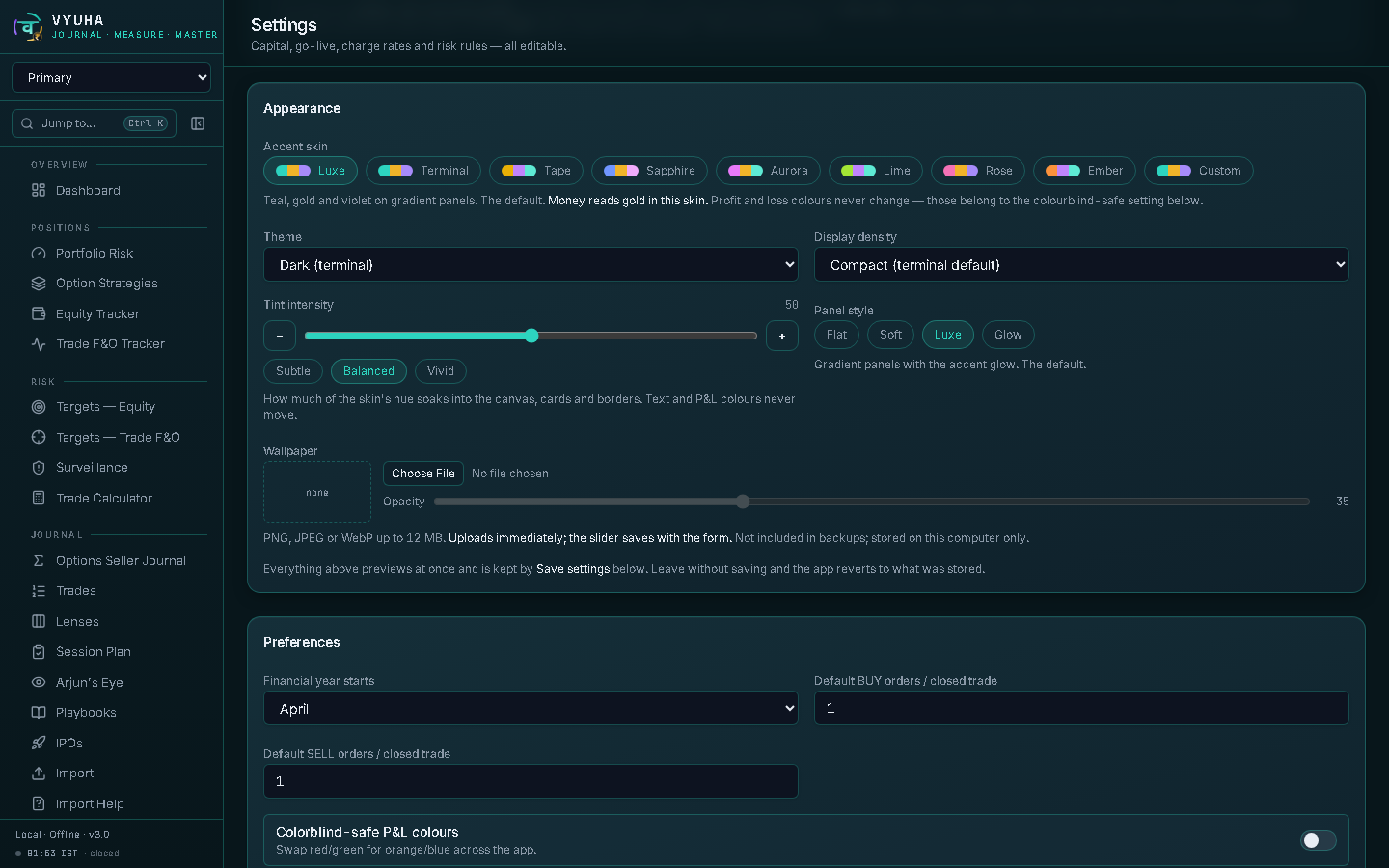
> v2.99.97 — Appearance becomes a set of dials. A tint intensity slider (0–100, Subtle /
> Balanced / Vivid) decides how much of the skin's hue the canvas, sidebar, cards and borders
> wear — tuned so every skin holds ≥9:1 (dark) / ≥7:1 (light) body-text contrast even at 100.
> A panel style (Flat / Soft / Luxe / Glow), a wallpaper (PNG/JPEG/WebP ≤12 MB, kept out
> of backups, scrimmed per theme, never printed) and a ninth skin, Custom — seven colours ×
> dark/light with a readability badge on each, seeded from any built-in skin. The tokens are
> computed by a pure engine and injected inline on ``, so there is no flash and charts
> stay literal-colour. Also: the buy buttons open a copyable WhatsApp dialog inside the desktop
> shell, and reinstalling over a running copy no longer errors on node.exe.
>
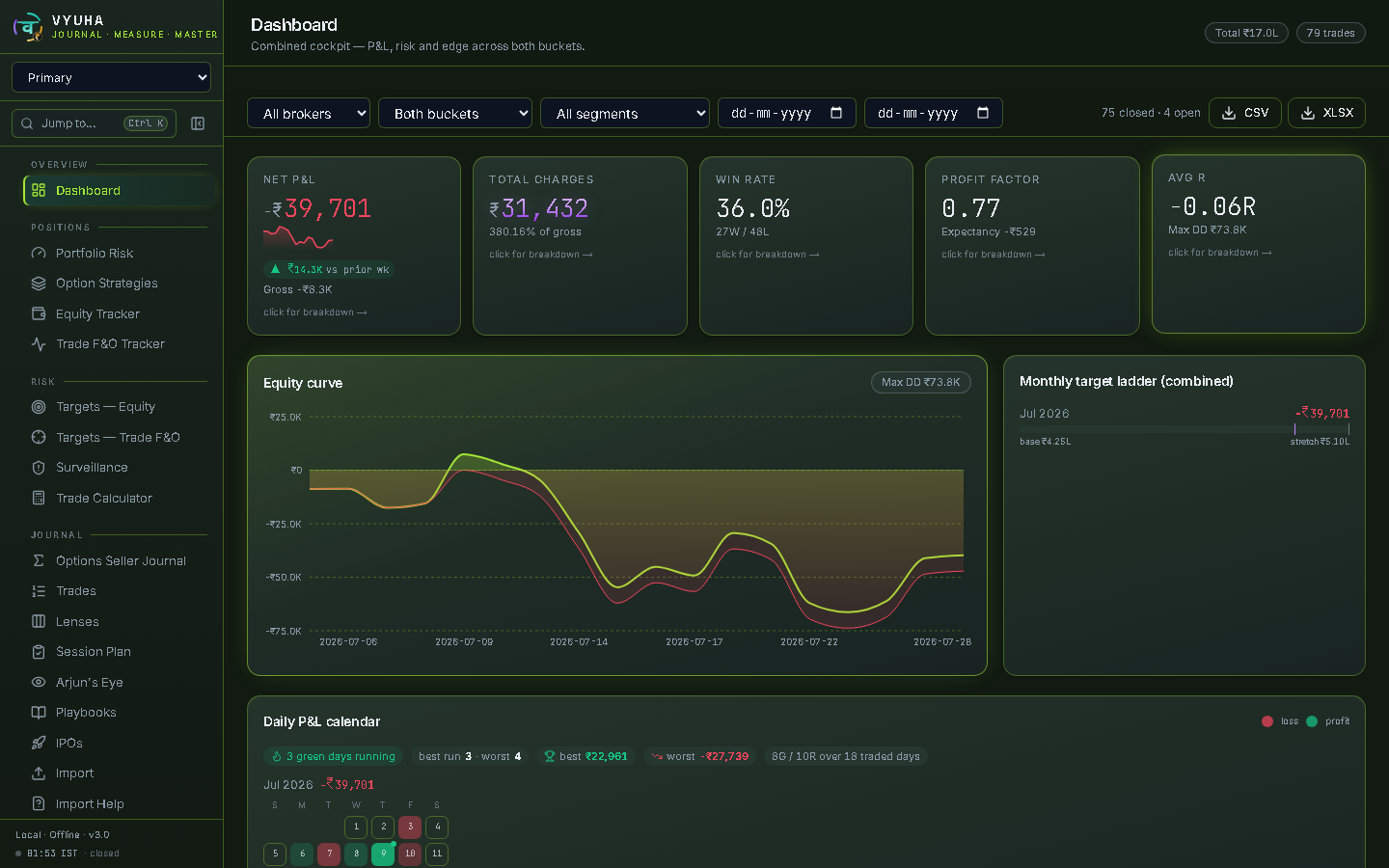
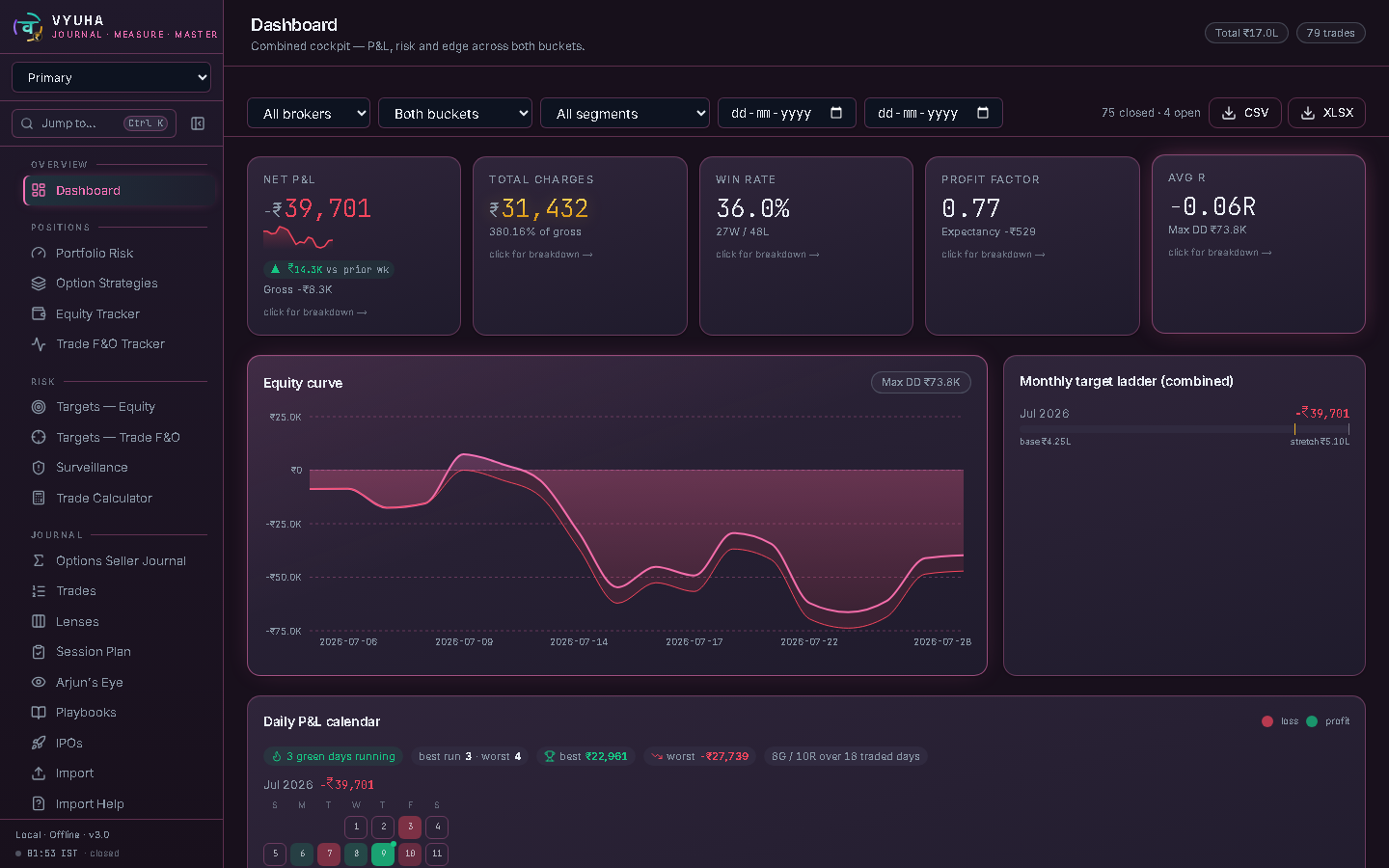
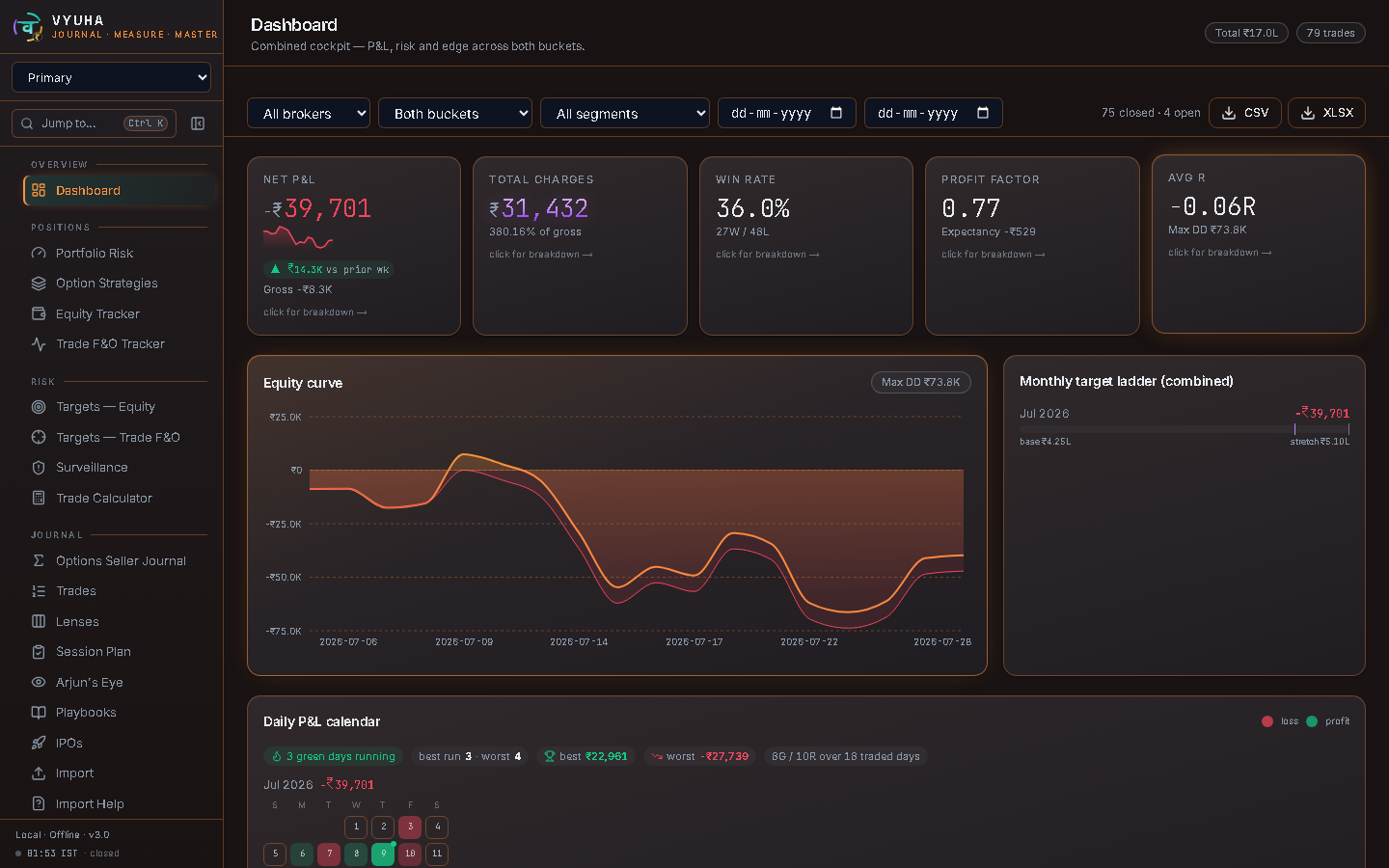
> v2.99.96 — eight skins that tint the whole screen. Ice and Royal are retired (they shared
> hexes with Sapphire and Luxe/Aurora and were telling only by their buttons; a stored choice
> maps to Sapphire). In their place Lime, Rose and Ember — and every coloured skin
> now tints canvas, panels and borders in its own hue, so the roster is Luxe, Terminal, Tape,
> Sapphire, Aurora, Lime, Rose, Ember, with a test that no two share a primary or an
> analytics-vs-primary hex.
>
> v2.99.95 — launch pricing that survives division, and a comparison that hides nothing.
> List prices are ₹13,000/yr (Pro — Annual) and ₹35,999 (Journal — Lifetime), effective
> 2027-01-01; until then the launch offer sells at ₹7,999/yr and ₹29,999, and the savings
> badges are computed and floored — 38% off and 16% off, never rounded up. Lifetime is
> now the featured plan and lists the roadmap. The pricing and landing pages carry a
> seven-product comparison read from public pages on 2026-08-15, with "not stated" wherever a
> claim could not be verified — the ₹999–₹2,499 Indian competitors included. macOS selling
> claims came off every surface (the Mac edition will be offered separately), the current
> mark replaced the retired flat tile everywhere, and the refund policy states its edges.
>
> v2.99.94 — the renewal you were never warned about, and four claims that were not true.
> An annual licence now warns from 30 days out — a dated countdown and a renew link on every
> Pro screen, nothing withheld while it counts down, and the journal itself is unaffected by
> expiry either way. PDF is no longer described as an importer (it reads a broker PDF's text
> so you can enter trades by hand; it produces no trades), prices no longer claim to include
> tax, the download promise says "private link" because a 35 MB installer cannot be emailed,
> and a refund policy, terms of use and privacy statement now ship inside the download. For
> the seller: a licence term must be stated explicitly and a paid key needs its payment
> reference before it can be issued.
>
> v2.99.93 — five things that only showed up under load, two of which lost data. A load
> and stress suite now exists, and its first six tests found five real defects. Screenshot
> thumbnails no longer vanish on restore (they had no database row, so backups never carried
> them — take a fresh backup after updating), deleting a large account no longer trips
> SQLite's 32,766-parameter limit (a 2,000-trade delete went from 4,010 statements to 29),
> and rebuilding a staged ladder is one all-or-nothing write instead of a half-repriced
> position. Import preview is 364× faster on a 25,000-trade book (8 s → ~20 ms) and Data
> Quality 31× faster when symbols are not price-marked (10 s → fast), with case-insensitive
> symbol matching so a fresh mark is never reported stale.
>
> v2.99.92 — the same app as v2.99.91, shipped by a pipeline that now works. No behaviour
> changed. v2.99.91's Windows job died on the release gate, so it published with macOS assets
> only and no Vyuha_x64-setup.exe; everything below reaches a Windows machine for the first
> time here. The cause was a DPAPI round-trip test — the one test that spawns a real process,
> two cold powershell.exe starts — timing out against vitest's 5s default on a cold runner.
>
> v2.99.91 — a withdrawn licence now stops working before the next release. Revocation
> was a build-time list: a refunded or leaked key kept working until the user happened to
> install a newer build. It now also travels as an Ed25519-signed list the app picks up
> during the version check it already ran at every launch. The list goes down and nothing
> goes up — no key id, no machine id, no account in the request; the same public file is
> served to everyone. It warns before it locks (a dated countdown on the Pro screens for
> the grace window, with nothing withheld), it is reversible by publishing a newer list,
> an older list can never undo a newer one, and it fails open offline. Two limits are
> written down rather than hidden: a permanently offline machine never receives it, and none
> of this survives a patched binary. Shipping it meant retiring four in-repo promises that no
> such mechanism would exist and correcting three published claims that described the launch
> update check as optional — see below.
>
> v2.99.90 — the first broker that connects itself every morning. Angel One joins
> Zerodha and Dhan for live API pulls — and unlike either, nothing expires on you: each pull
> mints the day's login code from your enrolled TOTP secret, so one click after the close
> brings in the day's fills. The integration is read-only by construction — it can log in
> and read the trade book, nothing else, and the test suite pins that export list so a trading
> capability cannot be added without failing CI. The TOTP engine is forty lines of node:crypto
> pinned to RFC 6238's own test vectors; no new dependency.
>
> v2.99.80 — what the database file knows, it no longer tells. Every stored secret — the
> licence key and all broker credentials — is now encrypted with a key the database does not
> hold: DPAPI-wrapped to your Windows profile, or a machine-identity KDF on macOS/Linux. The
> .sqlite file alone, copied or synced or shared, carries nothing usable. Backups stop
> carrying credentials entirely, and on a new machine the app asks you to re-paste rather than
> breaking. The honest boundary, stated in the docs: this defends the file at rest, not a
> compromised machine — no user-mode design does, keychains included.
>
> v2.99.77 — the boundary holds everywhere. Eleven defects, most of them one disease: code
> touching an account-scoped table without resolving which account it was in. Session plans can
> no longer drift across accounts from a stale tab; IPOs land where you'd expect and refuse
> cross-account edits; every staged-leg mutation runs the delete engine's own-account guard.
> IPO exit charges now price through the charges engine and your editable rate card instead
> of rates frozen in source. And the guard tests can now fail: the account registry maps every
> scoped table to owner files that must resolve the account, catching a real distinction on its
> first run.
>
> v2.99.76 — the price becomes the positioning. Two plans, stated plainly in-app for the
> first time: Pro — Annual ₹7,999/yr and Journal — Lifetime ₹29,999, with the free tier
> free forever. Prices carry the date they were set and the buy message quotes exactly what you
> saw, because an offline app quoting a price is a promise the seller has to keep.
>
> v2.99.75 — six brokers auto-detect, deletion grows an undo, and the book gets lenses.
> Import detection was rebuilt on in-content fingerprints after a real misroute — every
> broker parser must now prove whose file it holds before it claims one, and a file that names
> no broker gets a question, never a guess. That rebuild carried three new formats in with it:
> Paytm Money tradebook (per-execution with the broker's own charges), Angel One tax
> P&L (seven sub-tables, explicit MTF quantities), and Groww order history. Deleting
> became something you can reason about: every delete now writes a snapshot first — trades,
> legs, chart attachments and all — restorable from Backup & Restore → Deleted items, and new
> scopes (date range, current view, one broker, one file) all pass through the same
> show-exactly-what-goes confirmation. The new Lenses screen cuts the same book six ways —
> month, broker, trade type, import file, setup, outcome — with per-group performance, and the
> app finally answers "how much?" in-app: real prices on the upsell panel and a pricing page.
>
> v2.99.70 — seven skins, and the chrome grows reflexes. Three new accent skins — Royal
> (regal violet, since retired), Sapphire (electric indigo with orchid analytics), Aurora (fuchsia with
> teal) — each a measured triple like the original four: same contrast floors on both themes,
> money/analytics roles kept far apart on the hue wheel, P&L colours untouched. Around them the
> chrome sharpened: real 300 ms tooltips replace the browser's slow title bubbles on the hot
> surfaces, the Ctrl+K palette became a true dialog (focus trap, scroll lock), and the animated
> count-up numbers rolled out from the dashboard to the report and tracker screens.
>
> **v2.99.60 — built for the ten-thousand-trade book, dressed to match.** Three engineering
> releases: the Trades table now virtualizes and ships 44% less data (measured — an ~10k-trade
> book stays instant), the hottest queries went from filesort to index scan, and every report
> screen now wears the same table chrome, feedback voice and empty-state language as the rest of
> the app. Print pagination works, dialogs keep Save on screen, a fresh install greets you with a
> next step instead of five ₹0 tiles.
>
> **v2.99.45 — it remembers how you trade, and it survived a forensic audit.** Every feature was
> audited against real journal data before this build — money identities across every row, all 40
> screens rendered live, an adversarial read of every changed file — and the three defects found
> (a half-rupee rounding edge, a viewer that could reopen uninvited, a file variant that could
> silently clear a surveillance category) are fixed and pinned by tests.
>
> **v2.99.40 — it remembers how you trade.** The calculator keeps a separate last trade for
> Equity and for F&O — with an index picker that knows the January-2026 market lots (Nifty 65,
> Sensex 20…) and which exchange each index calls home. Surveillance now reads NSE's own files:
> drop `fo_secban.csv` or the `REG_IND` indicator file and ban/ASM/GSM/ESM land in the right
> categories with the date read from the file itself. Chart screenshots open in an in-app viewer.
> Trades columns reorder by drag. Four coordinated skins — Luxe, Terminal, Ice (since retired → Sapphire), Tape — in dark and
> light. And the installer wears the Vyuha mark end to end, not the NSIS globe.
>
> *v2.99.9 — every broker's MTF list, compared.* 10,501 per-stock own-margin percentages across
> all seven brokers, each from the broker's own feed — and a Broker Costs section that prices
> **your** delivery/MTF symbols on every list, cheapest broker highlighted (Sahi listed honestly:
> no MTF delivery). Approved-but-unfunded scrips are declared, never disguised as funded.
>
> *v2.99.8 — MTF that knows your broker's list.* 3,083 per-stock own-margin percentages from
> the brokers' own published MTF lists (Zerodha and Paytm Money complete; partial/rule-based
> coverage declared honestly for the rest). The Trades form auto-splits your capital vs
> broker-funded the moment you enter price and quantity — both sides editable, each deriving the
> other — and Portfolio Risk flags open MTF positions whose current requirement has drifted since
> entry. Plus: chart screenshots attach at trade entry, and selected trades export as a PDF report.
>
> *v2.99.7 — sectors in one click, and edge by theme.* A bundled snapshot of NSE's 54 index
> constituent lists (~1,150 symbols with official industry, ISIN and thematic memberships) fills
> your instruments master in one click — sector concentration works with zero typing, and your
> hand-typed tags are never overwritten. The Edge report gains a **theme lens**: expectancy per
> thematic index (Defence, Railways PSU, EV, Digital…), honestly labelled — themes overlap, thin
> samples are flagged, and the untagged remainder is reported.
>
> *v2.99.6 — files in, typing out.* Instruments fill from NSE's own files (bhavcopy /
> EQUITY_L / F&O market lots — with in-app guidance on where each lives), corporate actions
> import from the CF-CA CSV with every reading shown for verification before applying, symbol
> aliases take a CSV, and AIS reconciliation parses the income-tax portal's JSON download
> directly. The audit log now groups by what happened — your edits are no longer buried under
> auto-MTM maintenance rows. And the first-run database is finally anonymous: zero capital,
> go-live stamped on first launch.
>
> *v2.99.5 — Vyuha gets its mark, and tables you can actually read.* The Devanagari **व**
> hanging from an edge-to-edge shirorekha — the letter's headline stroke doubling as a price
> level — now ships as the installer icon, favicon, sidebar and share-card mark, generated from
> one committed glyph outline (Noto Sans Devanagari, SIL OFL) so no surface depends on the
> user's fonts. Every table gained visible row rules (the old separators measured 1.08:1 —
> below what the eye registers), a proper uppercase header band, a pinned Instrument column,
> truncated option names, and a **Compact/Comfortable display density** setting. Light-mode
> primary now passes WCAG AA.
>
> *v2.99 — Vyuha runs on a Mac, and the journal cleans up after itself.* Native builds for
> Windows, macOS Apple silicon and macOS Intel. A **Help Desk** describing every screen — including
> what each deliberately won't do. **Honest deletion**: select rows, delete an imported file (with
> the its-trades question asked, never assumed), batch scopes by date/broker/segment — every delete
> previews the exact set first and audits the full before-snapshot. **Cross-source duplicate
> detection** stops a P&L export silently double-recording trades a transaction report already
> supplied. **My Default Settings** restores your baseline in one click — preferences and rate
> tables, never licence or accounting state. Seller depth: expectancy by DTE band, hedged-vs-unhedged
> as an honest gap, roll chains against the first leg, IV rank, premium per day of risk. And the
> licence clock is now a ratchet — winding the system clock back no longer renews a trial.
>
> *v2.98 proved the safety net (atomic restore, stronger backup crypto, aggregate-view write
> guards) and added the ITR schedule-format export with the S.48 STT rule applied per head.*
- 🇮🇳 To-the-rupee Indian cost engine. STT, exchange txn, SEBI, stamp, IPFT, GST, DP, pledge — computed per broker × segment × exchange from an editable rate table, reconciled against real broker files. Money is stored as integer paise (no float drift), with statutory rounding.
- 💸 MTF done right — the only journal that gets it. Interest accrues on the broker-funded portion only (own-margin % is broker-specific: Dhan/Groww ≈25%, Zerodha ≈20%), with the correct T+1 day-count verified against Dhan's own docs. See ROI on your own capital, leverage, breakeven price, and a ⚠ flag when interest has eaten your entire paper gain.
- 📚 Playbooks that enforce discipline, not just describe it. 25 preset setups from trading ecosystems worldwide (ORB → Wyckoff → Minervini VCP → India's expiry-day theta), fully editable, plus your own. Tag a trade and its rules become a followed/broken checklist — the Discipline page then shows which broken rule costs you the most ₹.
- 🇮🇳 Knows today's SEBI regime. A compliance radar reads your open book against the post-2024 F&O rules — the +2% expiry-day ELM on short options expiring today, the loss of calendar-spread margin benefit on expiry, which indices still have weeklies, and how close your index exposure sits to the ₹1,500 cr limit that's now snapshotted intraday. No other journal tracks this.
- 🔍 Honest analytics. Expectancy cards warn you when the sample is too small to trust. The stop-tuning report says "descriptive, not prescriptive." Mistake economics report the expectancy gap, never fake counterfactuals. A SEBI reality-check card compares your F&O book to the published loss statistics.
- 🔒 You stay in control — always. Auto-MTM is opt-in. Update dialogs ask, never install. Breach alerts say "check a live quote and review your plan" — the app never places, closes, or changes anything on its own.
- 🪜 Positions built the way you actually trade them. Scale in across tranches with a stop on each, scale out in parts, and see per-leg R — with exits priced at the blended average, quantity retired FIFO so the surviving tranche keeps its own stop, and R frozen at your first entry so it stays comparable. Broker tradebooks rebuild the ladder automatically.
- 🔬 Every KPI explains itself. Click any headline number — Net P&L, Open Risk @ SL, MTF funded, Unrealised P&L — and it opens a breakdown of what it's actually made of: gross minus every charge with your best and worst day, open risk sitting next to initial risk with the unstopped-position count, effective leverage and how much of your paper gain financing has already eaten. Sixteen cards, keyboard-accessible.
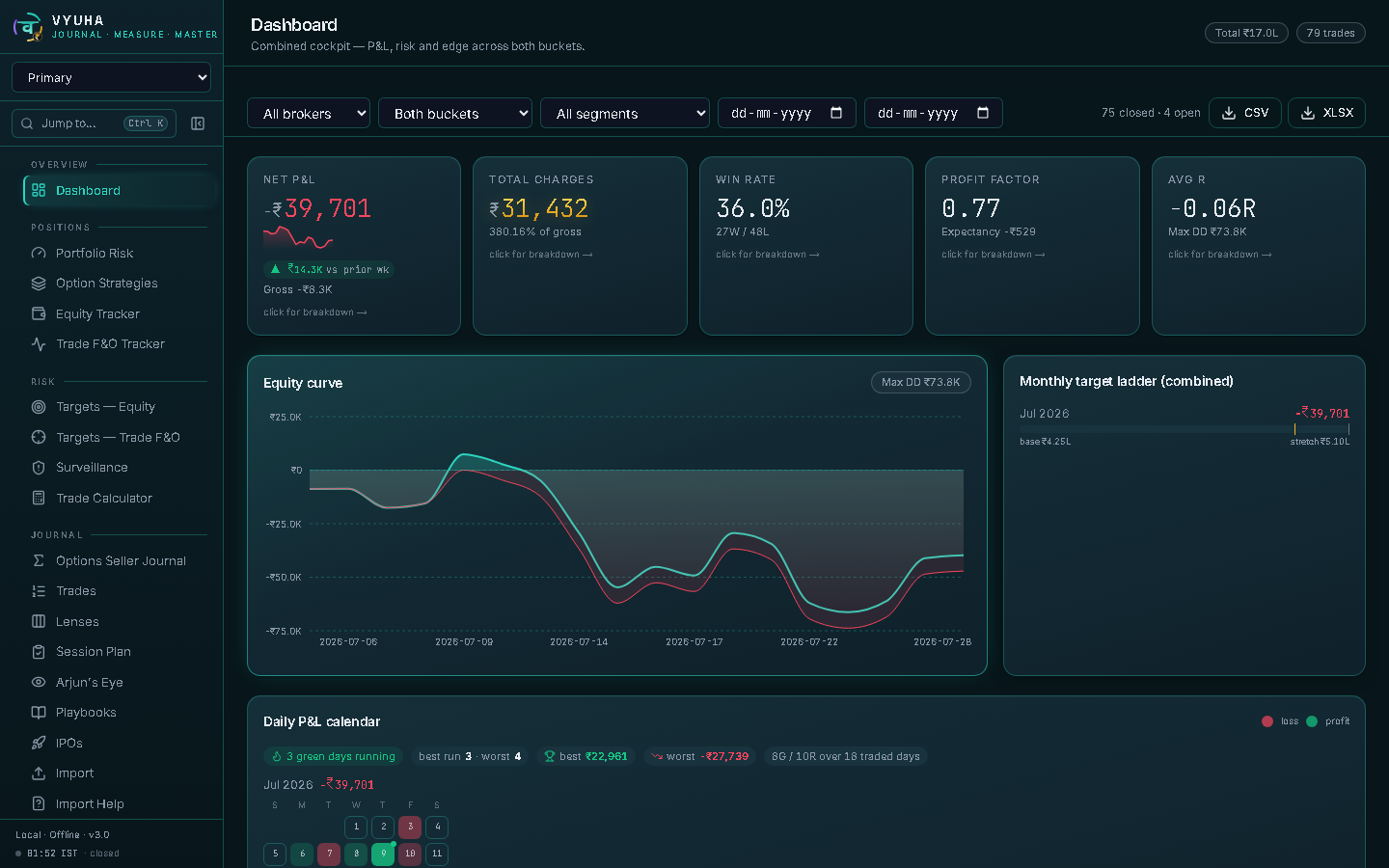
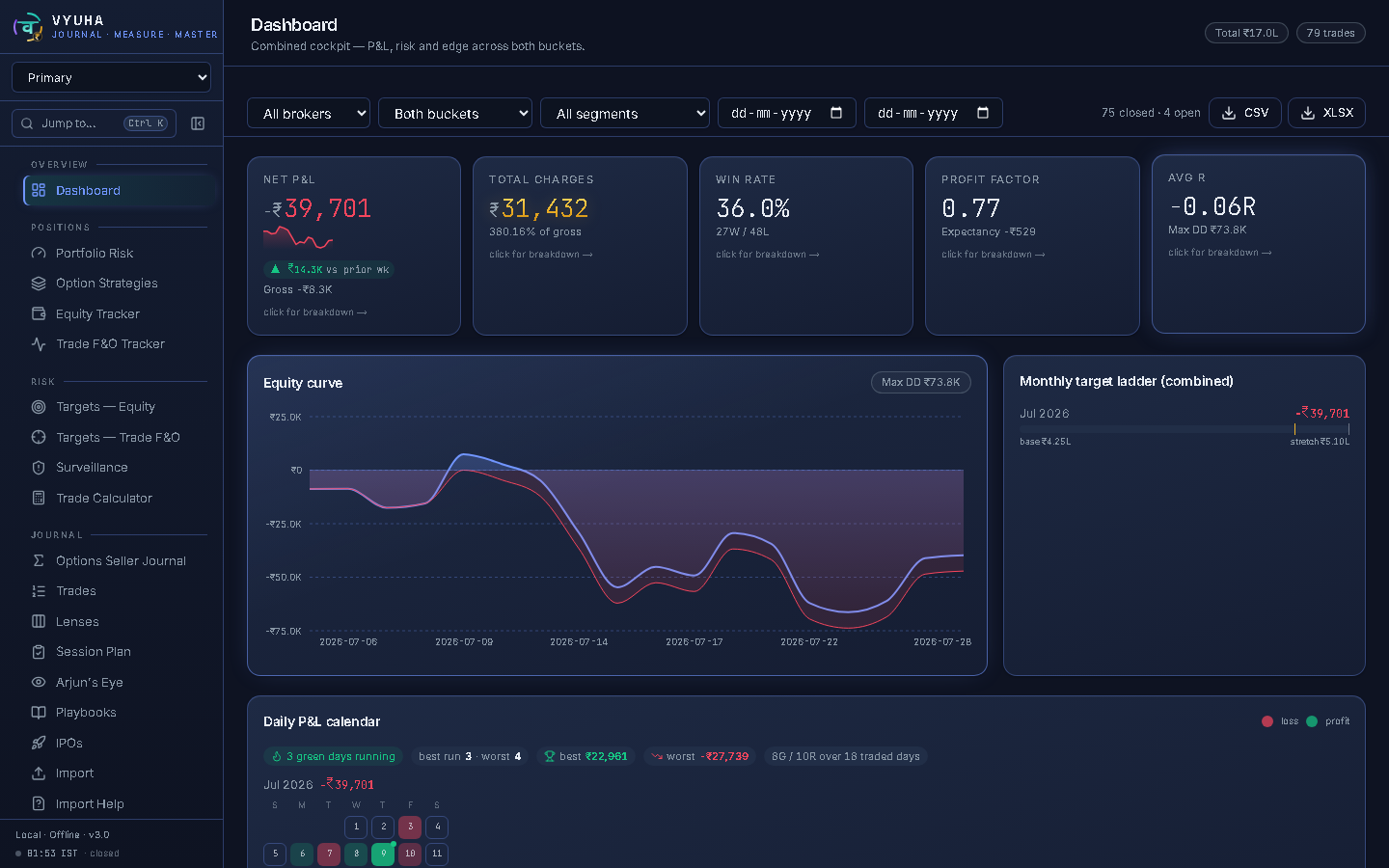
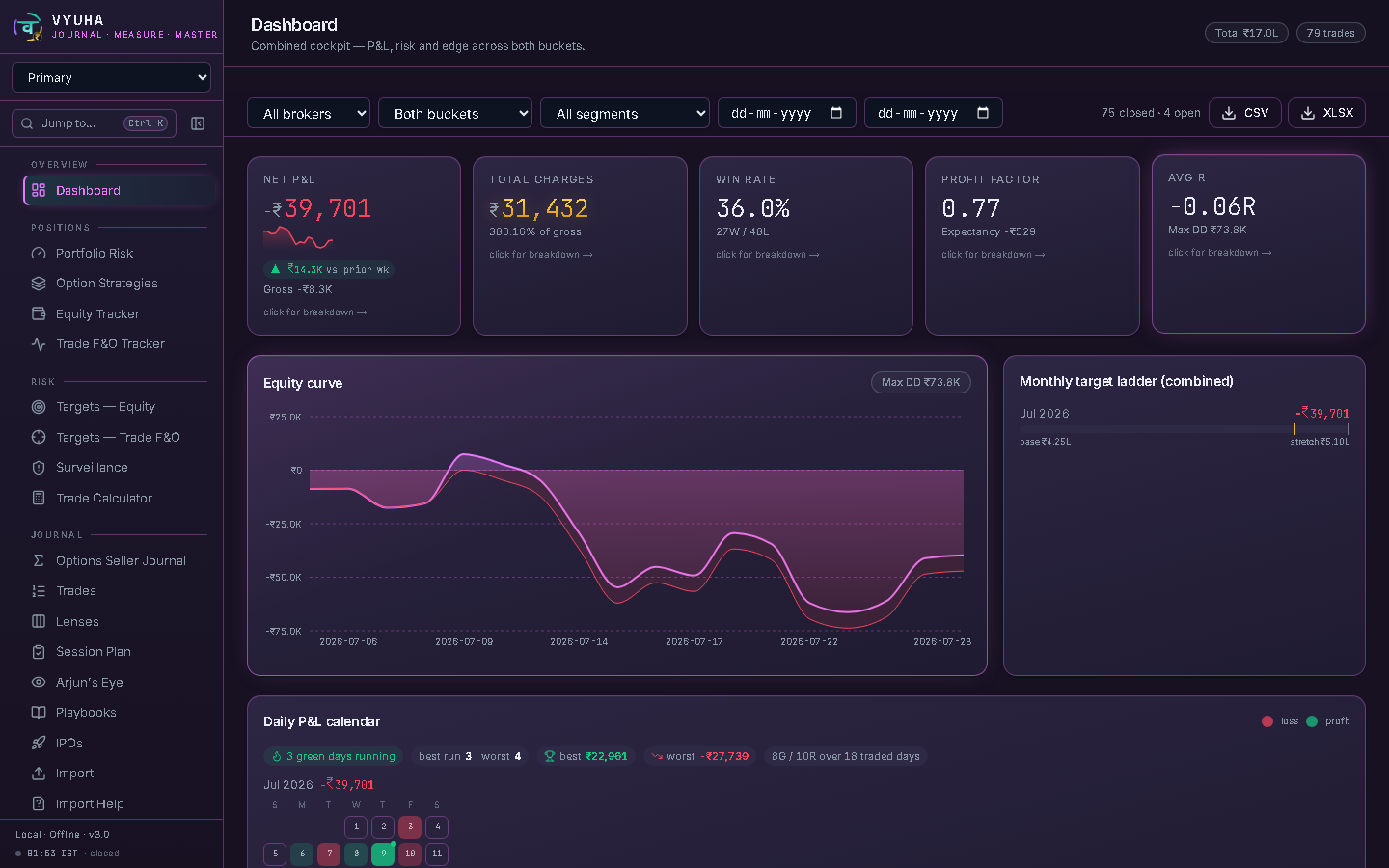
- 🖥 Looks like a terminal, feels alive. JetBrains Mono on every number, sparkline KPIs with week-over-week deltas, animated equity curve with crosshair, a magnitude-scaled P&L calendar, live IST market clock,
Ctrl+K command palette — dark or light, nine skins with a tint dial, and a colorblind-safe mode.
📊 At a glance
| | |
|---|
| 10,501 | 7 | 0.69% |
| per-stock MTF margins bundled | brokers' MTF lists compared(Sahi has none — it offers no MTF delivery; Fyers' and Nuvama's lists are not bundled yet) | charge-engine error vs a real broker report |
| 12021 | 45 | 0 |
| tests, 142 end-to-end flows | screens in the desktop app | bytes of your data uploaded without your say-so |
> Read that third number again. On a real 92-row broker report, Vyuha's computed statutory
> charges land within 0.69% of the broker's own — STT, exchange, SEBI, stamp, IPFT, GST, DP and
> pledge, per broker × segment × exchange, in integer paise with statutory rounding. Brokerage is
> excluded from that claim because it isn't derivable from the file. We say so rather than pad the
> number.
>
> And it keeps being re-proven: on 2026-08-27 a live Dhan API pull was reconciled against the
> broker's signed contract note — all 9 contracts matched to the 4th decimal, STT to the exact
> paisa (₹1,222.00 vs ₹1,222.00), and non-brokerage levies landed within 0.081%.
💸 What's free, what's paid
Your record is free. The intelligence about it is paid.
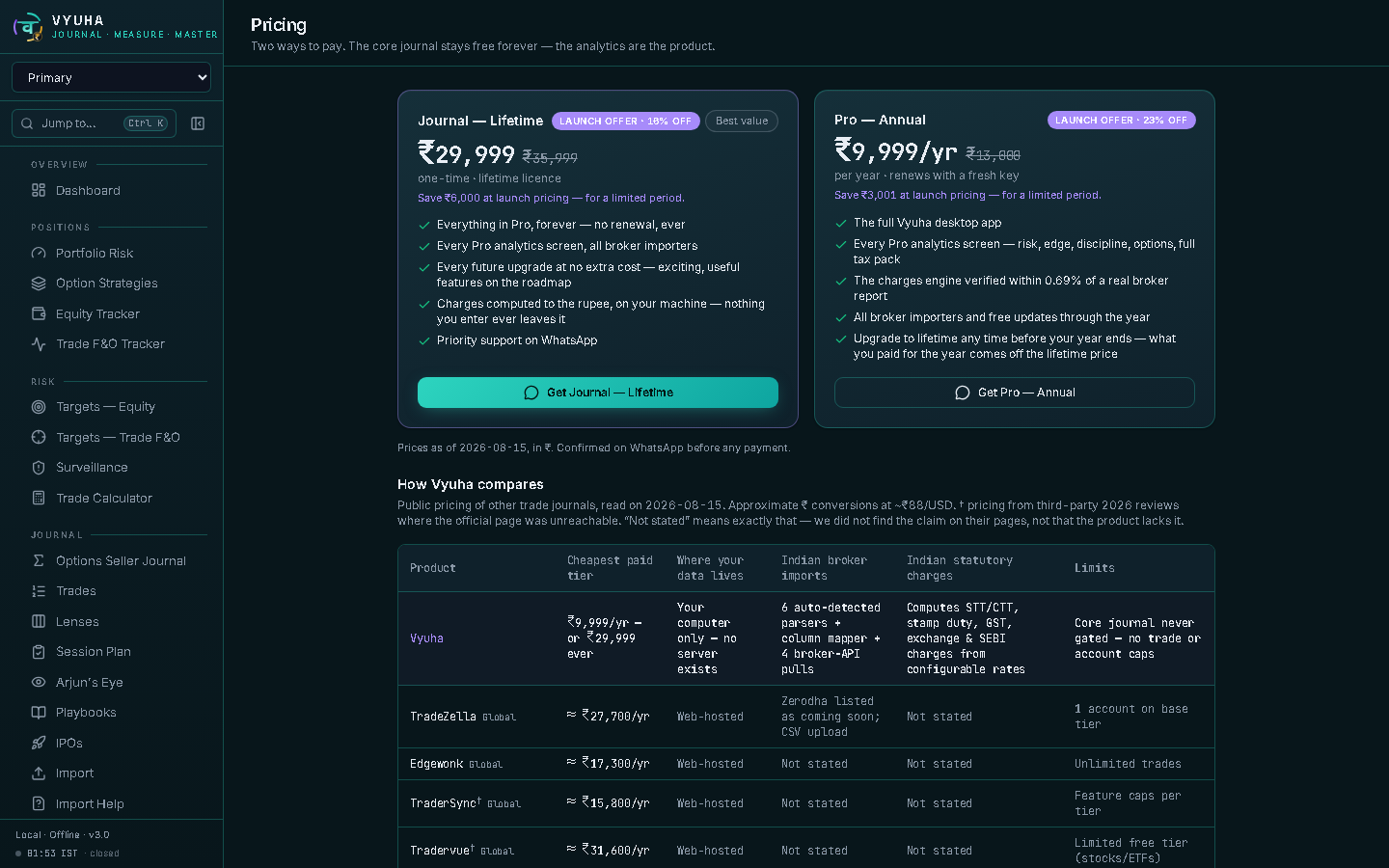
Pro — Monthly ₹999 first month (launch offer), then ₹1,499/month · Pro — Annual ₹7,999/yr ·
Journal — Lifetime ₹29,999, launch prices (annual and lifetime list at ₹13,000/yr and ₹35,999
from 2027-01-01). Monthly is given on request — message us and a one-month key is issued; each
month renews with a fresh key, there is no auto-renewal and no card is stored. All three are quoted
in-app with the date they were set, and the buy message embeds the price you saw.
| ♾ Free forever | 🔑 Pro |
|---|
| Recording closed trades — add, edit, delete, tag | Live open-position tracking — SL/TSL/target, running risk |
| All eight broker importers + duplicate detection | Portfolio Risk cockpit — VaR, Greeks, margin, breach alerts |
| Dashboard, P&L calendar with day drill-down & streaks | Arjun's Eye, and the Edge Clinic hub — Setups, Discipline, Scaling & Replay tabs |
| Staged positions, playbooks, sessions, calculator | Trade Review Desk — review queue, Sunday ritual, Process Score |
| First-run setup wizard — capital always optional | Options Seller Journal, and the Capital & Expiry hub — Return on Margin, Expiry tabs |
| Chart screenshots, symbol aliases, corporate actions | Tax Summary, ITR Pack, Advance Tax, Harvest, AIS Reconcile |
| Backup & restore, full CSV/JSON export, audit log | The Costs hub — Charges & MTF Leak, Broker Costs (cross-broker MTF comparison) tabs |
| Workspace mode, sidebar layout, appearance (skins, tint, panels, custom theme, wallpaper), multi-account | PDF reports — monthly, and any hand-picked selection of trades |
| Lenses grouping — by month/broker/type/file, with delete | Lenses edge — per-group win rate, profit factor, expectancy |
| Recoverable delete — every delete snapshots first, restorable | |
| Live Desk — open positions, their marks, their P&L and how old each price is · the results date you recorded, as a "Results in N days" chip | Live Desk Pro columns — R, risk if the stop is hit, portfolio heat (with what your trailed stops have locked in at stop), the chart overlay · Sizing Lab — seven sizing methods with their formulas · Market Atlas — breadth, sectors and cap bands from your own stored bars |
Every fresh install of Vyuha Desktop starts a 7-day full-Pro trial — no signup, no card, no server call. When it ends,
every trade you have already recorded stays readable, editable and exportable without a key,
forever. Your own record of your trading is never held hostage.
✨ Feature tour
📒 Journal every leg, effortlessly
- Import from ANY broker. Eight are auto-detected — Dhan (P&L and the charge-carrying Global Transaction Report), Groww (stocks P&L and order history), Zerodha (tradebook and Console P&L), Angel One (tradebook, P&L, and the seven-section tax P&L with explicit MTF quantities), Upstox, Paytm Money (per-execution tradebook with the broker's own charge breakdown), Fyers (tradebook, plus its Realised P&L as a reference) and Nuvama (the P&L report, with the charges Nuvama billed on every line). (A broker PDF is read for its text only — no PDF layout has been calibrated, so it never imports a trade, and the import screen says so.) Detection keys on in-content fingerprints, never on filename or column shape: every parser must prove whose file it holds before claiming it, and a cross-broker refusal matrix in the test suite keeps it that way. For every other broker — Kotak Neo, Sahi, or one that launches next year — drop the CSV/XLSX and Vyuha asks you to match the columns once, then remembers the mapping. Nothing is ever guessed: a file whose layout is unknown produces a question, never a trade with quantity in the price field. Mapped tradebooks go through the same FIFO pairing, de-duplication and charge engine as native ones, with the charge reconciliation panel (computed vs broker-reported) before commit. Live API pulls too: Zerodha Kite, Dhan, Angel One SmartAPI — fully unattended, its daily login minted from your TOTP secret — and Upstox on its year-long, read-only Analytics token, all credentials encrypted at rest.
- Brokers with no API of their own — Groww, Paytm Money, Kotak — can pull live through OpenAlgo, an open-source bridge you run on your own computer. Deliberately off by default behind an in-app disclosure, because it means running one more program that holds a broker credential: your credentials go into OpenAlgo, never into Vyuha; the data flows only from your broker to your machine; Vyuha's pull is read-only and goes through the same preview → charges → duplicate-check pipeline as every file. The integration was verified live against brokers' own contract notes before this line was written — the full setup guide is docs/OPENALGO_SETUP.md.
- Lenses — the same book, cut six ways. One tab strip re-groups every trade by month, broker, trade type, import file, setup or outcome — so "what exactly did that one file produce?" is one click, in isolation, with that group's own P&L and charges (and, with Pro, its win rate, profit factor, expectancy and average R). Any group can be deleted from right there.
- Deletion you can reason about — and undo. Delete by date range, by import file, by broker, by trade type, or exactly what the table is showing; every path goes through one confirmation that shows the precise set, counts and net P&L before anything happens, with type-to-confirm past ten trades. And every delete writes a snapshot first — trades, staged legs, chart attachments and all — restorable from Backup & Restore → Deleted items. Snapshots are never auto-purged.
- Back, everywhere it means something. A back control appears in the header only when there is an in-app screen to return to (labelled with where it goes), Alt+← and the mouse's back button work in the desktop shell, and drill-downs carry their own in-page back.
- Add / open / close / edit any trade, any time — with a live charge preview from the same engine that books it, so what you see is exactly what gets saved.
- Risk auto-computes from your SL (|entry − SL| × qty), with manual override. Current R (live) and Target R:R (planned) side by side on every view.
- Chart screenshot attachments, emotion tags, mistake tags, notes — the full behavioral journal.
🔭 Lenses — the same book, cut six ways
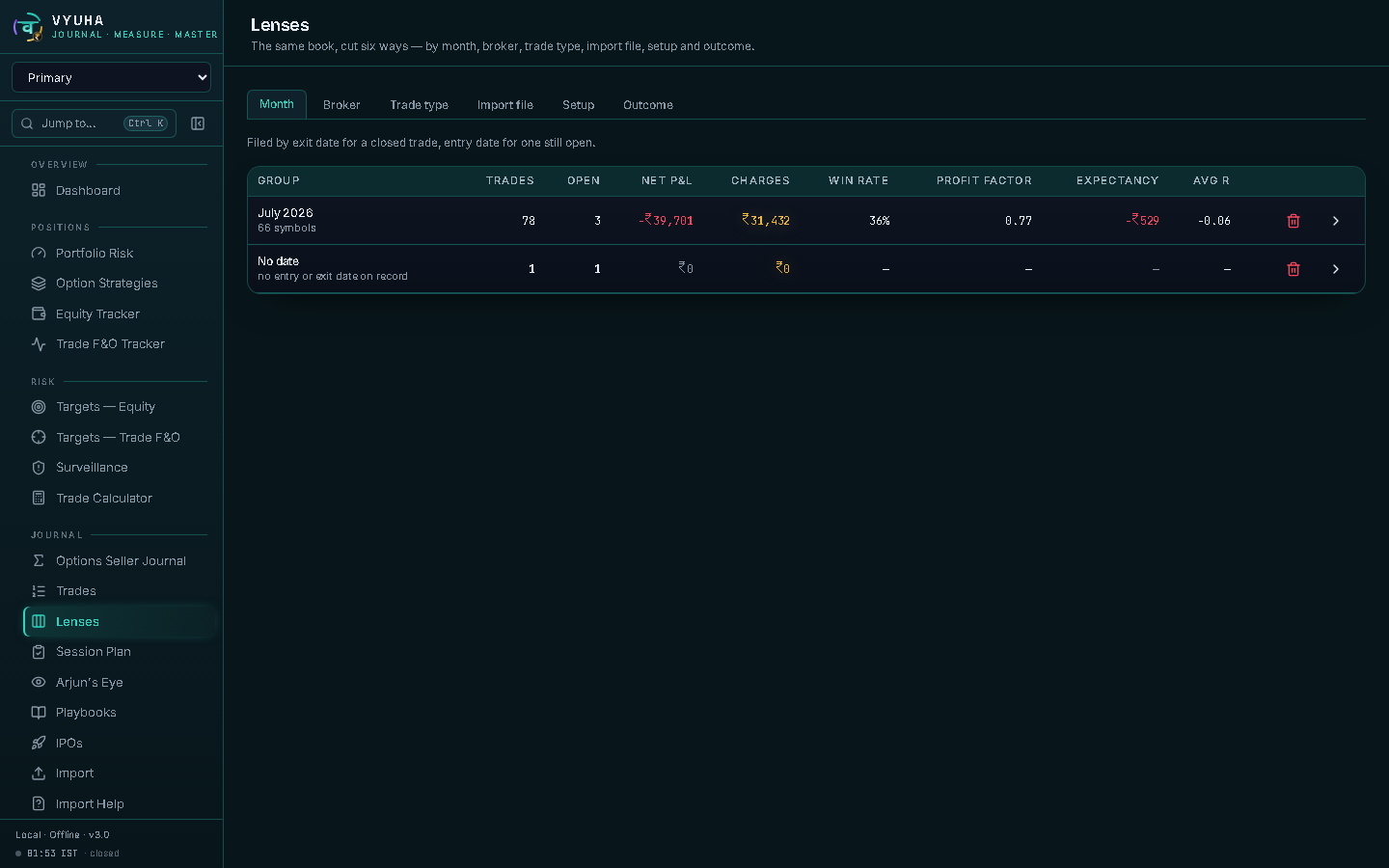
- One tab strip, six regroupings — by month, broker, trade type, import file, setup or outcome — each showing that group's own net P&L, charges, win rate, profit factor, expectancy and average R. When an import looks wrong, the Import file tab shows exactly what that one file produced, in isolation, and deletes just that group from where you are standing.
- Every cut is a partition, and the tests prove it: each trade lands in exactly one group and the groups add up to the whole book. Trades with no usable date, no setup recorded, or an import record that was deleted get their own honest group rather than being quietly dropped.
- What a group counts is what deleting it removes — the confirmation resolves the same ids the group was built from, so the number you read is the number that goes.
🔌 Connect a broker — and Angel One connects itself
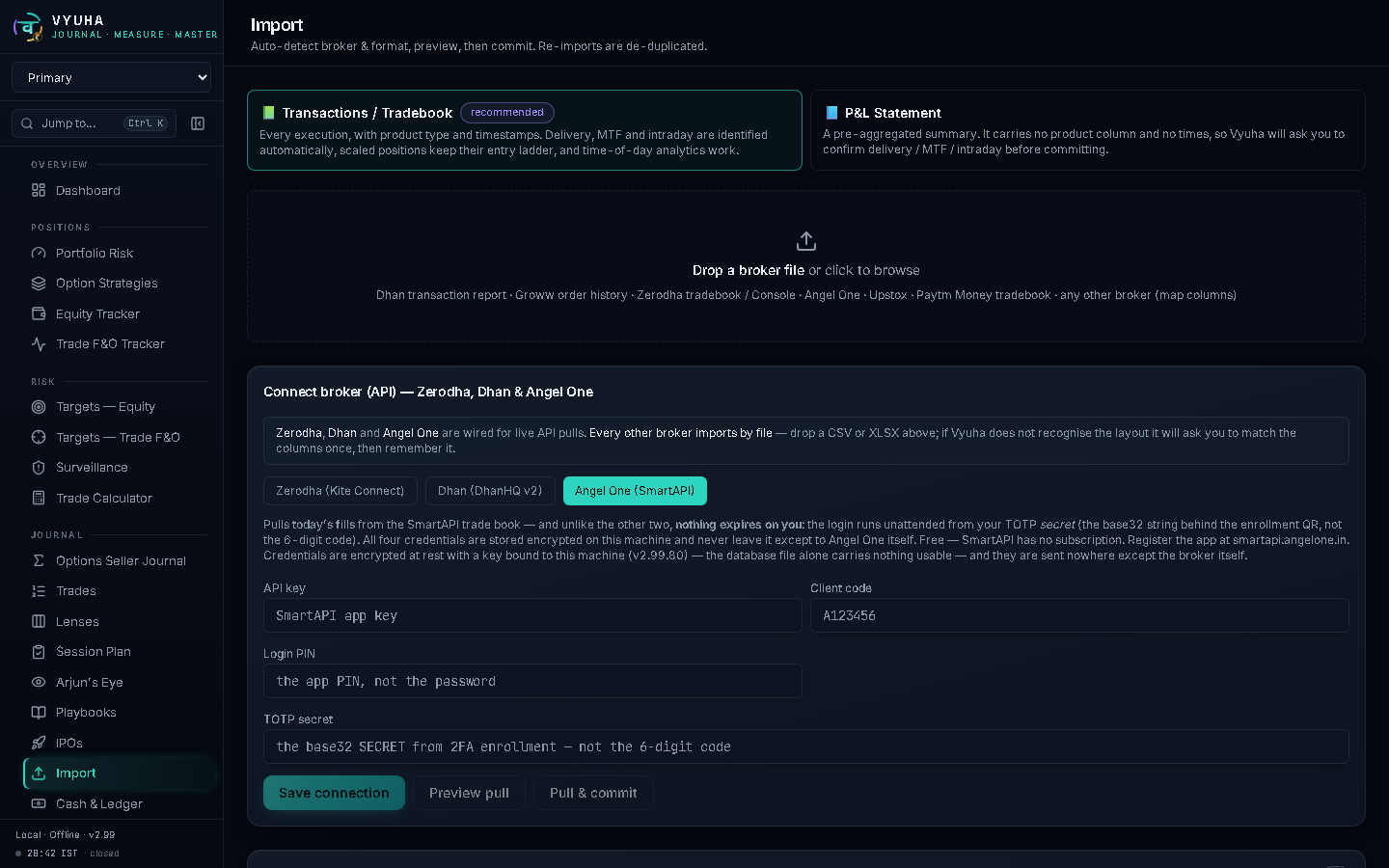
- Four live API pulls. Zerodha (today's executions with fill times), Dhan (the only Dhan source that states MTF outright), Upstox, and Angel One — the one that needs no daily attention, because each pull mints its own login code from your TOTP secret.
- Credentials are encrypted at rest, bound to this machine, redacted from backups, and sent nowhere except the broker. A broken vault refuses to save a credential rather than quietly storing it in the clear.
- Pasting the 6-digit authenticator code where the secret belongs is caught at save with an explanation — not discovered the next morning as a cryptic login failure.
- Dhan connects the way the form promises (v3.8). Re-saving an enrolment no longer demands the Client ID again — the stored key stays on the server side and no plaintext leaves it; a 401 with enrolment present re-mints once and retries; an enrolment that is stored but unreadable says exactly that. Every connection row wears a mode pill — PIN + TOTP · mints its own token vs pasted token · expires … — with a one-time note when a pasted token expires, and in All-accounts view "Save connection" names the account it will write to rather than picking one silently.
🪜 Staged positions — build in tranches, scale out in parts
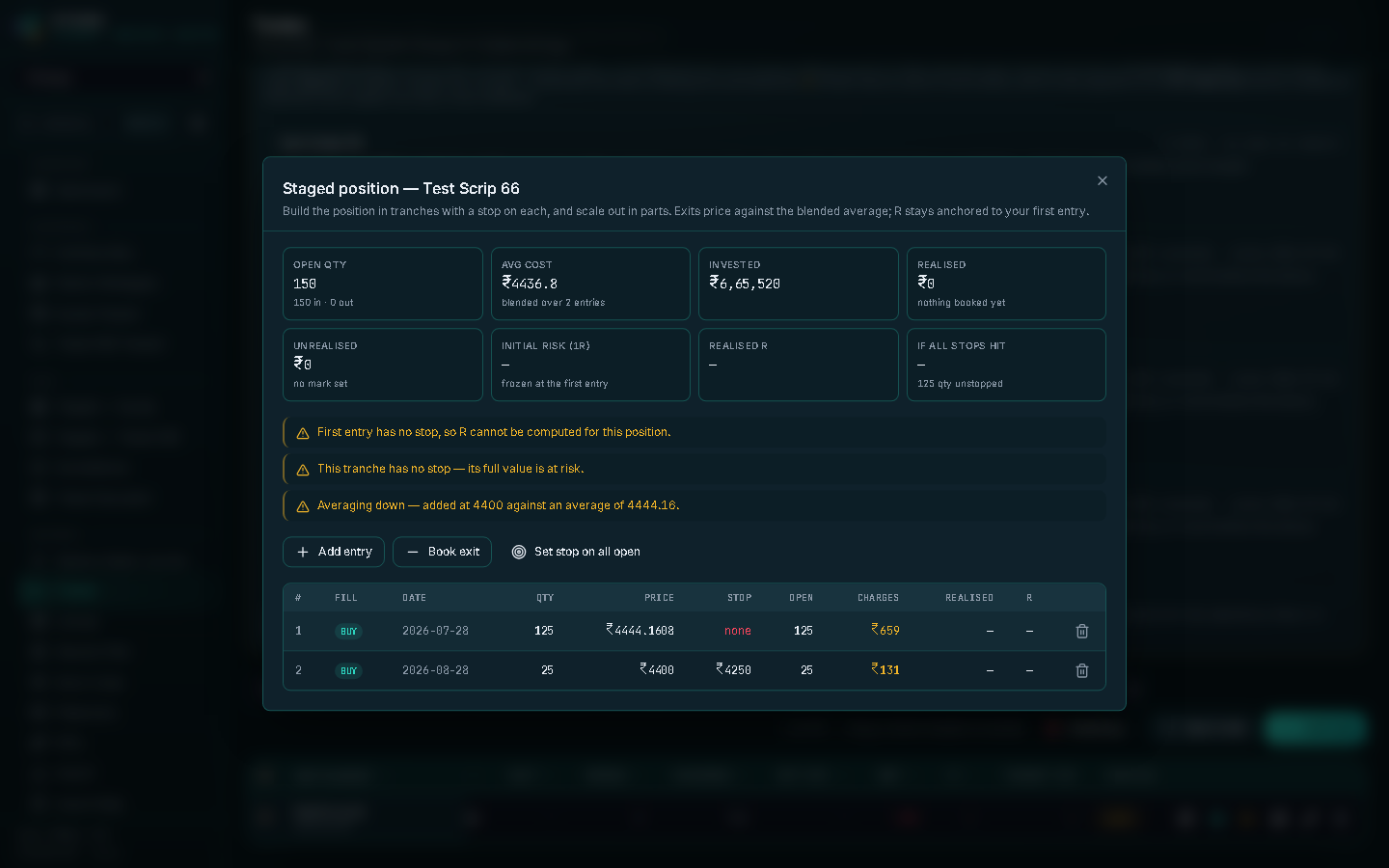
- Add entries as the trade proves itself, each tranche with its own stop and target — or set one stop across every open tranche in a click. Book partial exits on any trade (25/50/100% or any quantity) and let the rest run.
- Three rules, chosen deliberately: exits price against the blended average (so your journal never disagrees with your broker's average price); quantity is consumed FIFO (money is fungible, stops are not — the surviving tranche keeps its stop); and R is frozen at your first entry, so a 3R stays a 3R whether or not you pyramided.
- Charges are booked per fill — brokerage per order, STT per execution, DP once per exit day, MTF interest per tranche from its own entry date. Scaling into options really does cost ₹20 an order, and Vyuha says so instead of hiding it in an average.
- Imports rebuild the ladder for you. Zerodha, Angel One and Upstox tradebooks list every execution — those fills are preserved, so a scaled position arrives with its real shape. An ordinary buy-then-sell stays an ordinary trade.
- Two warnings worth having: averaging down (adding below your average — inverted correctly for shorts), and open risk now exceeds your initial risk — which fires on any add you didn't fund by trailing the earlier stops up.
👁 Arjun's Eye — the trader's cockpit
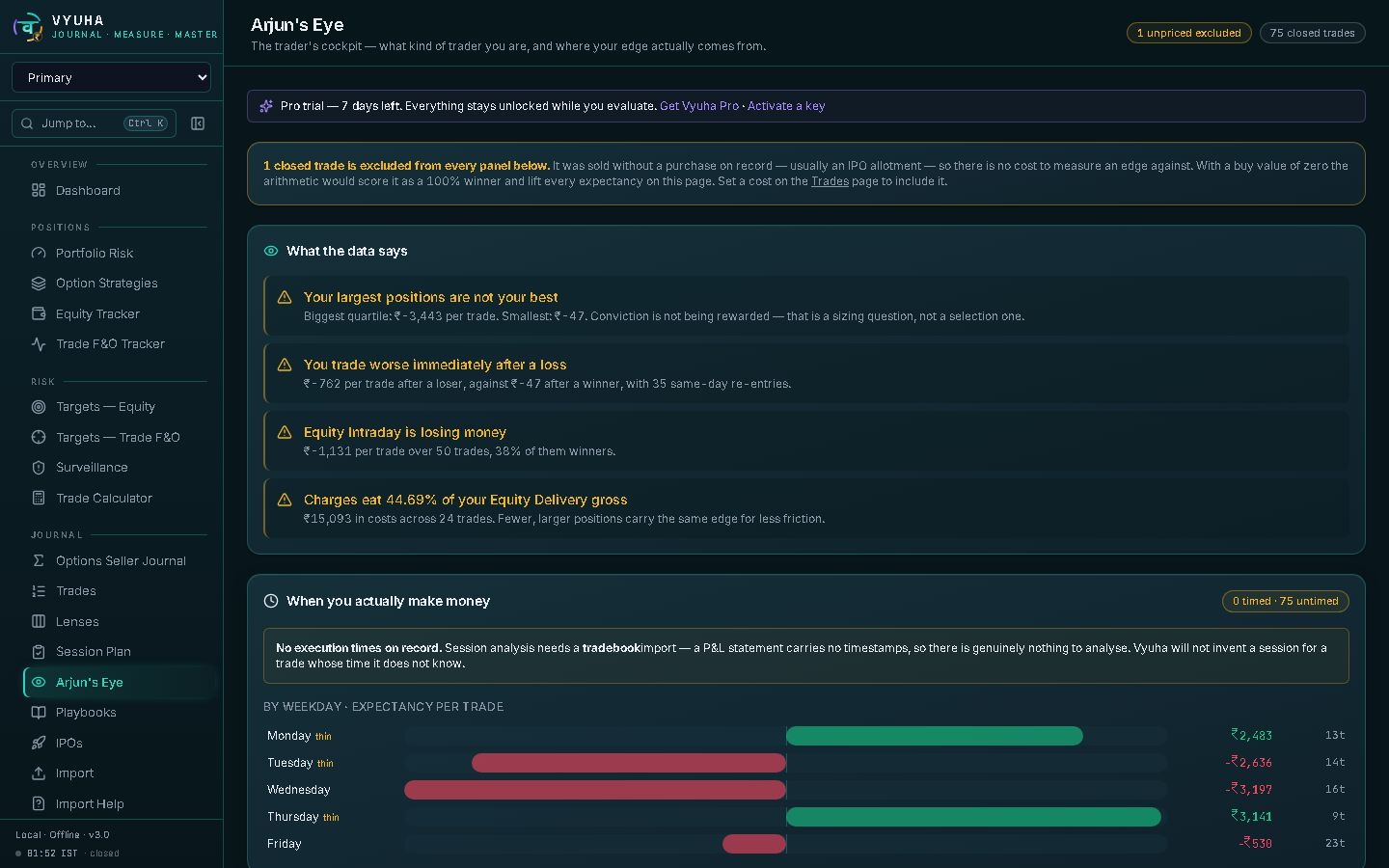
- Every other report answers how did my money do. This one answers what kind of trader am I, and where does my edge actually come from.
- When you actually make money — expectancy by Indian session (pre-open · opening drive · morning trend · midday chop · afternoon push · closing hour) and by weekday. The pre-open band (09:00–09:15) names the fill time, and says so: a pre-open order filling at 09:15:00 is indistinguishable from a regular fill. The session review states how many trades carry no time rather than filing them before the cutoff.
- Do you cut winners and hold losers? The single most common structural leak in retail trading, invisible in a P&L total.
- Does a loss change how you trade? Expectancy after a win vs after a loss, plus same-day re-entries — revenge trading, measured.
- Is your conviction rewarded? Expectancy by position-size quartile. If your biggest positions are not your best, that is a sizing question, not a selection one.
- Three honesty rules enforced in code: no finding below 15 trades in a group; no invented sessions for trades whose time is unknown; and every finding phrased as an observation, never an instruction — there is a test asserting no finding says "you should".
📋 Trades table — how many, at what, for how much
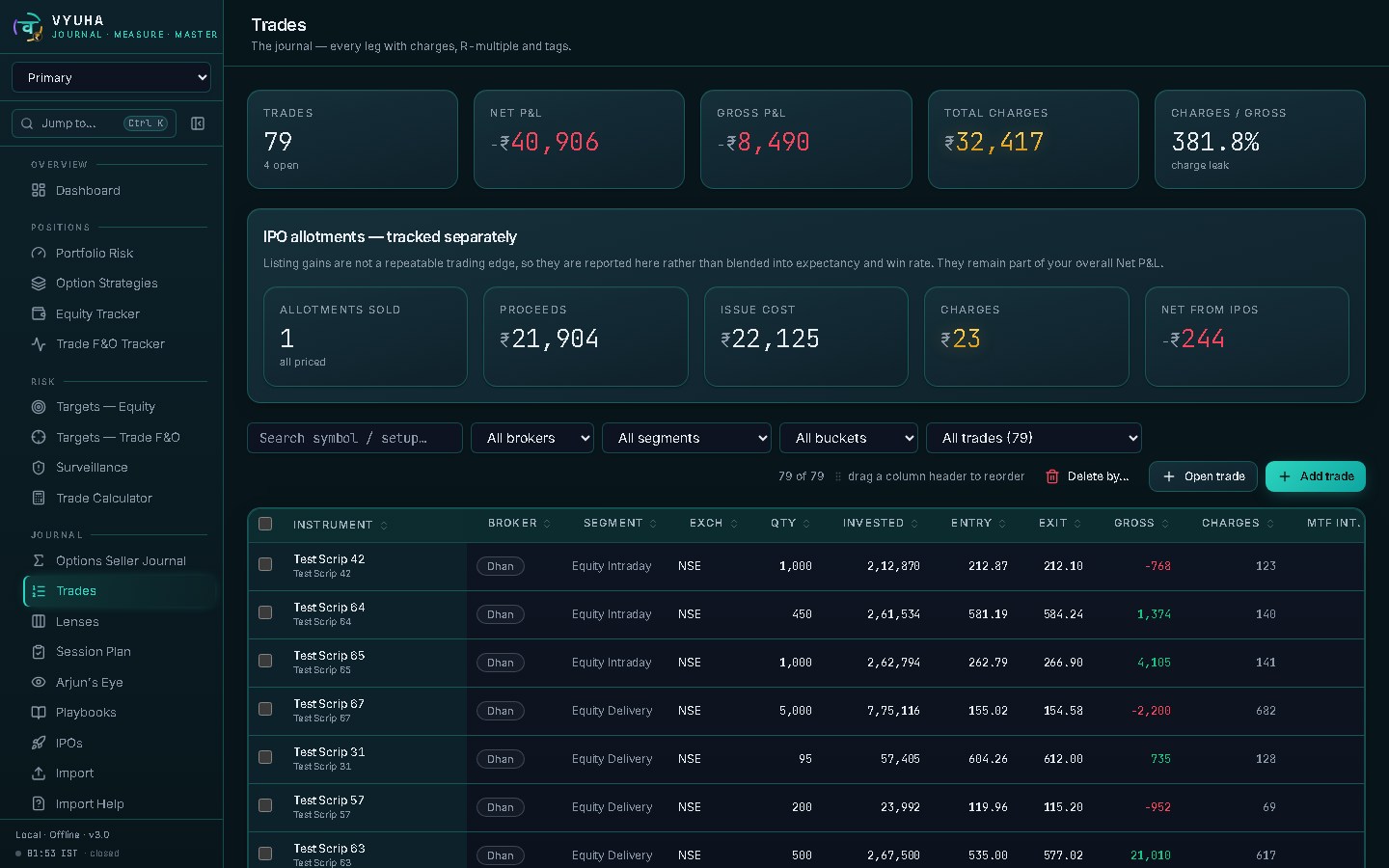
- Qty · Invested · Entry · Exit replaced the raw Buy/Sell rupee totals (v2.99.96): the quantity, what you actually put in, and the two weighted-average prices — universal, because every import path (six parsers, the column mapper, three API pulls) already produced them.
- On MTF rows, Invested is your own contribution with the broker-funded amount alongside; when the funding split is not yet resolved it says so instead of inventing a percentage.
- An open trade shows "—" for its exit, never ₹0, and sorts to the bottom of an Exit sort — a missing side is
undefined, not zero.
- Served in pages of 500, from the server (v3.9). Every filter, view and sort is transcribed to SQL, and the counts are aggregates over the whole filtered set, never over the page — a count that quietly means "of what we fetched" is a fabricated denominator. The KPI strip, the acquisition and unmarked-holdings panels and the delete-by-scope candidate list stay whole-book projections. Measured on a 25,000-trade book: 1,968 → 1,063 ms median (p95 2,280 → 1,115), the last route over budget.
- The order was never total, and now is.
created_at has second resolution and an import batch writes one value for every row it commits, so ordering by (sell date, created time) left whole batches tied — on the owner's own book 842 of 905 rows sat inside a tie block (174 blocks, largest 36), and SQLite demonstrably returned different orders for different query plans. Rows imported in one batch are now ordered by id, which is insertion order, newest first. Nothing else moved: tax-by-FY is identical to the paisa on both books, every harvest lot keeps its id, LT/ST status and quantity, and the holding clock is unchanged.
- Switching accounts no longer leaves the previous account's rows on screen.
initialRows was a useState initialiser, which does not re-run when the prop changes, so after a refresh the table rendered the earlier server render while the KPI strip above it showed the new account. State is now adjusted during render, not in an effect. Only an end-to-end flow could find it.
🔎 See exactly the trades you mean
- One dropdown on Trades covers both questions: status (Open · Closed · Staged) and outcome (In gain — open · In loss — open · Profit — closed · Loss — closed).
- Every option carries its own live count, computed after your other filters — so you can see a view is empty before you choose it, and the numbers always add up: open + closed = all.
- A
/trades?… link keeps its word (v3.8). The query string persists, so a filtered view can be bookmarked and returned to with the browser's Back; basis=unknown and every view= the select offers are honoured — a URL that cannot mirror "Loss — closed" is a URL that lies.
- An open position with no mark price appears in neither "in gain" nor "in loss" — because it has no unrealised result. Vyuha stores 0 for an unmarked holding, and reading that 0 as breakeven would file it under a result it never had. The count of unmarked positions is stated on screen instead of leaving a silent shortfall.
🔍 Search — Ctrl+K, over everything you have written down
- One box over your trades (a full-text index with mid-word hits across notes, tags, symbols, setup, mistake and emotion tags, exit triggers), symbols (name, ticker or BSE code), playbooks, instruments and aliases, sessions, challans, help entries and screens — with category chips.
- Gated screens are shown with a lock and one line on what unlocks them — never hidden. Your own trade rows are never locked; a user's record of their trades is not held hostage.
- A previous-search control and a "back to where I was" control, neither of which touches browser history. Results for trades return ids only, so the Trades screen keeps its own ordering — search can never reorder a page.
- Every source is account-scoped on its own terms (three tables carry no account column, and a test asserts the scope is carried per source). On a 25,000-trade book a query returns in about 15 ms.
- Search v2 (v3.9): the ledger and the audit trail joined the index, and there is now a second surface for them — a floating search assistant on
Ctrl + Shift + K that stays open across navigation, so a result can be opened, read, and the next one tried without retyping. It drags anywhere, remembers where you left it, and is clamped back into the viewport when reopened on a smaller display — a panel restored off-screen is unreachable, because the only way to move it is a header you cannot see. Both surfaces call the same API through the same helpers and render the same result list, so the chips, the locks and the notices are identical by construction rather than by two copies kept in step. A results group that is not narrowed by your account selection says "across all accounts"; the account-scoped groups deliberately say nothing, because the only account they could name is the one already on screen.
🧾 Reads the product type out of the charges themselves
- Dhan's Global Transaction Report has no product column — but India levies statutory charges at different rates per product, so the rate is a fingerprint. Stamp duty 0.015% on a delivery buy vs 0.003% intraday, corroborated independently by STT (0.1% both legs vs 0.025% sell-only). Two witnesses agreeing on 89 of 92 rows of a real report.
- A bill that mixes both is split algebraically. Stamp duty is linear in value, so "bought 3,600, squared 1,800 same day" has exactly one solution. Labelled derived — it is arithmetic on a total, not a stated fact.
- MTF is still never claimed, and that was verified rather than assumed:
Oth. Charges totalled ₹0.03 across 92 rows and GST was 18% of (brokerage + txn + SEBI) to within ₹0.01. No unexplained rupee, nowhere for financing to hide. So Vyuha asks about the delivery rows only — intraday and F&O can never be MTF.
- Legs pair same-day first, then FIFO across dates, into real positions — the exchange nets a scrip's same-day buy and sell before anything reaches delivery (verified against Paytm Money's own lot statement, 2026-08-20), and oldest-first for the rest is how the Income Tax Act treats equity delivery, so holding periods agree with the ones that decide STCG vs LTCG. Shares sold that the file never shows being bought become opening sells with the basis left blank. A conservation check asserts not one share or rupee is created or lost.
- The broker's own charges are stored as truth. Vyuha cannot be more accurate about a charge than the charge itself; its computed figures stay alongside as a cross-check.
- Paytm Money pairs on ISIN, and the same signature decides the product there too (v3.8). Paytm switches a security's
Script label from ticker to numeric code mid-window; pairing on the label split 35 securities into a phantom open buy and a phantom unpriced sale. Fills now group on ISIN, and a scrip-day whose stamp duty sits between the intraday and delivery rates is split rather than booked as delivery by the calendar (of 83 same-day round trips in a real file, 34 were intraday and 49 genuine delivery — the calendar cannot tell them apart; the charges can). On a real 7,544-execution book: 804 → 793 positions, unpriced sales 72 → 38, charges conserved to the paisa.
🏦 MTF, answered by the broker rather than guessed
- Every Dhan file is silent about margin funding — MTF and delivery carry identical STT and stamp duty, and financing interest is booked to the ledger, not the contract note. So Vyuha stopped guessing and went to the two places that actually know.
- Dhan API (
Import → Connect broker): productType returns MTF outright. Stated, not inferred — those rows need no confirmation at all.
- Dhan ledger (
Cash & Ledger): MTF interest is calculated daily and posted weekly, so the ledger holds the real number. Vyuha imports it and shows actual vs its own estimate side by side — a comparison, never a correction, because splitting a weekly account-level posting across positions would invent an allocation the broker never made.
- The ledger parser finds columns by header keyword, not position; matches MTF first so a generic "charges" rule cannot swallow it; treats opening-balance rows as assertions, not entries; and lists anything it cannot classify rather than filing a guess.
🎟 IPO allotments become real holdings
- IPO shares are credited, never bought, so the holding arrives with no cost basis and no mark price — unable to be valued, unable to be scored. Vyuha surfaces those holdings instead of letting them sit dead.
- "This came from an IPO" creates a linked record seeded from the holding. The issue price is left blank on purpose — it is the one fact only you know, and guessing it would defeat the point.
- Fill it in and the IPO record becomes the source of truth: issue price (minus category discount) supplies the basis, listing price supplies the mark, an exit price closes the position and books the P&L, and the allotment date starts the tax holding period. One place, so the numbers can never drift.
- With no listing price it stays honestly unmarked — basis supplied so it rejoins the statistics, but no mark invented.
🎟 Sold something you never bought? It says so instead of scoring a win
- Sell an IPO allotment and the tradebook holds the sale and nothing else — shares are credited on allotment and never appear as a buy. With a buy value of zero the arithmetic reads it as a 100% winner, every time.
- Those trades are counted in cash but quarantined from every edge statistic — win rate, expectancy, profit factor, ROM — until you set a cost.
- Vyuha recovers that cost from the file's own footer. The rows omit the purchase, but the broker's gross P&L includes it, so subtracting everything matchable leaves what it must have cost. On a real report: −₹8,268.27 matched against a −₹8,489.60 footer left −₹221.33 for one holding — 37 shares sold for ₹21,904, implying ₹597.98 a share. Pre-filled for confirmation, never applied silently.
- IPO P&L is reported apart from trading edge — a listing-day pop is not a repeatable skill.
- The import summary warns about the shape of what it read (v3.8). When sales-without-a-purchase are 10% or more of a file's positions, or a security appeared under two labels, it says so with the count before you trust Net P&L — the product-side twin of the release harness. An unpriced sale contributes only its charges to Net P&L, and the screen now says exactly that.
- A same-day covered short is named as one (v3.9). Sell first, buy back the same session, and the closed position says so — the arithmetic was already right (buys sort before sells within a date), the meaning was missing. A sale an existing holding could deliver is not called a short, and cash equity cannot be short overnight, so a multi-day sale with no purchase stays exactly that.
- Bought on NSE, sold on BSE: a note, deliberately not a split. The position carries "one holding, the exchange is where the fill happened". Splitting it was measured in v3.8 and rejected — on the owner's 7,544-execution book it turned 38 sales-without-a-purchase into 101.
- Remove a broker's imported rows, then re-import clean. One confirmed, audit-logged, account-scoped step on the Import screen takes every row a broker's imports created into Trash, restorable as a set under the original ids from Backup & Restore → Deleted items; ledger and IPO rows are unlinked, never deleted.
📥 Import that tells you what kind of file you brought
- Two clearly-labelled kinds, because they are not equivalent. A tradebook states the product and the time; a P&L statement states neither.
- So the P&L path asks once, before commit — grouped by symbol, with a guess pre-selected. Changing a product re-prices immediately, because charges, MTF interest and ROM all derive from it.
- Same-day round trips are inferred as intraday. MTF is never inferred — it is indistinguishable from delivery in a P&L file — so the default is delivery, the safest wrong answer, and guessed rows are labelled assumed.
- More of each broker's catalogue reads natively (v3.8): Dhan's Realised P&L (
.xls, the per-segment charge reference), Dhan P&L .xlsx, Dhan Ledger and Dividend payout as cash sources on the Cash & Ledger screen, and Angel One's Trades_History tradebook with per-row charges. A broker-named parser must see the broker's own fingerprint before it claims a file — Zerodha's detector had been claiming Angel One's tradebook on two column names.
- Seven more formats in v3.9, none of which imports a trade. Paytm Money's Realized P&L, Dhan's DP Charges and Demat Holding summary, the Dhan contract note (PDF), the Upstox ledger, Angel One's account statement and Angel One's P&L statement. Six store the broker's own stated figures; the contract note enriches trades you already have; three also post to Cash & Ledger. Each warns out loud that it created no trades, so a reference import can never be mistaken for an import that read nothing. Two are recorded exceptions to the name rule — Dhan's DP Charges and Angel One's P&L statement name no broker in any cell, sheet name or filename, so an exact sheet-and-header conjunction is the fingerprint (0.9; the broker's name in the filename adds 0.1), written up as deliberate exceptions in
docs/BROKER_FORMATS.md rather than as a precedent.
- A contract note never creates a trade. It is the only Dhan document that states the time of every fill, so those times and the instrument type are applied to trades the book already holds, matched on symbol, date, side and quantity; unmatched enrichments are reported, not stored. The transaction report is the book — importing a note as trades would double-book every execution it carries, with no dedup key strong enough to notice. The Dhan MTF Report is a web screen with no export in any format, so there is no MTF file and no parser for one; those figures come from the transaction report, the Realised P&L and the ledger.
- BIFF8
.xls files declare the whole sheet as their used range. A 1,400-cell DP-charge report has a !ref of A1:Q65536, so every detector that opened it paid 270–440 ms to flatten 65,536 rows, and ranking one file cost 3.7 s. Each sheet's range is now trimmed once, on the memoised workbook, to its populated bounding box: 440 ms → 2 ms per flatten. Nothing a parser sees changes except phantom trailing rows.
- A confidently empty import is the worst kind. Dhan's Global Transaction Report was detecting at 0.98 and importing zero rows once the 2026 export changed its date grammar; a golden-book harness over 27 redacted real exports — exact position shapes, the broker's own totals, charges conserved — caught it on its first run and is now a release gate. A recognised file that parses to nothing warns with the unparsed sample.
- Import → Broker Truth puts what the broker's statement says next to what your journal says — per financial year, per segment and per scrip, with the delta — plus a quantities-only table for a demat holding summary: what the broker holds, what your book has open, and the difference.
- Nothing is averaged, blended or corrected into anything else. The screen computes no arithmetic of its own; every figure on it comes out of one query, because a total recomputed on the way to a page is a second arithmetic path over the same cells, and the app would then show two numbers for one file.
- Where they differ, the reason is a counted fact from your own book — how many sales have no purchase and what they sold for, charges the file states nothing about, quantity still open against a scrip the broker calls realised, a product filed under a different segment. A delta with no knowable cause is reported with no cause, never with an invented one.
- The status is a direction, not the word "mismatch": Within tolerance · Broker higher · Vyuha higher. A file that states no gross P&L at all reads "Not compared" — not a zero, and not a match.
- Joined on ISIN first, symbol only as a fallback — and it says which. ISIN is the only stable identity: Paytm restated the same security under a ticker and then a numeric BSE code mid-window, so a symbol join is said out loud rather than assumed.
- On All accounts it renders one book per account, never one summed book — two brokers' statements added together is a figure no statement states.
- Charges the broker states is its own table: a DP fee per financial year, a contract note's brokerage/STT/GST for one trading day, and a ledger's own charge tables. Each line is one broker's statement against that broker's own trades — two brokers' fees are never added together, and a fee your book has no column for (a CUSPA sell-off, delayed-payment interest), or a year or a day that broker traded nothing in, gets no Vyuha side and no delta at all.
- Seven files feed it: Dhan Realised P&L · Paytm Money Realized P&L · Angel One P&L Statement · Dhan Demat Holding summary · Dhan DP Charges · Dhan contract note · Angel One account statement. The empty state names them from the import registry, so it can never advertise a file the app cannot read.
📐 Return on Margin — what your capital actually earned
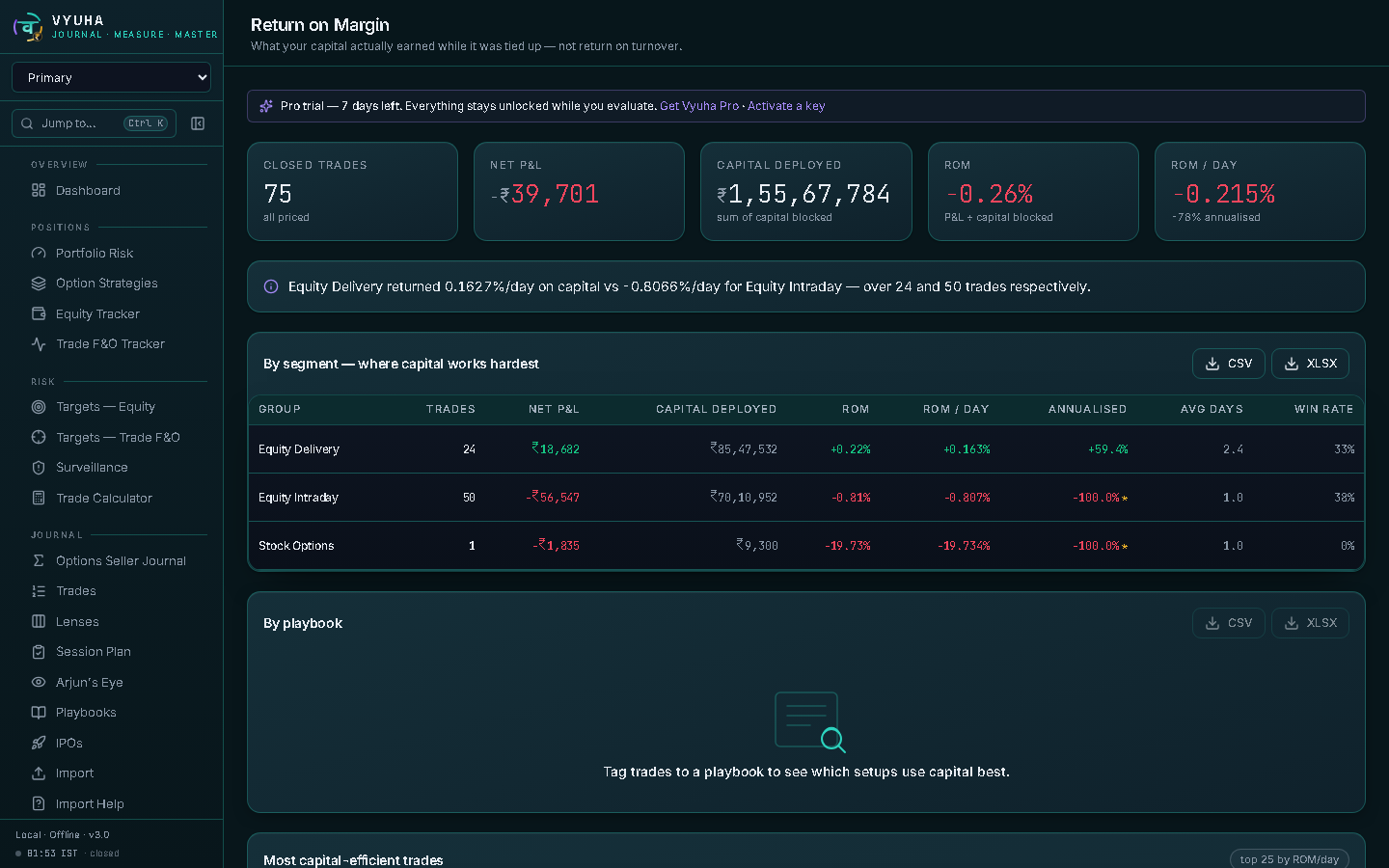
- Every Indian F&O journal reports P&L against turnover or notional. Both are close to meaningless: a long option and a short strangle can carry identical notional while tying up wildly different capital. ROM measures against what was actually blocked.
- The denominator is instrument-aware, because the market is — long options cost the premium and block no SPAN margin; short options block against the underlying (a ₹10,000 credit can tie up ₹1.5 lakh); futures/intraday block a percentage of contract value; MTF blocks only your own capital; delivery blocks the lot.
- ROM/day is weighted by capital-days, so ₹1L held ten days counts as ten times the commitment of ₹1L held one — and a scalper and a swing trader finally become comparable.
- Grouped by segment and playbook, so you can see that your F&O book returns x%/day on margin while delivery returns y% on capital. No other Indian journal does this.
- Annualised figures are clamped and marked — a book losing 10%/day extrapolates to −3,887%, which is arithmetically true and impossible. Honest beats impressive.
🔬 Numbers that explain themselves
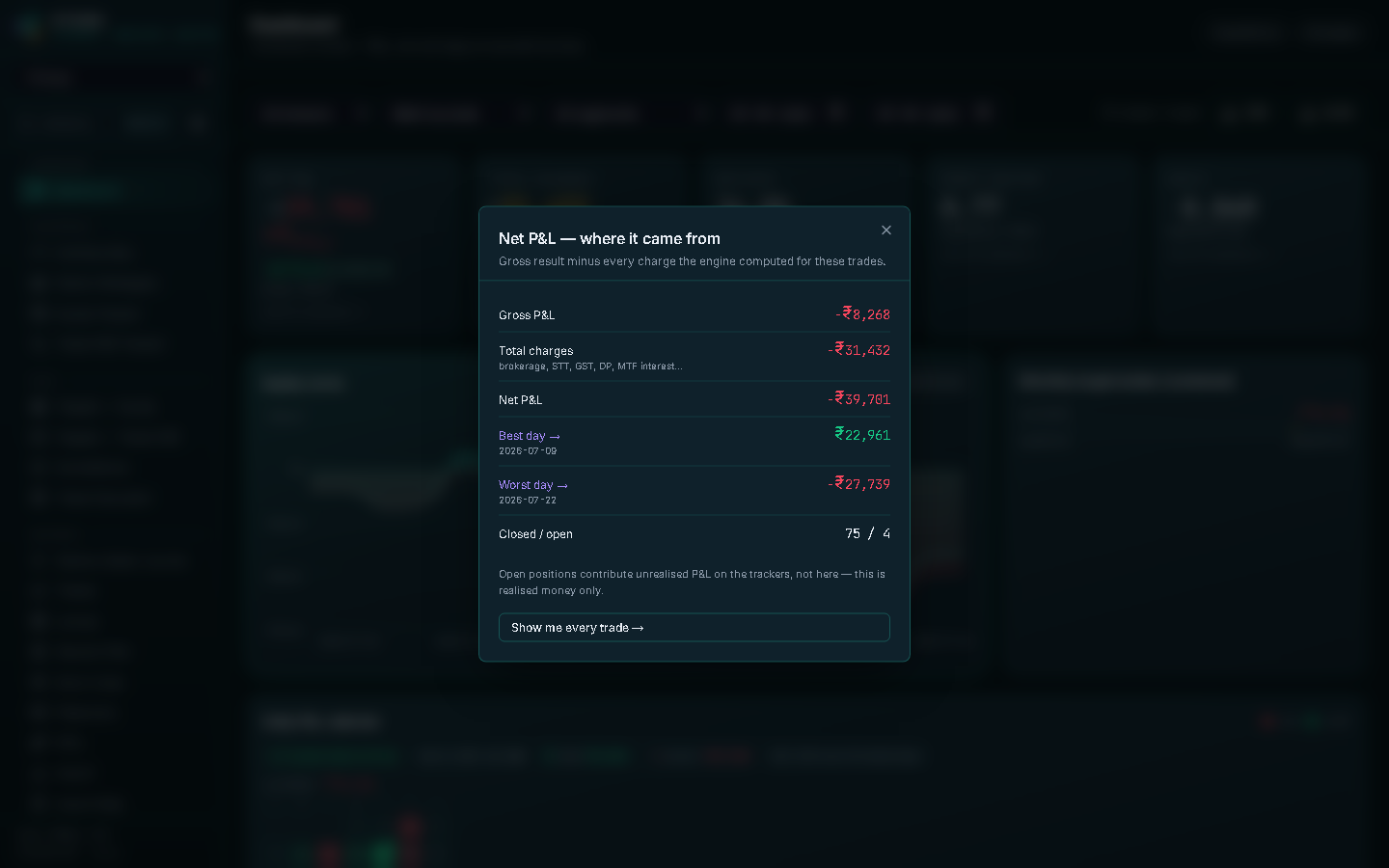
- Every headline KPI is clickable — 16 cards across Dashboard, Portfolio Risk, Equity Tracker and Trade F&O Tracker. Hover lifts and glows; click (or
Enter) opens the breakdown.
- And the breakdown goes somewhere. Best/worst-day rows deep-link to
/trades filtered to that date, and the rows shown add up exactly to the figure you clicked — an e2e test asserts the reconciliation, because a link showing roughly-related trades is worse than no link.
- Not a tooltip — a derivation: Net P&L splits into gross minus every charge with your best and worst day and their dates; Open Risk @ SL sits next to initial risk with the unstopped-position count, so you can see trailing a stop move the number; MTF funded shows effective leverage and how much of your paper gain interest has already eaten.
📚 Playbooks & discipline
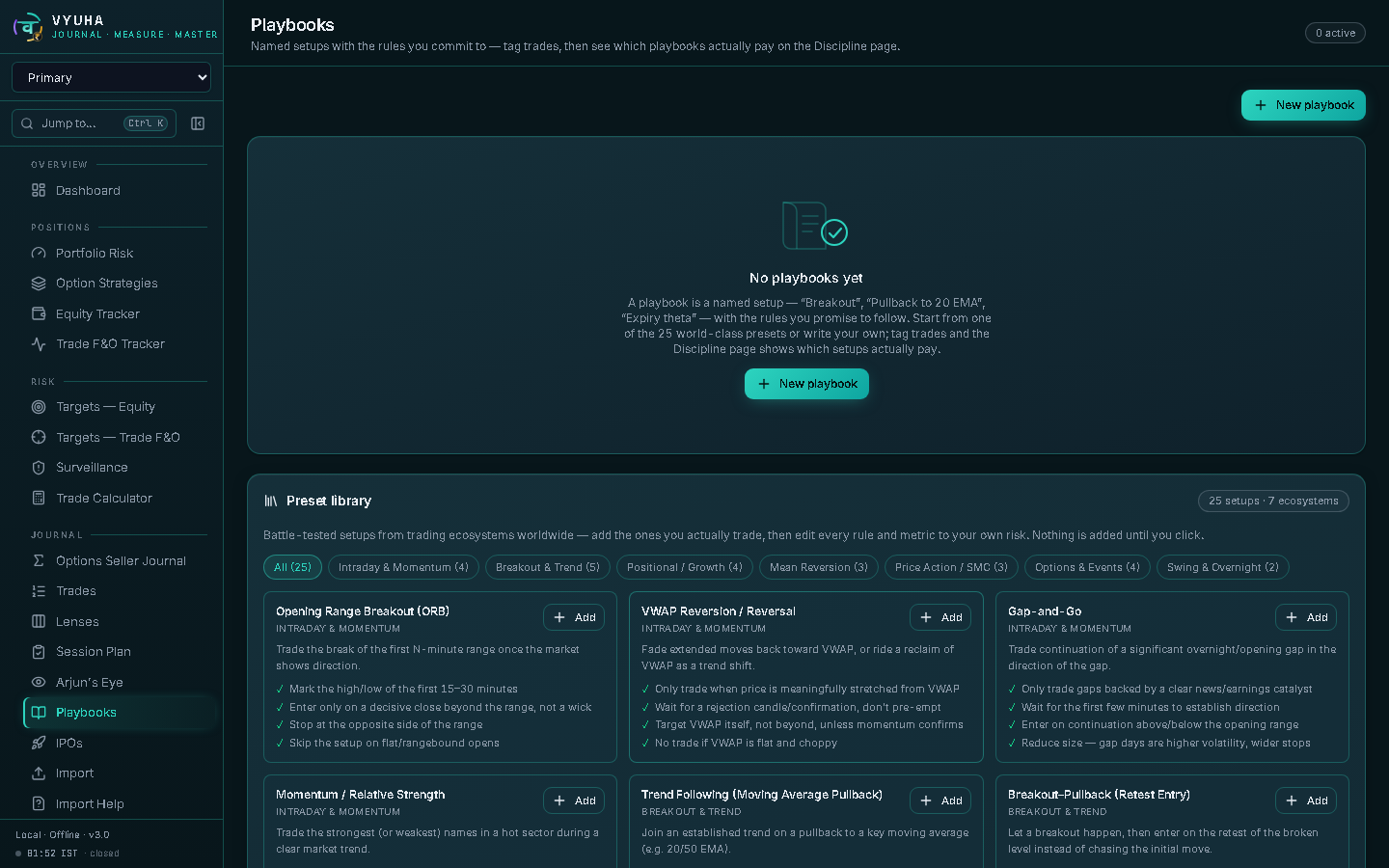
- Browsable preset library — 25 playbooks across 7 global ecosystems — Intraday & Momentum, Breakout & Trend (Turtle, Darvas, 52-week-high), Positional/Growth (CANSLIM, Minervini SEPA, Wyckoff, Weinstein), Mean Reversion (Connors RSI-2), Price Action/SMC (ICT liquidity sweeps), Options & Events (iron condor, India weekly expiry theta), Swing & Overnight (BTST). Filter by ecosystem, read every rule on the card, one-click Add, then tune every metric to your own risk. Nothing is auto-seeded — 25 untraded setups would bury your real playbooks and turn per-playbook expectancy into noise, so a playbook only becomes yours when you click.
- Rule-checklist enforcement: journaling a trade shows its playbook's rules — tick what you actually followed. Broken rules land on the Discipline page with their real cost.
- Per-playbook expectancy cards: win rate, net, expectancy, profit factor, avg R — with a small-sample caution until 20 closed trades.
- Discipline scorecard: the weekly Process Score (the same five components the Review Desk shows, each with its arithmetic), cost-of-mistakes rollup, trading-by-emotion, entry-time limit breaches, and the per-rule cost table. A week with fewer than 10 closed trades does not score — it says what was short and is excluded from averages instead of counted as zero, and every average states its coverage (“across 7 scoring weeks of 12”).
📓 Trade Review Desk — read your own trades back
- A queue of what you have not reviewed yet. Every closed trade carrying no review stamp, filtered and windowed, stating “showing N of M” rather than presenting a slice as the whole. Each row opens the same journal dialog the Trades screen uses; saving stamps the trade, and a trade with nothing to add can be stamped directly and reopened later.
- A Sunday ritual that closes one ISO week. What closed, what it netted and cost, the widest expectancy gaps by mistake tag, best and worst by R, why positions were closed — plus a free-text note. Completing a week stores the score that was on screen at that moment beside the score recomputed today. In-app only: it sends no reminder, by Telegram or anything else.
- A transparent Process Score. Five equal-weight components — planned (SL or target recorded), risk-cap (loss within its own risk), daily-stop (day net within your stop), rules-followed (a playbook, and no rule broken), reviewed — each shown as “n of m · pct” with its own coverage, so the arithmetic sits on screen beside the number. A component with nothing honest to measure shows a dash and drops out of the mean; it never scores you against a limit you never set.
- On upgrade the queue does not start from zero. When v3.7.0 first opens your database, closed trades you have already journalled — carrying a note, an exit trigger or mistake tags — are stamped as reviewed, dated by the last time that row was touched rather than by today. A journalled book therefore opens with a non-zero “Reviewed n of m” and a shorter queue; a trade nobody annotated stays in it, which is the point. It is not a claim that those trades were reviewed on the desk — the desk did not exist — only that the record shows they were read by hand.
- Pro/lifetime, after the 7-day trial.
📉 Options Seller Journal
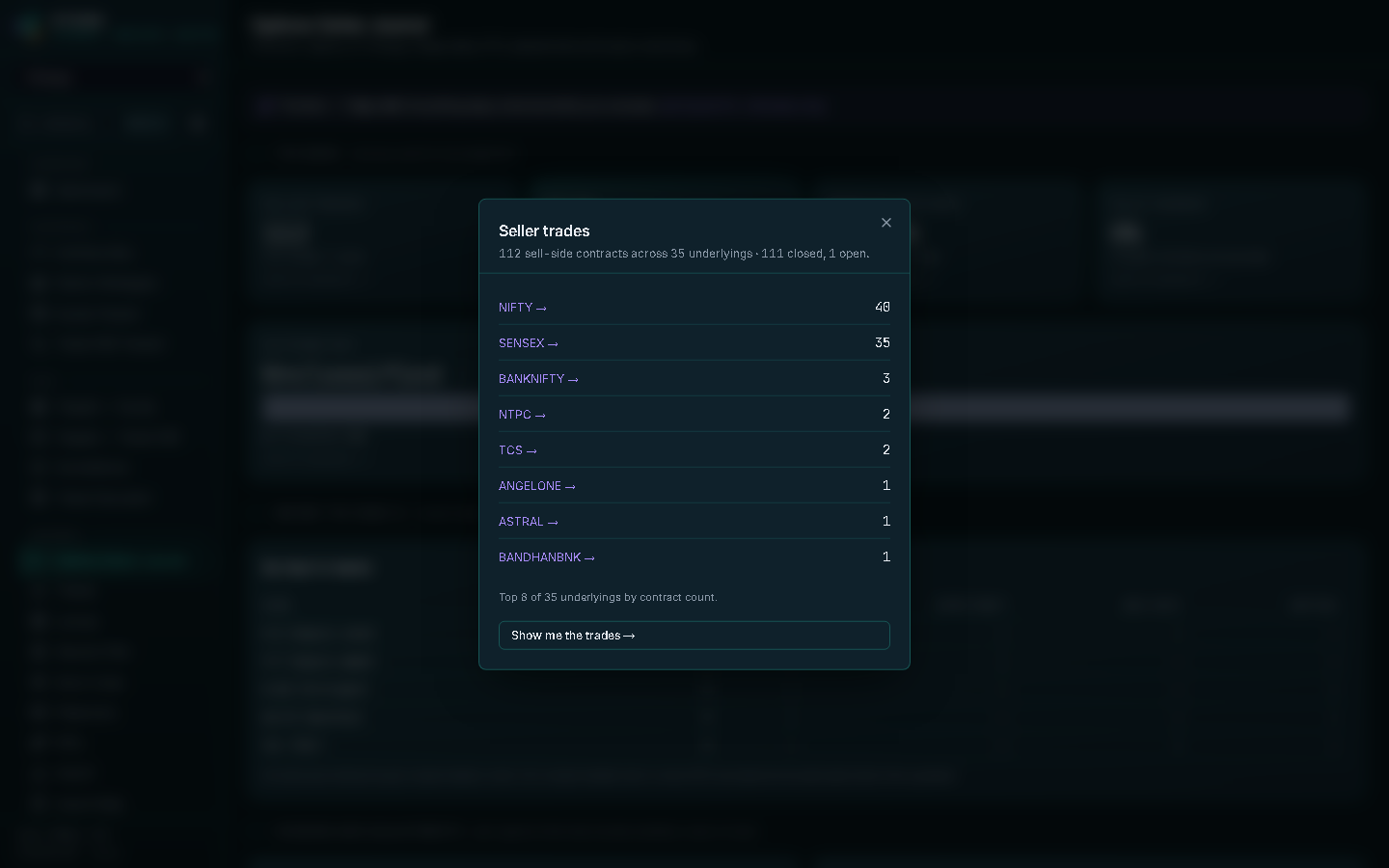
- Expectancy by DTE band, hedged-vs-unhedged reported as an honest gap, roll chains against the first leg, IV rank, and premium per day of risk.
- The four seller KPIs and the outcome mix open the same breakdown dialog the Dashboard uses — per-underlying counts, realised vs open, best and worst contract, capture arithmetic in one sentence — each row a deep link into the trades it counts.
🛡 Portfolio risk cockpit
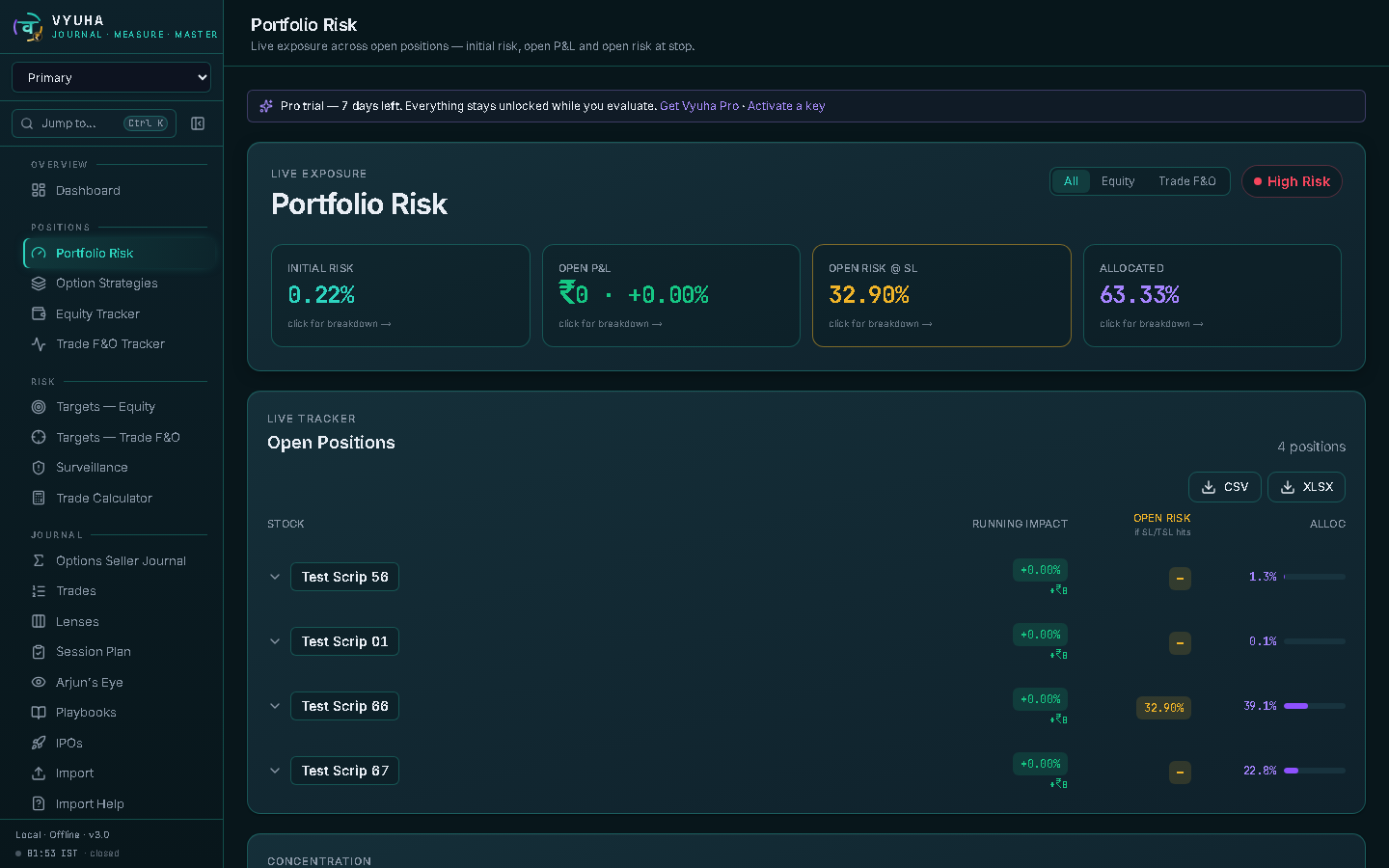
- Live exposure: initial risk, open P&L, open risk @ SL, allocation, sector concentration (HHI), one-click trail-to-breakeven.
- Sector concentration says how sure it is (v3.8). A bundled four-level NSE taxonomy (macro · sector · industry · basic industry) classifies 2,229 ISINs with a confidence tier and provenance; the resolution chain is your own instruments → the taxonomy → the bundled index map, and your own tag is never overwritten. Data layer only — sector analytics shipped in v4.0.0.
- VaR / CVaR / parametric VaR, beta-weighted exposure, NIFTY stress scenarios (±3%, ±5%, crash+IV spike).
- Option Greeks (Black-Scholes) with a three-tier IV fallback ending at the real India VIX.
- Margin estimate (SPAN approximation) per broker × segment, fully editable rate table.
- Physical-settlement radar: ITM stock options and futures near expiry get delivery-obligation and extra-STT warnings.
- Pre-trade limits check (per-trade cap, daily stop, max-open, concentration) — advisory with override, and overrides are recorded so you see what ignoring the guardrails cost.
- SL/TSL/target breach alerts on Dashboard & Risk — every alert reminds you the marks are EOD/manual and to verify live. A per-device, opt-in button asks your system for notification permission and fires only on a new breach set; whether the desktop shell actually surfaces that notification has never been proven on a built installer, so the banner itself is the record either way.
- SEBI compliance radar — date- and position-aware reminders for expiry-day margin rules, the weekly-expiry regime and index position limits. Informational only; your broker's RMS stays the source of truth.
🧮 Know your costs before you trade
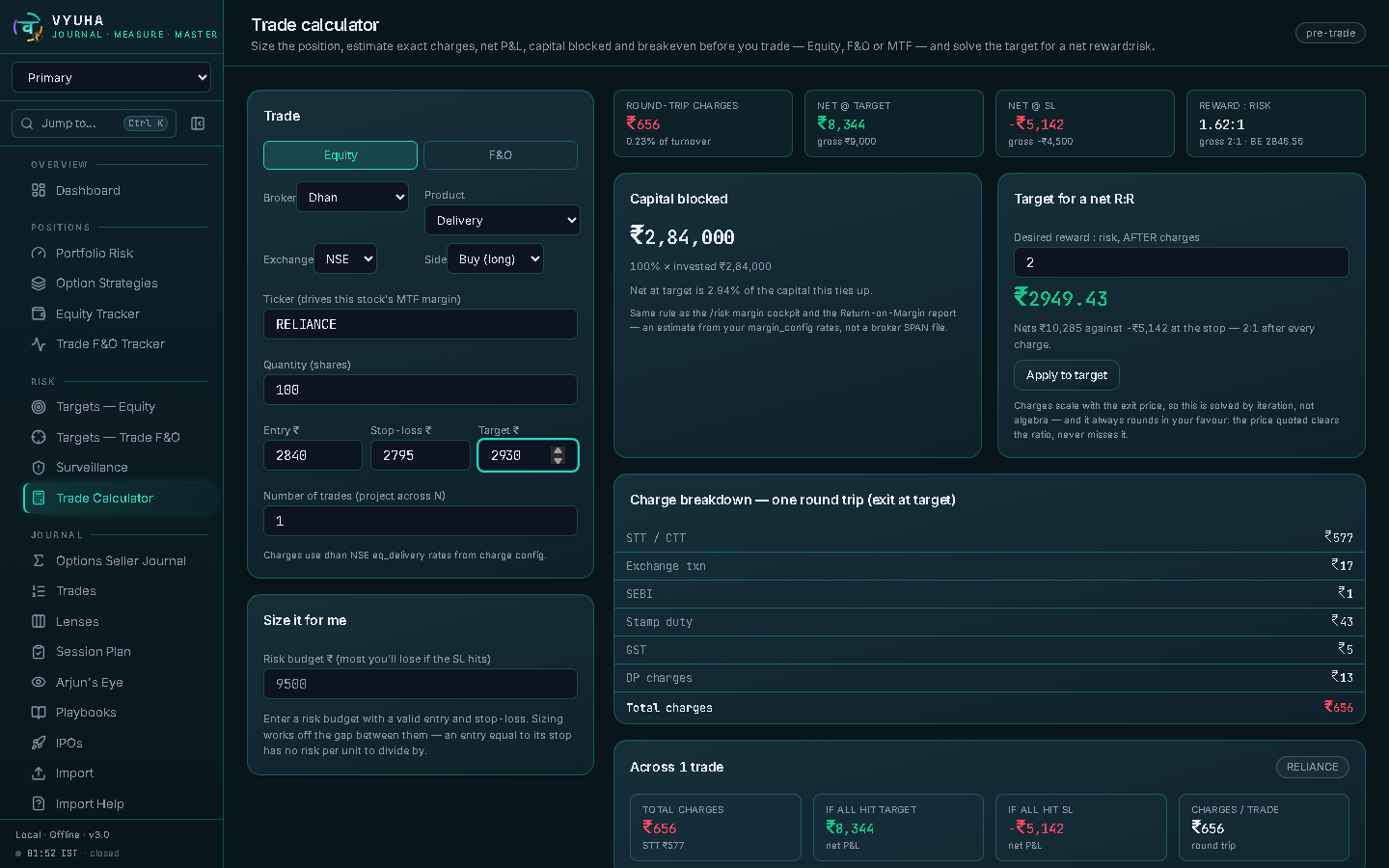
- Trade calculator: exact round-trip charges, net-at-target, net-at-SL, charge-adjusted reward:risk and breakeven — equity, F&O, or MTF, projected across N trades.
- Charges & MTF leak report: where your gross P&L actually goes.
- Broker cost comparison: your entire history re-priced on every broker's rate card — see who'd have been cheapest. Free and paid plans are listed separately (Kotak Neo's ₹249/month Trade Free Pro sits beside its free tier), with the subscription amortised over the months your trades span and counted in the total — a paid plan judged on brokerage alone always looks cheaper than it is.
📈 Edge analytics that don't flatter you
- Expectancy, win rate, avg R by setup tag and segment.
- MAE/MFE excursions from your own EOD price history, plus a stop-tuning report in R: how much heat your winners took, how many losers ran past 1R (late/moved stops — flagged as behavioral, not placement).
- Equity curve with max drawdown, daily P&L calendar, streaks, monthly target ladder, benchmark ingestion, Monte-Carlo utilities, XIRR.
- Shareable stat cards — post your numbers without posting your account size: defaults to % of capital, can hide ₹ entirely, and the PNG is rendered on your machine with a permanent "self-reported · not broker-verified" watermark.
- Tax Summary: STCG/LTCG with 31-Jan-2018 grandfathering (per-share FMV), rate-cutover handling, dividend TDS tracking.
- Advance tax instalments measured against a dated challan ledger — record what you actually paid (date, amount, optional BSR code and challan serial) and each instalment is judged on what had been paid by its own due date, not on one running total. The safe harbour is decided by date, and anything paid after 31 March is named as self-assessment tax, not advance tax. Plus the tax-loss harvesting scanner and AIS/Form 26AS reconciliation.
- ITR Pack: speculative vs non-speculative vs capital-gains segregation per FY, ICAI Guidance Note turnover, and a 44AB/44AD audit-applicability read with layered cautions — export CSV/XLSX for your CA.
- Taxes paid (advance tax) on the ITR pack — your own challans in the return's Schedule IT shape (BSR code, date of deposit, serial, amount), exportable, and blank rather than 0 for anything it cannot derive.
- Schedule-format export — the same figures emitted in the return's own item codes: Schedule CG (A2 for STCG u/s 111A on ITR-2 — A3 on ITR-3, which numbers the schedule differently; the 112A box is AY-keyed — B4 for LTCG u/s 112A in AY 2025-26, B3 in AY 2026-27 — with the ₹1.25L deduction), Schedule BP for both business heads, and Schedule CFL with each loss vintage and the year it lapses. It also says which form your book implies — ITR-2, or ITR-3 the moment any intraday or F&O appears.
- It gets the STT rule right, which a re-label would not. STT is excluded from capital-gains deductions (proviso to S.48) but allowed in full as a business expense against intraday and F&O. Every other figure in Vyuha is net of STT, so the Schedule CG balance is deliberately higher than the net P&L shown elsewhere (except exited IPO allotments, whose STT is not yet added back — recorded, DECISIONS 2026-10-01 C0, STATE §0.4 item 15) — the charge breakdown is stored per trade, so this is a fact here rather than an estimate.
🔄 Automation — with your consent, never without it
- First-run setup, four steps and skippable: account and optional starting capital → get your trades in → optional Telegram → done. Capital stays optional — skip it and every report that needs a base still says “— · set your capital in Settings” rather than inventing one. “Run setup again” lives in Settings, and an install that already has a book never sees the wizard.
- Opt-in EOD auto-MTM: once per trading day, fetch NSE's bhavcopy and mark open positions to close — and, on each app open, catch up to ten missed sessions of the last 252 (one file every 1.5 s) under the same consent. OFF by default; warns that it overwrites matched marks; skips silently offline; every run is audit-logged.
- MTF interest accrual runs idempotently on app open.
- Signed auto-updates: the desktop app checks once at launch and shows Update now / Later — nothing ever installs itself, and your DB is backed up automatically before any migration.
🎨 Appearance — nine skins, tint, panels, custom, wallpaper
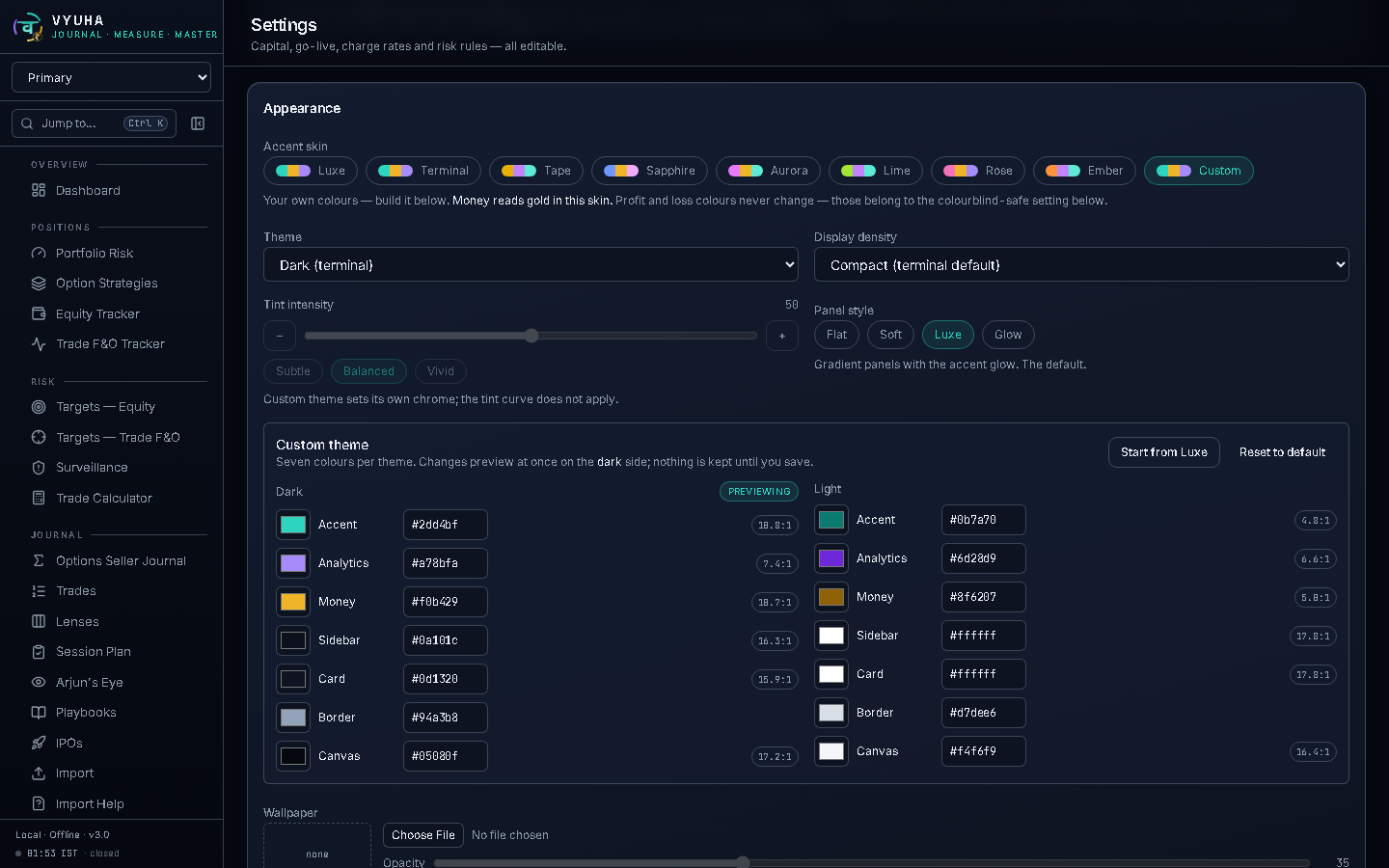
- Nine skins: eight built-in — Luxe, Terminal, Tape, Sapphire, Aurora, Lime, Rose, Ember — plus Custom. Every coloured skin tints canvas, panels and borders in its own hue, and a test asserts no two share a primary hex. (Ice and Royal, retired in v2.99.96, map to Sapphire.)
- Tint intensity — a 0–100 dial with Subtle / Balanced / Vivid presets deciding how much of the skin's hue the canvas, sidebar, cards and borders wear; every skin holds ≥9:1 (dark) / ≥7:1 (light) body-text contrast even at 100.
- Panel style — Flat / Soft / Luxe / Glow.
- Custom theme — seven targets (accent, analytics, money, sidebar, cards, borders, canvas) × dark/light, each row wearing a WCAG readability badge that warns and never blocks; seed it from any built-in skin.
- Wallpaper — PNG/JPEG/WebP ≤12 MB, kept locally in app-data outside backups, scrimmed per theme, never printed.
- The tokens are computed by a pure engine and injected inline on `` — no first-paint flash, and charts stay literal-colour.
🗃 Operational depth
IPO tracker with allotment P&L · capital compounding (double-count-safe) · cash & ledger · corporate actions · symbol aliases · instrument/sector master · surveillance-list warnings · immutable audit log · one-file backup/restore · Search + command palette (Ctrl+K) · a bundled symbol snapshot of 5,691 NSE/NSE-Emerge/BSE securities with name, board, BSE code and series (a BSE code resolves keyed on the code, never the ticker) · collapsible sidebar with live IST market clock · light/dark, nine skins + colorblind-safe mode · toast notifications · animated, skeleton-loaded UI.
🔑 Licensing (for the maintainer)
Vyuha Desktop ships with a serverless licence gate — an Ed25519 signature verified on the user's own
machine. Activation makes no server call. Every fresh install begins a
7-day full-Pro trial; the core journal is free forever.
Vendor tooling lives in scripts/:
node scripts/license-issue.mjs buyer@email.com app --lifetime   # mint a Lifetime key (also records it)
node scripts/license-issue.mjs buyer@email.com app --years 1    # ...or a Pro Annual key
node scripts/license-issue.mjs buyer@email.com app --months 1   # ...or a Pro Monthly key (given on request)
node scripts/license-issue.mjs buyer@email.com app --machine ABCD-EF12-3456       # lock to one PC
node scripts/license-list.mjs --expiring 30                     # renewals due
node scripts/license-revoke.mjs A1B2-C3D4-E5 "refunded"         # bake into future builds
node scripts/revocation-publish.mjs --add A1B2-C3D4-E5 --message "Refunded — contact support."
                                                                # signed list; reaches live installs
Each key embeds the buyer's email in its signed payload, so no two are alike, and the app shows
"Licensed to <email>". Keys can optionally be bound to one computer via a hardware-derived
fingerprint — Windows MachineGuid, macOS IOPlatformUUID, or Linux
/etc/machine-id, each namespaced so the same value on two platforms cannot
collide. Revocation has two halves: a build-time list baked into each release, and
since v2.99.91 a signed list fetched during the launch version check, so a
refunded or leaked key stops working without waiting for the user to update. It
travels one way only — the list comes down, nothing about the user goes up — it
warns for a grace period before it locks, and it fails open when offline, which
is stated rather than hidden. Full procedures:
docs/owner/LICENSE_OPERATIONS.md.
Buying is a WhatsApp message. Every "Get Pro / Get Lifetime" button in the app opens a
buy dialog — the number +91 73936 73714, a pre-filled message quoting the plan and the
price you saw, and Copy number / Copy message buttons (plus an Open-WhatsApp link when you are
in a browser). It is a dialog rather than a link because the
desktop webview opens no external pages; the key arrives by reply and is pasted into Settings →
License.
🔒 Your data, your choice of home
Vyuha Desktop needs no login and ships no telemetry and no analytics SDKs. A web platform is in development; when it ships, this section will state what each surface sends.
On the desktop app: Everything lives in one SQLite file on your disk — copy it and you've backed up your entire trading life. Unprompted, the desktop app talks to 127.0.0.1 and makes exactly one download-only call: at launch it asks GitHub for the latest signed release and the licence-revocation list — sending no account, no identifier and no data, and not something you can switch off. Every other network path exists only if you enable it: the EOD bhavcopy fetch (off by default), broker-API pulls that talk only to your own broker (Dhan's PIN+TOTP sign-in goes only to auth.dhan.co, and the opt-in launch auto-pull just runs those same pulls once a day), the Live Desk's price poll to the bridge you run on your own machine — off until you switch the integration on, accept the disclosure and pick that source, answering on 127.0.0.1 unless you enter another address, and carrying the trading symbols of your open positions and nothing else about them — and the opt-in Telegram EOD digest — the one path that uploads anything, and what it uploads is your own recorded numbers, to Telegram's servers, behind an explicit disclosure. On the desktop app, nothing about you or your trades leaves the machine by any path you didn't switch on.
🚀 Get it
Landing page: https://thejesh-k463.github.io/VYUHA-LOG/ — features, screenshots, pricing and the comparison table.
Desktop: grab your platform's build from Releases — zero dependencies, Node.js is bundled, and your data persists in app-data across updates and reinstalls; the uninstaller warns and copies the journal and licence to Documents\Vyuha-backup- before its delete-data option can act. Ticking "Delete the application data" erases that folder — journal, licence key and attachments — once the copy has been made. Upgrading from v4.5.x to v4.6.0: the installer runs the v4.5.0 uninstaller once, and that one is the guarded one — it names the journal and licence, copies them to Documents\Vyuha-backup- and stops if you Cancel, so nothing is asked of you. Migrations 0075–0078 run on first launch behind an automatic backups\pre-migrate-.sqlite copy; upgrading from v4.4.x applies 0074–0078 in order. Upgrading from v3.9.x to v4.0.0: the installer runs the v3.9.1 uninstaller once, and that one is the guarded one — it names the journal and licence, copies them to Documents\Vyuha-backup- and stops if you Cancel, so nothing is asked of you. Migrations 0064–0067 run on first launch behind an automatic backups\pre-migrate-.sqlite copy. Upgrading from v3.7.1 or earlier: the installer runs that older uninstaller once, and it has no backup step at all — leave its "Delete the application data" box unticked.
| Platform | File | Data lives in |
|---|
| Windows | Vyuha_x.y.z_x64-setup.exe | %APPDATA%\in.vyuha.tradejournal |
Current release: v4.6.0. If the window ever comes up blank, the sidecar's own log is at
%APPDATA%\in.vyuha.tradejournal\logs\sidecar.log — attach it to a bug report.
What's free and what isn't: every fresh install starts a 7-day full-Pro trial — no signup, no card, no server call. After that the core journal is free forever: recording closed trades, all eight broker importers, the dashboard, staged positions, playbooks, the trade calculator, Lenses grouping with per-group delete, recoverable deletion, and backups. A licence unlocks the analytics layer — the Portfolio Risk cockpit, Arjun's Eye, the Edge Clinic hub (Setups, Discipline, Scaling & Replay), the Trade Review Desk (review queue, Sunday ritual, Process Score), the Options Seller Journal and the Capital & Expiry hub (Return on Margin, Expiry), the tax pack (Tax Summary, ITR, Advance Tax, Harvest, AIS reconcile), the Costs hub (Charges & MTF Leak, Broker Costs), per-group edge on Lenses, PDF reports, and live open-position tracking with SL/target. Your own record of your trading is never held hostage — every trade you have already taken stays readable, editable and exportable without a key — and your record stays yours either way.
New here? Flip through the 📽 Getting-Started deck — 13 visual slides covering install → import → journal → the playbook loop → Pro activation. (Download and open locally, or print to PDF; arrow keys navigate.)
Run from source:
git clone https://github.com/Thejesh-k463/VYUHA-LOG.git && cd VYUHA-LOG
npm install
npm run setup     # migrate + seed → ./data/vyuha.sqlite
npm run dev       # http://localhost:3000
🗂 Where things live
app/         Next routes — one folder per page, plus /api
components/  UI, grouped by feature (trades, import, cash, dashboard…)
lib/
  engine/    charges, classification, rate tables — pure, no DB
  analytics/ every report's maths — pure, no DB, no React
  import/    parsers (one per broker file), pairing, product inference
  risk/      position sizing, limits, margin
  queries/   the ONLY layer that touches the database (server-only)
  domain/    shared constants and vocabulary
drizzle/     migrations, applied in order at startup
tests/       12021 unit + integration tests across 511 files (+ tests/load: 16 load cases, run separately)
e2e/         142 Playwright flows through the real app, in 38 specs
docs/
  client/    what a BUYER gets — install guide, getting-started deck
  owner/     VENDOR ONLY — licensing, release, monetization, indicators
  sales/     public marketing assets (landing page, brochure)
  screenshots/  23 shots retaken by scripts/retake-screenshots.mjs — dashboard, trades, lenses,
                pricing, broker-connect, staged-position, arjuns-eye, rom-report, kpi-drilldown,
                playbooks, calculator, risk, options-journal, edge-report, tax-pack, surveillance,
                settings-appearance, custom-theme, skin-{lime,rose,ember,sapphire,aurora}
scripts/     build, release, and the vendor licence tooling
The rule that keeps the maths honest: lib/analytics/* and lib/engine/*
import neither the database nor React. They take plain data and return plain
data, which is why every number in the app can be unit-tested without a browser
or a fixture database — and why a reporting bug can be reproduced in three
lines.
🧪 Built like an engine, not a spreadsheet
- 12021 tests. Most run over pure, DB-free modules — charge engine, classification, MTF interest, capital gains, VaR, Greeks, settlement, discipline, ITR turnover, breach detection, MAE/MFE… A handful deliberately do not: backup/restore and multi-account isolation are exercised against a real migrated SQLite file, because the failures worth catching there (a wiped attachment directory, a half-applied restore, one account's rows leaking into another's tax pack) cannot occur in a mock.
- Load-tested. 16 load cases in
tests/load (npm run test:load, deliberately outside npm test) drive the app at ten-thousand-trade scale — cross-source duplicate detection, delete-at-scale, staged-leg depth, Lenses grouping, backup/restore. The first batch of seven found five real defects, the second batch found more, and the third (C8, 2026-08-21) found a quadratic in the import pairing engine that no other case could see, because none of them imported it — all fixed and pinned, each measured before/after in that README: a quadratic duplicate filter (8 s → 20 ms), a too many SQL variables throw on a whole-account delete, a staged rebuild with zero transactions, a per-batch re-filter in Lenses, a restore that derived its scrypt key twice, and a FIFO lot walk that cost 15.9× for 4× the legs (50,000 legs on one symbol: 775 ms → 63 ms, byte-identical output).
- Charges reconciled against real broker files; MTF math verified against Dhan/Zerodha/Groww's own documentation.
- Next.js (App Router) + TypeScript · Tailwind v4 · Drizzle ORM / better-sqlite3 · Recharts · TanStack Table · Tauri 2 desktop shell with a bundled-Node sidecar.
- Full changelog in
CHANGELOG.md.
📜 Key npm scripts
| Script | What it does |
|---|
npm run dev | Start the app on localhost:3000 |
npm run build / npm run start | Production build / serve |
npm run setup | db:migrate + seed in one go |
npm run db:generate / db:migrate | Generate / apply Drizzle migrations |
npm run db:studio | Inspect the DB in Drizzle Studio |
npm test | Vitest unit + integration suite (12021 tests) |
npm run test:e2e | Playwright e2e — 142 flows incl. the Dhan transaction report, Lenses grouping and drill-down, delete-by-scope, unpriced-sale quarantine, status/outcome views, the backup export→restore round trip and account switching |
npm run test:load | 16 load/stress cases (tests/load, .load.ts) — outside npm test by construction and run in CI as its own required load job (v3.8); results append to a gitignored trend file |
npm run demo | Serve the app on localhost:3214 against a throwaway, freshly-seeded demo database — the real journal is never opened (-- --fresh rebuilds it) |
npm run typecheck / npm run lint | tsc --noEmit / ESLint |
npm run verify | typecheck + lint + tests + production build — run this before pushing. The first three pass on code that cannot be bundled; only the build catches a client-boundary violation |
npm run bump-version x.y.z | Sync the version across package/tauri/cargo/sidebar |
npm run desktop:build | Build the native desktop app for the CURRENT platform (needs Rust; see below) |
🖥 How the desktop app works
Vyuha is a full-stack Next.js server (server actions + better-sqlite3), so it can't be a static
export. The Tauri shell spawns the Next standalone server as a bundled-Node sidecar bound to
127.0.0.1, waits for the port, then points the native webview at it — WebView2 on Windows, WKWebView
on macOS. On first run the launcher copies a seeded template DB (empty journal) into the OS app-data
dir (%APPDATA%\in.vyuha.tradejournal, or ~/Library/Application Support/in.vyuha.tradejournal);
your data persists there across updates and reinstalls; the uninstaller warns and copies the journal
and licence to Documents\Vyuha-backup- before its "Delete the application data" checkbox can act —
ticking that box erases the app-data folder, so the copy, and a Cancel, is what stands between a
mis-read label and the journal. The sidecar's stdout/stderr go to
/logs/sidecar.log (%APPDATA%\in.vyuha.tradejournal\logs\sidecar.log on Windows).
# one-time prerequisites
#   Windows : Rust + WebView2 + MSVC C++ build tools
#   macOS   : Rust + Xcode Command Line Tools (xcode-select --install)
npm run desktop:build
# → Windows: src-tauri/target/release/bundle/nsis/
# → macOS:   src-tauri/target/release/bundle/dmg/
desktop:build builds for whichever platform you run it on — there is no cross-compilation, so a
macOS build needs a Mac. That is what the release matrix is for.
Releases are built by CI on tag push (v*) across a matrix — Windows x64, macOS Apple silicon and
macOS Intel (macOS is built by CI but not sold or supported) — signed with the updater keypair and published as drafts, so updates only reach
users when a draft is explicitly published. macOS ships per-architecture rather than as one universal
binary because the app carries a bundled Node runtime, and a universal bundle would embed a
single-architecture Node that fails on the other kind of Mac.
⚙️ Configuration & data
- Database:
data/vyuha.sqlite (git-ignored). Reset: delete data/, run npm run setup.
- Capital model: two buckets (Equity / Trade F&O), editable in Settings; every risk %, allocation and target computes against bucket capital, with opening snapshots kept in sync.
- Nothing statutory is hard-coded: all charge rates live in
charge_config (broker × segment × exchange) and margin rates in margin_config (broker × segment) — both editable in-app, in Drizzle Studio, or via the seed files.
- Known limits: broker P&L files lack segment/MTF flags and per-trade dates — re-tag those rows once (overrides persist across re-imports). Brokerage/MTF interest can't be derived from scrip-aggregated files; the reconciliation panel surfaces the deltas.
🗂 Project layout
VYUHA-LOG/
  app/            # App Router pages (dashboard, risk, trackers, reports…)
  components/     # UI primitives, layout, feature components
  lib/
    engine/       # PURE classification + charges engines
    analytics/    # PURE metrics, tax, ITR, MAE/MFE, greeks, VaR…
    risk/         # PURE calculators, margin, alerts
    import/       # parsers, detect, dedup, commit pipeline
    jobs/         # MTF accrual, auto-MTM
    db/           # Drizzle schema, migrations, seed
  src-tauri/      # Rust desktop shell
  tests/          # 12021 Vitest unit + integration tests (+ tests/load)
Convention: business logic lives in pure modules with zero DB/React imports, unit-tested first,
then wrapped by thin server-only query layers.
⭐ If Vyuha saves you one bad trade…
…that's worth more than a star — but the star helps others find it. Star the repo and share it with a trader who still journals in Excel.
> Disclaimer: Vyuha is a journaling and analytics tool. Nothing in it is investment, tax, or
> legal advice. Charge/tax figures are computed from editable, documented rates and reconciled
> where possible, but your broker's contract notes and your CA remain the source of record.