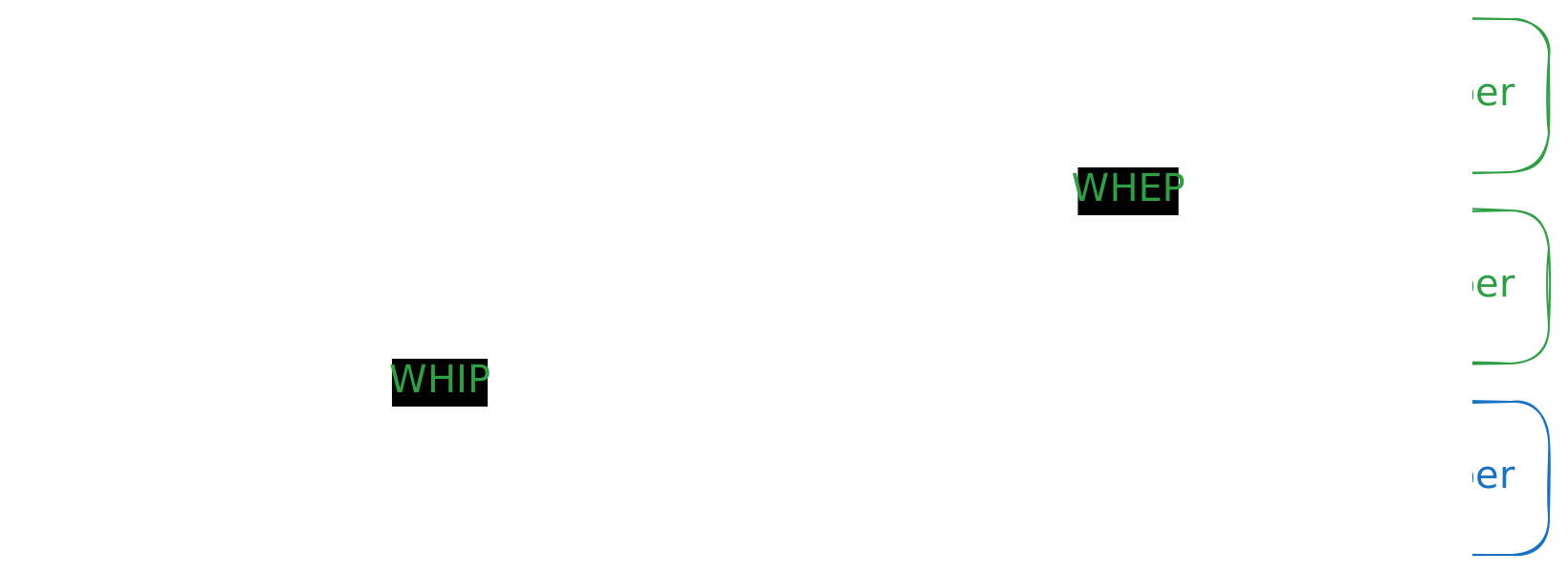
Whipinto is a high-performance SFU (Selective Forwarding Unit) server designed for real-time video streaming using WHIP/WHEP protocols. It enables seamless media distribution by supporting various audio and video protocols and integrating with tools like Gstreamer, FFmpeg, OBS Studio, and WebRTC clients.
Key Features:
WHIP/WHEP Protocol Support: Enables interoperability between WebRTC applications without custom adaptations.
P2P/SFU Architecture: Focuses on efficient media forwarding, reducing resource overhead by avoiding transcoding and confluence workloads.
Multi-Platform Compatibility: Supports Linux, macOS, Windows, Android, arm, and x86 architectures for broad device support.
Protocol Conversion: Facilitates the conversion of widely used audio and video protocols, such as RTP to WHIP or WHEP.
Media Integration: Works seamlessly with popular media tools like Gstreamer and OBS Studio for enhanced functionality.
Audience & Benefit:
Ideal for developers, streaming platform operators, and organizations requiring low-latency, scalable real-time communication solutions. Whipinto provides a reliable and efficient SFU server to streamline media distribution and enhance user experiences.
Available via winget installation.
README
Live777
A real-time audio and video streaming media server
Live777 is a very simple, high performance, lightweight WebRTC SFU (Selective Forwarding Unit) server, with WHIP/WHEP as its first-class protocols.
Live777 works with GStreamer, FFmpeg, OBS Studio, VLC, WebRTC and other clients to receive and distribute streams — a typical publish (push) / subscribe (play) server model. It also converts between the audio and video protocols widely used on the Internet, such as RTP/RTSP to WHIP and WHEP.
Features
📚 Support WHIP/WHEP
Implements the WHIP/WHEP protocols for out-of-the-box interoperability with other WebRTC application modules — no custom adaptation required.
🗃️ P2P/SFU Mix architecture
Only forwards media streams — no mixing, transcoding or other resource-hungry media processing on the server. Encoding and decoding stay on the sender and the receiver respectively.
🌐 Multiple platform support
Native support for Linux, macOS, Windows and Android, on both ARM and x86.
🕸️ Cluster & cascade
The companion liveman manager turns multiple Live777 nodes into a cluster — proxying client requests, managing cascade state between nodes, and coordinating recording across the cluster.
🎥 Stream recording
Record published streams as fragmented MP4 segments to the local filesystem or S3-compatible object storage, controlled through the REST API.
📊 WebUI & observability
An embedded WebUI, admin and session REST APIs, and Prometheus metrics are built in for easy operation and observability in production.
Quick Start
Run Live777 with Docker (host networking is required):
docker run --name live777-server --rm --network host ghcr.io/binbat/live777-server:latest live777
Then open your browser at http://localhost:7777/.
For prebuilt binaries, Linux packages, winget and cargo installs, see the installation guide.
 Live777