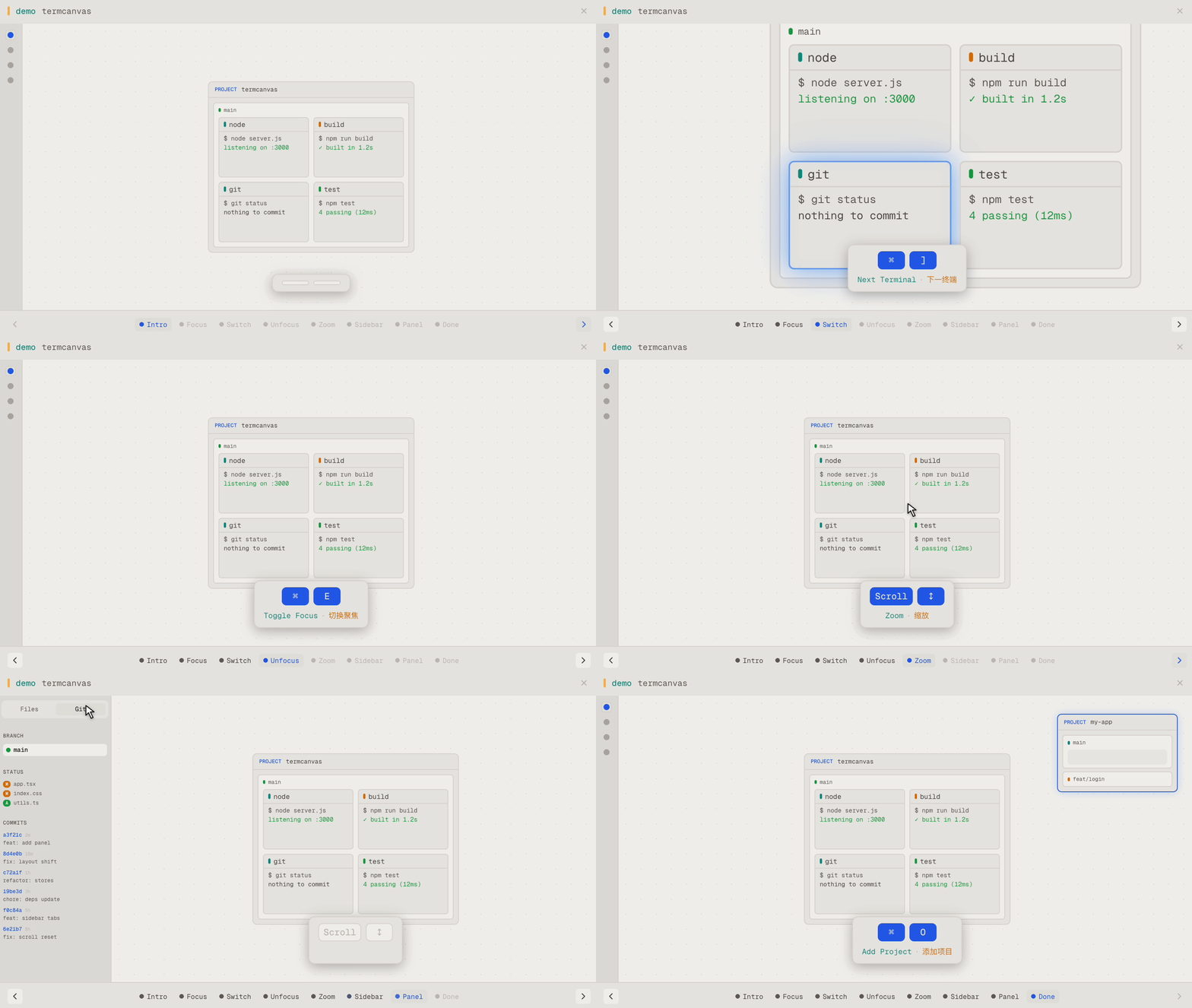
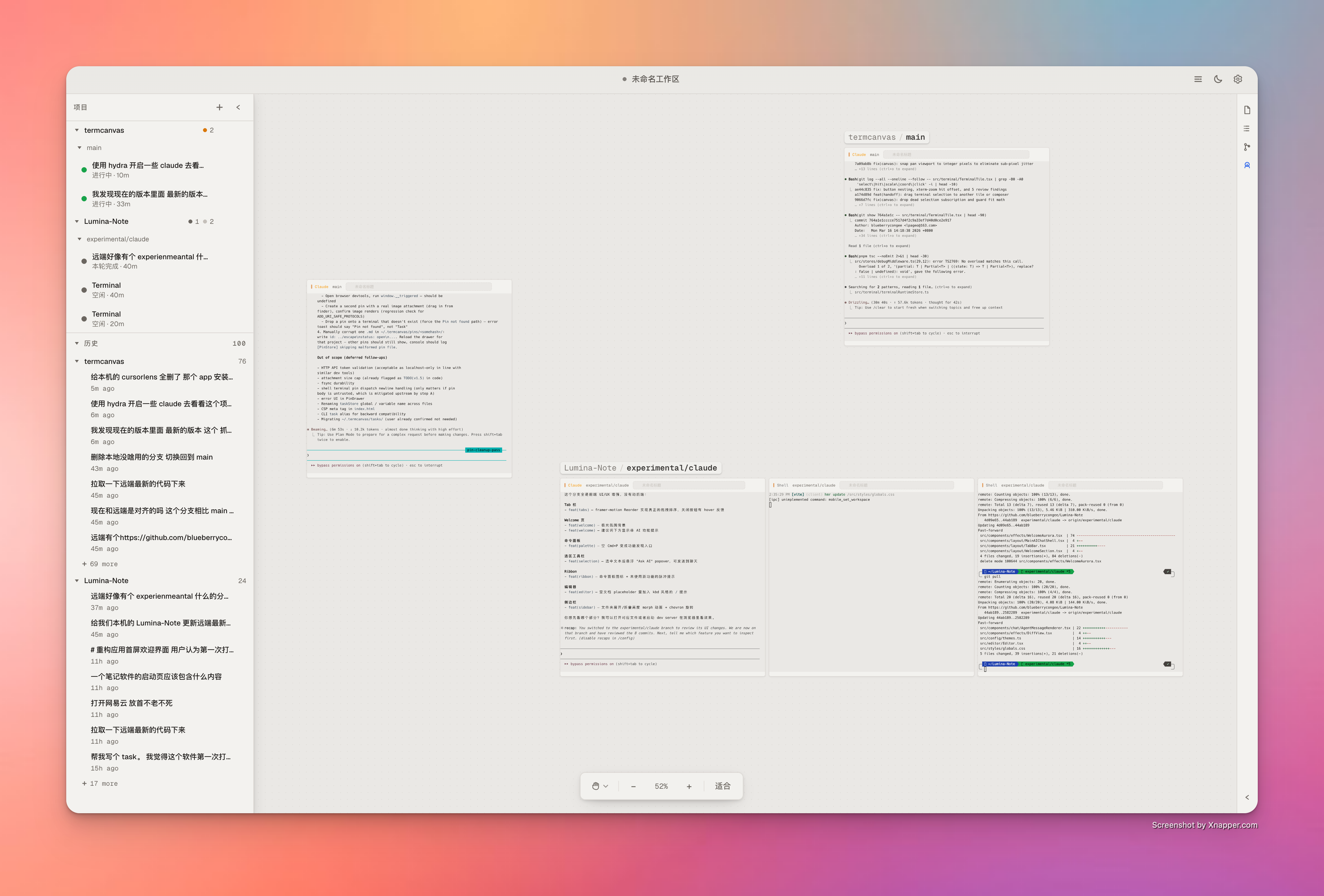
TermCanvas spreads all your terminals across an infinite spatial canvas — no more tabs, no more split panes. Drag them around, zoom in to focus, zoom out to see the big picture.
It organizes everything in a Project → Worktree → Terminal hierarchy that mirrors how you actually use git. Add a project, and TermCanvas auto-detects its worktrees. Create a new worktree from the terminal, and it appears on the canvas instantly.
中文文档 →
> New to TermCanvas? Read the full User Guide — every interaction explained, every keyboard shortcut, plus the non-obvious tricks (⌘E focus chain, drag-to-stash, session replay, etc.).
Quick Start
Download — grab the latest build from GitHub Releases.
> [!IMPORTANT]
> Apple Silicon (M-series) Macs — pick the file with arm64 in its name
> Files with arm64 in the filename (e.g. TermCanvas-X.Y.Z-arm64.dmg, TermCanvas-X.Y.Z-arm64-mac.zip) are native Apple Silicon builds. Files without arm64 are Intel (x64) builds — they'll still launch on M-series Macs via Rosetta 2, but you'll see noticeable lag when panning/zooming the canvas.
>
> To verify after install: open Activity Monitor, find TermCanvas, and check the Kind column — it should say Apple, not Intel. If it says Intel, delete the app and redownload the arm64 variant.
> [!WARNING]
> macOS note for unsigned builds
> If macOS says TermCanvas is damaged or blocks launch because the app is unsigned, clear the quarantine attribute and try again:
>
> bash > xattr -cr /Applications/TermCanvas.app >
>
> If you installed the app somewhere else, replace the path with the actual app location.
Build from source:
This workspace uses pnpm, and pnpm-lock.yaml is the canonical lockfile.
git clone https://github.com/blueberrycongee/termcanvas.git
cd termcanvas
pnpm install
pnpm dev
Install CLI tools — after launching the app, go to Settings → General → Command line interface and click Register. This adds termcanvas and hydra to your PATH.
Registration also installs TermCanvas skills and lifecycle hooks for Claude/Codex. For Codex 0.129.0 and newer, TermCanvas writes the required hook trust state in ~/.codex/config.toml so the generated hooks are reviewed/trusted and continue to emit terminal lifecycle and telemetry events.
Features
Canvas
Infinite canvas — pan, zoom, and arrange terminals freely. Three-layer hierarchy: projects contain worktrees, worktrees contain terminals. New worktrees appear automatically as you create them.
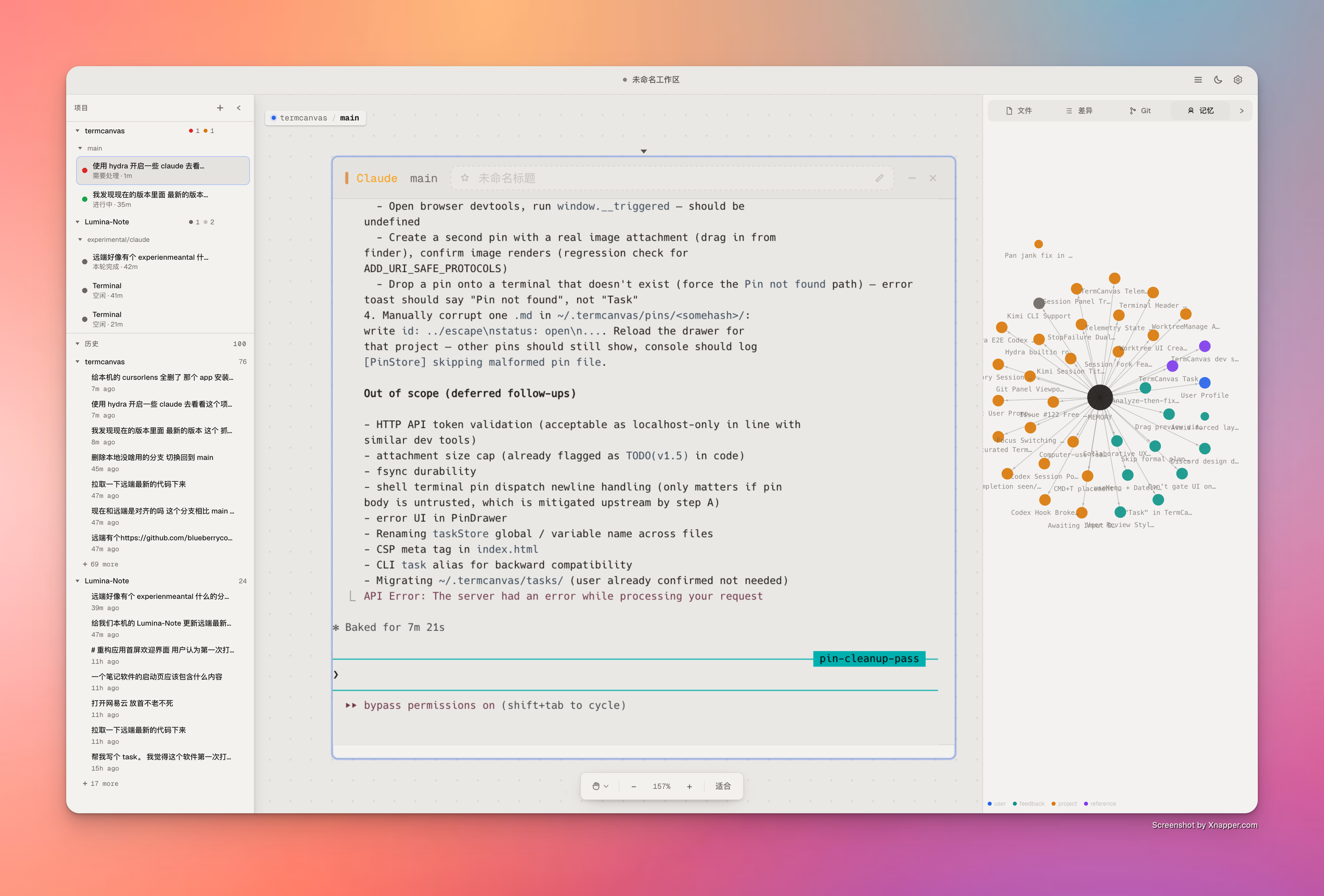
Double-click a terminal title bar to zoom-to-fit. Drag to reorder. Box-select multiple terminals. Draw and annotate freely on the canvas itself with the Free Canvas tool — sketches, callouts, and grouping lines live alongside your terminals. Save your entire layout to a .termcanvas file.
AI Coding Agents
First-class support for Claude Code, Codex, Kimi, Gemini, and OpenCode.
- Glance at any tile to know what it's doing — a coloured status dot tells you whether the agent is thinking, awaiting input, idle, or done
- Pick up where you left off — close and reopen an agent terminal without losing the conversation
- Review changes in place — inline diff cards let you read an agent's edits without leaving the canvas
Sessions Panel
Every past Claude / Codex conversation in your projects, organised as projects → worktrees → sessions. Click any row to replay it, or jump straight to the running terminal. Worktrees show their live git status so you can tell at a glance what's clean.
Git
Commit history, diff viewer, and live git status — built into the sidebar so you never need to leave the canvas to check what changed.
Terminals
Shell, lazygit, and tmux terminals live alongside AI agents on the same canvas. Star the ones you keep coming back to (⌘F) and cycle through just those with ⌘] / ⌘[ — use ⌘G to choose whether you're cycling all terminals, just starred, or whole worktrees. Custom titles, per-agent CLI override, and your preferred terminal size is remembered after the first manual resize.
Usage Tracking
Track how much you're spending on Claude and Codex — across all projects, broken down by model, with quota meters for the 5-hour and 7-day rate limits. Sign in to keep usage in sync across devices.
Settings
Downloadable monospace fonts · dark / light theme · rebindable keyboard shortcuts · adjustable contrast for accessibility · English and Chinese · in-app auto-update.
CLI
Both CLIs are bundled with the app. Register them from Settings to use in any terminal.
termcanvas
Full command reference
Usage: termcanvas   [args]

Groups:
  project        add | list | remove | rescan
  worktree       list | create | remove
  terminal       create | list | status | output | destroy | set-title
  workflow       Lead-driven Hydra workflow over HTTP (init / dispatch / watch …)
  telemetry      get | events
  pin            add | list | show | update | rm
  diff            [--summary]
  state          dump full canvas state as JSON

Common shapes:
  project add
  worktree create --repo  --branch  [--from ]
  terminal create --worktree  --type
          [--prompt ] [--parent-terminal ] [--auto-approve]
  terminal output  [--lines N]              # default 50
  telemetry get --terminal
  telemetry get --workflow  --repo
  pin add --title  [--body <b>] [--link ] [--link-type ]

Flags:
  --json    Machine-readable output for any command
termcanvas project add ~/my-repo
termcanvas terminal create --worktree ~/my-repo --type claude --prompt "Audit the auth flow and fix the root cause"
termcanvas terminal status
termcanvas telemetry get --terminal
termcanvas diff ~/my-repo --summary
For Claude/Codex task automation, start a fresh terminal with termcanvas terminal create --prompt "...". termcanvas terminal input is not a supported dispatch path.
hydra
Hydra is TermCanvas's terminal orchestration toolkit for Lead-driven workflows and isolated direct workers. It coordinates git worktrees, assignment/run file contracts, and the telemetry truth layer without taking control away from the agent sessions themselves.
Hydra is now Lead-driven. One main terminal owns the workbench, reads the codebase, and decides what to do at each decision point. Worker terminals stay autonomous. Workbench state lives under repo-local .hydra/workbenches/, and the authoritative contract is on disk: inputs/intent.md, dispatches//intent.md, report.md, result.json, and ledger.jsonl. Terminal prose is advisory only; validated result.json is the machine gate.
Role-driven workflows currently target Claude/Codex through the Hydra role registry. If you only need one isolated worker without a Lead-driven DAG, use hydra spawn instead.
This design is inspired by Anthropic's harness design research on long-running agent orchestration, adapted for terminal-based agents where each process is naturally isolated. For the theoretical foundations behind this approach, see Harness Design from a Distribution Perspective.
Getting started
Run hydra init-repo in your project (or click Enable Hydra in the worktree header) to sync the Hydra instructions into CLAUDE.md / AGENTS.md. Then either talk to your main agent, or drive the workflow yourself:
> Write a PRD or describe your requirements clearly, then tell the agent:
>
> "Read the Hydra skill. I want you to choose the right mode and autonomously complete this task based on the PRD in docs/prd/auth-redesign.md."
The main agent should classify the task and pick the lightest fitting path:
- Stay in current agent — simple or local tasks, no orchestration overhead
hydra spawn — a direct isolated worker when the task is clear and self-containedhydra init + dispatch + watch — Lead-driven workflow for ambiguous, risky, parallel, or multi-step work
hydra init-repo

hydra init --intent "Add OAuth login" --repo .

hydra dispatch --workbench  --dispatch dev --role dev \
  --intent "Implement OAuth login and the tests that cover it" --repo .

hydra watch --workbench  --repo .

hydra dispatch --workbench  --dispatch review --role reviewer \
  --intent "Independent review of the OAuth change" \
  --depends-on dev --repo .

hydra watch --workbench  --repo .
hydra complete --workbench  --repo .
Role files choose the CLI / model / reasoning profile. The caller chooses the role; Hydra resolves the terminal from that role definition.
Full command reference
Usage: hydra  [options]

Lead-driven workbench:
  init        Create a workbench context
  dispatch    Dispatch a unit of work into a workbench
  watch       Wait until a decision point is reached
  redispatch  Re-run an eligible/reset dispatch
  approve     Mark a dispatch output as approved
  reset       Reset a dispatch (and downstream by default) for rework
  ask         Ask a completed dispatch a follow-up question via session resume
  merge       Merge completed parallel dispatch branches
  complete    Mark a workbench as completed
  fail        Mark a workbench as failed

Inspection:
  status      Show structured workbench + assignment state
  ledger      Show workbench event log
  list        List direct spawned agents (pass --workbenches for workbenches)
  list-roles  Show available role definitions

Housekeeping:
  spawn      Create one direct isolated worker terminal
  cleanup    Clean up workbench state or direct spawned workers
  init-repo  Sync Hydra instructions into CLAUDE.md and AGENTS.md
Example commands
# Repo setup
hydra init-repo

# Start a Lead-driven workbench
hydra init --intent "fix the login bug" --repo .

# Dispatch a unit of work and wait for the decision point
hydra dispatch --workbench  --dispatch dev --role dev \
  --intent "Fix the login bug and add regression coverage" --repo .
hydra watch --workbench  --repo .

# Ask a completed dispatch a follow-up question without re-running it
hydra ask --workbench  --dispatch dev \
  --message "Why did you change the session validation path?" --repo .

# Send a dispatch back for rework
hydra reset --workbench  --dispatch dev \
  --feedback "The fix regressed the refresh-token path. Rework it." --repo .
hydra redispatch --workbench  --dispatch dev --repo .

# Direct isolated worker
hydra spawn --task "investigate the flaky CI failure" --repo .

# Inspection
hydra status --workbench  --repo .
hydra ledger --workbench  --repo .
hydra list --workbenches --repo .
hydra list-roles --repo .

# Cleanup
hydra cleanup --workbench  --repo . --force
hydra cleanup  --force
Lead-driven workbenches advance through validated result.json evidence inside .hydra/workbenches/. The telemetry truth layer provides real-time turn_state, last_meaningful_progress_at, derived_status, and session attachment data — used by both the UI and Hydra's watch / retry / health-check paths.
Typical workflow: write a PRD → run hydra init-repo once → let the Lead choose direct work vs spawn vs init/dispatch/watch → monitor via hydra watch or the canvas UI → read report.md before approving / resetting / completing. See Hydra Orchestration Guide for the control-plane details, and the Hydra Panoramic Flowchart for the updated state / file model.
Find your way around
A short map of where each major feature lives. Every shortcut here is rebindable in Settings → Shortcuts (Windows/Linux uses Alt in place of ⌘).
Discovery — when you don't know where something is
| Shortcut | Surface | What it's for |
|---|
| ⌘P | Command Palette | Run any in-app action by name (toggle a panel, open settings, switch theme, etc.) |
| ⌘K | Global Search | Files, terminals, sessions, git branches/commits, memory — fuzzy across the canvas |
| ⌘⇧J | Hub | Right-anchored command center: live terminals, recent activity, waypoints, pinned items |
| ⌘⇧/ | Status Digest | Quiet floating chip with the 3–5 most relevant signals across the canvas |
Canvas navigation
| Shortcut | Action |
|---|
| ⌘E | Toggle focus — zoom into focused terminal / out to fit |
| ⌘0 · ⌘1 · ⌘= · ⌘- | Zoom: fit · 100% · in · out |
| ⌘] / ⌘[ | Next / previous terminal (or worktree / starred — see ⌘G) |
| ⌘G | Cycle focus level (terminal → worktree → starred) |
| ⌘F | Star / unstar the focused terminal |
| ⌘⇧1–9 · ⌥1–9 | Save / recall a spatial waypoint (per project, 9 slots) |
| ⌥` | Pan to whichever terminal had output most recently (cycles on rapid re-press) |
| V · H · Space(hold) | Select tool · Hand tool · Temporary pan |
Multi-canvas
| Shortcut | Action |
|---|
| ⌘⇧] / ⌘⇧[ | Next / previous canvas (each canvas owns its viewport, projects, waypoints) |
| ⌘⇧N | Open Canvas Manager (rename, reorder, switch) |
Terminals
| Shortcut | Action |
|---|
| ⌘T · ⌘D | New / close terminal in the focused worktree |
| ⌘; | Open composer (or inline-rename the focused terminal title) |
Panels & overlays
| Shortcut | Action |
|---|
| ⌘/ | Toggle right panel (Files / Diff / Git / Memory) |
| ⌘⇧U | Usage dashboard (cost & quotas) |
| ⌘⇧H | Sessions overlay |
| ⌘⇧T | Snapshot history (browse and restore canvas states, with diff) |
| ⌘⇧A | Activity heatmap on the canvas |
Workspace
| Shortcut | Action |
|---|
| ⌘O | Add project |
| ⌘S · ⌘⇧S | Save / save-as a .termcanvas workspace file |
| ⌘, | Settings |
DesktopElectron
FrontendReact · TypeScript
Terminalxterm.js (WebGL) · node-pty
StateZustand
StylingTailwind CSS · Geist
Auth & syncSupabase
BuildVite · esbuild
Acknowledgements — lazygit is integrated as a built-in terminal type for visual git management on the canvas.
Roadmap
TermCanvas is evolving from a local desktop tool into a cloud-native AI development platform. Here's what's coming:
Cloud Runtime
Move task execution from your local machine to the cloud. Spin up AI agents on remote runtimes — your tasks run in managed environments with full git, toolchain, and dependency support, while your canvas remains the single pane of glass.
- Hosted agent execution — delegate Claude, Codex, and other agent tasks to cloud workers with on-demand compute
- Persistent remote sessions — close your laptop, come back later, your agents are still working
- Parallel cloud workers — scale out Hydra workflows across multiple cloud instances instead of local terminals
Automated Vibe Pipeline
End-to-end automation from idea to shipped code, powered by cloud runtime:
- Intent → Plan → Implement → Review → Merge — a fully automated pipeline where you describe what you want and the system handles the rest
- Continuous vibe loop — agents plan, implement, self-review, and iterate autonomously until the result meets acceptance criteria
- Pipeline-as-code — define reusable workflow templates for common tasks (bug triage, feature implementation, migration, refactoring)
- Human-in-the-loop checkpoints — configurable approval gates at any stage for when you want to stay in control
Vision
The goal is simple: you describe intent, TermCanvas handles the rest. Your canvas becomes a mission control for autonomous AI development — monitor progress, review results, intervene when needed, and let the cloud do the heavy lifting.
Contributing — fork, branch, and open a PR. Licensed under MIT.