ZPL2PDF - ZPL to PDF Converter







English | Português-BR | Español | Français | Deutsch | Italiano | 日本語 | 中文
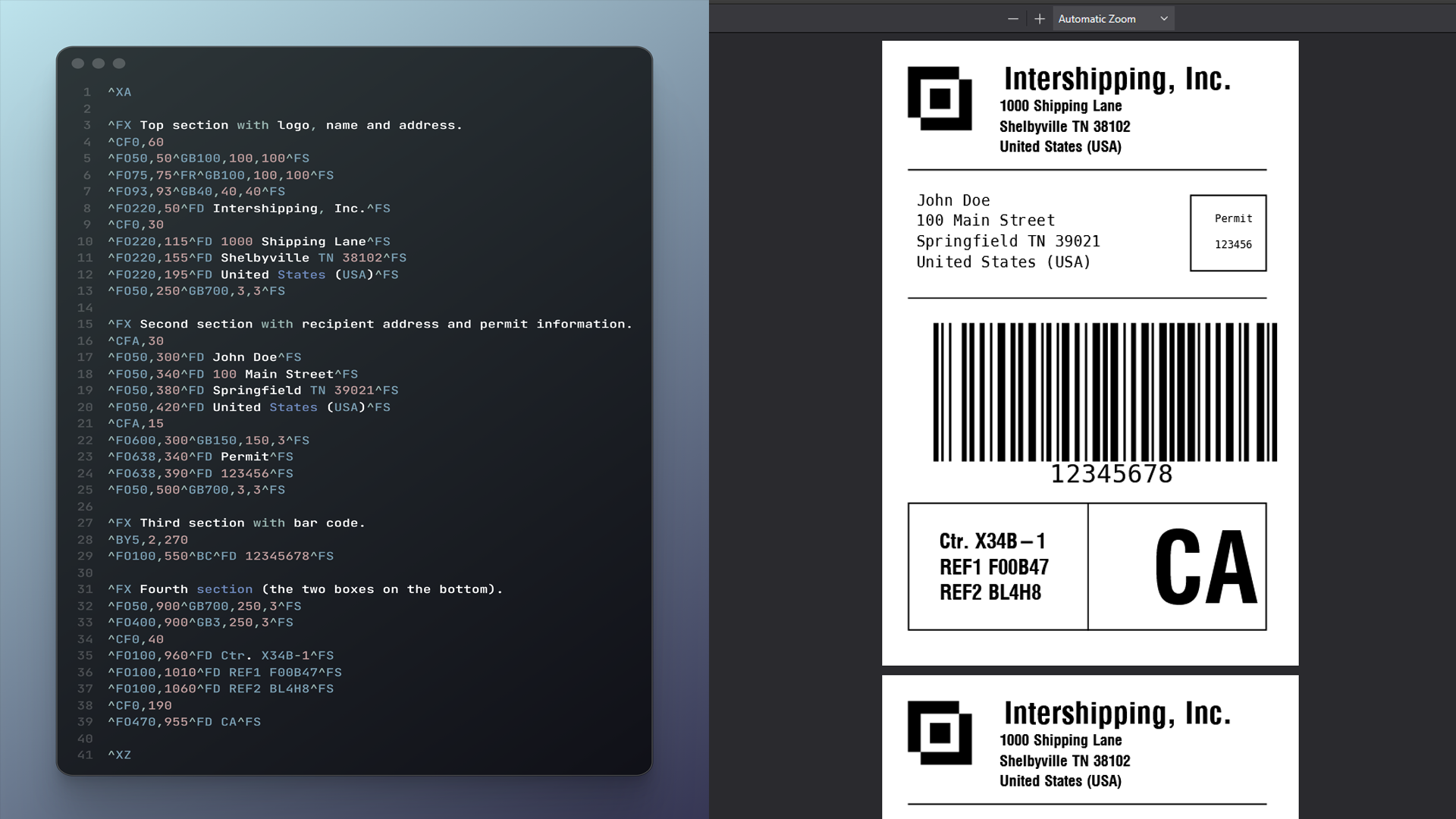
A powerful, cross-platform command-line tool that converts ZPL (Zebra Programming Language) files to high-quality PDF documents. Perfect for label printing workflows, automated document generation, and enterprise label management systems.
🚀 What's New in v3.1.3
🔧 Changed
- Release tooling: Scripts under
scripts/release/; Linux packaging assets under scripts/release/packages/ (documentation and contributor paths updated).
- Internals: Single Labelary PDF fallback path in
ConversionService across CLI, API, TCP server, and daemon; dimension/value-object consolidation and daemon PID handling without reflection.
🛠️ Maintenance
- Installer pipeline: More reliable cleanup in
08-build-installer.ps1; optional cleanup-installer-output.ps1 for installer/Output.
- Docker: Leaner default build context via
.dockerignore.
- Repo hygiene:
.github/prompts/ and .github/skills/ remain untracked; the rest of .github (workflows, templates) stays versioned.
Recent highlights (v3.1.3)
--stdout, smarter default PDF naming, BinaryKits/PDFsharp bumps, dimension validation fix, Aztec ^B0 → ^BO preprocessing.- Thanks to Jacques Caruso (jacques.caruso@exhibitgroup.fr) for contributions that landed in v3.1.3.
✨ Key Features
🎯 Three Operation Modes
Conversion Mode - Convert individual files
ZPL2PDF -i label.txt -o output/ -n mylabel.pdf
Daemon Mode - Auto-monitor folders
ZPL2PDF start -l "C:\Labels"
TCP Server Mode - Virtual printer
ZPL2PDF server start --port 9101 -o output/
📐 Intelligent Dimension Handling
- ✅ Extract dimensions from ZPL commands (
^PW, ^LL)
- ✅ Support for multiple units (mm, cm, inches, points)
- ✅ Automatic fallback to sensible defaults
- ✅ Priority-based dimension resolution
🌍 Multi-Language Interface
Set your preferred language:
# Temporary (current session)
ZPL2PDF status --language pt-BR

# Permanent (all sessions)
ZPL2PDF --set-language pt-BR

# Check configuration
ZPL2PDF --show-language
Supported Languages:
- 🇺🇸 English (en-US)
- 🇧🇷 Português (pt-BR)
- 🇪🇸 Español (es-ES)
- 🇫🇷 Français (fr-FR)
- 🇩🇪 Deutsch (de-DE)
- 🇮🇹 Italiano (it-IT)
- 🇯🇵 日本語 (ja-JP)
- 🇨🇳 中文 (zh-CN)
📦 Installation
Windows
Option 1: WinGet (Recommended)
winget install brunoleocam.ZPL2PDF
Option 2: Installer
- Download ZPL2PDF-Setup.exe
- Run installer
- Choose your language during installation
- Done! ✅
Linux
Ubuntu/Debian (.deb package)
# Download .deb package from releases
wget https://github.com/brunoleocam/ZPL2PDF/releases/download/v3.1.3/ZPL2PDF-v3.1.3-linux-amd64.deb

# Install package
sudo dpkg -i ZPL2PDF-v3.1.3-linux-amd64.deb

# Fix dependencies if needed
sudo apt-get install -f

# Verify installation
zpl2pdf -help
Fedora/CentOS/RHEL (.tar.gz)
# Download tarball from releases
wget https://github.com/brunoleocam/ZPL2PDF/releases/download/v3.1.3/ZPL2PDF-v3.1.3-linux-x64-rpm.tar.gz

# Extract to system
sudo tar -xzf ZPL2PDF-v3.1.3-linux-x64-rpm.tar.gz -C /

# Make executable
sudo chmod +x /usr/bin/ZPL2PDF

# Create symbolic link
sudo ln -s /usr/bin/ZPL2PDF /usr/bin/zpl2pdf

# Verify installation
zpl2pdf -help
Docker (All Linux distributions)
docker pull brunoleocam/zpl2pdf:latest
docker run -v ./watch:/app/watch -v ./output:/app/output brunoleocam/zpl2pdf:latest
macOS
Intel Macs
# Download
curl -L https://github.com/brunoleocam/ZPL2PDF/releases/download/v3.1.3/ZPL2PDF-v3.1.3-osx-x64.tar.gz -o zpl2pdf.tar.gz

# Extract and run
tar -xzf zpl2pdf.tar.gz
./ZPL2PDF -help
Apple Silicon (M1/M2/M3)
curl -L https://github.com/brunoleocam/ZPL2PDF/releases/download/v3.1.3/ZPL2PDF-v3.1.3-osx-arm64.tar.gz -o zpl2pdf.tar.gz
tar -xzf zpl2pdf.tar.gz
./ZPL2PDF -help
🚀 Quick Start
Convert a Single File
ZPL2PDF -i label.txt -o output_folder -n my_label.pdf
Convert with Custom Dimensions
ZPL2PDF -i label.txt -o output_folder -w 10 -h 5 -u cm
Convert ZPL String Directly
ZPL2PDF -z "^XA^FO50,50^A0N,50,50^FDHello World^FS^XZ" -o output_folder
Start Daemon Mode (Auto-Conversion)
# Start with default settings
ZPL2PDF start

# Start with custom folder
ZPL2PDF start -l "C:\Labels" -w 7.5 -h 15 -u in

# Check status
ZPL2PDF status

# Stop daemon
ZPL2PDF stop
📖 Usage Guide
Conversion Mode Parameters
ZPL2PDF -i  (-o  | --stdout) [options]
ZPL2PDF -z  (-o  | --stdout) [options]
| Parameter | Description | Example |
|---|
-i | Input ZPL file (.txt, .prn, .zpl, .imp) | -i label.zpl |
-z | ZPL content as string | -z "^XA...^XZ" |
-o | Output folder for PDF (required unless --stdout) | -o C:\Output |
--stdout | Write PDF bytes to stdout only (no file) | --stdout |
-n | Output PDF filename (optional; default: input basename or timestamp for -z) | -n result.pdf |
-w | Label width | -w 10 |
-h | Label height | -h 5 |
-u | Unit (mm, cm, in) | -u cm |
-d | Print density (default: 203) | -d 300 |
--renderer | Rendering engine (offline/labelary/auto) | --renderer labelary |
--fonts-dir | Custom fonts directory | --fonts-dir C:\Fonts |
--font | Map specific font | --font "A=arial.ttf" |
Custom fonts (offline renderer): ZPL font IDs (^A0N, ^AAN, ^ABN, …) are mapped to TTF/OTF files. Use --font "A=arial.ttf" to map font A; use multiple --font for B, 0, etc. If you set --fonts-dir ./fonts, relative paths in --font are resolved under that directory (e.g. --font "A=arial.ttf" → ./fonts/arial.ttf). Example:
ZPL2PDF -i zpl_teste.txt -o output -n label1.pdf -d 600 -w 10.0 -h 8.0 -u cm --fonts-dir ./fonts --font "A=arial.ttf" --font "B=another.ttf"
Daemon Mode Commands
ZPL2PDF start [options]    # Start daemon in background
ZPL2PDF stop               # Stop daemon
ZPL2PDF status             # Check daemon status
ZPL2PDF run [options]      # Run daemon in foreground (testing)
| Option | Description | Default |
|---|
-l | Folder to monitor | Documents/ZPL2PDF Auto Converter |
-w | Fixed width for all conversions | Extract from ZPL |
-h | Fixed height for all conversions | Extract from ZPL |
-u | Unit of measurement | mm |
-d | Print density | 203 |
TCP Server Commands
ZPL2PDF server start [options]    # Start TCP server (virtual printer)
ZPL2PDF server stop               # Stop TCP server
ZPL2PDF server status             # Check TCP server status
| Option | Description | Default |
|---|
--port | TCP port to listen on | 9101 |
-o | Output folder for PDFs | Documents/ZPL2PDF TCP Output |
--foreground | Run in foreground (not background) | Background |
--renderer | Rendering engine | offline |
Language Commands
--language            # Temporary language override
--set-language        # Set language permanently
--reset-language            # Reset to system default
--show-language             # Show current configuration
🎨 Rendering Engines
Offline (BinaryKits) - Default
ZPL2PDF -i label.txt -o output/ --renderer offline
- ✅ Works without internet
- ✅ Fast processing
- ⚠️ Some ZPL commands may render differently
Labelary (API) - High Fidelity
ZPL2PDF -i label.txt -o output/ --renderer labelary
- ✅ Exact Zebra printer emulation
- ✅ High-fidelity rendering via Labelary (uses Labelary to generate PNGs)
- ✅ Works for multi-label ZPL inputs
- ⚠️ Requires internet connection
Auto (Fallback)
ZPL2PDF -i label.txt -o output/ --renderer auto
- ✅ Tries Labelary first
- ✅ Falls back to BinaryKits if offline
🌐 REST API
Start the API server:
ZPL2PDF --api --host localhost --port 5000
Health check
curl -s http://localhost:5000/api/health
{
  "status": "ok",
  "service": "ZPL2PDF API"
}
Convert (ZPL to PDF/PNG)
Endpoint: POST /api/convert
Request body
{
  "zpl": "^XA...^XZ",
  "zplArray": ["^XA...^XZ"],
  "format": "pdf",
  "width": 7.5,
  "height": 15,
  "unit": "in",
  "dpi": 203,
  "renderer": "offline"
}
Notes:
- You must provide either
zpl or zplArray (at least one non-empty ZPL string).
renderer supports offline (BinaryKits), labelary (Labelary online API), or auto (try Labelary then fall back).- If
width/height are not set or are 0, dimensions are extracted from ZPL (^PW / ^LL) by default.
Example: PDF (offline renderer)
curl -s -X POST http://localhost:5000/api/convert -H "Content-Type: application/json" -d '{
  "zpl": "^XA^FO50,50^A0N,50,50^FDHello^FS^XZ",
  "format": "pdf",
  "renderer": "offline",
  "width": 7.5,
  "height": 3,
  "unit": "in",
  "dpi": 203
}'
{
  "success": true,
  "format": "pdf",
  "pdf": "JVBERi0xLjQKJc...base64...",
  "pages": 1,
  "message": "Conversion successful"
}
Example: PDF (Labelary renderer - direct PDF)
curl -s -X POST http://localhost:5000/api/convert -H "Content-Type: application/json" -d '{
  "zpl": "^XA^FO50,50^A0N,50,50^FDHello^FS^XZ",
  "format": "pdf",
  "renderer": "labelary",
  "width": 7.5,
  "height": 3,
  "unit": "in",
  "dpi": 203
}'
{
  "success": true,
  "format": "pdf",
  "pdf": "JVBERi0xLjQKJc...base64...",
  "pages": 1,
  "message": "Conversion successful"
}
Example: PNG (Labelary renderer)
curl -s -X POST http://localhost:5000/api/convert -H "Content-Type: application/json" -d '{
  "zpl": "^XA^FO50,50^A0N,50,50^FDHello^FS^XZ",
  "format": "png",
  "renderer": "labelary",
  "width": 7.5,
  "height": 3,
  "unit": "in",
  "dpi": 203
}'
{
  "success": true,
  "format": "png",
  "image": "iVBORw0KGgo...base64...",
  "pages": 1,
  "message": "Conversion successful"
}
If more than one label/image is produced, the response uses images (array) instead of image (single string).
🐳 Docker Usage
Quick Start with Docker
# Pull image
docker pull brunoleocam/zpl2pdf:latest

# Run daemon mode
docker run -d \
  --name zpl2pdf \
  -v ./watch:/app/watch \
  -v ./output:/app/output \
  -e ZPL2PDF_LANGUAGE=en-US \
  brunoleocam/zpl2pdf:latest
Docker Compose
Create docker-compose.yml:
version: '3.8'

services:
  zpl2pdf:
    image: brunoleocam/zpl2pdf:latest
    container_name: zpl2pdf-daemon
    volumes:
      - ./watch:/app/watch
      - ./output:/app/output
    environment:
      - ZPL2PDF_LANGUAGE=pt-BR
    restart: unless-stopped
Run:
docker-compose up -d
📘 Full Docker Guide: docs/guides/DOCKER_GUIDE.md
🔧 Configuration
Configuration File (zpl2pdf.json)
Create a zpl2pdf.json file in the application directory:
{
  "language": "en-US",
  "defaultListenFolder": "C:\\Users\\user\\Documents\\ZPL2PDF Auto Converter",
  "labelWidth": 10,
  "labelHeight": 5,
  "unit": "cm",
  "dpi": 203,
  "logLevel": "Info",
  "retryDelay": 2000,
  "maxRetries": 3
}
See zpl2pdf.json.example for full configuration options.
Environment Variables
| Variable | Description | Example |
|---|
ZPL2PDF_LANGUAGE | Application language | pt-BR |
📘 Language Configuration Guide: docs/guides/LANGUAGE_CONFIGURATION.md
📐 ZPL Support
Supported ZPL Commands
- ✅
^XA / ^XZ - Label start/end
- ✅
^PW - Print width in points
- ✅
^LL - Label length in points
- ✅ All standard ZPL text, graphics, and barcode commands
ZPL2PDF automatically extracts dimensions:
^XA
^PW800        ← Width: 800 points
^LL1200       ← Height: 1200 points
^FO50,50^A0N,50,50^FDHello^FS
^XZ
Conversion: mm = (points / 203) * 25.4
Priority Logic
- ⭐ Explicit Parameters (
-w, -h) - Highest priority
- ⭐⭐ ZPL Commands (
^PW, ^LL) - If no parameters
- ⭐⭐⭐ Default Values (100mm × 150mm) - Fallback
🏗️ Architecture
ZPL2PDF follows Clean Architecture principles:
src/
├── Application/          # Use Cases & Services
│   ├── Services/         # Business logic
│   └── Interfaces/       # Service contracts
├── Domain/              # Business entities & rules
│   ├── ValueObjects/    # Value objects
│   └── Services/        # Domain interfaces
├── Infrastructure/      # External concerns
│   ├── FileSystem/      # File operations
│   ├── Rendering/       # PDF generation
│   └── Processing/      # Queue management
├── Presentation/        # CLI & user interface
│   └── Handlers/        # Mode handlers
└── Shared/             # Common utilities
    ├── Localization/   # Multi-language
    └── Constants/      # Configuration
🧪 Testing
Run Tests
# All tests
dotnet test

# Unit tests only
dotnet test tests/ZPL2PDF.Unit/

# Integration tests
dotnet test tests/ZPL2PDF.Integration/

# With coverage
dotnet test --collect:"XPlat Code Coverage"
Test Coverage
- ✅ Unit Tests: 90%+ coverage
- ✅ Integration Tests: End-to-end workflows
- ✅ Cross-Platform: Windows, Linux, macOS
📚 Documentation
User Guides
Developer Guides
Build & Deployment
💡 Use Cases
1. ERP Integration
// C# example
Process.Start("ZPL2PDF.exe", "-i label.txt -o output/ -w 10 -h 5 -u cm");
2. Batch Processing
# Process all ZPL files in a folder
for file in *.txt; do
    ZPL2PDF -i "$file" -o output/
done
3. Automated Workflow
# Start daemon on system startup
ZPL2PDF start -l "C:\Labels\Incoming"
4. Docker Deployment
# Deploy to server
docker run -d \
  -v /srv/labels:/app/watch \
  -v /srv/pdfs:/app/output \
  --restart always \
  brunoleocam/zpl2pdf:latest
Benchmarks
| Metric | Value |
|---|
| Single Label | ~50ms |
| Batch Processing | 100+ labels/minute |
| Memory Usage | <50MB typical |
| PDF File Size | ~100KB per label |
| Startup Time | <1 second |
Optimization Features
- ✅ Async processing with configurable concurrency
- ✅ Retry mechanisms for locked files
- ✅ Memory-efficient image processing
- ✅ Optimized PDF generation with compression
🛠️ Development
Prerequisites
- .NET 9.0 SDK or later
- Git
- Visual Studio 2022 or VS Code
- Docker (for cross-platform testing)
Build from Source
# Clone repository
git clone https://github.com/brunoleocam/ZPL2PDF.git
cd ZPL2PDF

# Restore dependencies
dotnet restore

# Build solution
dotnet build

# Run tests
dotnet test

# Build for your platform
dotnet publish -c Release -r win-x64 --self-contained true

# Build all platforms
.\scripts\build-all-platforms.ps1  # Windows
./scripts/build-all-platforms.sh   # Linux/macOS
Project Structure
ZPL2PDF/
├── src/                    # Source code (Clean Architecture)
├── tests/                  # Unit & integration tests
├── docs/                   # Documentation
│   ├── i18n/              # Translated documentation
│   ├── Image/             # Screenshots & icons
│   └── Sample/            # Sample ZPL files
├── installer/              # Windows installer (Inno Setup)
├── scripts/                # Build & release scripts
├── .github/workflows/      # GitHub Actions CI/CD
├── docker-compose.yml      # Docker orchestration
└── Dockerfile              # Docker image definition
🐛 Troubleshooting
Common Issues
| Issue | Solution |
|---|
| File Locked Error | Wait for the process writing the file to complete |
| Invalid ZPL Content | Ensure file contains valid ZPL commands (^XA...^XZ) |
| Permission Denied | Run with appropriate permissions or check folder access |
| Docker: libgdiplus not found | Use official image: brunoleocam/zpl2pdf:alpine |
Debug Mode
# Enable verbose logging by setting "logLevel": "Debug" in `zpl2pdf.json`
# (then re-run your command)
ZPL2PDF -i label.txt -o output/
Get Help
🤝 Contributing
We welcome contributions! See CONTRIBUTING.md for details.
Quick Start
# 1. Fork and clone
git clone https://github.com/YOUR_USERNAME/ZPL2PDF.git

# 2. Create feature branch
git checkout -b feature/amazing-feature

# 3. Make changes and test
dotnet test

# 4. Commit and push
git commit -m "feat: add amazing feature"
git push origin feature/amazing-feature

# 5. Create Pull Request
📄 License
This project is licensed under the MIT License - see the LICENSE file for details.
🙏 Acknowledgments
Built with amazing open-source libraries:
📞 Support
💝 Support the Project
If ZPL2PDF helps you, consider supporting its development:
Your support helps maintain and improve ZPL2PDF for everyone!
🌟 Star History
If ZPL2PDF helps you, please ⭐ star the repository!
👥 Contributors
Thanks to all contributors who have helped make ZPL2PDF better!
Special thanks to Jacques Caruso (jacques.caruso@exhibitgroup.fr) for sending the solutions for version 3.1.3.

Image may be cached; see full list on GitHub.
ZPL2PDF - Convert ZPL labels to PDF easily and efficiently.