Use this command to install Nexus Launcher with WinGet:
winget install --id=chelal233.NexusLauncher -e
Keep control of your Harness versions, runtime, and data.
Nexus is a local Harness manager for Windows, macOS, and Linux ARM64. Install and switch Harness versions, choose a profile, start Web Harness or the official Desktop, and recover from startup problems in one place.
Runtime dependencies ship with Nexus. Full offline packages include Harness and the required runtimes, so you can import and start on another machine with the same operating system and architecture without downloading missing components.
What you can do
- Use Web or the official Desktop: open Web Harness in your system browser, or launch the native Desktop included in a supported managed Harness release. Nexus checks availability before showing the Desktop option; it does not maintain a replacement client.
- Keep versions and profiles under your control: prepare an upstream version before switching, keep up to eight managed version slots by default, and switch Web profiles from the workbench. Official Desktop manages its configuration in its own window. You can also connect an existing prebuilt Harness directory.
- Fix startup problems with a clear next step: distinguish failed plugins, missing service providers, and plugins still waiting to load. Review suggested repairs, temporarily disable an identified plugin when appropriate, then check and retry. Plugin packages and data are retained, and disabled plugins can be re-enabled.
- Understand what is running: the workbench and tray expose launch, open, stop, configuration, and maintenance actions. Choose between closing only Nexus and stopping all services before exiting. Preparation shows its stage and elapsed time, with a cancel action.
- Move a complete environment offline: export Harness, matching runtimes, and selected data together. Import a full package on the same OS and architecture without online dependency installation. Configuration-only or data-only exports are partial packages.
- Choose plugins and notifications: select a plugin market or use none; configure task notifications by event, delivery method, and window focus. Events depend on Harness and its observer plugin.
- Work in Chinese or English: both languages are available in the interface, usage documentation, and release notes.
Startup checks go beyond a running process or reachable page: they inspect client plugins and core services, and distinguish checking, limited functionality, failure, and unverified states. They do not verify every conversation, tool, or runtime business operation. Nexus does not replace Harness's agent, sessions, or models. Updating Nexus and switching Harness are separate operations.
Manage Harness versions, launch it your way, and keep control of your local data.
Nexus is a local desktop manager for DeepSeek Harness, available for Windows, macOS, and Linux. Prepare and switch versions, launch Web or supported official Desktop, manage profiles and plugins, and recover from startup problems in one place.
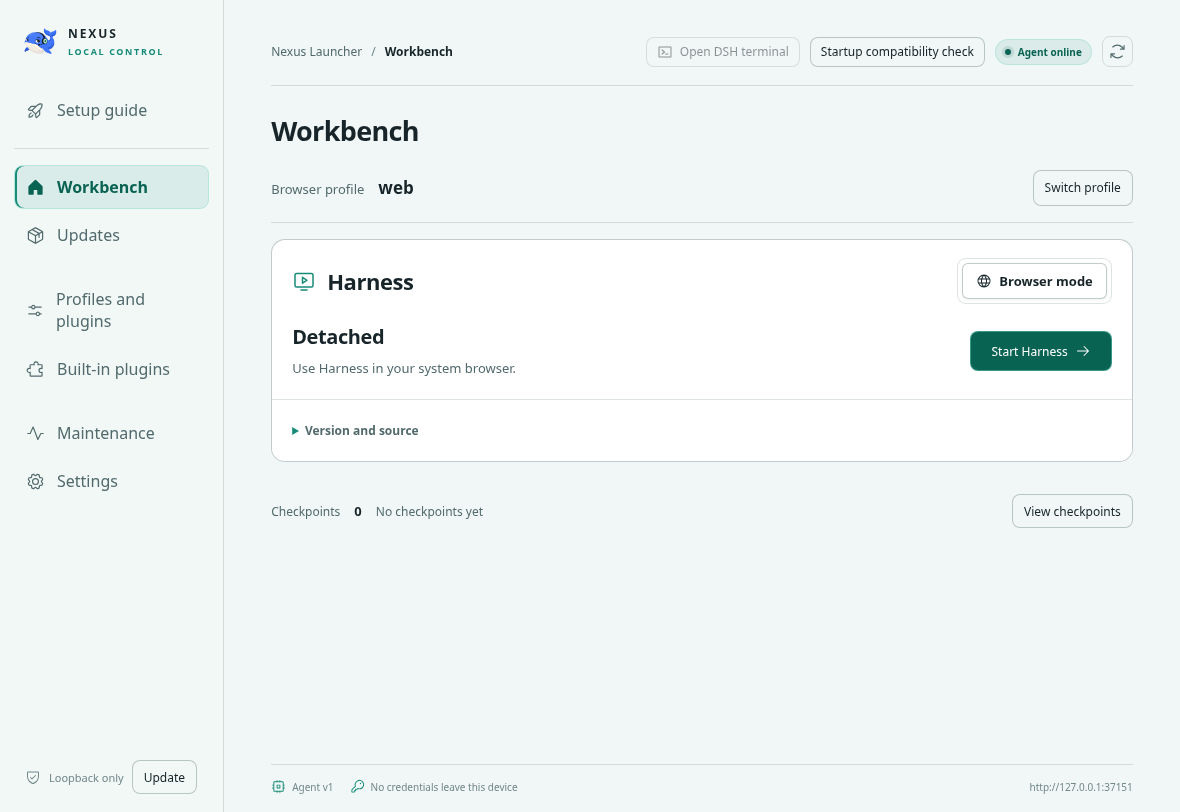
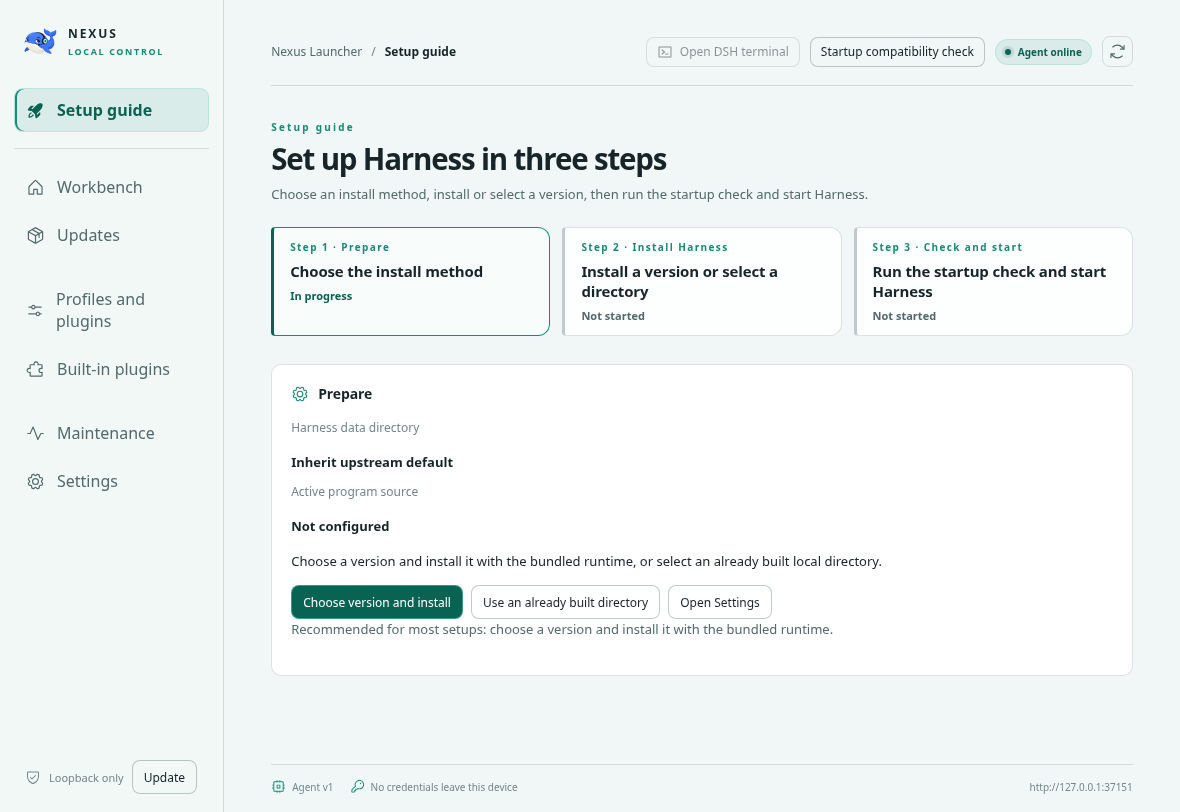
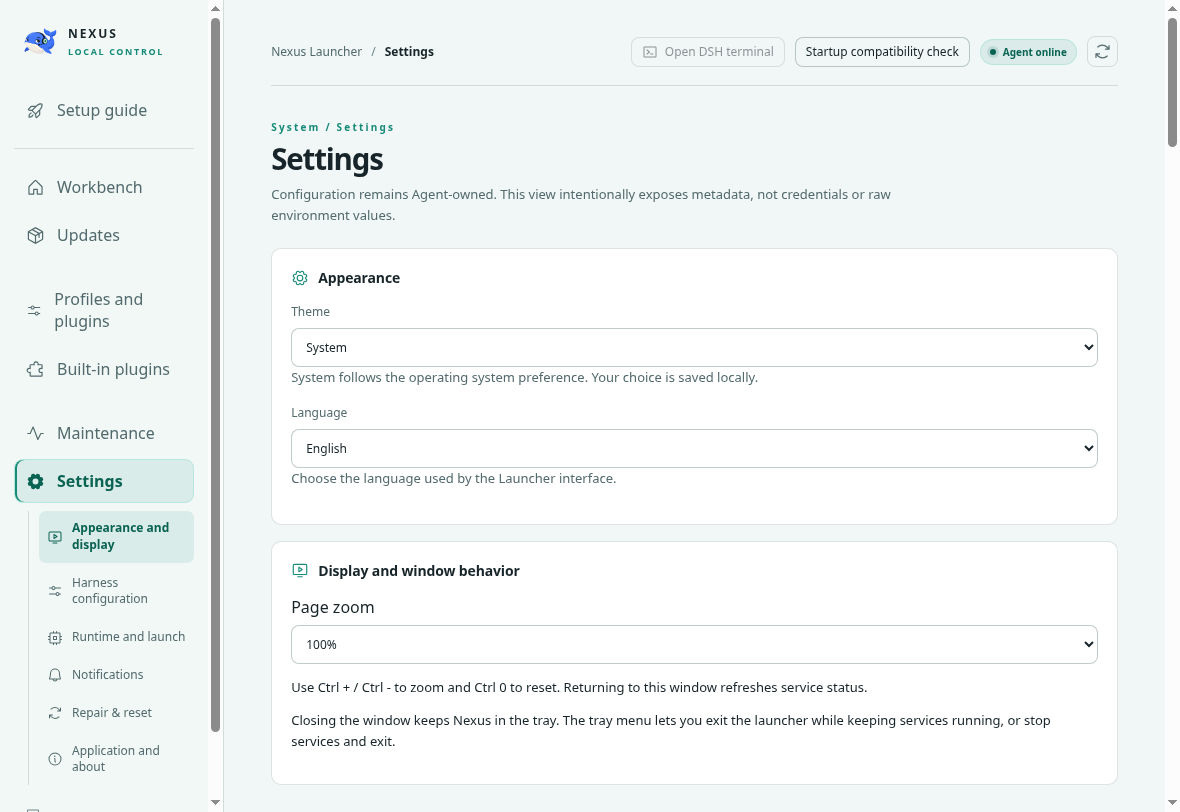
All screenshots show v1.0.5 on Debian 13 x86_64, running unchanged files extracted from the official DEB with isolated data: Agent online, no Harness installed or running. This was not a system installation. See capture details.
What you can do
Prepare versions before switching. Keep managed Harness versions side by side, switch explicitly after stopping Harness, or connect an existing prebuilt directory.
Choose Web or official Desktop. Open Web Harness in your browser, or use the upstream Desktop included in a compatible managed release. The workbench shows the active mode, profile, startup status, and controls.
Manage configuration and plugins. Select Web profiles, use the selected Harness version's official plugin manager where available, and inspect configuration without starting its plugins. Desktop uses its own desktop profile.
Recover with evidence. Inspect startup failures, preview local dependency repairs, edit damaged profiles with configuration recovery points, and collect diagnostics. Normal startup starts the actual instance; additional diagnosis is available when needed.
Move a prepared environment offline. Export the program, matching runtimes, and selected profiles/data, then import on the same OS and architecture. Choose exactly which contents to transfer.
Stay in control of local services. Use the workbench and tray to start, open, restart, or stop supported modes. Choose whether to keep Harness running when exiting Nexus. Chinese and English interfaces are included, with configurable task notifications.
Nexus manages the Harness lifecycle; Harness provides the AI agent, models, tools, and conversations. The Nexus background Agent is the local management service, separate from Harness's AI agent.
Download and install
The current release is v1.0.7. Choose the package matching your operating system and CPU architecture.
Web mode is available on all six targets. Desktop availability depends on the selected Harness release and its runtime resources; a Nexus package alone does not establish Desktop support.
Windows: install the EXE, or extract the complete ZIP before running Nexus Launcher.exe. Keep its resource files together. Portable means installation-free; user data is stored separately.
macOS: copy the complete application from the DMG or ZIP before opening it. v1.0.7 packages are ad-hoc signed and not notarized.
Linux: the full bundled runtime requires glibc 2.34 or newer, libcurl, zlib, and Electron's desktop libraries. DEB/RPM declare dependencies; AppImage users must check their system. A matching package format or a distribution name such as deepin, UOS, or Kylin does not guarantee compatibility with every version or desktop environment.
Release assets include build metadata and SHA-256 manifests. Windows and Linux packages are unsigned. See download verification and security; the manifest's Sigstore provenance is separate from operating-system code signing.
Start in three steps
Open Nexus. Confirm its local Agent is online, and follow any displayed startup guidance.
Choose Harness. Prepare a managed release and select it, import a complete offline package, or connect an external directory that is already built. Preparing a release does not automatically switch the active version.
Choose your mode and start. For Web, check the data directory and selected profile, resolve blocking checks, and start from Workbench. Open the browser once the client is ready. If official Desktop is available, select it and manage its configuration in its own window.
Versions, configuration, and the Agent
Updating Nexus and switching Harness are separate actions. Nexus does not automatically upgrade your Harness installation. v1.0.5 fixes a race in which background Desktop capability checks could restart an explicitly stopped Nexus Agent. v1.0.6 updates the first-install market pin to dshmarket 1.66.8; existing market installations are retained. v1.0.7 improves current-run startup diagnosis, bounded diagnostic exports and safe configuration recovery against Harness 0.2.1-alpha.1.
The bundled Desktop runtime lock remains Harness 0.1.6-alpha.2. Nexus also adapts to selected newer Harness interfaces, including 0.2 settings and Desktop preparation. Interface support does not establish compatibility with every plugin or session-data migration. Keep a pre-upgrade data backup; selecting an older version does not downgrade upstream data formats.
Explicit Node, pnpm, and Git paths take priority; otherwise Nexus uses bundled tools. Bundled Git includes SSH and Git LFS, and excludes GCM. Runtime and launch settings apply to subsequent starts, not processes already running.
Web uses the profile selected in Nexus; official Desktop uses profiles/desktop. Their plugin settings do not synchronize automatically. Stop the active mode before switching modes or versions, changing protected configuration, or transferring data. Closing a window can leave services running; use the explicit Stop or stop-all-services-and-exit action when needed.
The top of Settings; additional sections are available by scrolling.
Offline transfer and data safety
From a prepared environment, export a full offline package with Program and runtime and the profiles, installed plugins/dependencies, and data you need. Import it on the same OS and architecture. Inspect the package contents before selecting what to import; Harness remains stopped afterward. Configuration/data-only packages cannot supply a missing program or runtime.
Remote models, plugin downloads, and other network services still need connectivity unless those services run locally. An external source checkout must already be built; Nexus does not install its development toolchain for you.
Offline archives are not encrypted. Credentials and .env are optional sensitive contents; session history may also contain private information. Transfer only what you need, protect the archive, and import only from trusted sources. Project workspace files are not included in session-history transfer.
Nexus program files, Nexus management data, Harness data (DSH_HOME), and project workspaces are separate. Changing DSH_HOME does not move or delete the old directory. Configuration recovery points and snapshots cover their declared scope, not a complete backup of every project, session, and secret.
Compatibility and verification
Startup status distinguishes checking, ready, limited, failed, and unverified states. A running process or open window does not prove every model, tool, conversation, or third-party plugin works.
v1.0.7 release gates cover six-platform builds, resource verification, and installed-package startup on CI runners. CI success and checksum provenance do not establish production OS signing, every Linux distribution, or real-device upgrades.
macOS full in-browser Web sessions, real-session/full offline migration, every third-party plugin, physical-device upgrades, Gatekeeper first-open, production notarization, and crash recovery remain outside the accepted scope. Earlier v1.0.4 Mac subset checks are not v1.0.7 full migration acceptance. See the v1.0.7 release notes.
Harness and its plugins run with normal local-process capabilities. Nexus is not a sandbox for untrusted plugins.
Nexus is an independent project, not an official upstream Harness release. Nexus code is MIT licensed; third-party components retain their own licenses. See third-party notices.
Thanks to the LINUX DO community for its open and welcoming technical discussions.