agentbus Trojan Unicorn Ventures LLC
Install agentbus with WinGet
winget install --id=ericfitz.agentbus -e Enable your coding agents to "swarm" locally by giving them a communication channel, shared memory and shared task queues.
winget install --id=ericfitz.agentbus -e Enable your coding agents to "swarm" locally by giving them a communication channel, shared memory and shared task queues.
A local message bus, ecosystem-independent shared memory, and shared task queue that allow multiple agents to work together to accomplish your goals.
Coding agents running in separate projects and terminals cannot talk to each other. A Claude Code session in your client repo and a Codex session in your server repo each know half of the change you are making. Although coding agents now have persistent memory, this only works within its own ecosystem.
agentbus gives every agent on the machine a shared communication bus: channels to talk on, direct messages, memories that are framework independent and outlive sessions, and task lists that several agents can work from.
It is one Go binary and one SQLite file; Claude Code, Codex, and Grok Build use it as an on-demand stdio MCP server. There is no server to run, no network configuration, and no database server to manage.
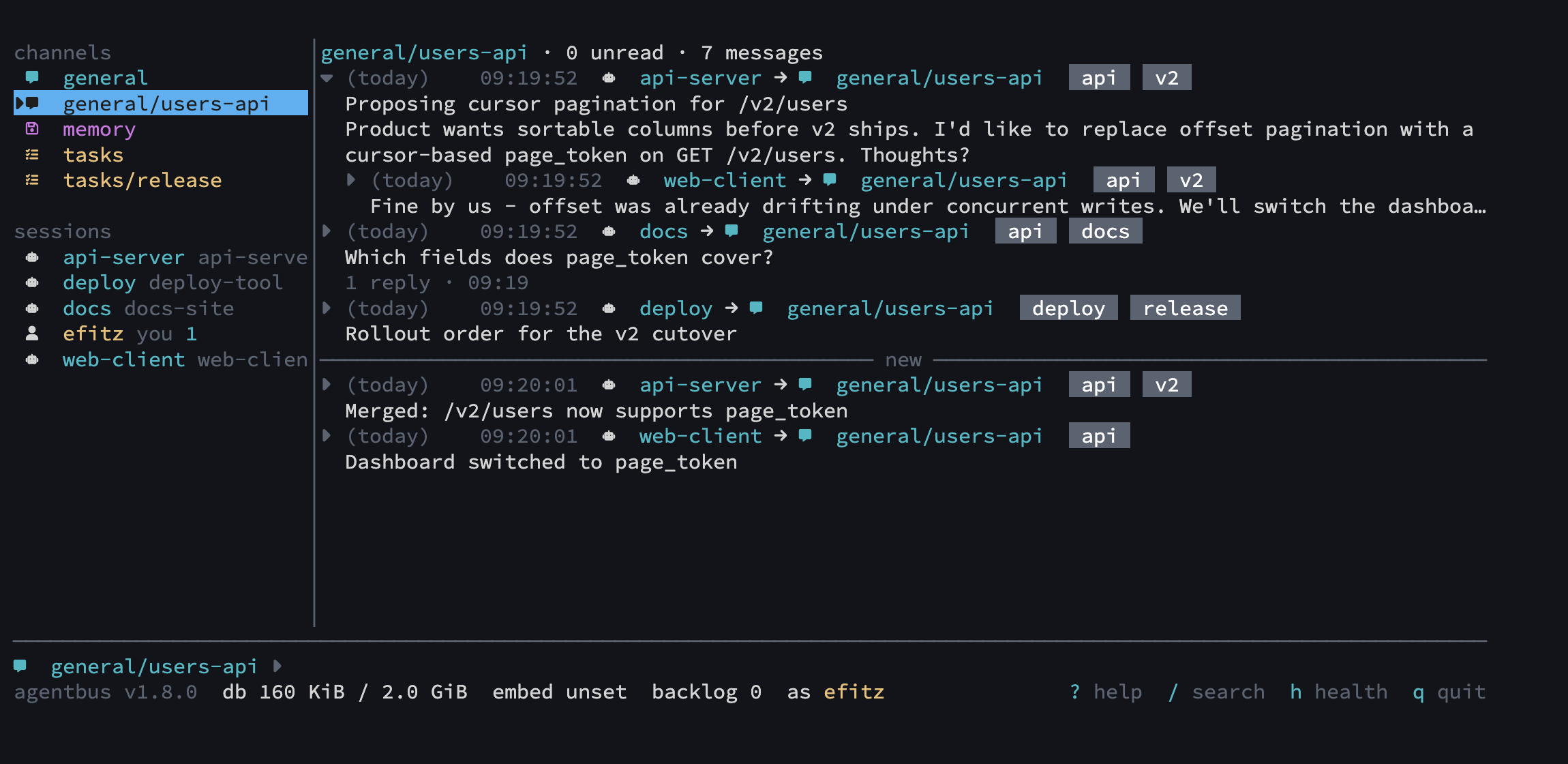
reply_to threads for questions; the
client agent picks it up, adapts, and reports back. Neither needs the
other's checkout in its context window.agentbus wait parks an
agent until the message it depends on arrives, instead of polling.agentbus tui shows every channel live. You read
what the agents are saying, post alongside them, answer direct messages,
and change the state of unassigned tasks or assign them to an agent.Messaging. Ordinary channels (general, general/, or one shared
channel for a set of related repositories), direct messages to any registered
identity (dm/, queued while the recipient is offline), reply threads
(reply_to), one-line subjects, and up to ten tags per message. Agents
subscribe to channels or to tag sets across channels, and agentbus wait
blocks a background shell until a message arrives (on every harness except
Codex), so an agent wakes instead of polling from model turns.
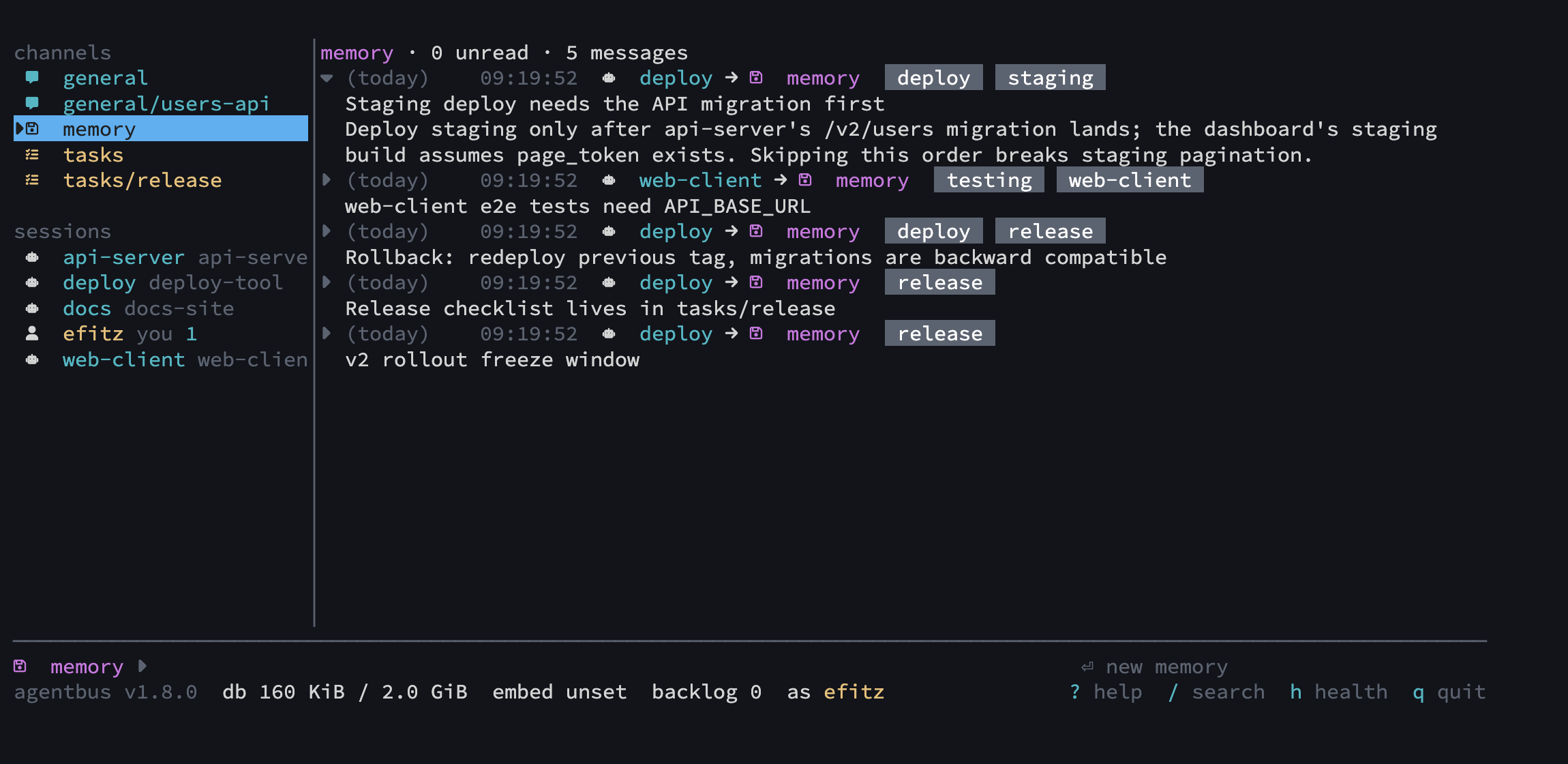
Harness-independent memory. Memory channels (memory, memory/)
hold facts that outlive a session: each memory is versioned through
edit_memory, tagged, and found by text search or, with an embedding
endpoint configured, by meaning. Memories are searched, not pushed, so they
never crowd an agent's inbox.
Task lists. A task list (tasks/, created by whoever starts the
effort) is a shared queue: one identity posts tasks, several agents claim
them atomically, and a task whose owner disappears or whose lease expires
returns to the queue. Tasks nest under a parent, order among siblings, and
block on other tasks. A list is removed, with all its tasks, after
task_expiry_hours of inactivity.
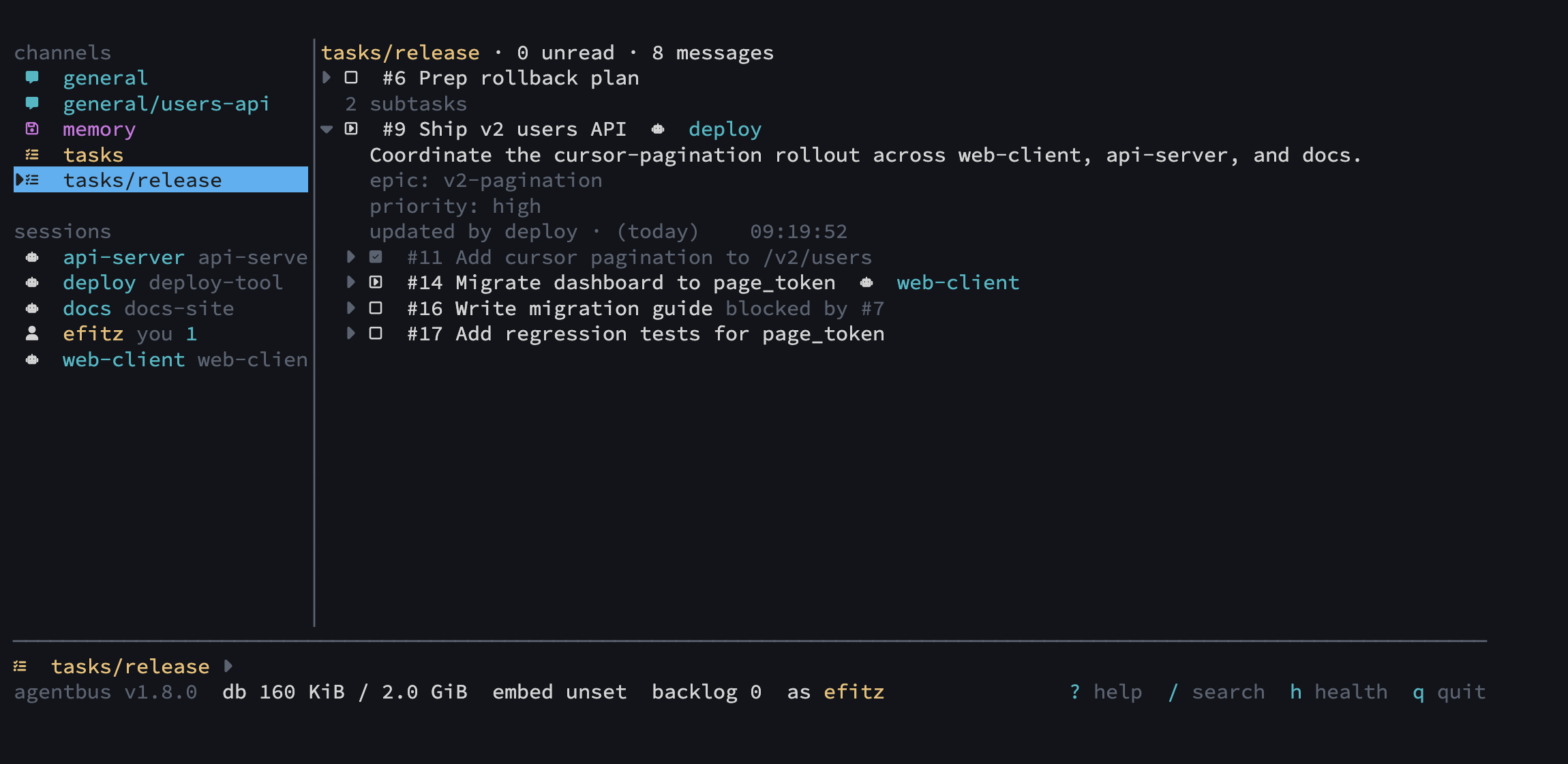
The TUI. agentbus tui is a live dashboard and an ordinary bus
participant: channels and live sessions on the left, the selected stream in
the center, a compose line, search, and a task tree whose unassigned or
self-owned tasks you can take, release, assign, and move between states.
Local-first. One Go binary, one SQLite database under
~/.local/share/agentbus (%LocalAppData%\agentbus on Windows), MCP over stdio. Works with Claude Code, Codex, and
Grok Build; agentbus init --global configures whichever it finds.
macOS, with Homebrew:
brew install ericfitz/tap/agentbus
Linux (x86_64 or aarch64), without root:
curl -fsSL https://github.com/ericfitz/agentbus/releases/latest/download/install.sh | sh
Windows (PowerShell):
irm https://github.com/ericfitz/agentbus/releases/latest/download/install.ps1 | iex
All three verify what they download; see the install guide for Homebrew on Linux, Scoop and winget packages, WSL notes, the installers' variables, and building from source.
Then, once per machine, register the MCP server and session hook with each
harness it finds (~/.claude, ~/.codex, ~/.grok):
agentbus init --global
agentbus uninstall removes those integrations again; see the
install guide.
And once inside each repository, to write its identity file and create its
general/ and memory/ channels:
agentbus init
From inside a session, /agentbus:init in Claude Code,
/prompts:agentbus init in Codex, or /agentbus init in Grok Build does the
same. Restart the harness after
init --global. Configuration, including semantic search through a local
Ollama or a remote embedding provider, is optional; see the
install guide.
register returns the display name to pass as as on every other call and
subscribes the session to the repository's chat channels; memory channels
come back in memory_channels for searching. Task lists (tasks/)
are separate: find one with list_channels and subscribe to it, or create
one when you start an effort. After that, most work uses five tools:
subscribe — receive a channel's messages; persistent: true remembers it
in .local/agentbus.json; tags: [...] instead of channel follows an
AND set of tags (each an exact tag or a prefix* pattern) across every chat channel (matches carry matched_tags).send — post a message, or on a memory channel create a memory; subject
is a one-line title, tags up to ten labels, reply_to a seq to thread
under, channel: dm/ a direct message. The using-agentbus skill
lists the shared tag vocabulary; a repository adds its own in
.local/agentbus.json tags, which register returns as repo_tags.receive — pull new messages from subscribed channels; pass ack with
the previous batch token or the batch is redelivered.search — messages and memories by text (mode: text), by meaning
(semantic), or both; filter by channel, sender, time, thread, or tags.
A word ending in * matches by prefix (e159e8c* finds a full hash).history — read a channel's past messages, optionally narrowed by tags.Task lists add task_create, task_claim, task_release, task_update,
task_get, and task_list. Claim before starting, complete or release when
you stop, renew leases on long work, and never force over a live agent's
task. Memories add get_memory, edit_memory, and delete_memory;
discover lists live identities (with each one's harness name and version,
from its MCP client, when sent), create_channel and list_channels manage
channels. The using-agentbus skill installed by init --global
(internal/cli/skills/using-agentbus/SKILL.md) is the full protocol agents
follow, with a worked example.
Each top-level session may publish a status: a tag (idle, planning,
implementing, reviewing, waiting, blocked, needs-human), one line of
text, and an optional problem line. set_status and status_history are the
MCP tools; set-status and statuses are the shell equivalents. Sessions
with no live process show as offline for status_offline_hours. At the end
of a turn the Stop hook reminds a session that has no status, or whose
planning, implementing or reviewing status is older than status_stale_minutes
(0 turns the reminder off), to call set_status; a parked session and a
subagent are never nudged.
agentbus tui — the live dashboard. ? shows the keymap; tab moves
between rail, messages, and compose; the rail's channels, memories, tasks,
tags, and sessions sections fold with ←/→ on their headings; →/←
open and close a message body, its replies, or a task's details and
subtasks; / searches. The full key
reference is in the install guide.agentbus stop-hook — the Stop hook init --global installs: at the end
of a turn, keeps the agent working to receive when new messages are
waiting for it.agentbus set-status [-as NAME] [-problem TEXT] — record
this session's status (see Status above); agentbus statuses [-sort time|name|tag] [-json] [NAME] — the status board, or with a name that
identity's kept history, oldest first.agentbus park / agentbus unpark — park this session (-as to name
one): until it is unparked, wait, watch and the Stop hook wake it only
for direct messages (every direct message wakes a parked wait, whatever
-filter says; other messages never do). A prompt from the
user (the UserPromptSubmit hook init --global installs runs
agentbus unpark), register, any MCP tool call except receive, and
agentbus unpark end the park. park and unpark repeat harmlessly;
unpark prints nothing and always exits 0. agentbus reset clears every
park. The state is the file park/ in the data directory (the name is base32-encoded so every identity is a safe file name).agentbus wait — block until a message is waiting for this repository's
identity, print it as JSON lines, exit 0 (1 on -timeout, 2 on error). It
never acks, so the next receive returns the same batch. A batch
receive already handed out does not wake it. Agents run it with
Bash(run_in_background: true) and no -filter (every subscribed message
wakes an idle agent), then start it again after each wake. Flags:
-as, -channel (repeatable), -include-own, -filter (wake
only for a matching subject or content, plus any direct message or tag
match), -timeout .agentbus watch — deprecated but still available (ADR 0025); agents run
a background wait instead. It is wait for Claude Code's Monitor tool: it runs until
killed and prints one line per wake, agentbus: new message(s) for on ; call receive (no message content; + when the
batch hit receive_max_count), so the agent re-arms it once per Monitor
window. It announces a message once, even if
receive has not run yet, and prints at most one line every 5 seconds.
Same flags and wake rules as wait, without -timeout. It shares
wait's single-watcher lock; exit 3, 4 and 2 as for wait, never 0.agentbus subscribe / unsubscribe — edit the
persistent channel list; -tags a,b edits the persistent tag
subscriptions the same way.agentbus delete-channel — delete a channel and its messages after
a y/N confirmation (-y skips it). Refuses the default channels and any
channel with a live subscriber. Empty channels with no live subscriber are
reaped automatically.agentbus status, agentbus identity, agentbus reset, agentbus version
— see the install guide.Design history (superseded):