a2acli ghchinoy
Use this command to install a2acli:
winget install --id=ghchinoy.a2acli -e A standalone A2A v1.0 compliant command-line client
winget install --id=ghchinoy.a2acli -e A standalone A2A v1.0 compliant command-line client


A standalone, A2A Specification v1.0 compliant command-line client for discovering, messaging, and managing agents. Built on the a2a-go SDK with an interactive streaming TUI and a scriptable JSON mode.
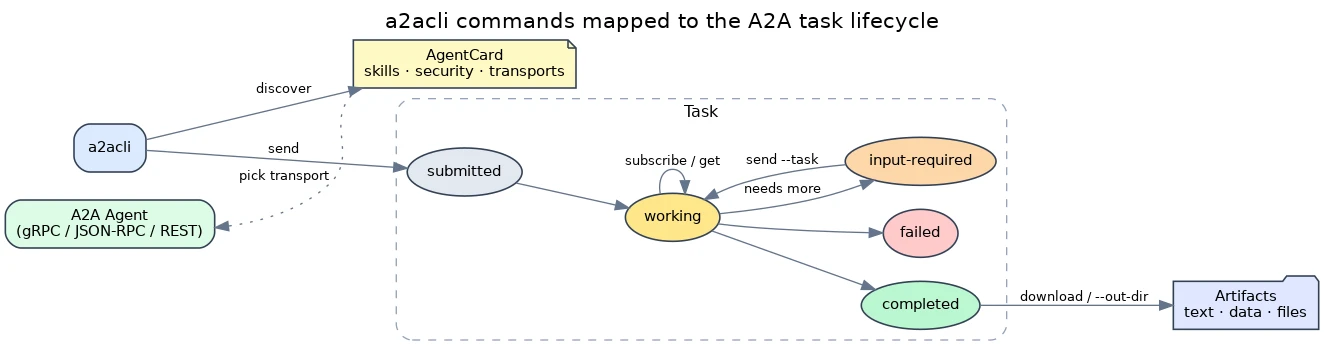
A2A (Agent-to-Agent) is an open protocol for talking to AI agents over a network — discover what an agent can do, send it a message, and stream back results and artifacts, regardless of how the agent is built. Every agent publishes an AgentCard (its skills, security requirements, and transports); you send a message that creates a task; the task moves through states (working → completed) and may produce artifacts (text, data, files).
a2acli is the command-line client for that protocol. To learn the protocol itself, see the canonical site: a2a-protocol.org.
brew tap ghchinoy/tap
brew trust ghchinoy/tap
brew install a2acli
curl -sL https://raw.githubusercontent.com/ghchinoy/a2acli/main/scripts/install.sh | bash
Download the .deb from the latest release:
sudo dpkg -i a2acli_*.deb
Download the .rpm from the latest release:
sudo rpm -i a2acli_*.rpm
winget install ghchinoy.a2acli
go install github.com/ghchinoy/a2acli/cmd/a2acli@latest
git clone https://github.com/ghchinoy/a2acli.git
cd a2acli
make build   # binary is written to bin/a2acli
a2acli version
You should see version, commit, and build-date information. If the command isn't
found, ensure your install location (e.g. $(go env GOPATH)/bin for go install,
or ./bin when building from source) is on your PATH.
You don't need a remote agent to get started — a2acli can run a local mock agent
for you. This golden path runs entirely on your machine, no auth required.
1. Start a local echo agent (in one terminal, or background it with &):
a2acli serve --echo --port 9001
2. Discover what it can do — fetch its AgentCard, skills, and security schemes:
a2acli discover --service-url http://localhost:9001
3. Send it a message and stream the response in real time:
a2acli send "Hello, agent!" --service-url http://localhost:9001
That's the full loop: serve → discover → send. The echo agent simply returns your message, which is exactly what you want when learning the mechanics.
4. Get a single JSON result instead of the interactive UI — this is the form scripts and AI agents use:
a2acli send "Hello, agent!" --service-url http://localhost:9001 --output json --wait
Once the loop makes sense, point the same commands at a real agent. If it's
protected by OAuth 2.1, log in once and every later command is authenticated
automatically — no --token needed:
a2acli auth login --service-url https://agent.example.com   # browser opens once
a2acli send "hello" --service-url https://agent.example.com --wait   # auto-authenticated
Tired of retyping URLs? Save a named environment and use --env:
a2acli config env add prod --service-url https://agent.example.com
a2acli send "hello" --env prod --wait
See the Reference Manual for full config details.
Commands are organized into four A2A-aligned groups. The table below is a map; the Reference Manual has the full flag lists, examples, and output schemas for each.
| Command | Group | What it does |
|---|---|---|
discover | Discovery | Fetch an agent's AgentCard, skills, and security schemes |
send | Messaging | Send a message to initiate or continue a task |
subscribe | Messaging | Subscribe to a running task's event stream |
get | Messaging | Retrieve state and artifacts of a task by ID |
list tasks | Messaging | List historical tasks (with --status/--context filters) |
cancel | Messaging | Cancel an active task |
push-config | Messaging | Manage push-notification callbacks for a task |
download | Messaging | Download artifacts from a completed task |
serve | Server | Run a local mock A2A agent for testing |
auth | Config | OAuth 2.1 login/status/token/logout |
conformance | Server | Run A2A conformance smoke checks against a live server |
Output modes are controlled by --output: tui (default interactive),
text (plain, for CI/pipes), and json (NDJSON for scripting). a2acli
auto-degrades from tui to text when output isn't a terminal. See
Output Modes.
For the complete grammar, every flag, global flags, shell completion, and automation guidance, see the Reference Manual.
a2acli is designed to be driven by AI coding agents (Claude Code, Cursor, GitHub
Copilot CLI) as well as shell scripts. Two rules make it deterministic in
non-interactive contexts:
--output json (or -n) to disable the TUI and emit parseable NDJSON.--wait with send to block until the task completes.This repository ships an agentskills.io compliant
skills/ directory that teaches agents these conventions automatically.
See Agent & Automation for details.
make build      # Compile to bin/a2acli
make run        # Build and run
make lint       # Run golangci-lint
make test-e2e   # Run end-to-end conformance tests
make diagrams   # Re-render docs/diagrams/*.dot to docs/img/*.webp
make clean      # Remove bin/
For release instructions see docs/RELEASING.md.
a2acli is tested against the official A2A Technology Compatibility Kit for both
v0.3.0 and v1.0.0. See the Conformance Report
for current status.
Running the tests requires the a2a-go SDK source locally, as the suite spins up the TCK SUT server dynamically:
# Default path: ../../github/a2a-go
make test-e2e

# Custom path
make test-e2e A2A_GO_SRC=/path/to/a2a-go
To run the SUT manually:
# In the a2a-go repository
cd e2e/tck
go run sut.go sut_agent_executor.go
Contributions are welcome. See CONTRIBUTING.md for guidelines and docs/CLI_DESIGN_BEST_PRACTICES.md for design conventions to follow before adding or modifying commands.
Apache 2.0. See LICENSE.
a2ui validate | Server | Validate A2UI v1.0 extension wire conformance |
config | Config | Manage named environments |