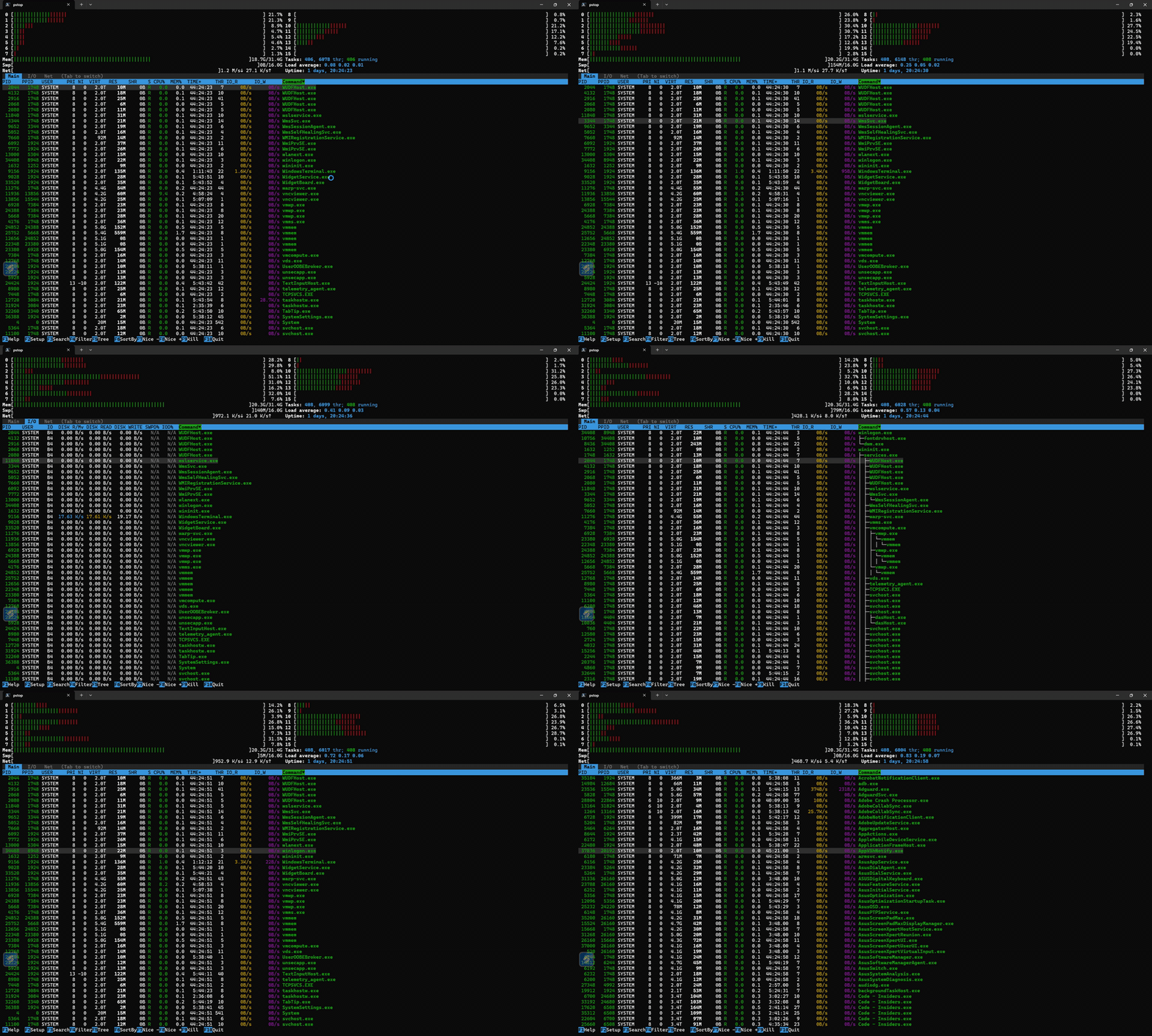
pstop is a full drop-in replacement for htop on Windows. Beautiful TUI system monitor
with per-core CPU bars, memory/swap/network monitoring, tree view, process management,
search/filter, 7 color schemes, and full mouse support. Installs both pstop and htop commands.
If you've ever missed htop on Windows, your search is over. pstop brings the full htop experience to Windows PowerShell. No WSL, no Cygwin, no compromises.
All methods install bothpstop and htop commands. Yes, you can just type htop on Windows.
Add htop Alias (Optional)
If you only installed pstop and want the htop alias in your PowerShell profile:
pstop --install-alias
This adds Set-Alias htop pstop to your $PROFILE automatically.
Features
🖥️ Per-Core CPU Monitoring
Real-time CPU usage bars for every logical core, color-coded by usage type (user / system / virtual), exactly like htop. CPU columns auto-adjust based on core count (2/4/8/16 columns) and terminal size — just like htop's calcColumnWidthCount.
📊 Memory, Swap, Network & GPU Bars
Mem bar: shows used (green), buffers (blue), cached (yellow)
Swap bar: swap usage with color threshold
Net bar: live RX/TX throughput in the header
GPU bar: overall GPU utilization percentage (shown on GPU tab)
VMem bar: dedicated video memory usage (shown on GPU tab)
🌳 Tree View
Press F5 or t to toggle process tree view — see parent-child relationships with ├─ / └─ tree connectors, collapsible nodes with +/-.
🔍 Search & Filter
F3 - Incremental search: jumps to matching process
F4 - Filter: hides all non-matching processes in real-time
📋 Four Tab Views
Main - Full process table (PID, USER, CPU%, MEM%, TIME+, Command...)
I/O - Disk read/write rates per process
Net - Per-process network bandwidth (live download/upload rates with auto-scaling B/s, KB/s, MB/s, GB/s) plus active connection counts. No admin required.
GPU - Per-process GPU engine utilization and dedicated/shared video memory usage via PDH performance counters
⚙️ F2 Setup Menu (Full htop Parity)
Press F2 to open the setup menu with 4 categories:
Display Options - 14 toggleable settings (tree view, highlight basename, shadow other users, show threads, detailed CPU time, and more)
Colors - Choose from 7 built-in color schemes with live preview
Columns - Add/remove/reorder visible columns
🎨 7 Color Schemes
Switch instantly in F2 > Colors:
Default - Classic htop green/cyan on black
Monochrome - Pure white on black
Black Night - Muted tones for dark terminals
Light Terminal - Optimized for light backgrounds
Midnight Commander - Blue background, MC-inspired
Black on White - Clean light theme
Dark Vivid - High-contrast neon colors
🖱️ Full Mouse Support
Click anywhere in the process table to select
Click column headers to sort
Click F-key bar buttons
Click tabs to switch views
Scroll wheel for navigation
⌨️ Keyboard Shortcuts
Familiar htop keybindings — zero learning curve if you know htop.
💾 Persistent Configuration
All settings auto-save to %APPDATA%/pstop/pstoprc and restore on next launch. Your color scheme, display options, column choices, sort preference... everything persists.
⚡ Performance
~1 MB single binary (release build with LTO + strip)
50ms event polling for instant keyboard response
Configurable refresh rate (200ms–10s)
Native Win32 API calls for I/O counters, process priority, CPU affinity
Zero runtime dependencies
Keybindings
Key
Action
F1 / ?
Help screen
F2
Setup menu (meters, display, colors, columns)
F3 / /
Search processes
F4 / \
Filter processes
F5 / t
Toggle tree view
F6 / >
Sort by column
F7 / F8
Decrease / Increase process priority (nice)
F9 / k
Kill process
F10 / q
Quit
Tab
Switch between Main / I/O / Net / GPU views
Space
Tag process
c
Tag process and children
U
Untag all
u
Filter by user
p
Toggle full command path / process name
H
Toggle show threads
K
Toggle hide kernel threads
+ / -
Expand / collapse tree node
e
Show process environment
l
List open handles (lsof equivalent)
a
Set CPU affinity
I
Invert sort order
Arrow keys
Navigate
PgUp / PgDn
Page through process list
Home / End
Jump to first / last process
Color Schemes
All 7 schemes affect every UI element — header bars, process table, footer, tabs, popups: