jsongrep is a command-line tool and Rust library for
fast querying
of JSON, YAML, TOML, JSONL, CBOR, and MessagePack documents using regular path expressions.
Try it in your browser · Install
Quick Links
Installation

via Homebrew:
brew install jsongrep
via Winget:
winget install jsongrep
via Scoop:
scoop install jsongrep
via cargo:
cargo install jsongrep
Quick Example
Extract all first names from the Nobel Prize API:
curl -s https://api.nobelprize.org/v1/prize.json | jg 'prizes[0].laureates[*].firstname'
prizes.[0].laureates.[0].firstname:
"Susumu"
prizes.[0].laureates.[1].firstname:
"Richard"
prizes.[0].laureates.[2].firstname:
"Omar M."
Works with inline JSON too:
echo '{"users": [{"name": "Alice"}, {"name": "Bob"}]}' | jg 'users.[*].name'
users.[0].name:
"Alice"
users.[1].name:
"Bob"
Why jsongrep?
JSON documents are trees: objects and arrays branch into nested values, with
edges labeled by field names or array indices. jsongrep lets you describe
sets of paths through this tree using regular expression operators - the
same way you'd match patterns in text.
**.name          # Kleene star: match "name" under nested objects
users[*].email   # Wildcard: all emails in the users array
(error|warn).*   # Disjunction: any field under "error" or "warn"
(* | [*])*.name  # Any depth: match "name" through both objects and arrays
This is different from tools like jq, which use a filter pipeline to transform
data. With jsongrep, you declare what paths to match rather than describing
how to transform. The query compiles to a
DFA that
processes the document efficiently.
See the blog post for the motivation
and design behind jsongrep.
jsongrep vs jq
jq is a powerful tool, but its filter syntax can be verbose for common
path-matching tasks. jsongrep is declarative: you describe the shape of the
paths you want, and the engine finds them.
Find a field at any depth:
jsongrep: -F treats the query as a literal field name at any depth:
curl -s https://api.nobelprize.org/v1/prize.json | jg -F firstname | head -6
prizes.[0].laureates.[0].firstname:
"Susumu"
prizes.[0].laureates.[1].firstname:
"Richard"
prizes.[0].laureates.[2].firstname:
"Omar M."
jq: requires a recursive descent operator and null suppression:
curl -s https://api.nobelprize.org/v1/prize.json | jq '.. | .firstname? // empty' | head -3
"Susumu"
"Richard"
"Omar M."
jsongrep also shows where each match was found (e.g.,
prizes.[0].laureates.[0].firstname:), which jq does not. (Examples below
show terminal output; when piped, path headers are hidden by default. See
--with-path / --no-path.)
Select multiple fields at once:
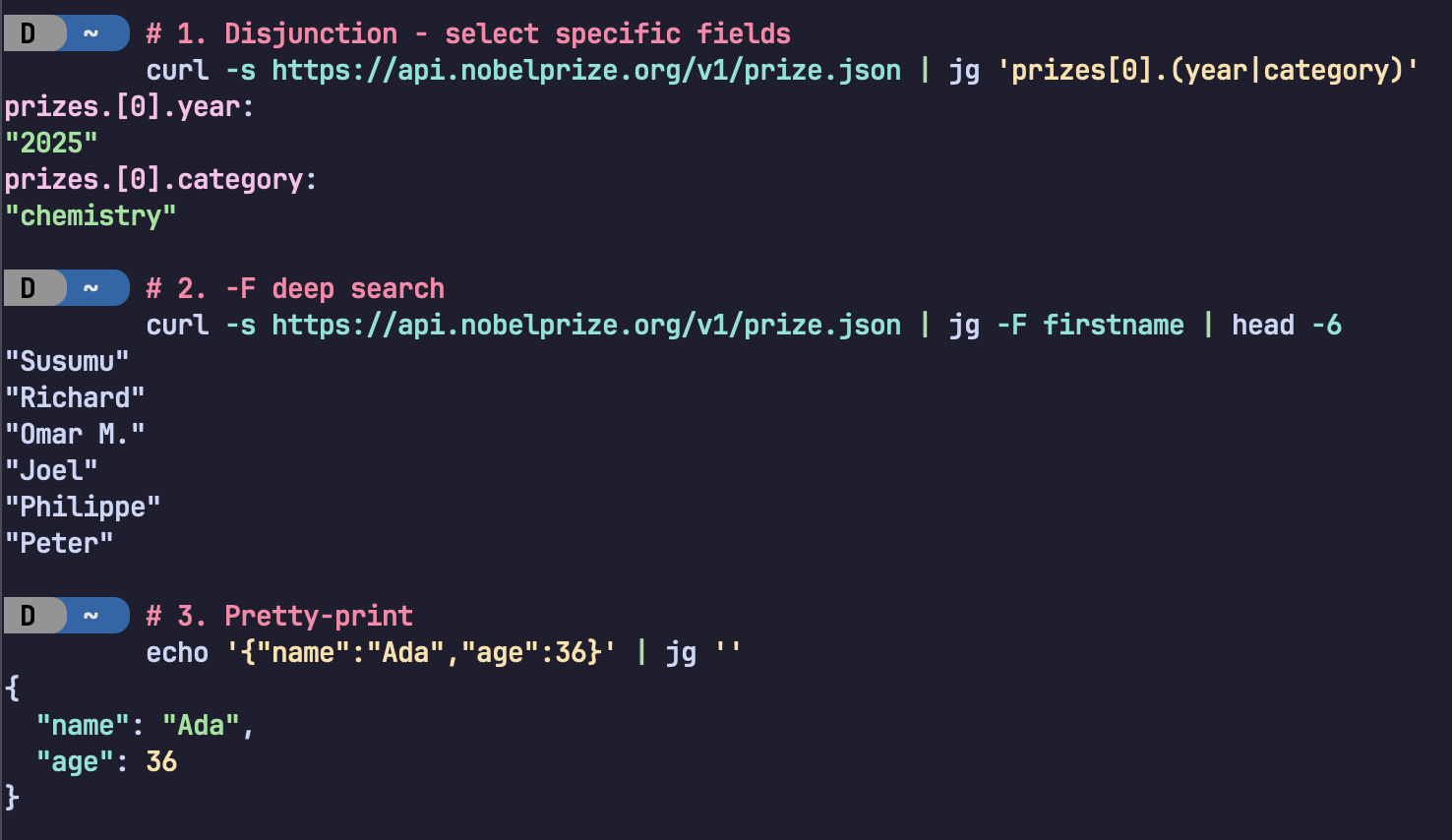
jsongrep: disjunction with (year|category):
curl -s https://api.nobelprize.org/v1/prize.json | jg 'prizes[0].(year|category)'
prizes.[0].year:
"2025"
prizes.[0].category:
"chemistry"
jq: requires listing each field separately:
curl -s https://api.nobelprize.org/v1/prize.json | jq '.prizes[0] | .year, .category'
"2025"
"chemistry"
Count matches:
jsongrep:
curl -s https://api.nobelprize.org/v1/prize.json | jg -F firstname --count
Found matches: 1026
jq:
curl -s https://api.nobelprize.org/v1/prize.json | jq '[.. | .firstname? // empty] | length'
1026
Pretty-print JSON (like jq '.'):
echo '{"name":"Ada","age":36}' | jg ''
{
  "name": "Ada",
  "age": 36
}
Benchmarks
jsongrep is benchmarked against
jsonpath-rust,
jmespath,
jaq, and
jql using
Criterion. Four benchmark groups isolate
different costs:
| Group | What's measured |
|---|
document_parse | JSON string → in-memory document |
query_compile | Query string → compiled query/DFA/filter |
query_search | Search only (pre-parsed doc + pre-compiled query) |
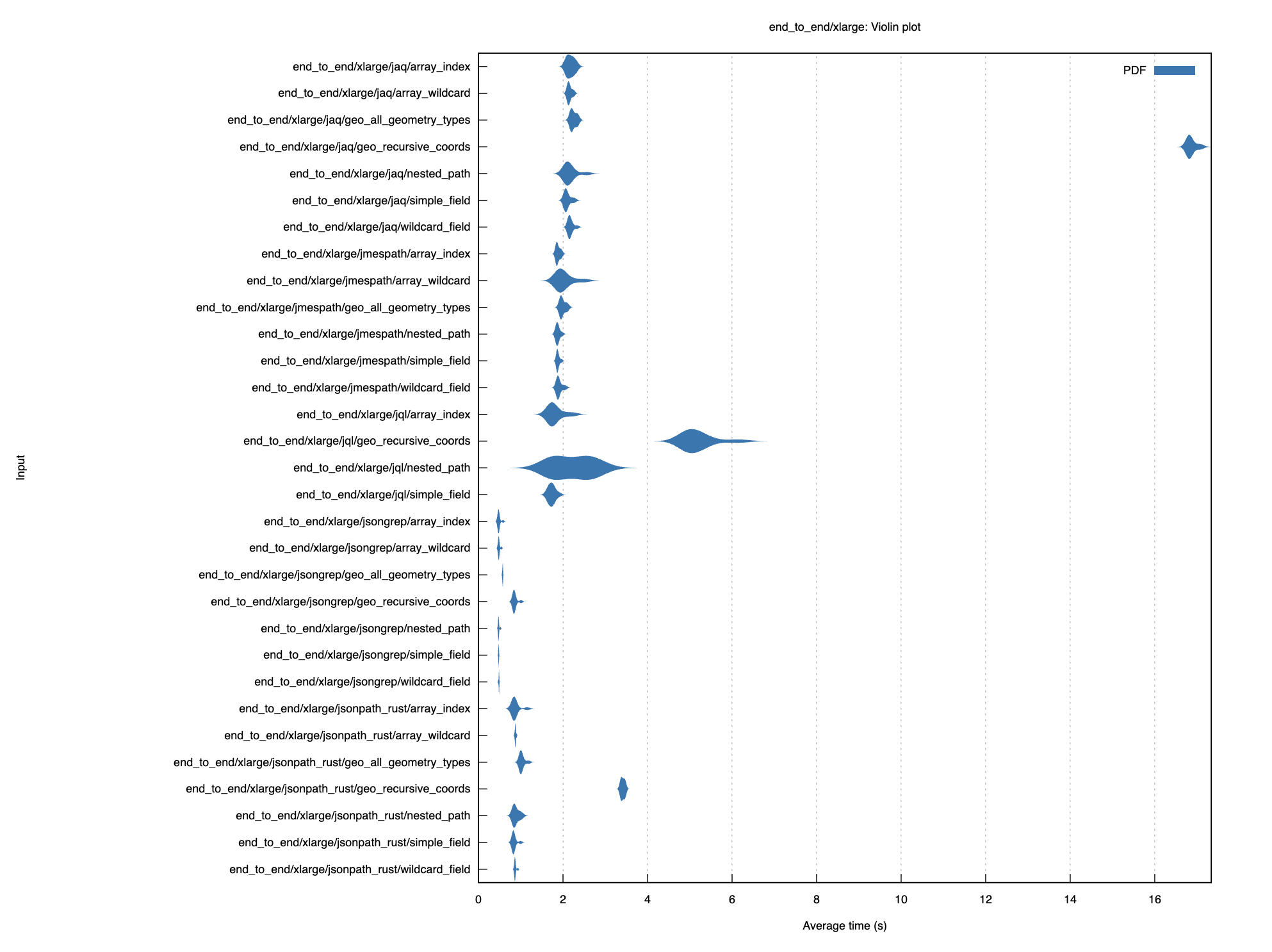
end_to_end | Full pipeline: parse + compile + search |
Test data ranges from a small sample JSON to a 190 MB GeoJSON file
(citylots.json), with queries
chosen to exercise equivalent functionality across tools (recursive descent,
wildcards, nested paths). Where a tool lacks a feature, the benchmark is
skipped rather than faked.
End-to-end on 190 MB GeoJSON (xlarge):
Interactive Criterion reports
| Benchmark source and methodology
jg natively supports multiple serialization formats. Non-JSON formats are
converted to JSON at the boundary, then queried with the same engine, so your
queries work identically regardless of input format.
Query your Cargo.toml:
jg 'dependencies.*.version' Cargo.toml
dependencies.clap.version:
"4.5.43"
dependencies.serde.version:
"1.0.219"
...
Query a docker-compose.yml:
jg 'services.*.image' docker-compose.yml
services.web.image:
"nginx:latest"
services.db.image:
"postgres:16"
JSONL/NDJSON: each line becomes an array element:
jg '[*].email' users.jsonl
[0].email:
"alice@example.com"
[1].email:
"bob@example.com"
Explicit format flag (useful for stdin or non-standard extensions):
cat config.yaml | jg -f yaml 'database.host'
database.host:
"localhost"
Binary formats (CBOR, MessagePack):
jg 'name' data.cbor
jg -f msgpack 'name' data.bin
| Format | Extensions | Feature flag | Notes |
|---|
| JSON | .json (default) | — | Always available |
| JSONL/NDJSON | .jsonl, .ndjson | — | Wrapped into JSON array |
| YAML | .yaml, .yml | yaml | Included by default |
| TOML | .toml | toml | Included by default |
| CBOR | .cbor | cbor | Included by default |
| MessagePack | .msgpack, .mp | msgpack | Included by default |
All format dependencies are included by default. To build without them:
cargo install jsongrep --no-default-features
CLI Usage
JSONPath-inspired query language for JSON, YAML, TOML, and other serialization formats

Usage: jg [OPTIONS] [QUERY] [FILE]... [COMMAND]

Commands:
  generate  Generate additional documentation and/or completions

Arguments:
  [QUERY]    Query string (e.g., "**.name")
  [FILE]...  Optional path(s) to file(s). If omitted, reads from STDIN. With multiple files, the query is compiled once and run against each file, with a file heading before each file's matches

Options:
  -g, --glob          Include or exclude files and directories for searching that match the given glob
      --files               Prints the files that will be searched
  -l, --files-with-matches  Print only the names of files containing at least one match (like `grep -l`)
  -i, --ignore-case         Case insensitive search
      --compact             Do not pretty-print JSON output (ignored for non-JSON output formats)
  -r, --raw-output          Print matched strings without JSON quotes or escaping (like `jq -r`)
      --count               Display count of number of matches
      --depth               Display depth of the input document
      --porcelain           Machine-readable output: strip labels and colors, print one JSON value per line (implies --compact)
  -n, --no-display          Do not display matched JSON values
  -F, --fixed-string        Treat the query as a literal field name and search at any depth
  -m, --max-count      Stop searching after NUM matches per input file
      --with-path           Always print the path header, even when output is piped
      --no-path             Never print the path header, even in a terminal
  -q, --quiet               Quiet: write nothing to stdout; communicate via the exit status only (errors still print to stderr)
  -f, --format      Input format (auto-detects from file extension if omitted) [default: auto] [possible values: auto, json, jsonl, yaml, toml, cbor, msgpack]
  -o, --output      Output format (auto-detects from file extension if omitted) [default: auto] [possible values: auto, json, jsonl, yaml, toml, cbor, msgpack]
  -h, --help                Print help (see more with '--help')
  -V, --version             Print version
More CLI Examples
Search for a literal field name at any depth:
curl -s https://api.nobelprize.org/v1/prize.json | jg -F motivation | head -4
Count matches:
curl -s https://api.nobelprize.org/v1/prize.json | jg -F firstname --count
Found matches: 1026
Machine-readable count (pipe-friendly):
curl -s https://api.nobelprize.org/v1/prize.json | jg -F firstname --count --porcelain
1026
Raw string output (like jq -r) for shell pipelines:
TOKEN=$(echo '{"auth": {"token": "abc123"}}' | jg -r 'auth.token')
echo "$TOKEN"
abc123
Search several files at once (the query compiles once and runs per
file, with per-file format autodetection and ripgrep-style headings):
jg 'services.*.image' staging/docker-compose.yml prod/docker-compose.yml
staging/docker-compose.yml
services.web.image:
"nginx:1.27"

prod/docker-compose.yml
services.web.image:
"nginx:1.26"
jg -l 'services.db' */docker-compose.yml # which files define a db service?
Piping to other tools:
By default, path headers display in terminals and hide when output is piped
(like ripgrep's --heading). This makes piping to sort, uniq, etc., work
cleanly:
curl -s https://api.nobelprize.org/v1/prize.json | jg -F firstname | sort | head -3
"A. Michael"
"Aage N."
"Aaron"
Force path headers when piped:
curl -s https://api.nobelprize.org/v1/prize.json | jg -F firstname --with-path | head -4
prizes.[0].laureates.[0].firstname:
"Susumu"
prizes.[0].laureates.[1].firstname:
"Richard"
Query Syntax
Queries are regular expressions over paths. If you know regex, this will
feel familiar:
| Operator | Example | Description |
|---|
| Sequence | foo.bar.baz | Concatenation: match path foo → bar → baz |
| Disjunction | foo | bar | Union: match either foo or bar |
| Kleene star | ** | Match zero or more field accesses |
| Repetition | foo* | Repeat the preceding step zero or more times |
| Wildcards | * or [*] | Match any single field or array index |
| Optional | foo?.bar | Optional foo field access |
| Field access | foo or "foo bar" | Match a specific field (quote if spaces) |
| Array index | [0] or [1:3] | Match specific index or slice (exclusive end) |
These queries can be arbitrarily nested with parentheses. For example,
foo.(bar|baz).qux matches foo.bar.qux or foo.baz.qux.
This also means that you can recursively descend any path with (* | [*])*,
e.g., (* | [*])*.foo to find all paths matching foo field at any
depth.
The query engine compiles expressions to an
NFA, then
determinizes to a
DFA for
execution. See the grammar directory and the
query module for implementation details.
> Not yet implemented: The grammar reserves /regex/ syntax for matching
> field names by pattern, but the engine cannot execute it yet, so such
> queries are rejected with an "Unsupported feature" error. Determinizing
> overlapping regexes (e.g., /a/ vs /aab/) requires subset construction
> across multiple patterns - planned but not complete.
Library Usage
Add to your Cargo.toml:
[dependencies]
jsongrep = "0.10.0"
Query with a one-liner:
let json: jsongrep::Value = serde_json::from_str(r#"{"users": [{"name": "Alice"}]}"#)?;
let results = jsongrep::grep(&json, "users[*].name")?;

for result in &results {
    println!("{:?}: {}", result.path, result.value);
}
For repeated queries, compile the DFA once and reuse it:
use jsongrep::query::QueryDFA;

let dfa = QueryDFA::from_query_str("users[*].name")?;
let results = dfa.find(&json);
Build queries programmatically with QueryBuilder:
use jsongrep::query::{QueryBuilder, QueryDFA};

let query = QueryBuilder::new()
    .field("users")
    .array_wildcard()
    .field("name")
    .build();

let dfa = QueryDFA::from_query(&query);
let results = dfa.find(&json);
More examples in the examples directory.
Shell Completions
> [!NOTE]
> Installed automatically with most package managers.
Generate completions with jg generate shell :
# Bash
jg generate shell bash > /etc/bash_completion.d/jg.bash

# Zsh
jg generate shell zsh > ~/.zsh/completions/_jg

# Fish
jg generate shell fish > ~/.config/fish/completions/jg.fish
Man Pages
> [!NOTE]
> Installed automatically with most package managers.
jg generate man -o ~/.local/share/man/man1/
man jg
Contributing
See CONTRIBUTING.md.
License
MIT - see LICENSE.md.