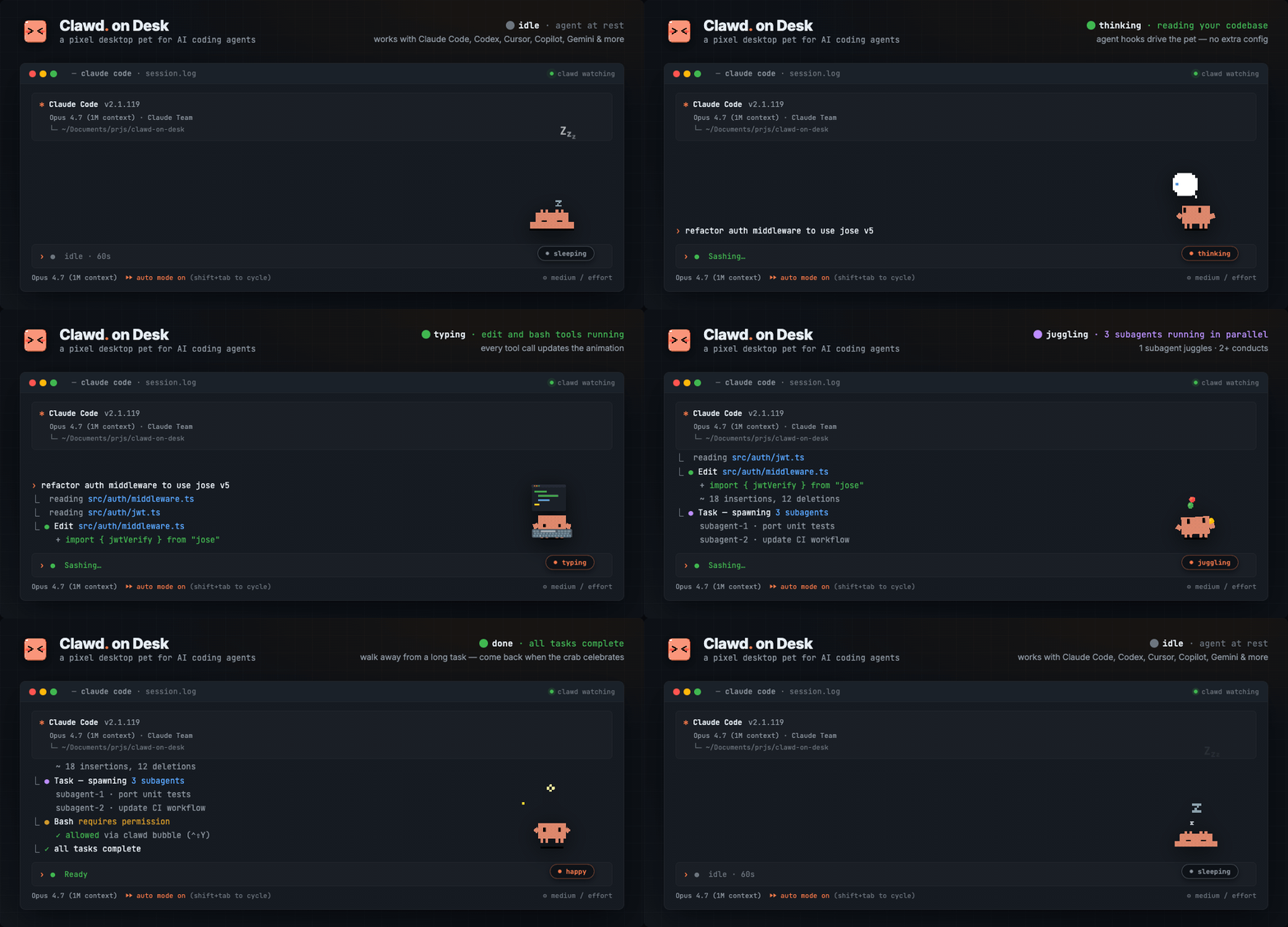
Clawd lives on your desktop and reacts to what your AI coding agent is doing — in real time. Start a long task, walk away, come back when the crab tells you it's done.
Thinking when you prompt, typing when tools run, juggling subagents, reviewing permissions, celebrating when tasks complete, sleeping when you step away. Ships with two built-in themes: Clawd (pixel crab) and Calico (三花猫), with full support for custom themes.
Supports Windows 11, macOS, and Ubuntu/Linux. Requires Node.js. Works with Claude Code, Codex CLI, Copilot CLI, Gemini CLI, Cursor Agent, CodeBuddy, Kiro CLI, and opencode.
Features
Multi-Agent Support
- Claude Code — full integration via command hooks + HTTP permission hooks
- Codex CLI — automatic JSONL log polling (~/.codex/sessions/), no configuration needed
- Copilot CLI — command hooks via ~/.copilot/hooks/hooks.json
- Gemini CLI — command hooks via ~/.gemini/settings.json (registered automatically when Clawd starts, or run npm run install:gemini-hooks)
- Cursor Agent — Cursor IDE hooks in ~/.cursor/hooks.json (registered automatically when Clawd starts, or run npm run install:cursor-hooks)
- CodeBuddy — Claude Code-compatible command hooks + HTTP permission hooks via ~/.codebuddy/settings.json (registered automatically when Clawd starts, or run node hooks/codebuddy-install.js)
- Kiro CLI — command hooks injected into custom agent configs under ~/.kiro/agents/, plus an auto-created clawd agent that is re-synced from Kiro's built-in kiro_default whenever Clawd starts, so you can opt into hooks with minimal behavior drift via kiro-cli --agent clawd or /agent swap clawd (registered automatically when Clawd starts, or run npm run install:kiro-hooks). State hooks have been verified on macOS.
- opencode — plugin integration via ~/.config/opencode/opencode.json (registered automatically when Clawd starts); zero-latency event streaming, permission bubbles with Allow/Always/Deny, and building animations when parallel subagents are spawned via the task tool
- Multi-agent coexistence — run all agents simultaneously; Clawd tracks each session independently
Animations & Interaction
- Real-time state awareness — agent hooks and log polling drive Clawd's animations automatically
- 12 animated states — idle, thinking, typing, building, juggling, conducting, error, happy, notification, sweeping, carrying, sleeping
- Eye tracking — Clawd follows your cursor in idle state, with body lean and shadow stretch
- Sleep sequence — yawning, dozing, collapsing, sleeping after 60s idle; mouse movement triggers a startled wake-up animation
- Click reactions — double-click for a poke, 4 clicks for a flail
- Drag from any state — grab Clawd anytime (Pointer Capture prevents fast-flick drops), release to resume
- Mini mode — drag to right edge or right-click "Mini Mode"; Clawd hides at screen edge with peek-on-hover, mini alerts/celebrations, and parabolic jump transitions
Permission Bubble
- In-app permission review — when Claude Code, CodeBuddy, or opencode request tool permissions, Clawd pops a floating bubble card instead of waiting in the terminal
- Allow / deny / agent-native extras — one-click approve or reject, plus permission rules / Always actions when the source agent supports them
- Global hotkeys — Ctrl+Shift+Y to Allow, Ctrl+Shift+N to Deny the latest permission bubble (only registered while bubbles are visible)
- Stacking layout — multiple permission requests stack upward from the bottom-right corner
- Auto-dismiss — if you answer in the terminal first, the bubble disappears automatically
- Per-agent toggle — open Settings… → Agents, pick an agent, and turn off Show pop-up bubbles to keep prompts in that agent's own terminal/TUI
Session Intelligence
- Multi-session tracking — sessions across all agents resolve to the highest-priority state
- Subagent awareness — juggling for 1 subagent, conducting for 2+
- Terminal focus — right-click Clawd → Sessions menu to jump to a specific session's terminal window; notification/attention states auto-focus the relevant terminal
- Process liveness detection — detects crashed/exited supported agent processes and cleans up orphan sessions
- Startup recovery — if Clawd restarts while any supported agent is still running, it stays awake instead of falling asleep
System
- Click-through — transparent areas pass clicks to windows below; only Clawd's body is interactive
- Position memory — Clawd remembers where you left it across restarts (including mini mode)
- Single instance lock — prevents duplicate Clawd windows
- Auto-start — Claude Code's SessionStart hook can launch Clawd automatically if it's not running
- Do Not Disturb — right-click or tray menu to enter sleep mode; all hook events are silenced until you wake Clawd. Permission bubbles are suppressed during DND — opencode falls back to its built-in TUI prompt, while Claude Code and CodeBuddy fall back to their built-in permission flow
- Sound effects — short audio cues on task completion and permission requests (toggle via right-click menu; 10s cooldown, auto-muted during DND)
- System tray — resize (S/M/L), DND mode, language switch, auto-start, check for updates
- i18n — English, Chinese, and Korean UI; switch via right-click menu or tray
- Auto-update — checks GitHub releases; Windows installs NSIS updates on quit, macOS/Linux git pull + restart when running from a cloned repo
🌏 Don't see your language? Open a PR to add one — Español, Français, Deutsch, etc. all welcome.
Clawd lives on your desktop and reacts to what your AI coding agent is doing — in real time. Start a long task, walk away, come back when the crab tells you it's done.
Thinking when you prompt, typing when tools run, grooving or juggling for subagents, reviewing permissions, celebrating when tasks complete, sleeping when you step away. Ships with three built-in themes: Clawd (pixel crab), Calico (三花猫), and Cloudling (云宝), with full support for custom themes and imported Codex Pet animation packs.
> Supports Windows 11, macOS, and Ubuntu/Linux. Windows releases provide separate x64 and ARM64 installers. Source builds require Node.js. Works with Claude Code, Codex CLI, Copilot CLI, Gemini CLI, Cursor Agent, CodeBuddy, Kiro CLI, Kimi Code CLI (Kimi-CLI), opencode, Pi, OpenClaw, and Hermes Agent.
Features
Multi-Agent Support
— full integration via command hooks + HTTP permission hooks
Codex CLI — official hooks with JSONL fallback (~/.codex/sessions/), registered automatically with real permission bubbles
Copilot CLI — command hooks via ~/.copilot/hooks/hooks.json
Gemini CLI — command hooks via ~/.gemini/settings.json (registered automatically when Clawd starts, or run npm run install:gemini-hooks)
Cursor Agent — Cursor IDE hooks in ~/.cursor/hooks.json (registered automatically when Clawd starts, or run npm run install:cursor-hooks)
CodeBuddy — Claude Code-compatible command hooks + HTTP permission hooks via ~/.codebuddy/settings.json (registered automatically when Clawd starts, or run node hooks/codebuddy-install.js)
Kiro CLI — command hooks injected into custom agent configs under ~/.kiro/agents/, plus an auto-created clawd agent that is re-synced from Kiro's built-in kiro_default whenever Clawd starts, so you can opt into hooks with minimal behavior drift via kiro-cli --agent clawd or /agent swap clawd (registered automatically when Clawd starts, or run npm run install:kiro-hooks). State hooks are verified on macOS and Windows.
Kimi Code CLI (Kimi-CLI) — command hooks via ~/.kimi/config.toml ([[hooks]] entries) (registered automatically when Clawd starts, or run npm run install:kimi-hooks)
opencode — plugin integration via ~/.config/opencode/opencode.json (registered automatically when Clawd starts); zero-latency event streaming, permission bubbles with Allow/Always/Deny, and building animations when parallel subagents are spawned via the task tool
Pi — global extension via ~/.pi/agent/extensions/clawd-on-desk (registered automatically when Clawd starts, or run npm run install:pi-extension); interactive lifecycle updates plus permission bubbles for bash / write / edit tool calls, with Pi terminal confirmation fallback
OpenClaw — state-only plugin integration via ~/.openclaw/openclaw.json (registered automatically when an OpenClaw config already exists, or run npm run install:openclaw-plugin); local openclaw tui --local sessions drive Clawd animations, without permission bubbles or terminal focus in Phase 1
Hermes Agent — plugin integration via Hermes' managed plugin directory (registered automatically when Hermes is installed, or run npm run install:hermes-plugin); state, sessions, SessionEnd, and terminal focus are supported
Multi-agent coexistence — run all agents simultaneously; Clawd tracks each session independently
Animations & Interaction
Real-time state awareness — agent hooks and log polling drive Clawd's animations automatically
Codex Pet imports — import Codex Pet zip packages from Settings… → Theme; Clawd adapts their atlas animations into managed themes
Eye tracking — Clawd follows your cursor in idle state, with body lean and shadow stretch
Sleep sequence — yawning, dozing, collapsing, sleeping after 60s idle; mouse movement triggers a startled wake-up animation
Click reactions — double-click for a poke, 4 clicks for a flail
Drag from any state — grab Clawd anytime (Pointer Capture prevents fast-flick drops), release to resume
Mini mode — drag to right edge or right-click "Mini Mode"; Clawd hides at screen edge with peek-on-hover, mini alerts/celebrations, and parabolic jump transitions
Permission Bubble
In-app permission review — when Claude Code, Codex CLI, CodeBuddy, opencode, or Pi request tool permissions, Clawd pops a floating bubble card instead of waiting in the terminal
Allow / deny / agent-native extras — one-click approve or reject, plus permission rules / Always actions when the source agent supports them
Global hotkeys — Ctrl+Shift+Y to Allow, Ctrl+Shift+N to Deny the latest permission bubble (only registered while bubbles are visible)
Stacking layout — multiple permission requests stack upward from the bottom-right corner
Auto-dismiss — if you answer in the terminal first, the bubble disappears automatically
Per-agent toggle — open Settings… → Agents, pick an agent, and turn off Show pop-up bubbles to keep prompts in that agent's own terminal/TUI
Session Intelligence
Multi-session tracking — sessions across all agents resolve to the highest-priority state
Subagent awareness — headphones groove for 1 subagent, three-ball juggling for 2+
Sessions dashboard + HUD — right-click or tray → Open Dashboard to inspect live sessions, recent events, aliases, and jump to a terminal; a compact HUD near Clawd keeps current live sessions visible
Terminal focus — Dashboard/HUD actions jump to a specific session's terminal window; notification/attention states auto-focus the relevant terminal
Process liveness detection — detects crashed/exited supported agent processes and cleans up orphan sessions
Startup recovery — if Clawd restarts while any supported agent is still running, it stays awake instead of falling asleep
System
Click-through — transparent areas pass clicks to windows below; only Clawd's body is interactive
Position memory — Clawd remembers where you left it across restarts (including mini mode)
Single instance lock — prevents duplicate Clawd windows
Auto-start — Claude Code's SessionStart hook can launch Clawd automatically if it's not running
Do Not Disturb — right-click or tray menu to enter sleep mode; all hook events are silenced until you wake Clawd. Permission bubbles are suppressed during DND — Codex and opencode fall back to their native prompts, Pi falls back to terminal confirmation, while Claude Code and CodeBuddy fall back to their built-in permission flow
Sound effects — short audio cues on task completion and permission requests (toggle via right-click menu; 10s cooldown, auto-muted during DND)
System tray — resize (S/M/L), DND mode, language switch, auto-start, check for updates
i18n — English, Simplified Chinese, Traditional Chinese, Korean, and Japanese UI; switch via right-click menu or tray
Auto-update — checks GitHub releases; Windows installs NSIS updates on quit, macOS/Linux git pull + restart when running from a cloned repo
Clawd adapts to multi-monitor setups: proportional sizing uses the display Clawd launches on, portrait monitors get a bounded boost so the pet stays readable on tall narrow screens, and you can drag Clawd across displays.
For normal use, download the latest prebuilt installer from GitHub Releases:
Windows: Clawd-on-Desk-Setup--x64.exe or Clawd-on-Desk-Setup--arm64.exe
macOS: .dmg
Linux: .AppImage or .deb
Launch Clawd after installing it; supported agent hooks/plugins are synced automatically on startup.
Run from source only if you're contributing, testing unreleased code, or debugging integrations. Source installs download Electron/build tooling and can create a large node_modules tree.
# Clone the repo
git clone https://github.com/rullerzhou-afk/clawd-on-desk.git
cd clawd-on-desk
# Install dependencies
npm install
# Start Clawd (auto-registers Claude Code hooks on launch)
npm start
Claude Code and Codex CLI work out of the box with auto-registered hooks. Gemini CLI, Cursor Agent, CodeBuddy, Kiro CLI, Kimi Code CLI (Kimi-CLI), opencode, Pi, OpenClaw, and Hermes Agent auto-register when Clawd launches (if they're installed; OpenClaw also needs an initialized config). Copilot CLI still needs one-time hook setup. Also covers remote SSH, WSL, and platform-specific notes (macOS / Linux): docs/guides/setup-guide.md
For the official Codex + WSL status, Clawd's current implementation boundary, and why this is easy to misread, see: docs/guides/codex-wsl-clarification.md
Known Limitations
Some agents have feature gaps (no permission bubble, polling latency, no terminal focus). See the full table: docs/guides/known-limitations.md
Custom Themes
Clawd supports custom themes — replace the default crab with your own character and animations. If you already have a Codex Pet package, import its zip from Settings… → Theme → Import pet zip; Clawd turns the atlas into a managed theme automatically.
Quick start:
Scaffold a theme:
node scripts/create-theme.js my-theme
# or
npm run create-theme -- my-theme
No argument also works: it creates the next available my-theme scaffold in your user themes directory.
Edit theme.json and create your assets (SVG, GIF, APNG, WebP, PNG, JPG, or JPEG)
Restart Clawd or open Settings… → Theme → select your theme
Minimum viable theme: 1 SVG (idle with eye tracking) + 7 GIF/APNG files (thinking, working, error, happy, notification, sleeping, waking). Eye tracking can be disabled to use any format for all states.
Validate your theme before distributing:
node scripts/validate-theme.js path/to/your-theme
Theme cards in Settings… → Theme now expose capability badges such as Tracked idle, Static theme, Mini, Direct sleep, and No reactions, so users can tell what a theme supports before switching.
See docs/guides/guide-theme-creation.md for the full creation guide with tiered paths (beginner → advanced), theme.json field reference, and asset guidelines.
> Third-party SVG files are automatically sanitized for security.
Roadmap
Some things we'd like to explore in the future:
Codex terminal focus via process tree lookup from codex.exe PID
Auto-registration of Copilot CLI hooks (like we do for Claude Code)
Theme registry and in-app download
Hook uninstall script for clean app removal
Contributing
Clawd on Desk is a community-driven project. Bug reports, feature ideas, and pull requests are all welcome — open an issue to discuss or submit a PR directly.
Artwork and bundled theme assets (including assets/ and themes/*/assets/) are NOT covered by AGPL-3.0. All rights reserved by their respective copyright holders. See assets/LICENSE and the notices below for details.
Clawd character is the property of Anthropic. This is an unofficial fan project, not affiliated with or endorsed by Anthropic.
Calico cat (三花猫) artwork by 鹿鹿 (@rullerzhou-afk). All rights reserved.
Cloudling (云宝) artwork by 鹿鹿 (@rullerzhou-afk). All rights reserved. Cloudling's visual direction includes an homage to the OpenAI Codex logo; Codex/OpenAI marks remain the property of OpenAI, and this project is not affiliated with or endorsed by OpenAI.
Third-party contributions: copyright retained by respective artists.
No cryptocurrency. This project has no token, coin, NFT, or airdrop, and is not affiliated with any cryptocurrency project.