rumdl is a high-performance Markdown linter and formatter written in Rust.
It catches stylistic and structural issues in Markdown documents, fixes
them automatically where possible, and integrates with editors through
the Language Server Protocol. rumdl ships a comprehensive rule set,
intelligent caching for fast incremental runs, and is configured via
pyproject.toml or .rumdl.toml.
README
rumdl - A high-performance Markdown linter, written in Rust
A modern Markdown linter and formatter, built for speed with Rust
# Install using Cargo
cargo install rumdl

# Lint Markdown files in the current directory
rumdl check .

# Format files (exits 0 on success, even if unfixable violations remain)
rumdl fmt .

# Auto-fix and report unfixable violations (exits 0 if all fixed, 1 if violations remain)
rumdl check --fix .

# Create a default configuration file
rumdl init
Overview
rumdl is a high-performance Markdown linter and formatter that helps ensure consistency and best practices in your Markdown files. Inspired by ruff 's approach to
Python linting, rumdl brings similar speed and developer experience improvements to the Markdown ecosystem.
🔄 CI/CD friendly with non-zero exit code on errors
Performance
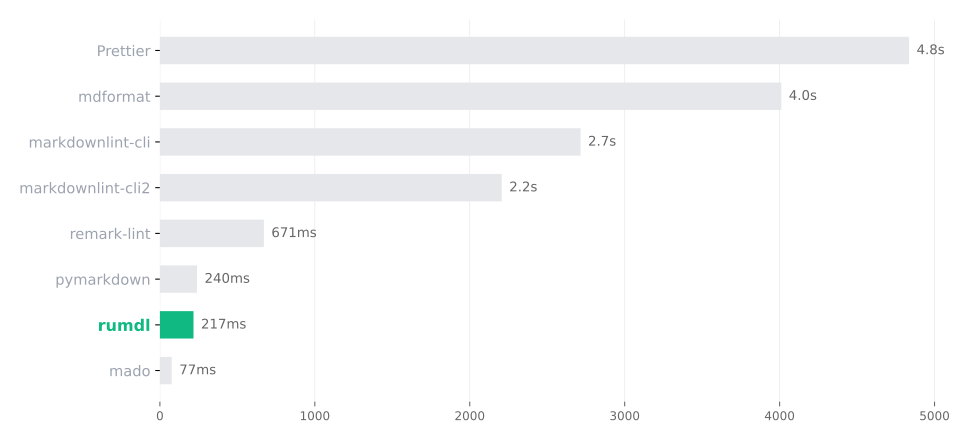
rumdl is designed for speed. Benchmarked on the Rust Book repository (478 markdown files, October 2025):
With intelligent caching, subsequent runs are even faster - rumdl only re-lints files that have changed, making it ideal for watch mode and editor integration.
# List available versions
mise ls-remote rumdl

# Install the latest version
mise install rumdl

# Use a specific version for the project
mise use rumdl@0.1.93
# Lint a single file
rumdl check README.md

# Lint all Markdown files in current directory and subdirectories
rumdl check .

# Format a specific file
rumdl fmt README.md

# Create a default configuration file
rumdl init
Common usage examples:
# Lint with custom configuration
rumdl check --config my-config.toml docs/

# Override config inline without touching any file (Ruff-compatible syntax)
rumdl check --config 'MD013.line-length=120' --config 'MD013.reflow=true' docs/
# See docs/cli-config-overrides.md for the full reference.

# Disable specific rules
rumdl check --disable MD013,MD033 README.md

# Enable only specific rules
rumdl check --enable MD001,MD003 README.md

# Exclude specific files/directories
rumdl check --exclude "node_modules,dist" .

# Include only specific files/directories
rumdl check --include "docs/*.md,README.md" .

# Watch mode for continuous linting
rumdl check --watch docs/

# Combine include and exclude patterns
rumdl check --include "docs/**/*.md" --exclude "docs/temp,docs/drafts" .

# Don't respect gitignore files (note: --respect-gitignore defaults to true)
rumdl check --respect-gitignore=false .

# Disable all exclude patterns from config
rumdl check excluded.md --no-exclude
Stdin/Stdout Formatting
rumdl supports formatting via stdin/stdout, making it ideal for editor integrations and CI pipelines:
# Format content from stdin and output to stdout
cat README.md | rumdl fmt --silent - > README_formatted.md
# Alternative: cat README.md | rumdl fmt --silent --stdin > README_formatted.md

# Use in a pipeline
echo "# Title   " | rumdl fmt --silent -
# Output: # Title

# Format clipboard content (macOS example)
pbpaste | rumdl fmt --silent - | pbcopy

# Provide filename context for better error messages (useful for editor integrations)
cat README.md | rumdl check - --stdin-filename README.md
Use --silent whenever stdout should contain only formatted Markdown. Plain rumdl fmt - may also emit remaining diagnostics.
Editor Integration
For editor integration, use stdin/stdout mode with the --silent flag when you want pure formatted output on stdout.
Use --quiet if you still want diagnostics but want to suppress summary lines:
# Format selection in editor (example for vim)
:'<,'>!rumdl fmt - --silent

# Format entire buffer
:%!rumdl fmt - --silent
Pre-commit Integration
You can use rumdl as a pre-commit hook to check and format your Markdown files.
The recommended way is to use the official pre-commit hook repository:
Add the following to your .pre-commit-config.yaml:
repos:
  - repo: https://github.com/rvben/rumdl-pre-commit
    rev: v0.1.93
    hooks:
      - id: rumdl      # Lint only (fails on issues)
      - id: rumdl-fmt  # Auto-format and fail if issues remain
Two hooks are available:
rumdl — Lints files and fails if any issues are found
rumdl-fmt — Auto-formats files and fails if unfixable violations remain (recommended for CI)
When you run pre-commit install or pre-commit run, pre-commit will automatically install rumdl in an isolated Python environment using pip. You do not need to install rumdl manually.
Excluding Files in Pre-commit
By default, when pre-commit explicitly passes files to rumdl, the exclude patterns defined in your .rumdl.toml configuration file are respected.
However, for pre-commit workflows where you want to include all files, even when they're excluded in the config, you can use the --no-exclude flag in your pre-commit config, e.g.:
The annotations report type displays issues directly in the PR's "Files changed" tab with error/warning severity levels and precise locations.
The action ref (rvben/rumdl@v0) selects the GitHub Action version, while the optional version input pins the rumdl CLI version installed inside the workflow.
Rules
rumdl implements 71 lint rules for Markdown files. Here are some key rule categories:
Category
Description
Example Rules
Headings
Proper heading structure and formatting
MD001, MD002, MD003
Lists
Consistent list formatting and structure
MD004, MD005, MD007
Whitespace
Proper spacing and line length
MD009, MD010, MD012
Code
Code block formatting and language tags
MD040, MD046, MD048
Links
Proper link and reference formatting
MD034, MD039, MD042
Images
Image alt text and references
MD045, MD052
Style
Consistent style across document
MD031, MD032, MD035
For a complete list of rules and their descriptions, see our documentation or run:
rumdl rule
Flavors
rumdl supports multiple Markdown flavors to accommodate different documentation systems. Each flavor adjusts rule behavior for syntax specific to that system, reducing false positives.
When no flavor is configured, rumdl auto-detects based on file extension (.mdx → mdx, .qmd/.Rmd → quarto, .md → standard).
For complete flavor documentation, see the Flavors Guide.
Command-line Interface
rumdl [options] [file or directory...]
Commands
check [PATHS...]
Lint Markdown files and print warnings/errors (main subcommand)
Arguments:
[PATHS...]: Files or directories to lint. If provided, these paths take precedence over include patterns
Options:
-f, --fix: Automatically fix issues where possible
--diff: Show diff of what would be fixed instead of fixing files
-w, --watch: Run in watch mode by re-running whenever files change
-l, --list-rules: List all available rules
-d, --disable : Disable specific rules (comma-separated)
-e, --enable : Enable only specific rules (comma-separated)
--exclude : Exclude specific files or directories (comma-separated glob patterns)
--include : Include only specific files or directories (comma-separated glob patterns)
--respect-gitignore: Respect .gitignore files when scanning directories (does not apply to explicitly provided paths)
--no-exclude: Disable all exclude patterns from config
-v, --verbose: Show detailed output
--profile: Show profiling information
--statistics: Show rule violation statistics summary
-q, --quiet: Print diagnostics, but suppress summary lines
--output-format : Output format for diagnostics
--stdin: Read from stdin instead of files
fmt [PATHS...]
Format Markdown files and apply fixes. Unlike check --fix, fmt keeps formatter-style exit codes and exits 0 after successful formatting, making it ideal for editor integration.
Arguments:
[PATHS...]: Files or directories to format. If provided, these paths take precedence over include patterns
Options:
All the same options as check are available (except --fix which is always enabled), including:
--stdin: Format content from stdin and output to stdout
-d, --disable : Disable specific rules during formatting
-e, --enable : Format using only specific rules
--exclude/--include: Control which files to format
-q, --quiet: Print diagnostics, but suppress summary lines
-s, --silent: Suppress diagnostics and summaries for pure formatter output
Examples:
# Format all Markdown files in current directory
rumdl fmt

# Format specific file
rumdl fmt README.md

# Format from stdin (using dash syntax)
cat README.md | rumdl fmt --silent - > formatted.md
# Alternative: cat README.md | rumdl fmt --silent --stdin > formatted.md
init [OPTIONS]
Create a default configuration file in the current directory
Options:
--pyproject: Generate configuration for pyproject.toml instead of .rumdl.toml
import [OPTIONS]
Import and convert markdownlint configuration files to rumdl format
Arguments:
``: Path to markdownlint config file (JSON/JSONC/YAML)
--format : Output format: toml or json (default: toml)
--dry-run: Show converted config without writing to file
rule []
Show information about a rule or list all rules
Arguments:
[rule]: Rule name or ID (optional). If provided, shows details for that rule. If omitted, lists all available rules
Useful options:
--list-categories: List available rule categories and exit
--category : Filter rules by category when listing
--output-format : Emit structured output such as json or json-lines
--explain: Include full documentation in json and json-lines output
config [OPTIONS] [COMMAND]
Show configuration or query a specific key
Options:
--defaults: Show only the default configuration values
--no-defaults: Show only non-default configuration values (exclude defaults)
--output : Output format (e.g. toml, json)
Subcommands:
get : Query a specific config key (e.g. global.exclude or MD013.line_length)
file: Show the absolute path of the configuration file that was loaded
server [OPTIONS]
Start the Language Server Protocol server for editor integration
Options:
--port : TCP port to listen on (for debugging)
-v, --verbose: Enable verbose logging
vscode [OPTIONS]
Install the rumdl VS Code extension
Options:
--force: Force reinstall even if already installed
--update: Update to the latest version (only if newer version is available)
--status: Show installation status without installing
completions [SHELL]
Print a shell completion script for rumdl to stdout. See Shell Completions for installation snippets.
Arguments:
[SHELL]: One of bash, zsh, fish, powershell, elvish. Auto-detected from $SHELL when omitted.
Options:
-l, --list: List available shells and exit
version
Show version information
Global Options
These options are available for all commands:
--color : Control colored output: auto (default), always, never
--config : Path to configuration file
--no-config: Ignore all configuration files and use built-in defaults
--isolated: Hidden compatibility alias for --no-config
Exit Codes
0: Success (no violations found, or all violations were fixed)
1: Violations found (or remain after --fix)
2: Tool error
Note:rumdl fmt exits 0 on successful formatting (even if unfixable violations remain), making it compatible with editor integrations. rumdl check --fix exits 0 if all violations are fixed, or
1 if violations remain after fixing (useful for pre-commit hooks and CI/CD).
Usage Examples
# Lint all Markdown files in the current directory
rumdl check .

# Format files (exits 0 on success, even if unfixable violations remain)
rumdl fmt .

# Auto-fix and report unfixable violations (exits 0 if all fixed, 1 if violations remain)
rumdl check --fix .

# Preview what would be fixed without modifying files
rumdl check --diff .

# Create a default configuration file
rumdl init

# Create or update a pyproject.toml file with rumdl configuration
rumdl init --pyproject

# Import a markdownlint config file
rumdl import .markdownlint.json

# Convert markdownlint config to JSON format
rumdl import --format json .markdownlint.yaml --output rumdl-config.json

# Preview conversion without writing file
rumdl import --dry-run .markdownlint.json

# Show information about a specific rule
rumdl rule MD013

# List all available rules
rumdl rule

# Query a specific config key
rumdl config get global.exclude

# Show the path of the loaded configuration file
rumdl config file

# Show configuration as JSON instead of the default format
rumdl config --output json

# Show only non-default configuration values
rumdl config --no-defaults

# Lint content from stdin
echo "# My Heading" | rumdl check --stdin

# Get JSON output for integration with other tools
rumdl check --output-format json README.md

# Show statistics summary of rule violations
rumdl check --statistics .

# Disable colors in output
rumdl check --color never README.md

# Use built-in defaults, ignoring all config files
rumdl check --no-config README.md

# Show version information
rumdl version
LSP
rumdl is also available as an LSP server for editor integration.
For editors that support generic LSP configuration, the minimal stdio setup is:
command = ["rumdl", "server"]
For editor-specific information on setting up the LSP, refer to our LSP documentation
Configuration
rumdl can be configured in several ways:
Using a .rumdl.toml or rumdl.toml file in your project directory or parent directories
rumdl automatically searches for configuration files by traversing up the directory tree from the current working directory, similar to tools like git , ruff , and eslint . This means you can
run rumdl from any subdirectory of your project and it will find the configuration file at the project root.
The search follows these rules:
Searches upward for .rumdl.toml, rumdl.toml, /.config/rumdl.toml, or pyproject.toml (with [tool.rumdl] section)
Stops searching when it encounters a .git directory (project boundary)
Maximum traversal depth of 100 directories
Falls back to markdownlint config files (.markdownlint.yaml, etc.) using the same upward traversal
Falls back to user configuration if no project configuration is found (see Global Configuration below)
Per-Directory Configuration
When running rumdl check . from the project root, rumdl resolves configuration
on a per-directory basis. Files in subdirectories with their own .rumdl.toml
use that config instead of the root config. This matches the behavior of
Ruff and
markdownlint-cli2.
Subdirectory configs are standalone by default. Use extends to inherit from a parent config:
Per-directory resolution is disabled when --config or --no-config is used (--isolated is still accepted as a compatibility alias).
To disable all configuration discovery and use only built-in defaults, use the --no-config flag:
# Use discovered configuration (default behavior)
rumdl check .

# Ignore all configuration files
rumdl check --no-config .
Editor Support (JSON Schema)
rumdl provides a JSON Schema for .rumdl.toml configuration files, enabling autocomplete, validation, and inline documentation in supported editors like VS Code, IntelliJ IDEA, and others.
The schema is available at https://raw.githubusercontent.com/rvben/rumdl/main/rumdl.schema.json.
Automatic Setup (via SchemaStore):
The schema is registered with SchemaStore, so editors with TOML support will automatically provide autocomplete and validation for .rumdl.toml and rumdl.toml files.
VS Code: Install the "Even Better TOML" extension - schema association is automatic.
Manual Schema Association:
If your editor doesn't support SchemaStore, associate this schema URL with .rumdl.toml or rumdl.toml in the editor's TOML schema settings:
If nothing is found in the platform config directory, rumdl also checks for ~/.rumdl.toml, then ~/rumdl.toml. This honors the classic Unix dotfile convention used by tools like git and npm.
This allows you to set personal preferences that apply to all projects without local configuration.
Example: Create ~/.config/rumdl/rumdl.toml (preferred) or ~/.rumdl.toml:
Note: User configuration is only used when no project configuration exists.
Project configurations always take precedence. When both a platform user-config
file and a home-directory dotfile exist, the platform user-config file wins.
Markdownlint Migration
rumdl provides seamless compatibility with existing markdownlint configurations:
Automatic Discovery: rumdl automatically detects and loads markdownlint config files by traversing up the directory tree (just like .rumdl.toml):
.markdownlint.json / .markdownlint.jsonc
.markdownlint.yaml / .markdownlint.yml
markdownlint.json / markdownlint.yaml
This means you can place a .markdownlint.yaml at your project root and run rumdl from any subdirectory - it will find and use the config automatically.
Explicit Import: Convert markdownlint configs to rumdl format:
# Convert to .rumdl.toml
rumdl import .markdownlint.json

# Convert to JSON format
rumdl import --format json .markdownlint.yaml --output config.json

# Preview conversion
rumdl import --dry-run .markdownlint.json
For comprehensive documentation on global settings (file selection, rule enablement, etc.), see our Global Settings Reference.
Inline Configuration
rumdl supports inline HTML comments to disable or configure rules for specific sections of your Markdown files. This is useful for making exceptions without changing global configuration:
This line can be as long as needed without triggering the line length rule.
Note: markdownlint-disable/markdownlint-enable comments are also supported for compatibility with existing markdownlint configurations.
Both kebab-case (line-length, respect-gitignore) and snake_case (line_length, respect_gitignore) formats are supported for compatibility with different Python tooling conventions.
Configuration Output
Effective Configuration (rumdl config)
The rumdl config command prints the full effective configuration (defaults + all overrides), showing every key and its value, annotated with the source of each value. The output is colorized and
the [from ...] annotation is globally aligned for easy scanning.
** Keys** are cyan, values are yellow, and the [from ...] annotation is colored by source:
Green: CLI
Blue: .rumdl.toml
Magenta: pyproject.toml
Yellow: default
The [from ...] column is aligned across all sections.
Defaults Only (rumdl config --defaults)
The rumdl config --defaults command shows only the default configuration values, useful for understanding what the built-in defaults are.
Non-Defaults Only (rumdl config --no-defaults)
The rumdl config --no-defaults command shows only configuration values that differ from defaults, making it easy to see what you've customized. This is particularly useful when you want to see only
your project-specific or user-specific overrides without the noise of default values.
This helps you quickly identify what customizations you've made to the default configuration.
The --defaults flag prints only the default configuration as TOML, suitable for copy-paste or reference:
[global]
enable = []
disable = []
exclude = []
include = []
respect_gitignore = true
force_exclude = false  # Set to true to exclude files even when explicitly specified

[MD013]
line_length = 80
code_blocks = true
...
Output Style
rumdl produces clean, colorized output similar to modern linting tools:
README.md:12:1: [MD022] Headings should be surrounded by blank lines [*]
README.md:24:5: [MD037] Spaces inside emphasis markers: "* incorrect *" [*]
README.md:31:76: [MD013] Line length exceeds 80 characters
README.md:42:3: [MD010] Hard tabs found, use spaces instead [*]
When running with --fix, rumdl shows which issues were fixed:
README.md:12:1: [MD022] Headings should be surrounded by blank lines [fixed]
README.md:24:5: [MD037] Spaces inside emphasis markers: "* incorrect *" [fixed]
README.md:42:3: [MD010] Hard tabs found, use spaces instead [fixed]

Fixed 3 issues in 1 file
For a more detailed view, use the --verbose option:
✓ No issues found in CONTRIBUTING.md
README.md:12:1: [MD022] Headings should be surrounded by blank lines [*]
README.md:24:5: [MD037] Spaces inside emphasis markers: "* incorrect *" [*]
README.md:42:3: [MD010] Hard tabs found, use spaces instead [*]

Found 3 issues in 1 file (2 files checked)
Run `rumdl fmt` to automatically fix issues
Output Format
Text Output (Default)
rumdl uses a consistent output format for all issues:
If you modify the configuration structures in src/config.rs, regenerate the JSON schema:
# Generate/update the schema
make schema
# Or: rumdl schema generate

# Check if schema is up-to-date (useful in CI)
make check-schema
# Or: rumdl schema check

# Print schema to stdout
rumdl schema print
The schema is automatically generated from the Rust types using schemars and should be kept in sync with the configuration structures.
Used By
rumdl is used by these notable open source projects: