telltale is a dispatch room where several coding-agent CLIs answer one brief
side by side, standing on a statusline and a cross-vendor HUD where every
number is traceable to measured tool output. A value it cannot source is
shown as absent rather than as a plausible zero, and a value it derived is
marked as derived.
One binary. `telltale council` is the dispatch room, and it is the product.
The two gauges under it are `telltale statusline` (an in-prompt statusline
for Claude Code and Antigravity CLI) and `telltale hud` (a watch-mode TUI
across Claude Code, Codex CLI, Gemini CLI, Antigravity CLI, Cursor and Grok
CLI). The same binary carries `telltale snapshot` (the fleet state as one
JSON document for a program to read), `telltale doctor` (a launch-time
preflight over the vendor binaries), and the relays that collect token
counts and fleet events.
Windows is the continuously verified target: every commit runs the suite,
the build and binary-level smokes on windows-latest.
README
telltale
Telltale is a harness that measures what it's driving and refuses to
drive one unwatched.
Telltale is for a builder who pays for two to five personal AI coding
subscriptions. You put one question to all of them and you see who is
right. You also see what each seat was allowed to do while it answered.
The room gives you five surfaces:
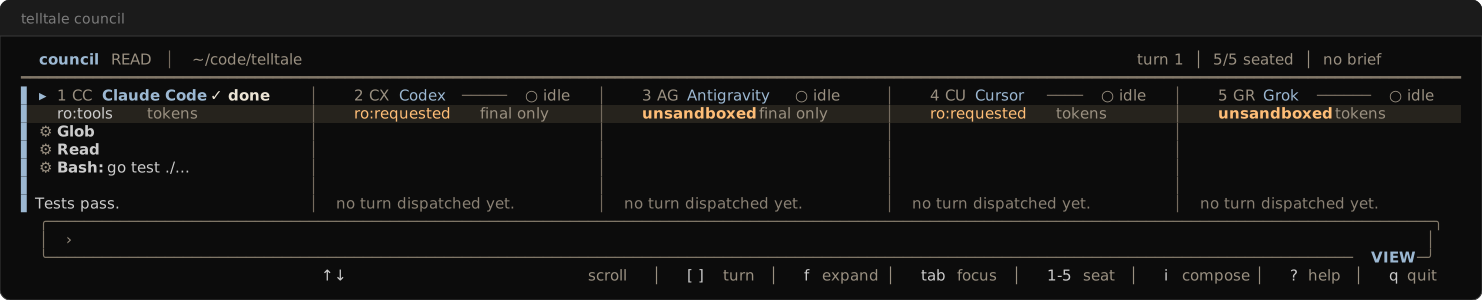
@all sends one brief to every seat: Claude Code, Codex, Antigravity,
Cursor, and Grok. The seats answer side by side, each in its own
column.
ctrl+r arms a rebuttal round. Each seat then reads the other seats'
last answers, fenced and labelled as untrusted material.
A gate card stops a seat that asks before a write, and y approves it.
The posture rail beside the card says what each seat may do, and it
marks a posture that no run measured. ? explains each badge.
/arena races one brief across the seats, each attempt in its own git
worktree. The room ranks the attempts by diff, and /arena check adds a PASS or a FAIL from a real exit code. /adopt merges
the attempt you pick.
--record keeps a real run, with every seat's output and every
card. --replay plays it back with the same renderer, and
telltale council replay-check reports what the file carries
before you share it.
Every number comes from measured tool output, and an empty gauge means
telltale did not measure it.
The script checks the archive against checksums.txt, and the binary is
not signed. Install states every route.
Play a room back:
telltale council --replay examples/demo.jsonl --replay-speed 8
That file is a scrubbed recording of a real room, and it plays on a
machine with nothing installed. Its shape is real and its words are
synthesized.
Then read what this machine has:
telltale doctor
> A telltale is the ribbon on a sail. It shows the air. It does not interpret it.
v0.3.0 (2026-09-04). Windows is verified on every commit.
The crew (per-seat turns, worktrees, @auto, --record/--replay, the
Unix host, three long-lived seats) is in this tag. It is built and tested
offline, and the live runs it owes are listed in STATE.md. The
tag was cut with that list unpaid, by the owner's ruling of 2026-09-04, so a
visitor who follows this page gets the room this page describes.
A darwin CI job on Apple Silicon runs the suite and the binary smokes on
a runner with no vendor CLI; its first run (2026-09-02, on the crew PR) found
a socket path past macOS's 104-byte bound and a test that read a sentence
off screen, both fixed, and it is green since. Intel macOS is smoke-checked
by hand. linux_amd64 is built, and a
source build was driven by hand on Linux with no vendor (doctor,
council ls, replay-check); the archive is not run.
No binary is signed. Check checksums.txt on the release.
Detail: SECURITY.md. The v1 cut gates are in docs/design.md §1.
Install
This section states every install route, including the one paste from the
sixty-second path above.
From source
go build -o telltale.exe ./cmd/telltale
./telltale.exe doctor
A source build reports dev from telltale version. A release binary reports its tag.
Windows, one paste (measured against v0.2.0, 2026-08-18)
It downloads the latest release, checks the archive against checksums.txt,
refuses on a mismatch, and puts telltale.exe on your user PATH.
It needs no administrator rights. The binary it installs is not signed,
and the script says so before it names the next command.
Source and knobs: packaging/install.ps1.
macOS, Homebrew (measured on Intel macOS against v0.3.0, 2026-09-11;
Apple Silicon brew install is unwalked)
brew tap sanlee-ys/telltale https://github.com/sanlee-ys/telltale
brew trust --formula sanlee-ys/telltale/telltale
brew install telltale
telltale doctor
Homebrew 6 refuses to load a third-party formula until that trust command
runs. The grant covers this formula only. A later brew upgrade telltale
reuses it. Homebrew fetches the release archive into its own cache and sets no
com.apple.quarantine mark, so Gatekeeper is never asked about the binary.
The binary is still not signed: the tap changes how it arrives, not what
it is. Apple Silicon gets darwin_arm64, Intel gets darwin_amd64, and
Linux gets linux_amd64. goreleaser rewrites
Formula/telltale.rb at each tag; the one checked in
names v0.3.0 with the sha256 values from that release's checksums.txt.
macOS, curl (measured on Intel macOS against v0.2.0, 2026-08-17; on
Apple Silicon write darwin_arm64 for darwin_amd64, a substitution nobody
has walked by hand)
curl -fLO https://github.com/sanlee-ys/telltale/releases/download/v0.3.0/telltale_0.3.0_darwin_amd64.tar.gz
curl -fLO https://github.com/sanlee-ys/telltale/releases/download/v0.3.0/checksums.txt
shasum -a 256 -c checksums.txt --ignore-missing
tar -xzf telltale_0.3.0_darwin_amd64.tar.gz
./telltale doctor
There is no xattr line because curl writes no com.apple.quarantine
attribute and a browser does, and Gatekeeper acts on that attribute alone.
After a browser download, run xattr -d com.apple.quarantine telltale once
the checksum passes; inside the curl block that same line exits 1 because
there is nothing to remove. The measured walk is in SECURITY.md.
macOS, from source
go build -o telltale ./cmd/telltale
./telltale doctor
Direct download. Each release attaches windows_amd64, darwin_amd64,
darwin_arm64, and linux_amd64, plus checksums.txt. Unpack one archive
and put telltale on PATH. The curl block above is that walk, measured.
Windows, winget (the 0.2.0 manifest merged into
microsoft/winget-pkgs on 2026-09-10, PR #417671; not yet exercised by a
winget install from the community source, and the first one is owed)
winget install --id sanlee-ys.telltale
winget delivers 0.2.0 until a 0.3.0 manifest is submitted; the one paste
and scoop above deliver v0.3.0 today. The manifests and the new-version
flow are in packaging/.
Run telltale with no arguments for the first frame.
telltale doctor is the preflight. telltale council opens the room.
Wire the statusline into Claude Code (~/.claude/settings.json):
The same block works for Antigravity CLI
(~/.gemini/antigravity-cli/settings.json). telltale reads the vendor
from the payload product field.
Cursor CLI (~/.cursor/cli-config.json) needs --vendor cursor.
Its payload has no vendor name. This statusline is interactive only
(measured; docs/design.md §7.16):
Then start an interactive cursor-agent session and run telltale hud.
Wire the MCP server into a client once, so an agent can read the fleet:
claude mcp add telltale -- C:\path\to\telltale.exe mcp
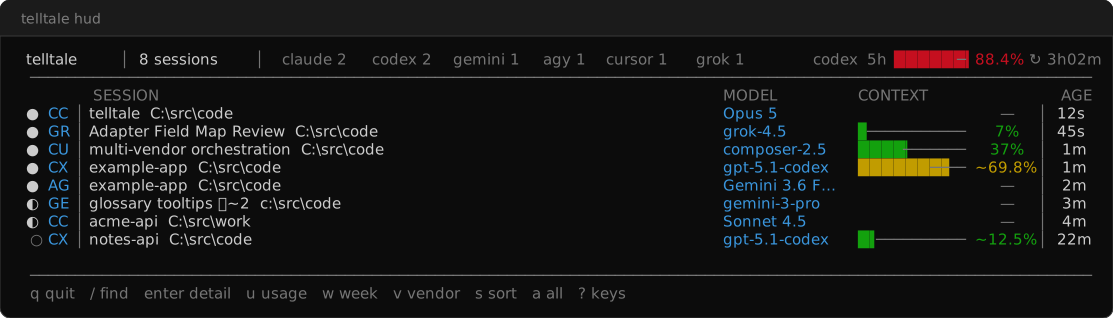
The test suite emits that picture from the HUD render.
Empty cells are fields no vendor writes. A ~ marks an estimate.
↑/↓ move the selection. enter opens the detail pane. / filters rows.
HUD flags: --vendor all|claude|codex|gemini|agy|cursor|grok|pi|self-reported,
--hide gemini,cursor (default from TELLTALE_HUD_HIDE),
--ascii (TELLTALE_ASCII=1), --no-title. NO_COLOR is honoured.
First five minutes
Run telltale doctor first. It reports what is installed here, it probes no
login and makes no network call, and it exits 0 even when every seat is
missing. Read its own words before you read this table: each row below is
keyed to a line doctor actually prints.
What you see
What it means
What to do
0 checks passed, and no seat above passed every check that ran
telltale is working. council drives a vendor CLI, and this machine has none.
Install one vendor CLI and run doctor again. telltale hud runs either way.
binary FAILED not found on PATH (looked for codex)
This shell cannot resolve that vendor.
Open the shell you normally run the vendor in, or put its binary on PATH. doctor also finds a vendor at a known install location and says a known install location, not on this shell's PATH.
drivable FAILED under a binary ok
The binary is here and council will not seat it. "Is it there" and "can it be driven" have different fixes, so doctor refuses to collapse them.
Read the reason on that row. It names the entry point and why: usually a shell shim that takes its prompt as an argument, which council will not put through cmd.exe.
auth not checked and network not checked, on every seat, always
Not a failure and not a soft pass. This report probes neither.
Nothing. A seat that is installed and signed out reports its own auth failure on its column the first time you dispatch to it.
re-measure §3.x before trusting the fields this adapter sources
Your vendor runs a version other than the one telltale surveyed.
Nothing on this machine. It is a staleness fact about telltale: no check failed, the tally is unchanged, and the command still exits 0.
telltale version says dev, or an older tag, after the install
Another telltale.exe is earlier on PATH. The install script appends its directory rather than jumping the queue.
Run Get-Command telltale (which -a telltale on macOS). It names the one that runs. Remove the other one, or set TELLTALE_INSTALL_DIR to the directory it already lives in.
A column in the room stays empty after a dispatch
The seat answered nothing, or the vendor refused the turn.
The column carries the reason. docs/council.md reads the badges and the phase words.
Windows warns before the first run
The binary is unsigned. No telltale release carries an Authenticode signature (docs/design.md §8, item 8).
Verify the archive against checksums.txt, which is the whole verification this release offers. SECURITY.md states what that does and does not prove.
The statusline shows nothing, or bad statusline input: unexpected end of JSON input
The statusline is wired, not run. The vendor calls it and hands it JSON on stdin, so by hand it gets no payload.
Paste the statusLine.command block above, then start a session.
telltale doctor output pastes into an issue as it stands: it is plain text
with no colour and no alternate screen, for exactly that reason.
What it is
telltale council: five vendor seats working as a crew, one column
each. This is the product.
telltale statusline: model, context, prompt-cache hit rate, session
cost, and quota pacing from the JSON the vendor sends on stdin. No network.
No credential read.
telltale hud: a watch TUI over Claude Code, Codex, Gemini CLI,
Antigravity CLI, Cursor (Composer and the cursor-agent CLI), Grok CLI,
and Pi.
telltale snapshot: the same scan as JSON, for a program.
telltale mcp: the same document over MCP on stdio, for an agent.
telltale history: what one vendor spent, day by day and project by
project, re-read from that vendor's own session files. Claude today; the
other six are surveyed and named on every run, with the reason each is not
read yet. It never sums two vendors.
telltale doctor: which vendor binaries this machine has.
telltale events / telltale events view: a loopback hook sink
and its reader.
telltale hook / telltale otel: relays that write per-turn
token totals under ~/.telltale/. They print nothing.
A documented adapter interface, plus a drop-file relay for a tool with
no adapter. Spec: docs/dropfile.md.
Gauges read vendor files on this machine. They make no network calls.
They write keys and numbers under ~/.telltale/ only.
telltale council is the one mode that starts vendor CLIs.
The Cursor store holds tokens in the same SQLite file as session state.
The adapter does not read them. SECURITY.md states the
boundary.
The crew room
telltale.exe council
An unaddressed brief goes to Claude. @codex, @agy, @cursor,
@grok, and @all route a turn. -@claude addresses every seat but
that one. A seat takes its brief while the other seats are still
answering theirs; a busy seat is refused by name, and ctrl+c cancels
the seat you are looking at. --read opens a room that only talks.
--cd sets the workspace. A plain telltale council can write, and the
header says so.
In a writing room every seat works in its own git worktree, cut once
beside the workspace on seat/. The room is the integrator:
/adopt codex merges that branch behind a y/n card, /hand claude codex
puts one seat's patch into another seat's brief, and /flow … & @seat …
fans a stage across seats and waits on all of them. --shared-tree is
the older room.
Every seat is a live process. Claude asks before every tool call,
measured, and wears gated. Codex and Grok can carry an approval request
into the same card on their live shapes, which were read from vendor
documentation and not yet driven: their badges say unmeasured until a
run on the reference box says otherwise. A live shape whose handshake is
refused falls back to the batch invocation that was measured, and the
column says so.
The strip under the header is the inbox: ⚠ NEEDS YOU names the seats
stopped on a card and the seats whose turn ended while you were reading
another column; . goes to the next one. @auto routes a brief to the
seated idle seat with the most measured headroom in its shortest quota
window, from the same relay the badges read, and refuses when no seat has
a reading.
--record keeps a real run, every seat's output and every card
with its timing; --replay plays it back with the same renderer
on a machine with nothing installed, labelled REPLAY on every frame;
telltale council replay-check lists what the file carries
before it is shared. examples/demo.jsonl is a real room of 2026-09-03
with every word replaced by telltale council replay-scrub; the real
recording stays with its operator.
--model codex=gpt-5.6-sol,grok=grok-4.5 asks a seat for a model. The
badge row shows the request (asked) beside the model that the vendor's
own session record names after a turn (ran). A mismatch wears ⚠, and
a record that names no model reads ran unknown. The mismatch test is
textual, so an alias such as opus shows beside its full id: pass the
full id to compare exactly. A seat with no measured model flag (Cursor
today) is refused before the room opens, and --host refuses the flag.
--host opens a read room in a process that outlives the terminal, on
Windows, macOS, and Linux; /detach walks away, telltale council
rejoins, telltale council kill ends it. Measured on Windows and Linux;
built for the Mac.
docs/council.md is the room guide: badges, routing,
keys, and flags. docs/design.md §9 is the measured
record per vendor, and §9.54 through §9.57 and §7.30 are the crew.
telltale snapshot
telltale.exe snapshot
One scan, one JSON document on stdout, exit 0. Flags: --vendor ,
--compact, --timeout (default 10s). An unknown flag or vendor
prints no document.
The same document, served to an agent over the Model Context Protocol on
stdio. You do not type this command: an MCP client starts it. One tool,
fleet_snapshot, takes an optional vendor argument and returns the
document above — the same bytes, so every rule in that table holds here.
One flag: --timeout (default 10s), per call.
It speaks stdio only. It binds no port, calls no network, and writes
nothing. docs/design.md §7.25 states the surface
and what is not verified.
telltale events
telltale.exe events
telltale.exe events view
One hook event per POST on loopback, appended under ~/.telltale/events/
and rebroadcast on /stream. Default bind: 127.0.0.1:4519. Any other
host is refused. This store holds payload content.
telltale events view reads the files. No gauge reads them.
Flags and the boundary: docs/design.md §7.21.
telltale doctor
telltale.exe doctor
Which vendor binaries are on this machine, where each one was found, and
what version each one reports. Auth and network always read not checked.
The command runs --version and writes nothing.
The honest-gauge rule
A segment may only display a value read from tool or vendor output.
Anything inferred is omitted or marked as an estimate.
A gauge that cannot tell "no data" from "zero" fails the build.
internal/hud renders one session at 0% and one session with no context
source, and asserts the two rows differ.
Fixtures are synthesized. This repository holds no real session content.