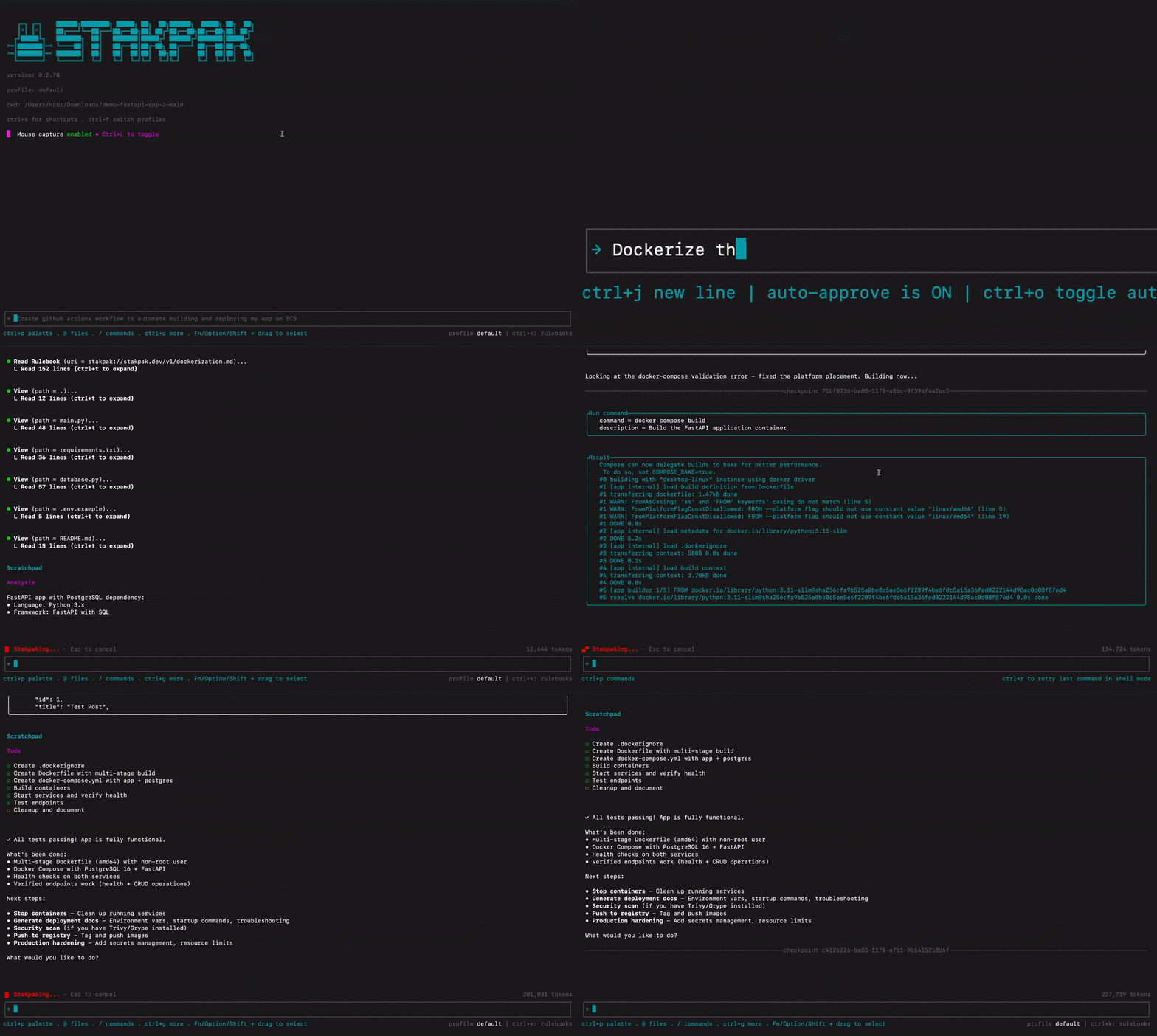
Stakpak is an open-source AI DevOps agent designed to simplify secure infrastructure management directly from your terminal. It empowers developers to deploy, run, and troubleshoot infrastructure without exposing sensitive credentials to large language models (LLMs), ensuring a safer and more efficient workflow.
Key Features:
Secret Substitution: Enables LLMs to work with credentials securely without ever viewing them.
Warden Guardrails: Network-level policies that prevent destructive actions before they occur.
DevOps Playbooks: A curated library of best practices for infrastructure management.
Security Hardening: Includes mutual TLS (mTLS), privacy mode, and secure password generation.
Real-time Progress Streaming: Provides live updates on long-running tasks like Docker builds or deployments.
Rulebooks: Customizable playbooks to align agent behavior with organizational standards.
Audience & Benefit:
Ideal for developers, DevOps engineers, and teams managing cloud infrastructure. Stakpak offers enhanced security by blocking risky operations, streamlined workflows through terminal access, and flexibility in API key usage or Bring Your Own Key (BYOK) options, making it a robust solution for secure AI-driven DevOps management.
README
<img src="assets/stakpak-dark.png" width="400" />
Secure Open source AI Agent in Your Terminal
Infrastructure shouldn’t be this hard. Stakpak lets developers secure, deploy, and run infra from the terminal.
:star: Help us reach more developers and grow the Stakpak community. Star this repo!
You can't trust most AI agents with your DevOps. One mistake, and your production is toast.
Stakpak is built different:
Secret Substitution - The LLM works with your credentials without ever seeing them
Warden Guardrails - Network-level policies block destructive operations before they run
DevOps Playbooks Baked-in - Curated library of DevOps knowledge in Stakpak Rulebooks
Generate infrastructure code, debug Kubernetes, configure CI/CD, automate deployments, without giving an LLM the keys to production.
Infrastructure Code Indexing - Automatic local indexing and semantic search for Terraform, Kubernetes, Dockerfile, and GitHub Actions
Documentation Research Agent - Built-in web search for technical documentation, cloud providers, and development frameworks
Subagents - Specialized research agents for code exploration and sandboxed analysis with different tool access levels (enabled with --enable-subagents flag)
Bulk Message Approval - Approve multiple tool calls at once for efficient workflow execution
Reversible File Operations - All file modifications are automatically backed up with recovery capabilities
🧠 Adaptive Intelligence
Rule Books - Customize agent behavior with internal standard operating procedures, playbooks, and organizational policies
Persistent Knowledge - Agent learns from interactions, remembers incidents, resources, and environment details to adapt to your workflow
Download the latest binary for your platform from our GitHub Releases.
Docker
This image includes the most popular CLI tools the agent might need for everyday DevOps tasks like docker, kubectl, aws cli, gcloud, azure cli, and more.
Option A: Running with a Stakpak API Key (no card required)
Just run stakpak and follow the instructions which will create a new API key for you.
stakpak
> Brave users may encounter issues with automatic redirects to localhost ports during the API key creation flow. If this happens to you:
>
> Copy your new key from the browser paste it in your terminal
You could also set the environment variable STAKPAK_API_KEY
export STAKPAK_API_KEY=
Or save your API key to ~/.stakpak/config.toml
stakpak login --api-key $STAKPAK_API_KEY
View current account (Optional)
stakpak account
Option B: Running Without a Stakpak API Key
Create ~/.stakpak/config.toml with one of these configurations:
Option 1: Bring Your Own Keys (BYOK) - Use your Anthropic/OpenAI API keys:
[profiles.byok]
provider = "local"

# Model names are auto-detected for built-in providers
smart_model = "claude-sonnet-4-5"
eco_model = "claude-haiku-4-5"

# Built-in providers - credentials can also be set via environment variables
# (ANTHROPIC_API_KEY, OPENAI_API_KEY, GEMINI_API_KEY)
[profiles.byok.providers.anthropic]
type = "anthropic"
api_key = "sk-ant-..."

[profiles.byok.providers.openai]
type = "openai"
api_key = "sk-..."

[profiles.byok.providers.gemini]
type = "gemini"
api_key = "..."

[settings]
Option 2: Bring Your Own LLM - Use a local OpenAI-compatible endpoint (e.g. Ollama, LM Studio):
[profiles.offline]
provider = "local"

# Custom provider models use the format: provider_key/model_name
smart_model = "offline/qwen/qwen3-coder-30b"
eco_model = "offline/qwen/qwen3-coder-30b"

# The provider key "offline" becomes the model prefix
[profiles.offline.providers.offline]
type = "custom"
api_endpoint = "http://localhost:11434/v1"
# api_key is optional for local providers

[settings]
Option 3: Mix Built-in and Custom Providers:
[profiles.hybrid]
provider = "local"

# Built-in provider - model name auto-detected
smart_model = "claude-sonnet-4-5"
# Custom provider - requires provider prefix
eco_model = "offline/llama3"

[profiles.hybrid.providers.anthropic]
type = "anthropic"
# Uses ANTHROPIC_API_KEY env var

[profiles.hybrid.providers.offline]
type = "custom"
api_endpoint = "http://localhost:11434/v1"

[settings]
Then run with your profile:
stakpak --profile byok
# or
stakpak --profile offline
# or
stakpak --profile hybrid
Start Stakpak Agent TUI
# Open the TUI
stakpak
# Resume execution from a checkpoint
stakpak -c
Start Stakpak Agent TUI with Docker
docker run -it --entrypoint stakpak ghcr.io/stakpak/agent:latest
# for containerization tasks (you need to mount the Docker socket)
docker run -it \
   -v "/var/run/docker.sock":"/var/run/docker.sock" \
   -v "{your app path}":"/agent/" \
   --entrypoint stakpak ghcr.io/stakpak/agent:latest
MCP Modes
You can use Stakpak as a secure MCP proxy or expose its security-hardened tools through an MCP server.
MCT Server Tools
Local Mode (--tool-mode local) - File operations and command execution only (no API key required)
Combined Mode (--tool-mode combined) - Both local and remote tools (default, API key required)
Start MCP Server
# Local tools only (no API key required, mTLS enabled by default)
stakpak mcp start --tool-mode local

# Remote tools only (AI tools optimized for DevOps)
stakpak mcp start --tool-mode remote

# Combined mode (default - all tools with full security)
stakpak mcp start

# Disable mTLS (NOT recommended for production)
stakpak mcp start --disable-mcp-mtls
Additional flags for the MCP server:
--disable-secret-redaction – not recommended; prints secrets in plaintext to the console
--privacy-mode – redacts additional private data like IP addresses and AWS account IDs
Stakpak also includes an MCP proxy server that can multiplex connections to multiple upstream MCP servers using a configuration file.
# Start MCP proxy with automatic config discovery
stakpak mcp proxy

# Start MCP proxy with explicit config file
stakpak mcp proxy --config-file ~/.stakpak/mcp.toml

# Disable secret redaction (NOT recommended – secrets will be printed in logs)
stakpak mcp proxy --disable-secret-redaction

# Enable privacy mode to redact IPs, account IDs, etc.
stakpak mcp proxy --privacy-mode
Agent Client Protocol (ACP)
ACP is a standardized protocol that enables AI agents to integrate directly with code editors like Zed, providing seamless AI-powered development assistance.
What ACP Offers with Stakpak
Real-time AI Chat - Natural language conversations with context-aware AI assistance
Live Code Analysis - AI can read, understand, and modify your codebase in real-time
Tool Execution - AI can run commands, edit files, search code, and perform development tasks
Session Persistence - Maintains conversation context across editor sessions
Streaming Responses - Real-time AI responses with live progress updates
Agent Plans - Visual task breakdown and progress tracking
Installation & Setup
Install Stakpak (if not already installed)
Configure Zed Editor - Add to ~/.config/zed/settings.json:
Use in Zed - Click Assistant (✨) → + → New stakpak thread
Rulebook Management
Manage your standard operating procedures (SOPs), playbooks, and runbooks with Stakpak Rulebooks. Rulebooks customize agent behavior and provide context-specific guidance.
# List all rulebooks
stakpak rulebooks get
# or use the short alias
stakpak rb get

# Get a specific rulebook
stakpak rb get stakpak://my-org/deployment-guide.md

# Create or update a rulebook from a markdown file
stakpak rb apply my-rulebook.md

# Delete a rulebook
stakpak rb delete stakpak://my-org/old-guide.md
Rulebook Format
Rulebooks are markdown files with YAML frontmatter:
---
uri: stakpak://my-org/deployment-guide.md
description: Standard deployment procedures for production
tags:
  - deployment
  - production
  - sop
---

# Deployment Guide

Your deployment procedures and guidelines here...
Shell Mode
Execute system commands explicitly from the input bar.