One identifier that opens a whole working context.




brew tap thatwasyahya/murl && brew install murl # macOS, Linux
Other platforms and package managers: docs/install.md.
> Status: experimental (format v0.2). A working reference implementation
> of a proposed primitive, not a standard. Interfaces and the format itself
> may still change; see docs/stability.md for what
> carries which label and docs/roadmap.md for what's next.
URL   :  identifier ──────────────▶ one resource
mURL  :  identifier ──▶ manifest ──▶ { resource, resource, resource, … }
A URL answers "where is this resource?". An mURL answers "what collection
of resources constitutes this logical destination?" — and lets the
operating system resolve it, show you exactly what that means, and dispatch
each part to the right handler:
                    murl://acme.example/project-x
                                 │
                        ┌────────▼────────┐
                        │  mURL resolver   │  parse → fetch manifest →
                        │                  │  validate → verify → policy
                        └────────┬────────┘
                                 │  consent: "Project X wants to open…"
     ┌──────────┬──────────┬─────┴─────┬───────────┬──────────┐
     ▼          ▼          ▼           ▼           ▼          ▼
  GitHub      Docs       Jira       Grafana   ~/projects   terminal
     │          │          │           │       /project-x     │
     ▼          ▼          ▼           ▼           ▼          ▼
  browser    browser    browser     browser    file mgr   terminal app
   SAFE       SAFE       SAFE        SAFE     SENSITIVE   DANGEROUS
Why this exists
The unit of human intent is a destination — "working on Project X",
"on-call for checkout", "onboarding week 1" — but the unit of addressing has
always been a single resource. The glue between them keeps being reinvented,
badly and tool-locally: bookmark folders, links-pages, tmuxinator configs,
PowerToys Workspaces, "useful links" wikis. None of them give you a name
you can put in a chat message that is inspectable before it acts,
verifiable (signed), versionable (@1.4.2), composable (destinations
inside destinations), and safe to click (consent + policy + trust).
mURL is that name, plus the machinery that makes it safe:
- A name, never a container —
murl://authority/name[@version][#part]
resolves through a local store or https://…/.well-known/murl/… to a
JSON manifest. Publishing a namespace = static files on any web
server. No registry, no accounts, no new infrastructure.
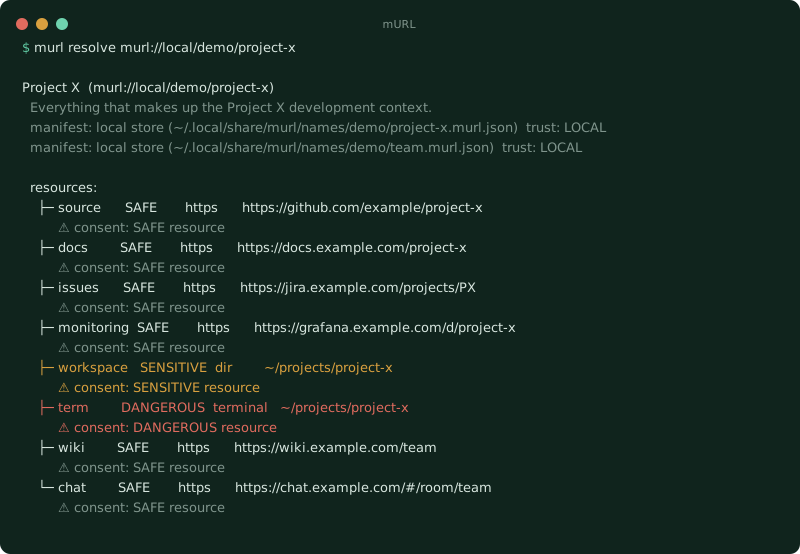
- Security as part of the addressing layer — resources are classified
SAFE / SENSITIVE / DANGEROUS by what they are; everything needs
consent; DANGEROUS additionally needs trust (local, or signed by a key
you pinned). Untrusted terminals aren't a prompt — they're a refusal.
No launch ever touches a shell. Limits (depth 3, 64 resources, 256 KiB,
cycle detection) are hard errors.
- Verifiable — ed25519 signatures over a canonical form (MCF-1),
per-authority key pinning, identity binding (a signed manifest can't be
replayed under a different name), byte-exact integrity pins for nested
destinations.
Quick start
brew tap thatwasyahya/murl && brew install murl   # macOS, Linux
cargo install murl-cli murl-daemon                # anywhere with Rust
Other options: docs/install.md.
Or from source:
git clone https://github.com/thatwasyahya/mURL && cd mURL
cargo install --path crates/murl-cli
cargo install --path crates/murl-daemon   # the consent dialog; required on macOS
Either way, murl is now on your PATH. The guided tours run from a checkout
and need no install at all — they use the build in target/:
bash examples/demo.sh          # hermetic: temp state, dry-run open, auto-cleanup
bash examples/daemon-demo.sh   # the daemon path, including fail-closed consent
Or by hand:
murl create --name "Project X"                # write a starter manifest
murl validate project-x.murl.json
murl name add project-x project-x.murl.json   # install as murl://local/project-x
murl resolve murl://local/project-x           # see the full plan — nothing opens
murl open murl://local/project-x              # consent, then dispatch
murl open 'murl://local/project-x#docs'       # just one part of it

murl keygen && murl sign project-x.murl.json  # sign it
murl export murl://local/project-x            # bundle it, nested manifests and all
murl os install                               # make murl:// clickable (Linux/Windows)
murl-daemon run                               # optional: a resident consent surface
A manifest looks like this (full schema: spec §5):
{
  "murlVersion": "0.1",
  "id": "murl://local/project-x",
  "name": "Project X",
  "resources": [
    { "id": "source",    "kind": "https",    "target": "https://github.com/acme/project-x", "role": "source" },
    { "id": "docs",      "kind": "https",    "target": "https://docs.acme.example/x",       "role": "docs" },
    { "id": "workspace", "kind": "dir",      "target": "~/projects/project-x",              "role": "workspace" },
    { "id": "term",      "kind": "terminal", "target": "~/projects/project-x", "dependsOn": ["workspace"] },
    { "id": "team",      "kind": "murl",     "target": "murl://local/team" }
  ]
}
Documentation
Try it in your browser first: the playground turns a pasted list of resources into a validated manifest, checked by murl-core compiled to WebAssembly — the same code the CLI runs.
| |
|---|
| docs/install.md | every way to install it, and which channels are actually published |
| docs/concept.md | why mURL exists; what it is and is not |
| spec/SPECIFICATION.md | the normative v0.1 specification |
| docs/architecture.md | crate layout, pipeline, decisions & reasons |
| docs/security.md · docs/threat-model.md | the security model and the 16 threats it answers |
| PRIVACY.md | what mURL sends over the network, to whom and when, and what it keeps on your computer |
| docs/trust-model.md | signatures, pinning, and why not PKI |
| docs/resolution.md · docs/resource-types.md | how names resolve; the kind registry |
| docs/os-integration.md | Linux, Windows, and macOS registration |
| docs/daemon.md | the resident resolver, its wire protocol, and its IPC threat model |
| docs/stability.md | what's stable, what's experimental, and the compatibility rules |
| spec/conformance/ | the vector suite an independent implementation can test against |
| docs/prior-art.md | honest map of neighbors (ORE, Metalink, PowerToys, …) and what's actually novel |
| docs/examples.md · docs/faq.md · docs/roadmap.md | walkthroughs, answers, plans |
Repository layout
crates/murl-core   the protocol: parser · manifest · validator · resolver ·
                   policy · trust · cache · bundles · dispatch planning
                   (no I/O effects; network & process creation behind traits)
crates/murl-net    the hardened HTTPS fetcher, shared by CLI and daemon
crates/murl-daemon the resident consent surface: wire protocol, socket
                   security, ConsentUi abstraction
crates/murl-cli    the `murl` binary: commands, launcher (argv-only),
                   consent, OS registration, daemon client
fuzz/              cargo-fuzz targets: parser, manifest, canonical JSON
spec/              the specification, JSON Schema, conformance vectors,
                   and the IANA registration templates
packaging/macos/   mURL.app bundle build (Launch Services registration)
docs/              design & operations documentation
examples/          Project X destination + demo.sh + daemon-demo.sh
Backward compatibility
mURL does not replace URLs — every leaf target is an ordinary URL or path,
dispatched to the same browser and apps as today. It is a composition layer
above locators. https:// links keep working; an mURL just gives a set of
them (plus local resources) a shared, verifiable name.
Development
cargo test                 # 120+ unit/integration/security tests
cargo clippy --all-targets # lint-clean, unsafe_code forbidden workspace-wide
cargo fmt --check
cargo +nightly fuzz run parse_murl   # needs cargo-fuzz
Contributions: see CONTRIBUTING.md. Security reports:
SECURITY.md. Licensed under MIT OR
Apache-2.0, at your option.