English | 简体中文
Gengchou
AI quota at a glance.
AI quota monitor for the Windows taskbar



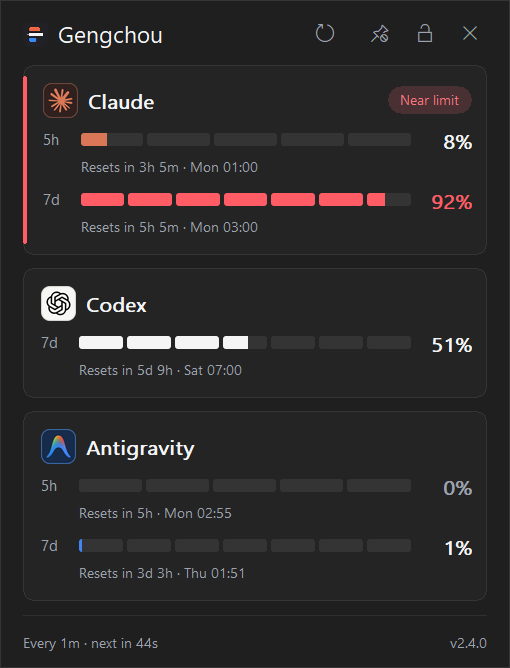
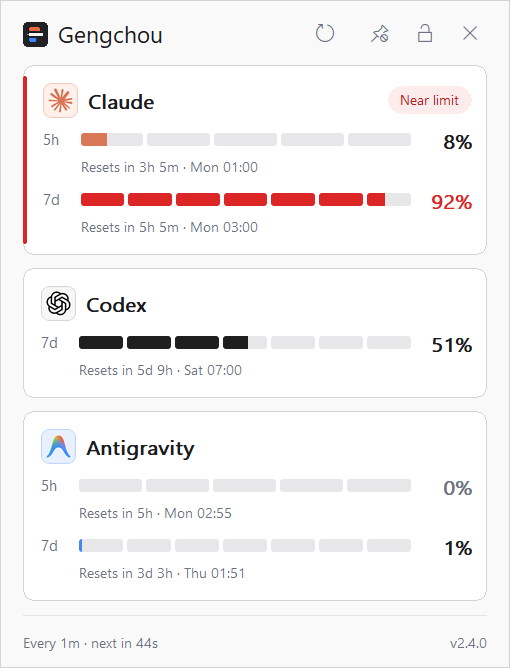
The detail popup in dark and light — including what a near-limit warning looks like.
Gengchou puts the quota windows your AI providers actually report — how much
is used, and when it resets — directly on the Windows taskbar. Claude,
Codex, Antigravity, and Grok each get a live percentage on whichever surface
you prefer, from a full detail card down to a single tray number, so checking
your remaining budget never means opening a dashboard.
> 烧香知夜漏,刻烛验更筹。
>
> — Yu Jianwu, 《奉和春夜应令》, Southern Liang
The name Gengchou (更筹) comes from the tally sticks used to mark the watches
of the night; by extension, the term can also refer to time itself. These
tally sticks made the passing hours visible; the app does the same for quota
usage and reset cycles.
Surfaces at a glance
| Dark | Light |
|---|
| Taskbar widget |  |  |
| Floating window |  |  |
| Tray icons | 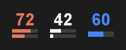 | 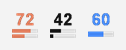 |
These previews are not screenshots: the app rendered them through its own
--dump-widget, --dump-tray-icons, and --dump-detail-popup modes, so they
show the exact pixels the shipped code draws. Regenerate them any time with
tools/render-readme-images.ps1.
- Taskbar widget. Embeds in the taskbar itself: one content-sized badge
per provider showing its logo, quota-window label, usage, and reset countdown.
Hover a badge to see every reported window with reset times. Drag the left
divider to reposition it, or drop it on another taskbar to change monitors.
If Explorer is temporarily gone, the widget hides and re-embeds rather than
landing on the desktop. A vertical taskbar is not supported: the badges are
laid out along a horizontal bar and are wider than a left- or right-docked
one, so use the floating window or the tray icons there.
- Floating window. A separate always-on-top numeric view, not a stretched
copy of the widget: up to the two highest-usage windows per provider, each
label, percentage, and countdown aligned above its micro gauge. Drag it from
anywhere on its surface; a short click still opens the detail popup. It
remembers its position, keeps an 8-pixel margin inside the work area, and
can be reset from Settings.
- Tray icons. One live icon per enabled provider — the number and adaptive
bars follow whatever quota windows that provider reports; with no data the
number gives way to the provider's initial. Disable Provider tray icons
to keep a single neutral app icon instead. The app icon also stands in
whenever no provider has been granted credential access, since there is no
provider whose mark would be honest to show; your preference is untouched
and the provider icons return as soon as one is authorized.
- Detail popup. Opens from a left-click on any surface: per-provider
status badges, exact reset clock times, and a live refresh countdown. Its
separate pin and position-lock controls can keep it open or stop it moving.
The pin preference survives popup closes and app restarts; position locking
applies only to the current opening.
When any quota window reaches 90%, it takes over that provider's badge, turns
it red, and shows its own reset countdown — the warning finds you, not the
other way around:
Install
Installation options, in recommended order:
-
Portable ZIP (recommended). Download
gengchou-windows-x64.zip from the
latest release,
extract it to any folder you can write to, and run gengchou.exe. The
bundle includes both READMEs and the retained license and attribution
notices.
-
Standalone EXE. For a single-file download, get gengchou.exe from
the same release and run it from any writable folder.
-
WinGet. The package is available under this identifier:
winget install --id ynjmxn.Gengchou --exact
WinGet distribution starts with v2.3.4. The ZIP and EXE remain available
for portable or manual installations.
To query usage, Gengchou reads credentials or session data already stored on
this PC and sends a credential only to the provider that issued it, over
HTTPS. It does not upload credentials or usage data to Gengchou or any third
party. See Data & privacy before installing for the complete
data-flow and storage details.
The executable is currently unsigned. Each release includes SHA256SUMS for
download verification, and self-updates check it automatically. Starting with
v2.1.0, release binaries also carry GitHub artifact attestations; these provide
build provenance but do not replace Authenticode signing.
The similarly named CodeZeno.ClaudeCodeUsageMonitor package is the
original project, not this app.
Build from source (Windows 10/11, stable Rust)
git clone https://github.com/ynjmxn/gengchou.git
cd gengchou
cargo build --release --locked
.\target\release\gengchou.exe
Release maintainers should also follow the
release checklist.
Controls
- Left-click the widget or a tray icon to open or close the detail popup.
- The popup is movable and closes on focus loss by default. Use the pin button
to keep it open and the separate lock button to stop it moving. From left to
right, the header controls are Refresh, Pin, Position lock, and Close. State
icons show the current state. All four support Tab / Shift+Tab and Enter /
Space; Esc always closes the popup.
- Right-click any surface, then click Provider tray icons, Widget, or
Floating Window directly to toggle that surface. Position resets,
notifications, and start-with-Windows live under Settings.
- Refresh polls immediately with Refresh now or sets the automatic
interval. Existing values stay visible while the refresh runs; the detail
footer says only Refreshing.
Beyond the surfaces
- Quota data comes from what each provider actually reports — windows and
reset times are never guessed or extrapolated
- A new installation shows whichever of Claude, Codex, Google Antigravity, and
Grok it detects on this machine; enable or disable any combination afterwards
- Windows system colours in High Contrast mode
- Optional reset notifications (off by default)
- Survives
explorer.exe restarts and RDP / lock-screen transitions; polling
keeps its cadence while the session is locked, and restoration only rebuilds
local UI surfaces
- Multi-monitor and multi-taskbar aware
- 11 languages · no telemetry · a single portable executable
- The in-app brand is 更筹 in Simplified Chinese, 更籌 in Traditional
Chinese, and Gengchou in every other language
Provider requirements
The monitor only reads your existing local sessions — it never creates
accounts or bypasses provider authentication, and what it can show follows
each provider's own account rules:
- Claude — a signed-in Claude Code session on Windows or WSL, or a
signed-in Claude Desktop session on Windows. The CLI executable is not
required when Desktop has a supported local session. Claude Code credentials
are checked across Windows and every known usable WSL distribution. Windows
defaults to
%USERPROFILE%\.claude\.credentials.json; when
CLAUDE_CONFIG_DIR is set, its .credentials.json is used instead. Each WSL
distribution resolves its own CLAUDE_CONFIG_DIR or falls back to
$HOME/.claude
- Codex — a signed-in Codex Desktop or CLI session; the CLI executable is
not required when Desktop has already saved a supported local session.
Windows resolves
%CODEX_HOME%\auth.json (normally
%USERPROFILE%\.codex\auth.json) or the Codex entry in Windows Credential
Manager; if neither is usable, $CODEX_HOME/auth.json (default
$HOME/.codex/auth.json) in a running WSL distribution is read next
- Antigravity — a signed-in Antigravity session; the IDE and the CLI share
one credential. Windows resolves
gemini:antigravity in Windows Credential
Manager; if that is unavailable,
$HOME/.gemini/antigravity-cli/antigravity-oauth-token in a running WSL
distribution is read next
- Grok — a signed-in grok CLI session. Windows resolves
%GROK_HOME%\auth.json (normally %USERPROFILE%\.grok\auth.json); if that
is unavailable, $GROK_HOME/auth.json (default $HOME/.grok/auth.json) in a
running WSL distribution is read next. auth.json can hold sign-ins from
several identity providers; only an entry issued by xAI itself is used, and
its token is only ever sent to xAI. An XAI_API_KEY environment variable is
not a session and is not read
Codex, Antigravity, and Grok credentials inside WSL are only read from
distributions
that are already running. Reading a stopped distribution would start its
virtual machine, and this check runs on a schedule, so Gengchou never wakes WSL
for it. Start the distribution first, then use Provider access → Detect
providers again in the context menu to check immediately.
Gengchou automatically finds a usable Claude session. When the Anthropic usage
endpoint confirms that a Windows Claude Code credential has been rejected, it
can run the installed claude update command in a hidden background process
(60-second timeout), verify that the local credential actually changed, and
retry the usage endpoint. If no usable CLI credential remains — or the CLI is
not installed — Gengchou can instead use an eligible, unexpired access token
from the current Windows user's Claude Desktop session. Both paths are enabled
by default and have no Settings item. WSL credentials never invoke the Windows
CLI, and network errors or rate limits never cause a credential-source switch.
To disable only claude update, set DISABLE_UPDATES=1 before launching
Gengchou. To disable only Claude Desktop session access, set
GENGCHOU_DISABLE_CLAUDE_DESKTOP_AUTH=1. Restart Gengchou after changing either
variable. Claude Code and Claude Desktop can be signed into different accounts;
usable CLI credentials take precedence, so disable Desktop access if that
fallback is not wanted.
Only a CLI version change produces a notification, and it is not optional:
because Gengchou changed something on your machine, it always says so. The
switch that matters is DISABLE_UPDATES=1, which stops the update itself.
Credential-only recovery and Desktop session selection stay silent. If no
usable session remains, non-renewable and server-rejected credentials appear as
Authentication failed and ask the user to sign in to Claude again; a
provider with no credential at all reports Not detected instead. In Claude
Desktop, send a message first to let the normal session flow refresh its
credentials; if monitoring still does not recover, sign out and back in. In
Claude Code CLI, run claude auth login. Credential watching resumes
monitoring automatically after sign-in.
Routine provider-detection, quota-reset, available-update, and Claude Code
update notifications use the Gengchou app icon and are silent. Only a current
credential problem that needs user action uses the Windows warning glyph and
notification sound.
Gengchou checks for its own updates once a day and announces a version it finds
once; repeating that every day would be nagging. Clicking the notification asks
whether to update now. Miss it and nothing is lost: the detail popup's footer
reads v2.5.3 → 2.5.4 until you take it, and clicking that line asks the same
question. The version entry under Settings carries the same offer, and is
the route for keyboard users.
The popup reserves badges for four conditions, in priority order:
Authentication failed, Refresh failed, Near limit, and Limit
reached. A network or request failure becomes Refresh failed after three
consecutive failures or when its data reaches the stale threshold (the greater
of twice the polling interval and five minutes). A 429 response cools down only
that provider and retries silently while its data is fresh; once stale, it uses
the same Refresh failed state. Old values stay visible but muted with Last
updated … ago. With no history, initial loading says Waiting for usage
data, authentication failure says Unable to get usage data, and a
persistent service or request failure says Temporarily unable to get
usage. The footer reports whether some or all providers failed to update.
For support, run gengchou.exe --claude-auth-diagnostics in a terminal. Only
this explicit command invokes the non-model claude auth status; it reports
resolved config paths, file state, expiries, CLI version, and internal reason
codes, followed by the copyable claude auth login recovery command. Tokens,
account identifiers, and raw CLI output are excluded. The same safe report is
written to Gengchou's diagnostic log.
On first start Gengchou asks once for permission, explaining that the access is
used only to query usage, consumes no model allowance, and stores no sign-in
information. Permission defaults to No, and no credential is read before it
is granted. Once granted, Gengchou checks which providers are signed in on this
machine and shows those providers. If none are detected, it keeps a locally
polled Codex placeholder visible so the first sign-in can be recognized without
changing the user's provider selection. Permission is granted once for every
provider, but revoking stays per provider: use Provider access in the
context menu to turn any single one off at any time. Turning a provider off
also stops it being read at all: neither the check at start, the periodic
check, nor Detect providers again touches its credentials until you turn
it back on. Showing or hiding a provider under Providers only changes
visibility; it does not grant credential access. Gengchou re-reads the original
file or Windows Credential Manager entry as needed, so provider-side token
refresh continues to work without copying the token into Gengchou.
Upgrading from an earlier version does not show the prompt again and keeps the
existing provider selection. A provider that was allowed stays allowed. A
provider whose older file only has allow=false, with no record of whether
you revoked it, is marked needs review and is not read until you choose
Allow access or Keep closed under Provider access. The review also
offers Decide later, which is its default: it changes nothing and leaves
the provider pending, so closing the dialog or pressing Enter never records a
decision for you. Detect providers again asks the same choice for each
pending provider and states that it will read that provider's local
credentials for ongoing monitoring. A provider added
by an upgrade that was never pending or revoked can still be discovered
automatically. To pick up a newly installed provider that is already allowed,
use Provider access → Detect providers again. Gengchou also checks once
shortly after each start and periodically thereafter, and shows a single
notification when it finds a newly signed-in provider; it never changes what
is displayed on its own. The check at startup is what tells you about a
provider added by an upgrade, rather than making you wait out the first
interval.
gengchou.exe --claude-auth-diagnostics is a separate, user-triggered
exception: it reads local Claude credentials only to print a redacted
diagnostic report.
A provider with no credential on this machine shows Not detected in the
detail popup along with a note that it is recognized automatically after
sign-in, and raises no notification — a provider that was never signed in has
nothing to sign in to again. Authentication failed means a credential
really is there and cannot be used: a Windows file or Credential Manager entry
that is unreadable or malformed, or a credential the provider expires or
rejects. These cases share the same simple recovery: sign in again. A WSL probe that
cannot start or finish is treated as a temporary refresh failure instead, never
as an authentication problem. Inside WSL, Claude's probe still separates an
absent credential from an unreadable one; the Codex, Antigravity and Grok
probes cannot tell a distribution that has no credential from one that failed
to answer, so they move on to the next source and a credential that lives only
inside an unreachable distribution reads as Not detected rather than
raising a false sign-in warning.
Data & privacy
| What | Where |
|---|
| Settings — including provider permission flags; never tokens | %APPDATA%\Gengchou\settings.json |
| Usage cache — percentages, quota-window metadata, and reset times only; never tokens | %APPDATA%\Gengchou\usage-cache.json |
Diagnostics (append-only within each generation; rotated while running; current plus one .old) | %LOCALAPPDATA%\Gengchou\diagnose.log |
| A settings file that could not be read, kept aside rather than lost; one generation | %APPDATA%\Gengchou\settings.json.corrupt |
| An empty file whose open handle is the single-instance guard; nothing is written to it | %APPDATA%\Gengchou\instance.lock |
If %APPDATA% is unavailable, settings and the usage cache fall back to the
Windows configuration directory and then %LOCALAPPDATA%. If no durable path
can be used, the app continues for the current session and shows one storage
warning instead of silently claiming that changes were saved.
A settings file that cannot be read is kept as settings.json.corrupt before
Gengchou starts from defaults, and one warning names that path. Starting from
defaults is not a read-only outcome: the first save that follows would
otherwise replace your layout, language, provider selection and access
decisions with nothing to recover them from.
Gengchou's own direct writes are limited to the paths above. Claude Desktop
session access is read-only: Gengchou reads the encrypted cache and Chromium
Local State, decrypts the cache only in memory, extracts only eligible access
tokens, never extracts or stores a refresh token, overwrites the decrypted JSON
and retained token buffers before release, and does not modify Desktop files.
Unless disabled with DISABLE_UPDATES, the separately installed Claude CLI may
update its own installation and credential files according to claude update's
behavior. Installations older than v2.2.4 must first run the retained v2.2.4
bridge twice and complete its verification before moving to v2.3.0 or later.
To uninstall: disable Start with Windows if you enabled it, then delete
the executable, %APPDATA%\Gengchou, and %LOCALAPPDATA%\Gengchou.
Network traffic goes directly to the enabled and explicitly authorized
providers (Anthropic, ChatGPT/Codex, Google, xAI) for read-only usage queries,
plus GitHub for update checks and user-approved update downloads. The app never:
- collects analytics or telemetry, or uploads any files;
- sends credentials anywhere except the provider that issued them;
- starts
claude auth login or writes credential files directly;
- runs provider commands except the non-model
claude --version / claude update recovery described above and the explicit
--claude-auth-diagnostics support command;
- triggers model generation — no
claude -p, codex exec, or calls to
/v1/messages, /v1/chat/completions, and similar endpoints.
Proxy selection uses standard ALL_PROXY / HTTPS_PROXY / HTTP_PROXY
environment variables first, then the current Windows user's static system
proxy, and finally a direct connection. Automatic PAC/WPAD scripts are not
executed yet.
Provider bearer tokens travel inside each TLS request, so only configure
proxies you trust.
Update troubleshooting
After a successful portable update, the previous executable may briefly remain
beside the app as gengchou.exe.old. Gengchou now continues to start if a
virus scanner, indexer, or another file handle still has that confirmed backup
open; cleanup is retried on a later launch and the exact path is written to
%LOCALAPPDATA%\Gengchou\diagnose.log.
If the file remains and a later update cannot proceed, exit Gengchou, wait for
the process holding the file to release it, delete only the reported .old
file beside gengchou.exe, and start the app again. Do not delete the running
executable or the update workspace.
Stability
The project began as a stability rework of the original code. External
WM_DESTROY, explorer.exe taskbar rebuilds, and RDP session switches
trigger in-process recovery — relaunch is only a last resort — and panics
are logged instead of silently ending the process. See
PROVENANCE.md for the technical summary.
Acknowledgements & license
Formerly AI Usage Monitor, Gengchou was derived from
CodeZeno/Claude-Code-Usage-Monitor
v1.4.8 (commit 9b29972). The tray-icon presentation and parts of the Claude
usage polling, caching, cooldown, and rate-limit handling were adapted from or
informed by
jens-duttke/usage-monitor-for-claude.
This project is not affiliated with, endorsed by, or sponsored by Code Zeno
Pty Ltd, Anthropic, OpenAI, Google, or xAI. Product names are used only to
describe compatibility; all trademarks belong to their respective owners.
MIT License — see LICENSE,
THIRD_PARTY_NOTICES.md, and
DEPENDENCY_LICENSES.md for retained notices.
