Materializr
Open-source parametric 3D CAD for makers - constraint sketches, solid
modeling, threads, SVG & text engraving, STEP/STL/SVG/DXF/OBJ/3MF exchange.
> 📱 Now on Android and iPad: Materializr runs on Android (arm64-v8a) and
> iPad - get it on the App Store -
> reusing the entire geometry codebase via an SDL3 + OpenGL ES 3.0 backend and
> cross-compiled OpenCASCADE, with a runtime touch mode that adapts gestures
> and hit targets. Designed for tablets - a phone screen will be cramped.
> On Android, get it on Google Play,
> grab the APK from the latest release,
> or see android/README.md to build it yourself.
> Also on F-Droid.
Download
⬇ Get the latest release
| Platform | File | How |
|---|
| Linux (x86_64 / aarch64) | Materializr-*.AppImage | chmod +x it and run - no install |
| Windows | Materializr-Setup.exe | run the installer |
| Windows (portable) | Materializr-windows-x64.zip | unzip anywhere, run materializr.exe |
| iPad | on the App Store | install from the App Store |
| Android (Google Play) | on Google Play | install + auto-update from the Play Store; tablets recommended |
| Android (F-Droid) | on F-Droid | install + auto-update from the F-Droid app; tablets recommended |
| Android (latest APK) | Materializr-*-arm64-v8a.apk | sideload (enable "install unknown apps") for the freshest fixes; tablets recommended |
| macOS (Apple Silicon) | Materializr-*-arm64.dmg | open the .dmg, drag Materializr to Applications - see the first-launch note below |
> Linux glibc requirement: the AppImage is built on a current toolchain, so
> it needs glibc 2.38 or newer (Ubuntu 24.04+, Fedora 39+, Zorin 18+ - any
> 2024-or-later distro). On older systems it won't start, failing with
> GLIBC_2.38 not found / GLIBCXX_3.4.32 not found. If you're on an older
> distro, either build from source - it compiles against
> your own libraries, so there's no version floor - or run the AppImage inside
> an ubuntu:24.04 Distrobox / Toolbox container.
> Prefer F-Droid? It builds each release from source on its own
> roughly-weekly cadence, so a brand-new bug fix can take a few days to reach it.
> If you're chasing a fix we just shipped, the GitHub APK above will have it
> first. One caveat: F-Droid signs its build with its own key, so you can't
> install the GitHub APK over an F-Droid install (or vice-versa) - Android
> rejects the signature change. Switching sources means uninstalling first,
> which clears the app's on-device files, so export any projects you want to
> keep beforehand. Easiest is to pick one source and stick with it.
> macOS first launch: the app is Apple-Silicon only (M1 or newer) and is
> ad-hoc signed, not notarized - so the first time you open it, macOS
> Gatekeeper will say it "cannot be opened because the developer cannot be
> verified." Right-click (or Control-click) the app in Applications and choose
> Open, then Open again in the dialog - this is a one-time approval.
> (Equivalently: System Settings → Privacy & Security → Open Anyway.)




Built on the OpenCASCADE geometry kernel -
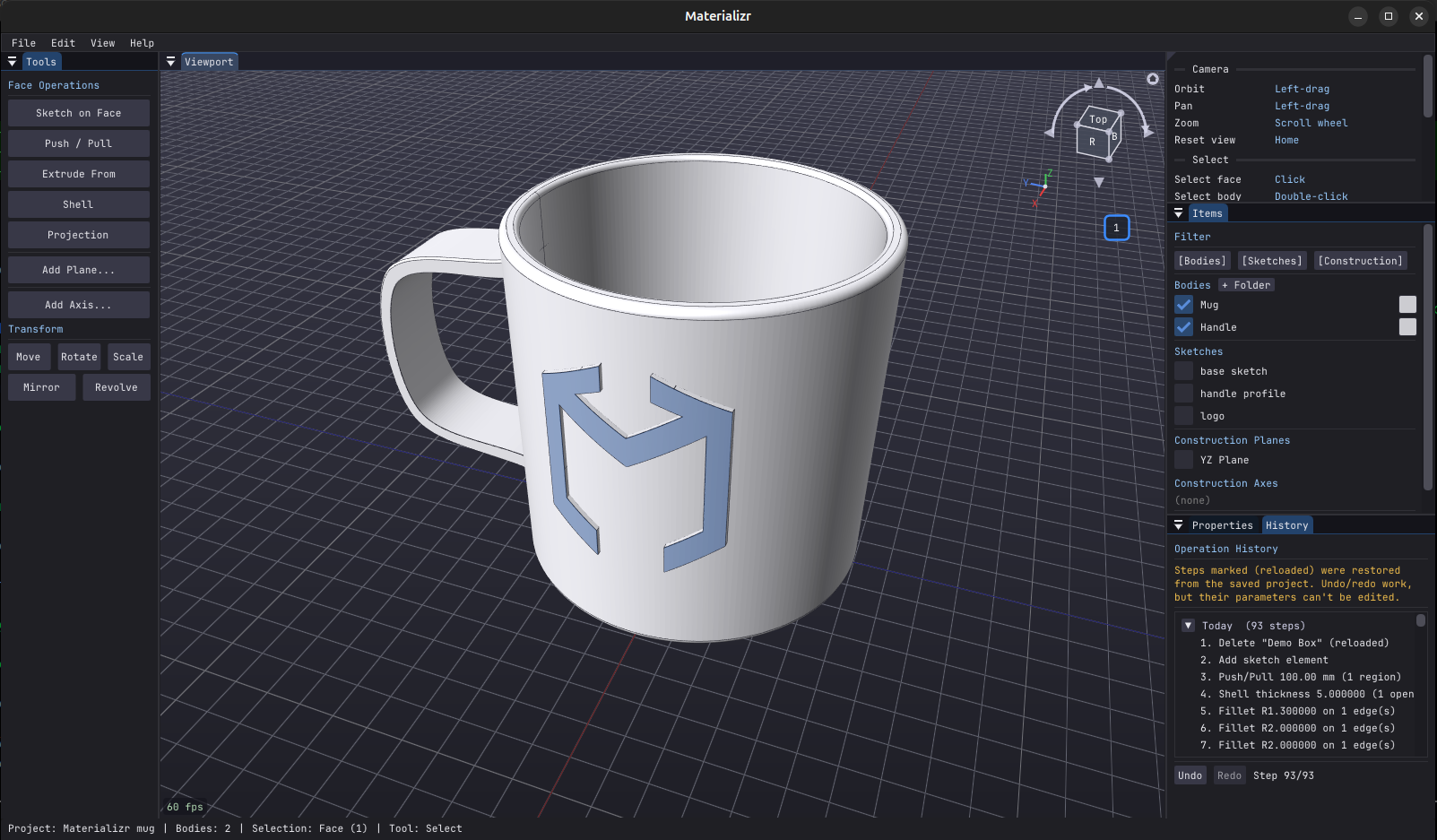
real B-rep solids, not meshes - with a Dear ImGui interface. Sketch on any
face or construction plane, pull it into a solid, keep editing any step of
the history later (even after closing the project).
What it is (and isn't)
Materializr isn't trying to replace SolidWorks, Fusion 360, FreeCAD, or any
other CAD program. It aims for the middle ground between dead-simple and
fully-featured - enough genuine parametric solid modeling to make real parts,
without a steep learning curve, a subscription, or an account. If you've ever
found beginner tools too limiting and pro tools too heavy, that gap is what
this is for.
It's also young software built quickly, so expect rough edges - there are
bugs we haven't found yet. The good news: operations validate their results
and refuse rather than silently produce garbage, so a failed action leaves
your model untouched instead of corrupting it. Still: save often, and if
something behaves oddly, a bug report is the most useful thing you can send.
What it does
Sketch - lines, circles, arcs, splines, polygons, rectangles with
SketchUp-style inference snapping (endpoints, midpoints, perpendicular,
tangent, 15° increments) and opt-in dimensions & constraints. Text as
real outline geometry (ten bundled fonts) and SVG import with live
placement preview - both become ordinary closed regions you can extrude.
Drop a reference image into the viewport and model against it.
Model - push/pull, extrude, lathe (spin a sketch profile around an
axis into a solid), revolve (rotate a body around an axis - watch a fan
spin or a hinge open), loft (N sections, plus guided loft steered by
guide curves), boundary fill, booleans, fillet/chamfer, shell, mirror,
linear & circular patterns, split, and separate (break a body's
disconnected solids into individual bodies). Drop in a primitive (box,
cylinder, sphere, cone, torus) when that's the faster start. Direct face
editing: draft (moulding draft angle, several faces at one angle, and it
works on curved walls - a cylinder drafts into a cone), scale face (pinch a
wing tip into a winglet),
twist a face about its normal to spiral the walls, edit a hole or boss to
an exact diameter.
Detail - validated screw threads (internal & external, standard
coarse defaults from the diameter - and fast: a full rod threads in a
fraction of a second), and Projection: engrave or emboss any sketch
onto a flat or curved face - wrap a logo around a cylinder in three
clicks.
Unfold - flatten a 3D body into a 2D cut pattern (bends, cones and even
doubly-curved surfaces) and export it as 1:1 SVG or tiled, printable PDF
with registration marks - sheet-metal and EVA-foam workflows without
leaving the app.
Stay in control - every operation is an editable history step, and
projects reload with the FULL history editable: open a saved part, change
step 1, and everything downstream replays. Fillets and chamfers placed on
boolean seam edges follow upstream edits (topological naming). Construction
planes & axes, Section View with any cutting plane, version snapshots
with auto-save, crash/hang recovery, undo everywhere.
Fits you - three interface layouts (Classic desktop, Modern rail, and
the near-zero-chrome im-touch for tablets), chosen on first launch with a
live preview and a tour that teaches the app in the layout you picked.
Select any face, edge or vertex for instant measurement readouts (area,
radius, length, centre - with totals across a multi-selection).
Exchange - STEP, IGES and BREP import/export, STL import (with
accuracy control - sketch directly on a scanned part's flat faces),
STL/glTF/OBJ/3MF export (Z-up corrected for printing), sketch →
SVG and DXF export (1:1 mm, for laser cutters and 2.5D CNC) that
round-trip cleanly back into sketches, SVG and DXF import, and a
compact native .mzr format (.materializr still opens) that stores
bodies, sketches, and the full history.
Known limitations
A few rough edges are deliberate trade-offs for now, not bugs - worth knowing
up front:
-
Editing a body after you move it can drop the sketch link. Move a
plain extruded body and its sketch stays linked, so you can keep tweaking
dimensions; a heavily-featured body may de-link on move (the move itself is
always fine). Why: re-deriving means re-applying every feature to the
moved shape. 1.4.0's topological-naming layer already keeps fillets,
chamfers and boolean-seam features following upstream sketch edits - the
move case is the remaining frontier and keeps narrowing.
-
Threads are re-applied after every change to a threaded body. You can
keep modeling on a threaded part - new operations are automatically
reordered to happen before the thread in the body's history, and the
thread is then re-cut on top (a progress prompt lets you cancel). Why:
threads are dense geometry; running cuts or fillets across them directly
is unreliable, so the app applies your change to the unthreaded shape and
threads it again last. Re-threading is near-instant for standard profiles;
the cost is only noticeable on long angular threads (square/ACME/buttress).
-
Chamfering an edge that meets a fillet can still fail. 1.5.0 added a
cut-based fallback (the blend's cross-section is swept along the edge
and subtracted) that rescues many cases OpenCASCADE's native chamfer
builder refuses - including edges crossed by holes and pockets - but it
covers straight, convex, planar-walled edges; where it doesn't apply the
operation is still refused rather than producing garbage. Workaround
when refused: cut the chamfer with a sketch, or chamfer the edge before
you fillet its neighbour.
Topological naming landed in 1.4.0 (and 1.5.0's face lineage extends it
through boolean splits), which keeps shrinking the first case. All three are
on the roadmap.
Documentation
The app ships an in-app Help → User Guide, a Keyboard Shortcuts
panel, and Help → Check for Updates.
Video Tutorial
A walkthrough from a first sketch to a printable part:
License
GNU GPLv3 - see LICENSE - with additional permissions under GPLv3
section 7 covering app-store distribution and platform-SDK linking; see
LICENSE-EXCEPTIONS.md. (Releases through 0.9.7.1
were MIT; the project is GPLv3 from here on, and code first published in
those releases also remains available under MIT.)
Contributing
Contributions welcome - bug reports and missing-workflow notes especially;
real-world dogfooding is what hardens each release. Open an issue first for
substantial changes; small fixes can go straight to a PR.
Join the community on Discord for questions, show-and-tell, and development chat.
Credits
- R4stl1n - original project.
- stevebushwa - design, testing, direction.
- TechHQUSA - macOS port, dimension tool, security hardening.
- Claude (Anthropic) - pair-coding collaborator.
Acknowledgments
Materializr is built on a stack of excellent open-source projects - none of
this would exist without them.
Geometry & math
- OpenCASCADE Technology - B-rep solid
modelling kernel (LGPL with Open CASCADE exception).
- GLM - OpenGL-friendly C++ math (MIT).
Graphics & windowing
- Dear ImGui - immediate-mode GUI,
used for every panel and overlay (MIT).
- SDL3 - window, input, and OpenGL context
creation on every platform, desktop and mobile alike (zlib).
- GLEW - OpenGL extension loading on
Windows (modified BSD / MIT).
File I/O & exchange
- nanosvg - SVG parser for the
sketch SVG-import tool (zlib).
- libcurl - HTTPS GET for Help → Check for
Updates (curl license).
- zlib - gzip stream for the v3
.materializr
project format (zlib license).
- portable-file-dialogs
- single-header bridge to the host's native Open / Save dialog
(WTFPL). Lets you save to SMB / NFS / cloud mounts the OS file manager
already knows about.
Bundled fonts
Ten typefaces ship for the sketch Text tool (JetBrains Mono, DejaVu Sans &
Serif, Liberation Sans & Serif, Ubuntu, Comic Neue, Black Ops One, Anton,
Pacifico), plus the Iconoir icon font for the UI. Full credits, copyrights
and license texts: assets/fonts/FONT-CREDITS.md.